Mars Images: June 30-July 4, 2026 | NASA's Curiosity & Perseverance Rovers
Friends of NASA (FoN) is an independent non-governmental organization (NGO) dedicated to building international support for peaceful space exploration, commerce, scientific discovery, and STEM education.
Pages
Saturday, July 04, 2026
Mars Images: June 30-July 4, 2026 | NASA's Curiosity & Perseverance Rovers
A Stellar July 4th Sparkler: Globular Star Cluster NGC 6426 in Ophiuchus | Hubble
Ancient stars shine in red, white and blue from a globular cluster almost as old as the universe itself in this image from the NASA/European Space Agency Hubble Space Telescope.
NASA released this image to celebrate the United States’ 250th anniversary, as the agency carries forward America’s legacy of exploration.
Located in the outer halo of our Milky Way galaxy, globular cluster NGC 6426 is a spherical collection of stars bound together by their mutual gravity, one of 150 known globular clusters in our galaxy. These groups of stars are thought to form as a unit from the same collapsing cloud of gas, and thus the stars in them typically have similar ages. The stars in globular clusters tend to be ancient. At approximately 13 billion years old, NGC 6426 is one of the Milky Way’s oldest globular clusters and almost as old as the universe itself (13.7 billion years).
In this image, blue indicates the shorter wavelengths that are visible light, while red depicts the longer wavelengths of visible light, as well as some near-infrared light. Colors in Hubble images are chosen based on standard image processing techniques to best represent the wavelengths of light that pass through the filters used in the observation. Because the color and temperature of stars are directly related, we know that the blue stars in this image are hotter and the red stars are cooler.
The stars of NGC 6426 have low metallicity, which means they have fewer elements that are heavier than hydrogen and helium. These conditions resemble those of the early universe, when matter was mostly helium and hydrogen and heavier elements were just beginning to form via nuclear fusion within massive stars.
Researchers have found evidence for two chemically distinct populations of stars in NGC 6426, indicating that the slightly younger and more metallic stars were enriched with material from the explosive deaths of the cluster’s earlier stars. Massive stars that explode as supernovae fling elements heavier than hydrogen and helium into the universe, seeding it with materials to build new stars and planets.
Hubble took this image as part of a study of globular clusters in the Milky Way’s halo intended to determine their ages and shed light on the formation and evolution of the galaxy. Over the past three decades in orbit, Hubble has fundamentally changed our understanding of the universe. Its discoveries are expanded upon and complemented by observations from other NASA missions like the infrared-detecting James Webb Space Telescope and the Nancy Grace Roman Space Telescope, scheduled to launch in late summer.
Image Description: NGC 6426 is a compact grouping of a multitude of stars shine in red, white and blue against the dark background of space. The stars are more densely collected toward the center of the cluster.
Release Date: July 4, 2026
NASA's Nancy Grace Roman Space Telescope: Launch Prep | Kennedy Space Center
🤩Here’s to 250 years of American ingenuity! Happy July 4th!
For the first time since arriving in Florida, NASA's Nancy Grace Roman Space Telescope is on full display after being unboxed and raised to its vertical position inside the high bay of the Payload Hazardous Servicing Facility at NASA’s Kennedy Space Center. And what a sight she is! Launching as early as August, Roman is set to transform how we explore the cosmos. Its sweeping surveys will help reveal billions of cosmic objects.
https://www.stsci.edu/roman
https://science.nasa.gov/people/nancy-roman/
Sign up here: https://go.nasa.gov/4ejkRcR
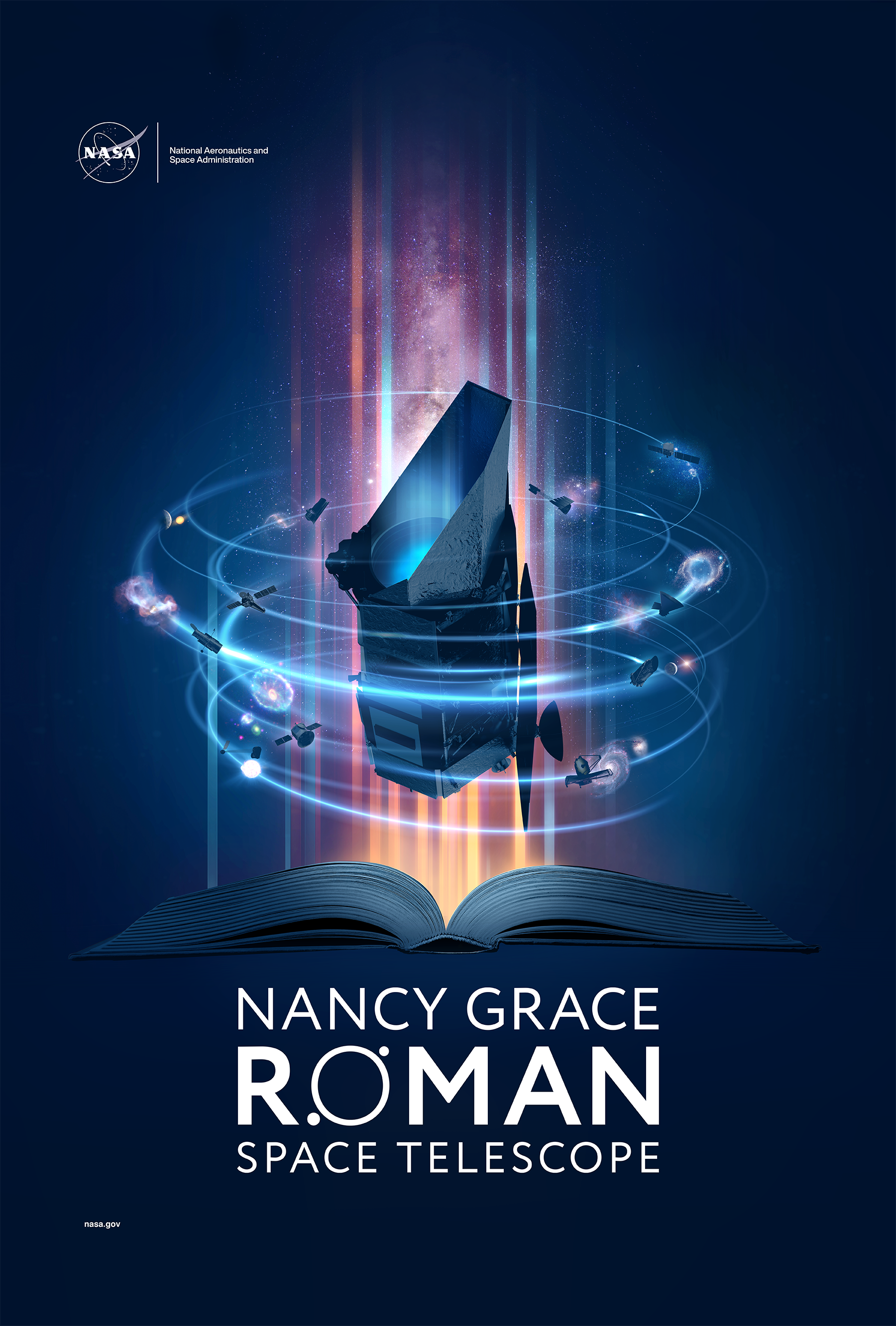
Download the free Nancy Grace Roman Space Telescope poster here:
https://assets.science.nasa.gov/content/dam/science/missions/rst/science/ROMAN-poster-24x36-2026.pdf
https://assets.science.nasa.gov/content/dam/science/missions/rst/science/ROMAN-poster2026.png
https://assets.science.nasa.gov/content/dam/science/missions/rst/science/ROMAN-poster2026-web.png
American Independence Day Wishes | International Space Station
Independence Day, known colloquially as the Fourth of July, is a federal holiday in the United States that commemorates the adoption of the Declaration of Independence on July 4, 1776, establishing the United States of America. By doing this, the delegates to the Second Continental Congress declared that the Thirteen Colonies were no longer subject (and subordinate) to the monarch of Britain, King George III, and were now united, free, and independent states. The Congress voted to approve independence by passing the Lee Resolution on July 2 and adopted the Declaration of Independence two days later, on July 4.
Station Commander: Sergey-Kud Sverchkov (Russia)
Roscosmos (Russia) Flight Engineers: Andrey Fedyaev, Sergei Mikaev
An international partnership of space agencies provides and operates the elements of the International Space Station (ISS). The principals are the space agencies of the United States, Russia, Europe, Japan, and Canada.
Credit: NASA
Duration: 1 minute, 16 seconds
Release Date: June 26, 2026
SpaceX Starship 60-second Engine Static Fire Test | Starbase Texas
A 60-second static fire test of Starship engines ahead of the 13th flight test.
https://www.spacex.com/launches/starship-flight-12
This was the first flight of the "next generation Starship and Super Heavy vehicles, powered by the next evolution of the Raptor engine."
Read more about the key upgrades designed to enhance performance and unlock Starship's full capabilities here: https://www.spacex.com/updates/starship-v3
NASA plans to use a lunar lander version of Starship to deliver astronauts and cargo to the Moon during the Artemis IV mission and beyond through the Human Landing System (HLS) Program.
https://www.spacex.com/vehicles/starship/
https://www.spacex.com/media/starship_users_guide_v1.pdf
Duration: 1 minute, 14 seconds
Date: July 2, 2026
Friday, July 03, 2026
NASA Artemis III Rocket RS-25 Engines Arrive at Kennedy Space Center
Two of the four RS-25 Space Launch System (SLS) rocket engines built by L3 Harris Technologies that will help launch the NASA Artemis III Mission arrived inside the Vehicle Assembly Building (VAB) at NASA’s Kennedy Space Center in Florida on Tuesday, June 23, 2026. Together, the engines generate over 2 million pounds of thrust at liftoff, powering the SLS rocket for the first 8 minutes of flight.
The SLS rocket will use four RS-25 engines in the core stage to propel the Orion spacecraft into orbit providing over two million pounds of thrust at liftoff. NASA plans to send Artemis astronauts on increasingly difficult missions to explore more of the Moon for scientific discovery and economic benefits, to establish an enduring human presence on the lunar surface, and to build on our foundation for the first crewed missions to Mars.
The Artemis III Mission is coming together, piece by piece . . .
Planned to launch in 2027, the Artemis III Mission will practice docking the Orion spacecraft with two lunar landers in low Earth orbit.
On future missions, including Artemis IV in 2028, landers will bring astronauts to the lunar surface. While Artemis III will not land on the Moon, it will test the complex capabilities NASA needs to return—this time to stay.
Date: June 23, 2026
NASA Artemis II Orion Spacecraft Views of The Moon and Earth: New Images
NASA's Artemis II Mission took NASA astronauts Christina Koch, Reid Wiseman, and Victor Glover, plus Canadian Space Agency (CSA) astronaut JeremyHansen on a nearly 10-day journey around the Moon and back to Earth.
The Orion spacecraft successfully splashed down on Friday, April 10, 2026, in the Pacific Ocean following its journey around the Moon.
The first crewed test flight of NASA’s Artemis Program lifted off from Launch Pad 39B at the agency’s Kennedy Space Center in Florida on April 1, 2026, carrying the first astronauts to travel to the Moon in more than half a century.
The crew completed a record-setting lunar flyby, taking them 252,756 miles at their farthest distance from Earth and 4,067 miles above the lunar surface at their closest approach.
Under Artemis, NASA will send astronauts on increasingly difficult missions to explore more of the Moon for scientific discovery, economic benefits, and to build on our foundation for the first crewed missions to Mars.
Learn more about NASA's Artemis II Mission:
https://www.nasa.gov/mission/artemis-ii/
Image Date: April 6, 2026
China Long March 4B Launch of Haiyang-2E Earth Ocean Observation Satellite
The Haiyang2E satellite will replace the Haiyang-2B launched in 2018 and work with the Haiyang-2C, 2D and other orbiting satellites in a network serving maritime rights, disaster mitigation, resource exploitation, and marine research.
The Long March 4B, also known as the Chang Zheng 4B, CZ-4B, and LM-4B, is a Chinese expendable orbital launch vehicle. It is mostly used to place satellites into low Earth orbit and Sun-synchronous orbits.
Atop of the launch vehicle was the China Academy of Space Technology-built 1,500-kilogram Haiyang-2E on behalf of China’s National Satellite Ocean Application Service, under the State Oceanic Administration. The spacecraft will monitor the environment of the world’s oceans, measuring their waves, temperatures, and winds. To do that, a handful of instruments are onboard:
A 1,600-kilometer swath Microwave Radiometer Imager for surface temperature, wind, and vapor monitoring; a dual-beam, 1,300-kilometer swath Scatterometer for collecting wind data; a 25-kilometer resolution Calibration Microwave Radiometer for measuring water vapor; a 16-kilometer resolution Radar Altimeter for tracking wave height; and a Laser Retroreflector Array to enable accurate distance measurements.
To assist the spacecraft with its tasks, France’s Doppler Orbitography and Radiopositioning Integrated by Satellite (DORIS) system is onboard as part of a regular collaboration for the Haiyang-2 series. This system assists the spacecraft by measuring its location in orbit with centimeter accuracy, allowing teams on the ground to better understand instrument data collected.
Haiyang-2E joins eight other spacecraft of its series currently in orbit, while being the eleventh deployed since the first launch in May 2002. The last addition was Haiyang-4-01 in November 2024 for monitoring ocean salinity. Across the current spacecraft, those designated under Haiyang-11 for measuring ocean color, Haiyang-22 keeps track of the marine environment, and Haiyang-33 performs general monitoring of the oceans.
Today’s Haiyang-2 spacecraft is also part of a new trio that will be launched this year and next, at least with Haiyang-2F and Haiyang-2G set to be added. Those will replace the aging Haiyang-2B, Haiyang-2C, and Haiyang-2D, respectively.
Finally, today’s launch was the 57th mission for the Long March 4B, the 118th launch for the Long March 4 series, the 270th Long March vehicle from the Shanghai Academy of Spaceflight Technology, and the 654th launch of the Long March launch vehicle series. This was also the 45th launch from China in 2026.
Date: July 1, 2026
#NASA #Space #Science #Earth #Satellites #Haiyang2ESatellite #EarthObservation #RemoteSensing #国家卫星海洋应用中心 #China #中国 #RocketLaunches #LongMarch4BRockets #长征四号乙火箭 #SAST #CASC #SpaceTechnology #CommercialSpace #JSLC #酒泉卫星发射中心 #Spaceports #InnerMongolia #InternationalCooperation #France #STEM #Education
China Long March 4B Launch of Haiyang-2E Earth Ocean Observation Satellite
At China's Jiuquan Satellite Launch Center Launch Site 94 in the Inner Mongolia Autonomous Region, a Long March 4B lifted off to fly towards a sun-synchronous orbit at 07:46 am China Standard Time on July 2, 2026, (23:46 pm Universal Coordinated Time on July 1st), carrying a new ocean monitoring spacecraft.
The Haiyang2E satellite will replace the Haiyang-2B launched in 2018 and work with the Haiyang-2C, 2D and other orbiting satellites in a network serving maritime rights, disaster mitigation, resource exploitation, and marine research.
The Long March 4B, also known as the Chang Zheng 4B, CZ-4B, and LM-4B, is a Chinese expendable orbital launch vehicle. It is mostly used to place satellites into low Earth orbit and Sun-synchronous orbits.
Atop of the launch vehicle was the China Academy of Space Technology-built 1,500-kilogram Haiyang-2E on behalf of China’s National Satellite Ocean Application Service, under the State Oceanic Administration. The spacecraft will monitor the environment of the world’s oceans, measuring their waves, temperatures, and winds. To do that, a handful of instruments are onboard:
A 1,600-kilometer swath Microwave Radiometer Imager for surface temperature, wind, and vapor monitoring; a dual-beam, 1,300-kilometer swath Scatterometer for collecting wind data; a 25-kilometer resolution Calibration Microwave Radiometer for measuring water vapor; a 16-kilometer resolution Radar Altimeter for tracking wave height; and a Laser Retroreflector Array to enable accurate distance measurements.
To assist the spacecraft with its tasks, France’s Doppler Orbitography and Radiopositioning Integrated by Satellite (DORIS) system is onboard as part of a regular collaboration for the Haiyang-2 series. This system assists the spacecraft by measuring its location in orbit with centimeter accuracy, allowing teams on the ground to better understand instrument data collected.
Haiyang-2E joins eight other spacecraft of its series currently in orbit, while being the eleventh deployed since the first launch in May 2002. The last addition was Haiyang-4-01 in November 2024 for monitoring ocean salinity. Across the current spacecraft, those designated under Haiyang-11 for measuring ocean color, Haiyang-22 keeps track of the marine environment, and Haiyang-33 performs general monitoring of the oceans.
Today’s Haiyang-2 spacecraft is also part of a new trio that will be launched this year and next, at least with Haiyang-2F and Haiyang-2G set to be added. Those will replace the aging Haiyang-2B, Haiyang-2C, and Haiyang-2D, respectively.
Finally, today’s launch was the 57th mission for the Long March 4B, the 118th launch for the Long March 4 series, the 270th Long March vehicle from the Shanghai Academy of Spaceflight Technology, and the 654th launch of the Long March launch vehicle series. This was also the 45th launch from China in 2026.
Duration: 37 seconds
Date: July 1, 2026
#NASA #Space #Science #Earth #Satellites #Haiyang2ESatellite #EarthObservation #RemoteSensing #国家卫星海洋应用中心 #China #中国 #RocketLaunches #LongMarch4BRockets #长征四号乙火箭 #SAST #CASC #SpaceTechnology #CommercialSpace #JSLC #酒泉卫星发射中心 #Spaceports #InnerMongolia #InternationalCooperation #France #STEM #Education #HD #Video
Emerald-colored Auroral 'Ribbons' over Planet Earth | International Space Station
Expedition 74 flight engineer and European Space Agency astronaut Sophie Adenot of France: "Watching this glowing green ribbon shimmer and dance, it's easy to lose yourself completely in the magic of the moment. Turn the sound on for the full experience—the music was carefully chosen to bring you as close as possible to what I felt watching this from space 💚."
Station Commander: Sergey-Kud Sverchkov (Russia)
Roscosmos (Russia) Flight Engineers: Andrey Fedyaev, Sergei Mikaev
An international partnership of space agencies provides and operates the elements of the International Space Station (ISS). The principals are the space agencies of the United States, Russia, Europe, Japan, and Canada.
Duration: 1 minute, 17 seconds
Release Date: July 3, 2026
Close-up: Distant Galaxy Cluster MACS J0553.4-3342 in Columba | Webb Telescope
Distance from Earth: 4 billion light years
MACS J0553.4-3342 is situated at a redshift of 0.412. Redshift is a measure of how much the cluster’s light has been stretched by the expansion of the Universe over the course of its long journey to Webb’s mirrors; this unassuming number tells us that we are seeing MACS J0553.4-3342 as it was 4.4 billion years in the past. However, for a galaxy cluster, this is relatively young. In fact, observations with the NASA/European Space Agency Hubble Space Telescope and other telescopes show a cluster still in the process of being built.
MACS J0553.4-3342 is composed of two sub-clusters—roughly equal in mass—that are actively merging. The two subclusters have already slammed through each other and traveled over one million light-years apart, but they will eventually come back together again and again until they finally merge. The construction process is messy, and MACS J0553.4-3342 is filled with extremely hot gas that radiates powerful X-rays. Each subcluster is anchored on an immensely bright and massive elliptical galaxy. These are easily identifiable as the two brightest points in the center of this scene with the largest glowing halos around them. The many smaller white elliptical galaxies are bound to one of the two subclusters by gravity, and will be incorporated into the final galaxy cluster. This image also features many foreground galaxies—spirals and dusty discs that are unrelated to MACS J0553.4-3342—and prominent bright stars in our own Milky Way galaxy.
Even mid-way through its construction, the titanic clumps of matter swirling around in this galaxy cluster have built a device that is already very useful for us here on Earth: a gravitational lens. The extreme and concentrated mass in MACS J0553.4-3342 curves light with its gravity, similar to how a glass lens bends and focuses light. In this image you can see prominent orange, stretched-out arcs alongside each of the subclusters. These arcs are images of distant background galaxies, whose light has been warped by the galaxy cluster’s gravitational pull. The arc on the left side, three bright spots joined together, is actually three images of a single background galaxy. A forest of smaller arcs and lines are scattered across the image too; such a fantastic view appears in few other places in the Universe.
Look in the right spot, however, and this galaxy cluster turns from a distorting funhouse mirror into a precision scientific device. The gravitational lensing focuses light, magnifying objects and enhancing their brightness so if they lie in exactly the right place, background galaxies and even individual stars that would have been far too faint and distant to spot will be made visible. By carefully mapping out the mass of the cluster, researchers can reconstruct where and how strongly it distorts light from our point of view, then search for serendipitously-magnified distant objects to study. The arcs we can see in MACS J0553.4-3342 already show a few galaxies from less than a billion years after the Big Bang.
This image, taken with Webb’s Near-Infrared Camera (NIRCam), stems from a survey program named VENUS (#6882). Astronomers aimed to create a collection of deep, high-quality images of massive galaxy clusters like MACS J0553.4-3342 across a wide range of infrared wavelengths, greatly expanding the area covered by Webb’s sensitive instruments. Researchers can then scour the clusters for distant and faint objects that have been brightened through gravitational lensing, from young galaxies and low-mass black holes to supernova explosions and individual stars. Gravitational lensing has been key to many of Webb’s most dramatic discoveries in recent years, and having many more examples of it allows us to systematically study the distant past and the evolutionary stages of the galaxies, stars and black holes we see today.
Image Description: A galaxy cluster in deep space. It is filled with elliptical galaxies: small, bright white glowing ovals. The two largest elliptical galaxies, left and right of center, are bright cores that radiate light. Unrelated, distant galaxies are scattered around as red smudges and dots. Many of these are stretched out into red arcs and lines by the galaxy cluster’s strong gravity, creating multiple images in places. Numerous spiral galaxies and bright stars appear in the foreground.
Release Date: July 3, 2026
#NASA #ESA #Astronomy #Space #Science #Galaxies #GravitationalLensing #GalaxyClusters #MACSJ055343342 #ColumbaConstellation #Cosmos #Universe #JWST #NIRCam #InfraredAstronomy #SpaceTelescopes #Europe #GSFC #STScI #UnitedStates #CSA #Canada #STEM #Education #HD #Video
Distant Galaxy Cluster MACS J0553.4-3342 in Columba | Webb Telescope
In this NASA/European Space Agency/Canadian Space Agency James Webb Space Telescope picture, we are taken on a visit to a "building site" of significant scale. The "project" is a galaxy cluster named MACS J0553.4-3342, located in the constellation Columba (the Dove).
Distance from Earth: 4 billion light years
MACS J0553.4-3342 is situated at a redshift of 0.412. Redshift is a measure of how much the cluster’s light has been stretched by the expansion of the Universe over the course of its long journey to Webb’s mirrors; this unassuming number tells us that we are seeing MACS J0553.4-3342 as it was 4.4 billion years in the past. However, for a galaxy cluster, this is relatively young. In fact, observations with the NASA/European Space Agency Hubble Space Telescope and other telescopes show a cluster still in the process of being built.
MACS J0553.4-3342 is composed of two sub-clusters—roughly equal in mass—that are actively merging. The two subclusters have already slammed through each other and traveled over one million light-years apart, but they will eventually come back together again and again until they finally merge. The construction process is messy, and MACS J0553.4-3342 is filled with extremely hot gas that radiates powerful X-rays. Each subcluster is anchored on an immensely bright and massive elliptical galaxy. These are easily identifiable as the two brightest points in the center of this scene with the largest glowing halos around them. The many smaller white elliptical galaxies are bound to one of the two subclusters by gravity, and will be incorporated into the final galaxy cluster. This image also features many foreground galaxies—spirals and dusty discs that are unrelated to MACS J0553.4-3342—and prominent bright stars in our own Milky Way galaxy.
Even mid-way through its construction, the titanic clumps of matter swirling around in this galaxy cluster have built a device that is already very useful for us here on Earth: a gravitational lens. The extreme and concentrated mass in MACS J0553.4-3342 curves light with its gravity, similar to how a glass lens bends and focuses light. In this image you can see prominent orange, stretched-out arcs alongside each of the subclusters. These arcs are images of distant background galaxies, whose light has been warped by the galaxy cluster’s gravitational pull. The arc on the left side, three bright spots joined together, is actually three images of a single background galaxy. A forest of smaller arcs and lines are scattered across the image too; such a fantastic view appears in few other places in the Universe.
Look in the right spot, however, and this galaxy cluster turns from a distorting funhouse mirror into a precision scientific device. The gravitational lensing focuses light, magnifying objects and enhancing their brightness so if they lie in exactly the right place, background galaxies and even individual stars that would have been far too faint and distant to spot will be made visible. By carefully mapping out the mass of the cluster, researchers can reconstruct where and how strongly it distorts light from our point of view, then search for serendipitously-magnified distant objects to study. The arcs we can see in MACS J0553.4-3342 already show a few galaxies from less than a billion years after the Big Bang.
This image, taken with Webb’s Near-Infrared Camera (NIRCam), stems from a survey program named VENUS (#6882). Astronomers aimed to create a collection of deep, high-quality images of massive galaxy clusters like MACS J0553.4-3342 across a wide range of infrared wavelengths, greatly expanding the area covered by Webb’s sensitive instruments. Researchers can then scour the clusters for distant and faint objects that have been brightened through gravitational lensing, from young galaxies and low-mass black holes to supernova explosions and individual stars. Gravitational lensing has been key to many of Webb’s most dramatic discoveries in recent years, and having many more examples of it allows us to systematically study the distant past and the evolutionary stages of the galaxies, stars and black holes we see today.
Image Description: A galaxy cluster in deep space. It is filled with elliptical galaxies: small, bright white glowing ovals. The two largest elliptical galaxies, left and right of center, are bright cores that radiate light. Unrelated, distant galaxies are scattered around as red smudges and dots. Many of these are stretched out into red arcs and lines by the galaxy cluster’s strong gravity, creating multiple images in places. Numerous spiral galaxies and bright stars appear in the foreground.
Release Date: July 3, 2026
#NASA #ESA #Astronomy #Space #Science #Galaxies #GravitationalLensing #GalaxyClusters #MACSJ055343342 #ColumbaConstellation #Cosmos #Universe #JWST #NIRCam #InfraredAstronomy #SpaceTelescopes #Europe #GSFC #STScI #UnitedStates #CSA #Canada #STEM #Education
Thursday, July 02, 2026
United Launch Alliance Atlas V Rocket Launches Amazon Leo 8 Satellite Mission
ULA website: www.ulalaunch.com
https://www.aboutamazon.com/what-we-do/devices-services/amazon-leo
United Launch Alliance Atlas V Rocket Launches Amazon Leo 8 Satellite Mission
ULA website: www.ulalaunch.com
https://www.aboutamazon.com/what-we-do/devices-services/amazon-leo
Williams & Meir on Second Spacewalk | International Space Station
Expedition 74 flight engineers and NASA astronauts Chris Williams and Jessica Meir concluded their second spacewalk together on Tuesday, June 30, 2026, after successfully replacing a malfunctioning wrist joint on the Canadarm2 robotic arm. The duo spent seven hours and 20 minutes on Canadarm2’s fourth repair job since its installation on April 26, 2001. Initial checkouts of the arm by flight controllers on the ground indicate the arm is functioning well and additional checkouts and verification will continue in the coming days.
Station Commander: Sergey-Kud Sverchkov (Russia)
Roscosmos (Russia) Flight Engineers: Andrey Fedyaev, Sergei Mikaev
An international partnership of space agencies provides and operates the elements of the International Space Station (ISS). The principals are the space agencies of the United States, Russia, Europe, Japan, and Canada.
Orbital Sunrise: Bright Orange Sunburst | International Space Station
Station Commander: Sergey-Kud Sverchkov (Russia)
Roscosmos (Russia) Flight Engineers: Andrey Fedyaev, Sergei Mikaev
An international partnership of space agencies provides and operates the elements of the International Space Station (ISS). The principals are the space agencies of the United States, Russia, Europe, Japan, and Canada.
Date: June 26, 2026
Release Date: July 1, 2026
How many satellites is too many? | European Southern Observatory
There are currently more than 14,000 satellites in orbit, but new proposals by SpaceX, Reflect Orbital and other companies could increase that number to over 1.7 million satellites. In this video, two European Southern Observatory experts tell us about the devastating consequences this would have on astronomy, and what are the technical and legal options to limit this damage.
https://www.eso.org/public/news/eso2607/
https://www.eso.org/public/archives/releases/sciencepapers/eso2607/eso2607a.pdf
Directed by: L. Calçada, M. Kornmesser, B. Ferreira
Hosted by: S. Randall
Written by: E. Elkington, S. Randall
Editing: M. Kornmesser, L. Calçada
Videography: A. Tsaousis
Animations & footage: ESO, L. Calçada, M. Kornmesser, Future/Brett Tingley, ESA, S. Guisard, Torsten Hansen/IAU OAES, S. Brunier, F. Kamphues, B. Häuẞler, SpaceX, Reflect Orbital, @EmericTimelapse, RubinObs/NSF/AURA/H. Stockebrand, C. Malin, B. Tafreshi, G. Lombardi, INAF-VST/OmegaCAM, P. Horálek, satellitemap.space, J. McDowell
Filming Locations: ESO Supernova
Duration: 14 minutes
Protostars of Young Star System FS Tau in Taurus | Webb Telescope
The NASA/European Space Agency/Canadian Space Agency James Webb Space Telescope has captured infrared light from bright protostars in the young star system FS Tau. In addition to myriad background galaxies that burst into view, this image flickers with a number of protostars, or baby stars that are formed from dense pockets of gas and dust. These hot, clumpy, and low-mass objects eventually will become full-fledged stars capable of burning hydrogen in their cores, like our Sun. The protostars of FS Tau are about 1 to 3 million years old. This is relatively young in cosmic scales. Our Sun, by contrast, is 4.6 billion years old.
FS Tau A, a pair of protostars that creates the largest diffraction pattern slightly to the left of center, is about half the mass of our Sun. FS Tau B, the orange protostar slightly right of center, is thought to be responsible for the red (molecular hydrogen) and orange (soot-like molecules known as polycyclic aromatic hydrocarbons) outflows that we see amid the dusty region. The blue ridges are areas where light has been scattered by dust.
The different colors of the background galaxies indicate how much dust is in front of them, as dust both absorbs and scatters light. Redder galaxies lie behind larger amounts of dust, yellower galaxies lie behind thinner layers of dust, and whiter galaxies are mostly unobstructed.
Image Description: FS Tau, a star-forming nebula. Clouds of transparent blue and purple gas and dust extend from slightly left of center to the right side of the frame, from 2 o’clock to 5 o’clock. Several yellow and white protostars, several showing Webb’s eight-pronged diffraction pattern are dispersed throughout the clouds. Orange wisps and filaments of gas extend from one of the protostars at the center toward the top left and bottom right corners of the frame. There are numerous, distant yellow and white galaxies strewn about the black background of space.
Release Date: July 2, 2026
NASA’s Nuclear-Powered Lunar Rover Concept: "PROMISE" | JPL
The Polar Rover for Observation, Mapping, and In-Situ Exploration (PROMISE) mission concept relies on the Curiosity Mars rover mission’s testbed rover. Elements of the Perseverance Mars testbed rover shown in this video could be used as well. As exact duplicates of Curiosity and Perseverance, the testbed rovers are equipped with flight-proven engineering systems capable of carrying technology as well as science instruments that would advance Moon Base efforts.
With a radioisotope thermal generator on board as a constant source of heat and power, PROMISE could operate without the need for solar power in the Moon’s frigid permanently shadowed regions, where water ice, a potential resource for astronauts, is likely to be found.
Both Curiosity and Perseverance were built at NASA’s Jet Propulsion Laboratory, where the two missions operate their vehicle system testbed rovers at the Mars Yard. Curiosity launched in 2011 and landed on the Red Planet in 2012; Perseverance launched in 2020 and landed in 2021.
Caltech in Pasadena, California, manages JPL for NASA.
Duration: 1 minute, 21 seconds
Release Date: June 30, 2026


.jpg)


NASA-JSC-CWilliams.jpg)