NASA's Nancy Grace Roman Space Telescope: "Go For Launch" | NASA Goddard
NASA’s Nancy Grace Roman Space Telescope is prepped for launch, and one phase of Roman is ending. It began with the 2010 Astronomy and Astrophysics Decadal Survey, where the community called for a wide-field infrared survey telescope: WFIRST. This was Roman’s start.
Institutes and businesses across the country began developing new hardware to support this mission. At the observatory’s heart was a mirror the same size as Hubble’s and a set of 18 state-of-the-art detectors that allowed for both a massive field of view and extremely high angular resolution. This combination would allow Roman to create vast and detailed surveys of the universe unlike anything seen before. Roman also holds a Coronagraph Instrument to test hardware never before flown in space. It will be able to see distant planets orbiting other stars and is a major step toward finding life outside the solar system.
Much of Roman’s hardware was developed and built in-house at NASA’s Goddard Space Flight Center. Other key systems came from places like NASA’s Jet Propulsion Laboratory (JPL), BAE Systems, and L3Harris. Beginning in 2023, all the parts converged on Goddard. Inside Goddard’s enormous clean room, a team of dedicated engineers and technicians spent over three years assembling the pieces. Throughout the process, they also used Goddard’s testing facilities to evaluate the hardware’s ability to survive launch and space. Pieces, assembled sections, and finally the entire observatory were subjected to tests like vibration and acoustic shaking, thermal vacuum freezing, and centrifuge g-force loading.
The early completion and future success of the Roman Space Telescope is a testament to the unwavering commitment and effort of thousands of people working together toward a common goal. Thanks to all their efforts, Roman will broaden our understanding of the universe and our place within it.
https://www.stsci.edu/roman
https://science.nasa.gov/people/nancy-roman/
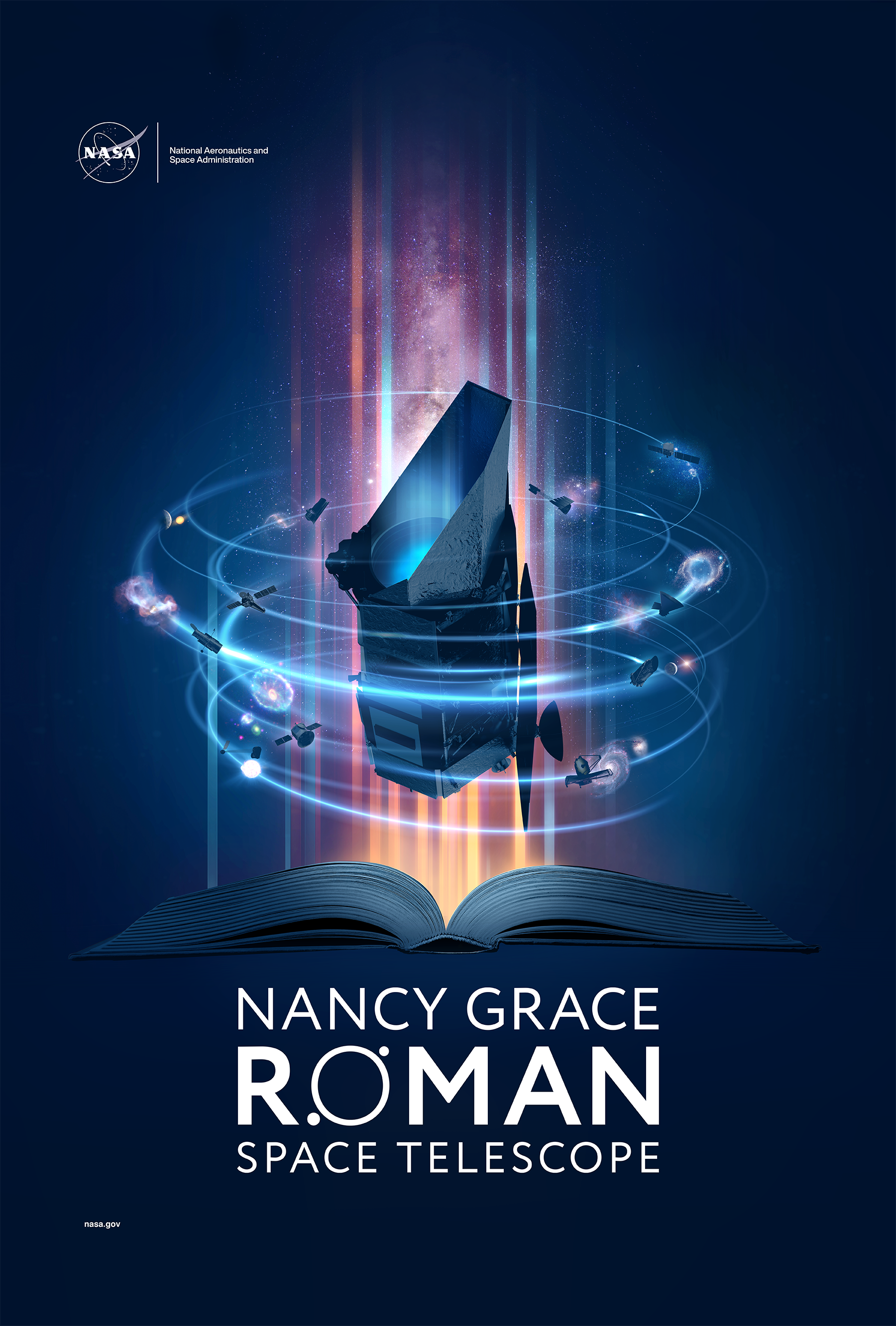
Download the free Nancy Grace Roman Space Telescope poster here:
https://assets.science.nasa.gov/content/dam/science/missions/rst/science/ROMAN-poster-24x36-2026.pdf
https://assets.science.nasa.gov/content/dam/science/missions/rst/science/ROMAN-poster2026.png

https://assets.science.nasa.gov/content/dam/science/missions/rst/science/ROMAN-poster2026-web.png
Producer: Scott Wiessinger (eMITS)
Narrator: Jacob Pinter (eMITS)
Videographers:
eMITS: Sophia Roberts, Scott Wiessinger, Rob Andreoli , John Philyaw
ASRC Federal: Jolearra Tshiteya
Rocz: Sydney Rohde
Drone Pilots:
Rob Fortunato
Christopher Albert
Animator: Adriana Manrique Gutierrez (eMITS)
Science Writer: Ashley Balzer (eMITS)
Editor: Scott Wiessinger (eMITS)
Duration: 3 minutes
Release Date: Aug. 28, 2026
No comments:
Post a Comment