Wednesday, July 29, 2026

China Long March 7 Rocket Launches Tianlian-3 Communications Satellite in Hainan

China Long March 7 Rocket Launches Tianlian-3 Communications Satellite in Hainan

A Long March 7A lifted off from Launch Complex 201 at the Wenchang Space Launch Site in China's southern Hainan island province at 7:50 pm China Standard Time (CST) (11:50 am Universal Coordinated Time) on July 29, 2026, bringing a Tianlian-3 (third generation) relay satellite towards a geostationary orbit.

The Tianlian-3-01 communications and data relay satellite will serve China's Tiangong Space Station and visiting spacecraft. The new relay is the first of the third-generation. It will boost throughput between the orbiting laboratory and Earth-based ground stations while further reducing communications dead zones.

In charge of developing the new generation communications series and its first satellite is the China Academy of Space Technology. Tianlian-3-01 required a Long March 7A since it made use of the Dongfanghong-4E satellite bus that can weigh about 6,000 kilograms. Advantages of using that bus are up to 10 kilowatts of usable power, from 13.5 kilowatts generated, for communication systems, improved multi-user parallel transmission capabilities, and a fifteen-year usable lifespan.

Tianlian-3-01 is the twelfth relay satellite launched in support of the orbiting laboratory. Between April 2008 and July 2021, five first-generation satellites were deployed, followed by six second-generation ones between March 2019 and July 23, 2026.

Four Long March 7 missions have taken place this year so far with a fifth under preparation to fly next month. The frequency of these missions is being supported by a second vehicle assembly building and another mobile launch platform dedicated to this launch vehicle in Hainan. 

Today’s mission was the 17th launch of a Long March 7A vehicle, the 28th launch of the Long March 7 series, and the 659th launch of the Long March launch vehicle series. This was also the 52nd launch from China in 2026.


Video Credit: China Academy of Launch Vehicle Technology
Text Credit: Jack C.
Duration: 28 seconds
Release Date: July 29, 2026


#NASA #Space #Science #Earth #Satellites #Tianlian301 #天链三号01星 #China #中国 #Rockets #LongMarch7AY29 #LongMarch7Rockets #长征七号运载火箭 #MediumLiftRockets #CAST #SpaceTechnology #CommercialSpace #Spaceports #Wenchang #Hainan #STEM #Education #HD #Video

SpaceX Starship Flight Test#13 Photo Collection | Starbase Texas

SpaceX Starship Flight Test#13 Photo Collection | Starbase Texas


Starlink satellite view

The thirteenth flight test of Starship successfully launched Friday, July 24, 2026, at 5:51 p.m. Central Time (CT). This was the second flight of the Starship and Super Heavy V3 vehicles and the first Starship flight to deploy "next generation" Starlink V3 satellites.

Watch the launch broadcast and read the full flight report here: 

The flight test began with Super Heavy igniting all 33 Raptor 3 engines and ascending over the Gulf of Mexico. The successful first-stage ascent was followed by a hot-staging maneuver with Starship’s upper stage igniting its six Raptor engines to continue its flight to space.

Following stage separation, the Super Heavy booster performed a directional flip maneuver. The startup sequence was modified for this flight to be more robust to timing variability in engine startup and flip in the desired direction. This is done to increase overall performance. The booster successfully completed the high thrust portion of the boostback burn with all 33 engines, the first time with a Super Heavy V3, before ending the burn early. It attempted to relight its engines for the landing burn with a subset successfully igniting before experiencing a hard splashdown in the Gulf.

After completing a full-duration ascent burn on all six Raptor engines, Starship achieved its planned velocity and trajectory. Starship then successfully deployed all 20 Starlink V3 satellites. SpaceX engineers were able to successfully communicate with every satellite using radio frequency and laser links and downloaded key telemetry from the satellites. The Starlink satellites were deployed on the pre-planned trajectory and are expected to have demised upon reentry approximately 20 minutes after deployment.

The vehicle also reignited a single Raptor engine in an in-space demonstration of a core capability for future orbital missions.

Starship re-entered the Earth’s atmosphere and was able to gather critical data on the performance of its heatshield before executing a dynamic banking move to mimic the trajectory that future missions returning to Starbase will fly. Starship then guided itself using its four flaps to the pre-planned splashdown zone in the Indian Ocean. After relighting all three Raptor engines, Starship executed a landing flip, landing burn, and soft splashdown, coming to rest intact in the Indian Ocean and providing critical views of an intact heatshield for the first time.

NASA plans to use a lunar lander version of Starship to deliver astronauts and cargo to the Moon during the Artemis IV mission and beyond through the Human Landing System (HLS) Program.

Download the Free Starship User Guide (PDF):
https://www.spacex.com/media/starship_users_guide_v1.pdf

Image Credit: Space Exploration Technologies Corporation (SpaceX)
Date: July 24, 2026

#NASA #SpaceX #Space #Earth #Mars #Moon #ArtemisProgram #ArtemisIII #ArtemisIV #Starship #StarshipV3 #FlightTest13 #ReusableSpacecraft #SuperHeavyBooster #SuperHeavyV3 #ElonMusk #Engineering #SpaceTechnology #HumanSpaceflight #CommercialSpace #SpaceExploration #StarbaseTexas #UnitedStates #STEM #Education

Little Red Dots: A Family Tree of Newly Discovered Distant Objects | Webb Telescope

Little Red Dots: A Family Tree of Newly Discovered Distant Objects | Webb Telescope

Scientists synthetically shifted the Saguaro, a lower-redshift spiral galaxy, to a higher redshift to find out how it would appear if it was in the early universe. Its compact red appearance suggests that little red dots are a phase of highly active supermassive black holes.
Scientists have proposed one pathway little red dots can follow as the universe matures based on their analysis of spiral galaxy WISEA J123635.56+621424.2, nicknamed the “Saguaro.” They suggest little red dots may be a temporary phase of highly active supermassive black holes.
Image Description: A rectangular image with thousands of galaxies of various shapes and colors on the black background of space. Theyare noticeably spirals, either face-on or edge-on, while others are blobby ellipticals. Many are too small to discern any structure. One prominent foreground star at top center features Webb’s signature 8-point diffraction spikes. At upper right, a box shows a zoomed in portion of the image. The pullout features a spiral galaxy labeled “WISEA J123635.56+621424.2.” The galaxy has a bright yellow center and faint brown arms speckled with regions of blue that appear to wind clockwise around the galaxy’s core.

Scientists have proposed one pathway little red dots can follow as the universe matures based on their analysis of spiral galaxy WISEA J123635.56+621424.2, nicknamed the “Saguaro.” They suggest little red dots may be a temporary phase of highly active supermassive black holes.

Since their discovery by NASA’s James Webb Space Telescope in 2022, little red dots (LRDs) have been the subject of great interest to astronomers. Understanding the nature of these extremely distant, compact red sources has been a puzzling scientific endeavor.

One popular theory is that little red dots are supermassive black holes known as active galactic nuclei, although they display characteristics unlike nearby active galactic nuclei. While they appear abundant at high redshift early in the universe, they rapidly decrease in number at lower redshifts. (The higher the redshift, the greater the distance the light has traveled across the universe.) This perplexing shift in number raises the question: What happens to little red dots as the universe matures?

A team of researchers led by Pierluigi Rinaldi of the University of Arizona’s Steward Observatory, now at the Space Telescope Science Institute (STScI) in Baltimore, has built upon their previous research in a new study published on July 29 in The Astrophysical Journal and proposed one pathway LRDs can follow as the universe ages. Although they may look like a unique galaxy population, these dots are affected by observational bias—features do not appear at higher redshifts with current technology.

Scientists have proposed one pathway little red dots can follow as the universe matures based on their analysis of spiral galaxy WISEA J123635.56+621424.2, nicknamed the “Saguaro.” They suggest little red dots may be a temporary phase of highly active supermassive black holes.

Their conclusions are based on their analysis of lower-redshift spiral galaxy WISEA J123635.56+621424.2, nicknamed the “Saguaro” for its prominent arms, like the cactus native to the Sonoran Desert in the Southwestern United States. A particularly intriguing feature of this redshift 2 galaxy that corresponds to approximately 3.3 billion years after the big bang is its little red dot-like center, reminiscent of the ruby red fruit produced by the desert plant.

“Everything created in the early universe must evolve into something around us. We have had little idea of what LRDs become, but these results finally show us how to find their progeny,” said co-author George Rieke of the University of Arizona. Previous studies by NASA’s retired Spitzer Space Telescope provided the first hint of the dust-obscured, compact galaxy population in the lower-redshift universe that the Saguaro belongs to, paving the way for NASA’s Hubble and James Webb space telescopes’ high-resolution analyses.

“The Saguaro is important because it’s a prototypical little red dot and is one of the few we have found at lower redshift. It can be used to study the pathway of these dots throughout cosmic time,” said Fabio Pacucci of the Harvard-Smithsonian Center for Astrophysics in Cambridge, Massachusetts, and a co-author of the study.

Among the thousands of sources Rinaldi looked at across several surveys, the Saguaro was an example of the right place—with one of Webb’s microshutter arrays perfectly framed over the galaxy’s core to take spectroscopic data—and right time—being at lower redshift. To get as broad a view of the spiral galaxy as possible across the electromagnetic spectrum, the team used Hubble’s ultraviolet- and Webb’s infrared-imaging and spectroscopic archival data, respectively.

“Because the Saguaro is at lower redshift, we can see the very beautiful and bright host galaxy in high resolution and detail with Webb and Hubble,” said Zihao Wu of the Harvard-Smithsonian Center for Astrophysics, and a co-author of the study. “Webb’s observations can help us understand how the galaxy and its little red dot-like nucleus are connected.”

The team took multiple approaches to verify that the Saguaro’s compact red nucleus matched the characteristics of a prototypical LRD. In particular, the Hubble and Webb data showed that the nucleus is brighter in both ultraviolet and infrared light than in visible light, just like distant LRDs. The team also carefully disentangled the light emitted from the host and nucleus, and considered the presence of X-ray emission from the source.

Although the majority of little red dots at high redshift are not detectable in X-ray light, NASA’s Chandra X-ray Observatory detected weak X-ray emission from the Saguaro.

“What the X-ray light observations show is that this galaxy has an active galactic nucleus, and a very obscured one at that,” said Carys Gilbert, a Master’s student at the University of Cape Town in South Africa and a co-author of the paper. “It’s not only obscured but also X-ray weak. That kind of combination could explain the lack of X-ray emission that we see from all other little red dots. It fits the puzzle of little red dots nicely.”

In addition to demonstrating how the Saguaro’s central compact red source fits the little red dot criteria, the team synthetically shifted the galaxy to a higher redshift to explore how this galactic environment would appear to observers if located in the early universe. As expected, the Saguaro’s surrounding galactic structure fades so that only the bright, LRD-like source at its center is visible.

“Our theory is that most of these distant sources are affected by this cosmological effect, creating an observational bias,” said Rinaldi. “We simply are not able to sample the immediate environment of high-redshift little red dots because their surroundings are just too faint to be observed even with Webb. Little red dots are far more complex than just being a dot. They’re just the tip of the iceberg — of a supermassive black hole interacting with its nearby surroundings.”

Scientists synthetically shifted the Saguaro, a lower-redshift spiral galaxy, to a higher redshift to find out how it would appear if it was in the early universe. Its compact red appearance suggests that little red dots are a phase of highly active supermassive black holes.

Considering the Saguaro case study, the team believes that LRDs may not be a unique galaxy population, but instead a temporary phase of highly active supermassive black holes. Could this theory be the link between the populous high-redshift little red dots seen by Webb and the local universe?

While the Saguaro is not representative of all LRDs, the team proposes that this is one phase of these compact red sources. To build more confidence, further study of the Saguaro is necessary, as well as seeking other Saguaro-like galaxies at lower redshift. The team also intends to comb through Webb’s bountiful archival data to build a census of little red dots to study how their environments may impact how they mature. These different approaches are all geared to helping uncover the family tree of little red dots.

The James Webb Space Telescope is the world’s premier space science observatory. Webb is solving mysteries in our solar system, looking beyond to distant worlds around other stars, and probing the mysterious structures and origins of our universe and our place in it. Webb is an international program led by NASA with its partners, the European Space Agency and the Canadian Space Agency.

The Hubble Space Telescope has been operating for over three decades and continues to make ground-breaking discoveries that shape our fundamental understanding of the universe. Hubble is a project of international cooperation between NASA and the European Space Agency. NASA’s Goddard Space Flight Center in Greenbelt, Maryland, manages the telescope and mission operations. Lockheed Martin Space, based in Denver, also supports mission operations at Goddard. The Space Telescope Science Institute in Baltimore, operated by the Association of Universities for Research in Astronomy, conducts Hubble science operations for NASA.


Credits: Image: NASA, ESA, CSA, STScI, Pierluigi Rinaldi (Steward Observatory); Image Processing: Alyssa Pagan (STScI), Illustration: Leah Hustak (STScI)
Release Date: July 29, 2026

#NASA #ESA #Astronomy #Space #Science #Galaxies #SpiralGalaxies #WISEAJ123635566214242 #Saguaro #GOODSNorthField #LittleRedDots #LRDs #BlackHoles #AGNs #Astrophysics #Cosmos #Universe #JWST #NIRCam #InfraredAstronomy #SpaceTelescopes #Europe #GSFC #STScI #UnitedStates #CSA #Canada #STEM #Education

Outer Milky Way Globular Star Cluster NGC 6934 in Delphinus | Hubble

Outer Milky Way Globular Star Cluster NGC 6934 in Delphinus | Hubble

This bright spray of stars in the small but evocative constellation of Delphinus (the Dolphin) is the globular cluster NGC 6934. Globular clusters are large balls of (typically) a few hundred thousand ancient stars that exist on the edges of galaxies.

Lying 50,000 light-years from Earth, in the outer reaches of our Milky Way galaxy, NGC 6934 is home to among the most distant stars still to be part of our galactic system—in a sense, it is a far-flung suburb to the Milky Way’s city center.

NGC 6934 was first seen by William Herschel in the late eighteenth century. He classified it as a “bright nebula” and was not able to resolve it into stars. The cluster is not bright enough to see with the naked eye, and even in ideal conditions it is very difficult to view with binoculars. However, it is a popular target for amateur astronomers as it can easily be observed using relatively inexpensive telescopes. Broadcaster Patrick Moore, presenter of BBC TV’s The Sky at Night for more than 50 years, included this cluster in his “Caldwell catalog” of celestial objects that amateur astronomers should look out for.

NGC 6934’s faintness is down to its distance—not how bright it really is. With its many thousands of stars, the cluster is no minnow. The fact that the huge core of our galaxy dwarfs it, along with the other 150 or so globular clusters that orbit the Milky Way’s galactic center, is a reminder of the breathtaking scale of the cosmos.

This picture was taken with the Wide Field Channel of the NASA/European Space Agency Hubble Space Telescope’s Advanced Camera for Surveys. It was created from images taken through filters F814W (near infrared) and F606W (orange), coloured red and blue respectively. The exposure times were 29 minutes per filter, and the field of view is 3.3 arcminutes across.


Credit: ESA/Hubble & NASA
Release Date: Sept. 27, 2010

#NASA #Hubble #Astronomy #Space #Science #Stars #StarClusters #GlobularStarClusters #GCs #NGC6934 #DelphinusConstellation #MilkyWayGalaxy #Cosmos #Universe #HubbleSpaceTelescope #HST #ACS #ESA #Europe #GSFC #STScI #UnitedStates #STEM #Education

Tuesday, July 28, 2026

NASA Astronaut Chris Williams Returns to Houston | Johnson Space Center

NASA Astronaut Chris Williams Returns to Houston | Johnson Space Center

NASA astronaut Chris Williams returned to Earth on Sunday, July 26, 2026, concluding an eight-month science mission aboard the International Space Station. After the Soyuz MS-28 spacecraft landed in Kazakhstan, Williams boarded a NASA Gulfstream V that took him back to Ellington Field in Houston, Texas. His flight landed in Houston, Texas, on Monday, July 27. As he stepped off the plane, he was greeted by NASA leadership, family, and his fellow astronauts. On his first mission, Williams spent 241 days in space, orbiting the Earth 3,856 times and traveling more than 102 million miles.


Follow Expedition 75:

Expedition 75 Crew
Station Commander: Jessica Meir
Roscosmos (Russia) Flight Engineers:
Andrey Fedyaev,
Anna Kikina, Pyotr Dubrov
European Space Agency Flight Engineer: Sophie Adenot
NASA Flight Engineers: Jack Hathaway, Anil Menon

An international partnership of space agencies provides and operates the elements of the International Space Station (ISS). The principals are the space agencies of the United States, Russia, Europe, Japan, and Canada.


Video Credit: NASA's Johnson Space Center
Duration: 2 minutes
Release Date: July 28, 2026

#NASA #Space #Science #ISS #Earth #SoyuzMS28 #CrewSpacecraft #Kazakhstan #Astronauts #ChrisWilliams #Europe #Cosmonauts #SergeyKudSverchkov #SergeiMikaev #Russia #Россия #Roscosmos #Роскосмос #HumanSpaceflight #Expedition74 #InternationalCooperation #NASAJohnson #JSC #EllingtonField #Houston #Texas #UnitedStates #STEM #Education #HD #Video

Expedition 74 Russian Soyuz MS-28 Crew Spacecraft Landing in Kazakhstan

Expedition 74 Russian Soyuz MS-28 Crew Spacecraft Landing in Kazakhstan

NASA astronaut Chris Williams holds a traditional Russian matryoshka doll gifted to him outside the Soyuz MS-28 spacecraft after he landed with Roscosmos cosmonauts Sergey Kud-Sverchkov, and Sergei Mikaev in a remote area near the town of Zhezkazgan, Kazakhstan on Sunday, July 26, 2026. 
NASA astronaut Chris Williams is seen outside the Soyuz MS-28 spacecraft after he landed.
Roscosmos cosmonaut Sergey Kud-Sverchkov of Russia is seen outside the Soyuz MS-28 spacecraft after he landed.
NASA astronaut Chris Williams, left, is looked after by NASA Flight Surgeon James Pavela, outside the Soyuz MS-28 spacecraft after he landed. 
NASA astronaut Chris Williams is carried to a medical tent shortly after he landed.
Roscosmos cosmonaut Sergei Mikaev of Russia is carried to a medical tent shortly after he landed.

NASA astronaut Chris Williams is carried to a medical tent shortly after he landed.
Roscosmos cosmonaut Sergei Mikaev of Russia  is carried to a medical tent shortly after he landed.

The Russian Soyuz MS‑28 spacecraft touched down at 5:27a.m. CDT (3:27 p.m. local time), July 26, 2026, completing a parachute‑assisted landing on the Kazakh steppe southeast of Dzhezkazgan.

NASA astronaut Chris Williams and Roscosmos cosmonauts Sergey Kud‑Sverchkov and Sergei Mikaev of Russia wrapped up a 241‑day mission as members of Expeditions 73 and 74 aboard the International Space Station, orbiting Earth 3,856 times and traveling more than 102 million miles. Soyuz MS‑28 launched and docked with the International Space Station on Nov. 27, 2025. This flight marked the first mission for Williams and Mikaev and the second for Kud‑Sverchkov.

After routine post‑landing medical checks, recovery teams flew the crew by helicopter to Karaganda, Kazakhstan. Williams then boarded a NASA aircraft bound for the agency’s Johnson Space Center in Houston.

Follow Expedition 75:

Expedition 75 Crew
Station Commander: Jessica Meir
Roscosmos (Russia) Flight Engineers:
Andrey Fedyaev,
Anna Kikina, Pyotr Dubrov
European Space Agency Flight Engineer: Sophie Adenot
NASA Flight Engineers: Jack Hathaway, Anil Menon

An international partnership of space agencies provides and operates the elements of the International Space Station (ISS). The principals are the space agencies of the United States, Russia, Europe, Japan, and Canada.


Image Credit: NASA/Bill Ingalls
Date: July 26, 2026


#NASA #Space #Science #ISS #Earth #SoyuzMS28 #CrewSpacecraft #SpacecraftLanding #Kazakhstan #Қазақстан #Astronauts #ChrisWilliams #Europe #France #ESA #Cosmonauts #SergeyKudSverchkov #SergeiMikaev #Russia #Россия #Roscosmos #Роскосмос #HumanSpaceflight #Expedition74 #InternationalCooperation #UnitedStates #STEM #Education

NASA's Nancy Grace Roman Space Telescope Moved from Goddard to Kennedy

NASA's Nancy Grace Roman Space Telescope Moved from Goddard to Kennedy

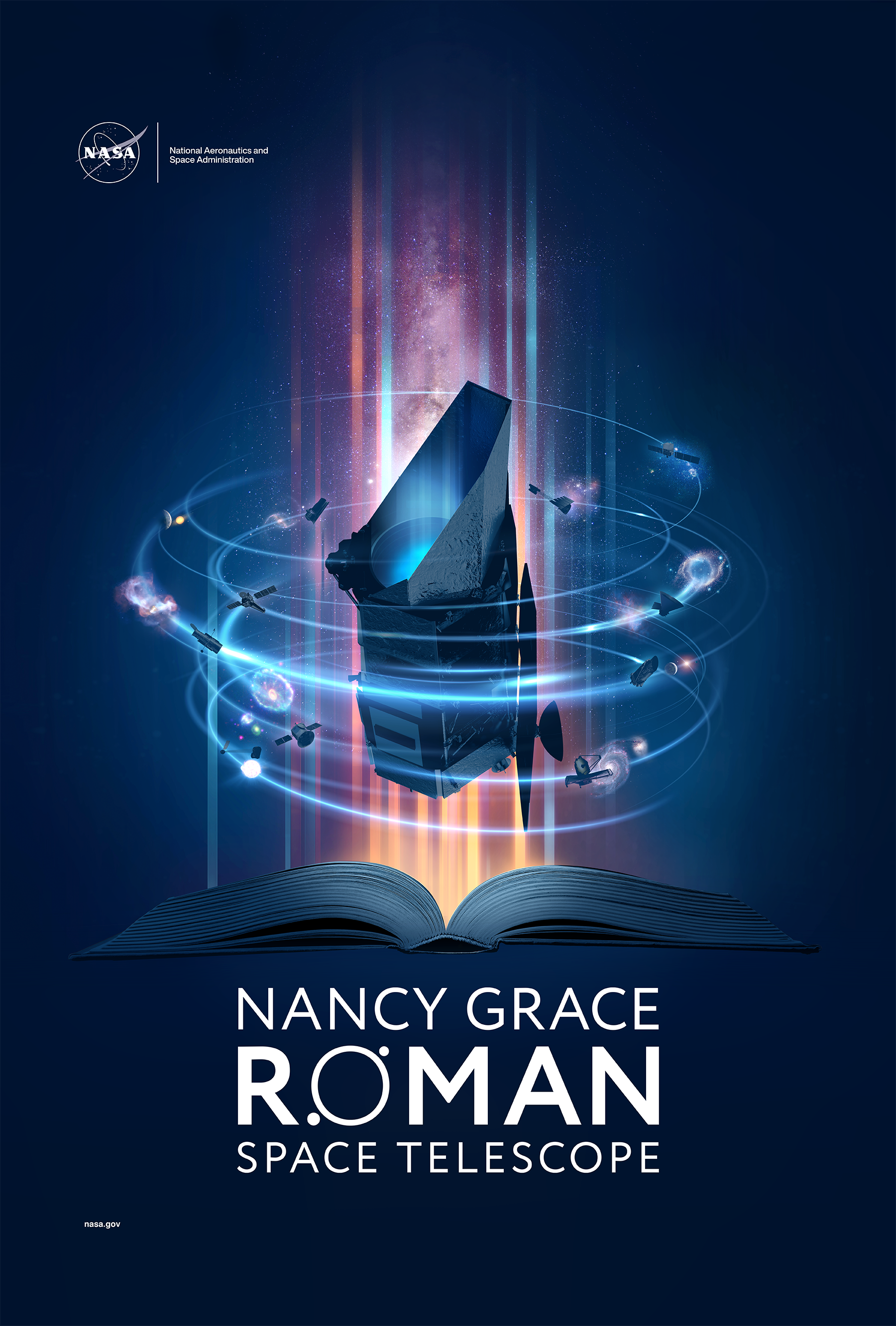
The Nancy Grace Roman Space Telescope was assembled and tested at NASA’s Goddard Space Flight Center in Greenbelt, Maryland. Once that work was finished, Roman had to travel to NASA’s Kennedy Space Center in Florida for its launch. The transport process was long, delicate, and painstaking.

Inside Goddard’s largest clean room, technicians moved Roman into a specially-built portable clean room called the Conditioned Housing for Air, Road, Imaging optics assembly, and Observatory Transport (CHARIOT). They lifted Roman into the lower portion, and then put an inner lid over it and covered the protruding antenna dish. Then they lowered an outer cover onto it with attachments for the air conditioning to keep Roman at a safe temperature. 

Once in the CHARIOT, techs pushed Roman out of the clean room and attached an advanced wheel system to allow a semi truck to pull it. The system features independent driving at the back and the ability to raise and lower over or under obstacles.

Starting in the evening of June 12, a team of engineers, police, and utility workers spent 13 hours slowly driving Roman from Goddard to the port of Baltimore. At 16 feet tall, the CHARIOT could not fit under many highway overpasses, so the carefully planned route snaked its way on secondary roads, through Baltimore city, and around to the port, often traveling only two miles an hour.

At the port, the CHARIOT was loaded into NASA’s special transport barge, called Pegasus. The semi detached and drove back out, and the CHARIOT was carefully chained to the deck. Over the next eight days, Pegasus was towed by a pair of tugboats from Baltimore down to Port Canaveral. Special new tugboats took over and pulled Pegasus up the Banana River to the Turn Basin at Kennedy.

With Pegasus secured to the dock, opened up, and the CHARIOT unchained from the deck, a semi pulled Roman out and onto dry land. Designed for this kind of transport, the Kennedy roads allowed faster, easier transport to the Payload Hazardous Servicing Facility. Once inside the airlock chamber, technicians removed the driving hardware and moved the CHARIOT on a cushion of pressurized air. They cleaned the CHARIOT, removed the outer lid, and pushed it into the inner clean room where the inner lid could come off. Roman was lifted out of the CHARIOT and attached to a device that could tilt it vertical. Roman was now ready for the final stages of preparation for launch.

The Roman telescope and the discoveries it will support:
https://www.stsci.edu/roman


Credits: NASA’s Goddard Space Flight Center
Producer: Scott Wiessinger (eMITS)
Videographers: Sophia Roberts (eMITS)
  Scott Wiessinger (eMITS)
  Rob Andreoli (eMITS)
  John Philyaw (eMITS)
  Jolearra Tshiteya (ASRC Federal)
  Sydney Rohde (ASRC Federal)
  Kim Shiflett (KSC)
Drone Pilots: Christopher Albert, Rob Fortunato
Editor: Scott Wiessinger (eMITS)
Duration: 2 minutes, 23 seconds
Release Date: July 28, 2026

#NASA #Space #Astronomy #Science #NASARoman #RomanSpaceTelescope #NancyGraceRomanSpaceTelescope #NancyGraceRoman #Exoplanets #Planets #SolarSystem #Stars #MilkyWayGalaxy #Galaxies #Cosmos #Universe #SpaceTelescopes #NASAGoddard #GSFC #STScI #NASAKennedy #KSC #Florida #UnitedStates #STEM #Education #HD #Video

Journey to Betelgeuse Star’s Companion | European Southern Observatory

Journey to Betelgeuse Star’s Companion | European Southern Observatory

This video takes us to the red supergiant star Betelgeuse, where astronomers have obtained the clearest image yet of what likely is a companion star orbiting it—Betelgeuse B. The video combines images taken with various telescopes at distinct wavelengths. It begins with a wide view of the sky in visible light. At 0:22, we see a mid-infrared image taken with the VISIR instrument at the European Southern Observatory’s Very Large Telescope (VLT), showing a large and complex dusty envelope around Betelgeuse.

As we keep zooming in we eventually see Betelgeuse’s surface at 0:35, imaged in January 2019 with the SPHERE instrument, also at the VLT. The video ends with another SPHERE image where Betelgeuse has been removed, revealing a bright source next to it. This is likely its companion, Betelgeuse B. This image was obtained in December 2024, when the companion was predicted to be furthest away from Betelgeuse as seen from Earth.

Read science paper "VLT/SPHERE imaging of the candidate companion of Betelgeuse": https://www.eso.org/public/archives/releases/sciencepapers/eso2611/eso2611a.pdf


Credit: ESO/M. Montargès et al./P. Kervella/Digitized Sky Survey 2 Acknowledgement: Eric Pantin, N. Risinger
Duration: 39s
Release Date: July 28, 2026

#NASA #Astronomy #Space #Science #Stars #Betelgeuse #SupergiantStars #BetelgeuseB #StellarCompanions #OrionConstellation #Astrophysics #Cosmos #Universe #VLT #VISIR #SPHERE #ParanalObservatory #Chile #Europe #DSS2 #STScI #STEM #Education #HD #Video

Astronomers find strongest evidence yet that Betelgeuse star has a companion | ESO

Astronomers find strongest evidence yet that Betelgeuse star has a companion | ESO

Digitized Sky Survey image of Betelgeuse
This image is a color composite made from exposures from the Digitized Sky Survey 2 (DSS2). The field of view is approximatelly 2.0 x 1.5 degrees.
VLT image of Betelgeuse’s companion
This image, taken with ESO’s Very Large Telescope (VLT), shows the clearest image ever of what likely is Betelgeuse B, a star orbiting Betelgeuse. The image was taken with the SPHERE instrument in December 2024, when the companion was predicted to be furthest apart from Betelgeuse as seen from Earth. The circle indicates the size of Betelgeuse. The bright source to the left, marked with a crosshair, is consistent with being Betelgeuse B.
VLT images of Betelgeuse and its companion
Using ESO’s Very Large Telescope (VLT), astronomers have obtained the clearest image ever of what likely is Betelgeuse B, a star orbiting Betelgeuse.
Betelgeuse is a red supergiant star in the Orion constellation. Its brightness changes periodically, and for decades astronomers had suspected that some of these variations could be due to a companion star orbiting around it.
The image in the middle inset in this image was taken in January 2019 with the SPHERE instrument at ESO’s VLT, and shows Betelgeuse itself. The image in the inset on the left was taken in December 2024, when the companion was predicted to be furthest apart from Betelgeuse as seen from Earth. In this inset Betelgeuse has been removed, revealing a source (marked with a crosshair) consistent with being Betelgeuse B.
Wide-field view of the region of the sky where Betelgeuse is located
This image shows the location of the red supergiant star Betelgeuse in the constellation of Orion (the Hunter). Betelgeuse can be seen quite easily without the need for a telescope as the right shoulder of Orion, as highlighted in this diagram.

At long last, astronomers have firm evidence that Betelgeuse, one of the most famous stars in the night sky, is not alone. Using the European Southern Observatory’s Very Large Telescope (ESO's VLT), a team led by French researcher Miguel Montargès obtained the clearest image ever of what likely is Betelgeuse B, the star orbiting Betelgeuse. “This is the conclusion of a century-long quest,” says Montargès.

“We have shown that Betelgeuse is not single, it is accompanied by a faint stellar companion,” says Montargès, astronomer at the Observatoire de Paris - PSL, France, and lead author of the study published today in Astronomy & Astrophysics. Betelgeuse—a reddish star in the Orion constellation that is easily visible with the naked eye and is known to change in brightness—has been observed for millennia. However, it still surprises astronomers.

“I jumped from my chair when I saw the processed images,” recalls Montargès. Astronomers have looked for the potential companion, originally proposed to explain Betelgeuse’s brightness changes, for about a century, but without success. Two studies published in 2024 robustly predicted that in December that year, the companion would be furthest from Betelgeuse and hence easier to spot. Montargès and his team got to work, observing the star with ESO’s VLT in December 2024 and spending several months processing the data.

“Honestly, I thought we did not have the sensitivity to detect Betelgeuse B as it was predicted,” explains Montargès. “Because it is more massive than predicted, we see it!” Originally thought to be about as massive as the Sun, the new observations reveal that Betelgeuse B has instead around two to three times the mass of the Sun. “The fact that we can still discover a nearby companion, more massive and brighter than the Sun, around such a well-studied star is remarkable,” says Montargès. “These are among the best moments in science: seeing something new, unexpected.”

Betelgeuse B was directly imaged, meaning the light from the star itself was detected, using the SPHERE instrument on ESO’s VLT in Chile’s Atacama Desert. While there was evidence for the existence of this companion star, including a possible direct detection with the Gemini North Telescope in Hawaiʻi, USA, this is the strongest evidence for, and clearest image yet of, Betelgeuse B. “It is remarkable to see how SPHERE and advanced post-processing techniques, originally developed to find exoplanets, also excel at detecting a companion around a massive, evolved star like Betelgeuse," says co-author Anthony Boccaletti, also an astronomer at the Observatoire de Paris.

“To be certain that the companion is really there, we still need to observe it in one year on the other side of the star, but there is very little space left for doubt,” adds Montargès.

A few years back, Betelgeuse was the subject of attention from astronomers and non-astronomers alike when it visibly started dimming. As an evolved supergiant star, Betelgeuse is expected to die in a supernova explosion, and the dimming led to speculations it could be about to explode. A group of astronomers led by Montargès studied the star with ESO’s VLT, finding it was instead obscured by a cloud of dust.

The potential detection of Betelgeuse B will prompt astronomers to investigate how the companion could affect Betelgeuse's anticipated supernova explosion. “The question is truly opened whether this companion is going to have an impact on the evolution of the red supergiant,” concludes Montargès.

This research was presented in a paper titled “VLT/SPHERE images the candidate companion of Betelgeuse” to appear in Astronomy & Astrophysics:
https://www.eso.org/public/archives/releases/sciencepapers/eso2611/eso2611a.pdf


Credits: European Southern Observatory (ESO), ESO/Digitized Sky Survey 2, M. Montargès et al, N. Rissinger
Acknowledgment: Davide De Martin
Release Date: July 28, 2026

#NASA #Astronomy #Space #Science #Stars #Betelgeuse #SupergiantStars #BetelgeuseB #StellarCompanions #OrionConstellation #Astrophysics #Cosmos #Universe #VLT #ParanalObservatory #Chile #Europe #DSS2 #STScI #STEM #Education 

Clearest Image Ever of Betelgeuse Star’s Companion | ESO

Clearest Image Ever of Betelgeuse Star’s Companion | ESO

Astronomers have finally obtained firm evidence that Betelgeuse, a famous star in the Orion constellation, is not alone. Using the European Southern Observatory’s Very Large Telescope (VLT) they have obtained the clearest image ever of what likely is Betelgeuse B, a star orbiting Betelgeuse. This can help explain its brightness variations.

Recent data suggests the Betelgeuse star's distance is closer to 642 or up to 724 light-years. Measuring stellar distances directly is challenging for large, variable stars.

Read science paper "VLT/SPHERE imaging of the candidate companion of Betelgeuse": https://www.eso.org/public/archives/releases/sciencepapers/eso2611/eso2611a.pdf


Credit: European Southern Observatory (ESO)
Duration: 1 minute, 22 seconds
Release Date: July 28, 2026


#NASA #Astronomy #Space #Science #Stars #Betelgeuse #BetelgeuseB #StellarCompanions #OrionConstellation #Cosmos #Universe #VLT #ParanalObservatory #Chile #Europe #STEM #Education #HD #Video

Monday, July 27, 2026

New China Commercial Rocket Launch Pads Nearing Completion in Hainan

New China Commercial Rocket Launch Pads Nearing Completion in Hainan

China is building new commercial launch pads in Hainan, eyeing 60 launches a year. Main civil construction work on Commercial Launch Pads 3 and 4 at the Wenchang Commercial Space Launch Site in Hainan province has been completed, according to site operator HICAL. The two multi-user pads, part of the site's second-phase expansion, are designed to host launch vehicles at least 3.35 meters in diameter. While core structures are finished, several support systems remain under installation, including a shared water storage tower and six lightning diversion towers still awaiting night-launch lighting.

The first launch from the new pads is expected in the fourth quarter of this 2026, potentially using a Long March 10B rocket with a reused first-stage booster. Once validated by an initial flight, the site will be able to support up to 60 launches a year, with most coming from the Long March 8 series. The expansion, spanning over 133 hectares along Wenchang's coast, also includes fueling systems, a command center, and a testing facility—another step in China's rapidly growing commercial space capacity as high-density launches become the new normal at the site.


Video Credit: SMG
Duration: 1 minute, 20 seconds
Release Date: July 27, 2026

#NASA #Space #Science #Earth #Satellites #SatelliteConstellations #China #中国 #Rockets #LongMarch8Rockets #长征八号运载火箭 #MediumLiftRockets #LongMarch10Rockets #长征十号 #HeavyLiftRockets #ReusableRockets #CAS #CASC #CAST #SpaceTechnology #CommercialSpace #Spaceports #Wenchang #WCSL #HICAL #Hainan #STEM #Education #HD #Video

High-Flying Balloons Give Students Unique Views of Solar Eclipses | NASA Goddard

High-Flying Balloons Give Students Unique Views of Solar Eclipses | NASA Goddard

The NASA-funded Nationwide Eclipse Ballooning Project allows teams of students from across the U.S. to get a unique view of total solar eclipses with scientific balloons. Before, during, and after a total solar eclipse, teams of college and high-school students use balloons to fly cameras and scientific instruments—either off-the-shelf weather sensors or instruments they built themselves—into the stratosphere to investigate the Sun, the eclipse’s effects on our atmosphere, and other phenomena that are best studied at high altitudes. Started in 2014, the project has not only produced new discoveries but provided hundreds of students with hands-on science and engineering experience along the way.

Learn more about the project: 

More details about solar eclipses:

Learn more about eclipse safety: 


Credit: NASA's Goddard Space Flight Center
Producer: Lacey Young (eMITS)
Videographer: Lacey Young (eMITS), Joy Ng (eMITS), Beth Anthony (eMITS)
Narrator: Angela Vazzana (CyPrESS)
Talent: Angela Des Jardins (Montana State University)
Additional video: Nationwide Eclipse Ballooning Project
Duration: 2 minutes
Release Date: July 27, 2026

#NASA #Space #Astronomy #Science #Earth #Atmosphere #Ionosphere #Moon #Sun #Corona #SolarEclipses #SolarEclipse2026 #TotalSolarEclipse #Balloons #HighAltitudeBalloons #Students #HighSchoolStudents #CollegeStudents #Learning #NASAGoddard #GSFC #Europe #UnitedStates #STEM #Education #HD #Video

SpaceX Starship Liftoff—Flight Test#13: High-speed video | Starbase Texas

SpaceX Starship LiftoffFlight Test#13: High-speed video | Starbase Texas

"High-speed video of 33 Raptor engines powering the Super Heavy booster on Flight 13."

The thirteenth flight test of Starship successfully launched Friday, July 24, 2026, at 5:51 p.m. Central Time (CT). This was the second flight of the Starship and Super Heavy V3 vehicles and the first Starship flight to deploy "next generation" Starlink V3 satellites.

Watch the launch broadcast and read the flight report here: 

The flight test began with Super Heavy igniting all 33 Raptor 3 engines and ascending over the Gulf of Mexico. The successful first-stage ascent was followed by a hot-staging maneuver with Starship’s upper stage igniting its six Raptor engines to continue its flight to space.

Following stage separation, the Super Heavy booster performed a directional flip maneuver. The startup sequence was modified for this flight to be more robust to timing variability in engine startup and flip in the desired direction. This is done to increase overall performance. The booster successfully completed the high thrust portion of the boostback burn with all 33 engines, the first time with a Super Heavy V3, before ending the burn early. It attempted to relight its engines for the landing burn with a subset successfully igniting before experiencing a hard splashdown in the Gulf.

After completing a full-duration ascent burn on all six Raptor engines, Starship achieved its planned velocity and trajectory. Starship then successfully deployed all 20 Starlink V3 satellites. SpaceX engineers were able to successfully communicate with every satellite using radio frequency and laser links and downloaded key telemetry from the satellites. The Starlink satellites were deployed on the pre-planned trajectory and are expected to have demised upon reentry approximately 20 minutes after deployment.

The vehicle also reignited a single Raptor engine in an in-space demonstration of a core capability for future orbital missions.

Starship re-entered the Earth’s atmosphere and was able to gather critical data on the performance of its heatshield before executing a dynamic banking move to mimic the trajectory that future missions returning to Starbase will fly. Starship then guided itself using its four flaps to the pre-planned splashdown zone in the Indian Ocean. After relighting all three Raptor engines, Starship executed a landing flip, landing burn, and soft splashdown, coming to rest intact in the Indian Ocean and providing critical views of an intact heatshield for the first time.

NASA plans to use a lunar lander version of Starship to deliver astronauts and cargo to the Moon during the Artemis IV mission and beyond through the Human Landing System (HLS) Program.

Download the Free Starship User Guide (PDF):
https://www.spacex.com/media/starship_users_guide_v1.pdf

Video Credit: Space Exploration Technologies Corporation (SpaceX)
Duration: 1 minute
Date: July 24, 2026

#NASA #SpaceX #Space #Earth #Mars #Moon #ArtemisProgram #ArtemisIII #ArtemisIV #Starship #StarshipV3 #FlightTest13 #ReusableSpacecraft #SuperHeavyBooster #SuperHeavyV3 #ElonMusk #Engineering #SpaceTechnology #HumanSpaceflight #CommercialSpace #SpaceExploration #StarbaseTexas #UnitedStates #STEM #Education #HighSpeedVideo #HD #Video

Chasing Solar Eclipses with NASA Supersonic Jet Pilots | NASA Goddard

Chasing Solar Eclipses with NASA Supersonic Jet Pilots | NASA Goddard

On August 12, 2026, a total solar eclipse will cross Russia, Greenland, Iceland, Spain, and Portugal. However, among the best views will come from 50,000 feet up, aboard NASA's WB-57 jet. Flying through the stratosphere, the jet’s instruments study the eclipse from above most of Earth’s atmosphere, avoiding the clouds, dust, and water vapor that can blur the view.

As the Moon's shadow races across the ground, the crew pushes the high-speed jet to stay inside totality for as long as possible, giving scientists and their instruments extra time to study the Sun.

The NASA Johnson Space Center (JSC) in Houston, Texas is the home of the NASA WB-57 High Altitude Research Program. Three WB-57 aircraft are based near JSC at Ellington Field. The aircraft have been flying research missions since the early 1970's, and continue to be an asset to the scientific community with service designed to meet a variety of scientific objectives.

The WB-57 is a mid-wing, long-range aircraft capable of operating for extended periods of time from sea level to altitudes in excess of 63,000 feet. The WB-57 can fly for approximately 6.5 hours, has a range of approximately 2500 miles, and can carry up to 8,800 lbs of payload. 

Lear more about solar eclipses:


Video Credit: NASA
Producer: Joy Ng (eMITS)
Pilots: Tom Parent (NASA JSC), Cary Klemm (NASA JSC)
Videographers: Josh Valcarcel (NASA JSC), Charles Clendaniel (eMITS) 
Duration: 2 minutes
Release Date: July 27, 2026


#NASA #Space #Astronomy #Science #Earth #Atmosphere #Ionosphere #Moon #Sun #Corona #SolarEclipses #SolarEclipse2026 #TotalSolarEclipse #WB57Aircraft #SupersonicAircraft #NASAJohnson #JSC #NASAGoddard #GSFC #Europe #UnitedStates #Russia #Greenland #Iceland #Spain #Portugal #STEM #Education #HD #Video

Russian Soyuz MS-29 Crew Spacecraft Arrival | International Space Station

Russian Soyuz MS-29 Crew Spacecraft Arrival | International Space Station


A Russian Soyuz rocket launched to the International Space Station with Expedition 75 crewmembers: NASA astronaut Anil Menon, Roscosmos cosmonauts Pyotr Dubrov, and Anna Kikina onboard, on Tuesday, July 14, 2026, from the Baikonur Cosmodrome in Kazakhstan. The trio will spend about eight months aboard the orbiting laboratory before returning to Earth in spring 2027.

At 1:52 p.m. EDT, their Russian Soyuz MS-29 spacecraft docked with the International Space Station’s Prichal module. At 4:30 p.m. EDT, the hatch opened between the International Space Station and the Soyuz MS-29 spacecraft.

The trio joined NASA astronauts Jessica Meir, Jack Hathaway, and Chris Williams, European Space Agency astronaut Sophie Adenot, and Roscosmos cosmonauts Sergey Kud-Sverchkov, Sergei Mikaev, and Andrey Fedyaev of Russia.

During his expedition, Menon will conduct scientific investigations and technology demonstrations intended to help humans prepare for future exploration missions to the Moon and Mars, and to provide benefits on Earth. Among the hundreds of experiments planned during his mission, he will participate in studies to better understand astronaut vein structure, blood flow, and blood composition in microgravity. He also will test producing intravenous fluids using the space station’s potable water.

The Soyuz MS-29 mission was his first spaceflight after he was selected as part of NASA’s 2021 astronaut class. A native of Minneapolis, Menon is an emergency medicine physician, mechanical engineer, and colonel in the United States Space Force. He also has served as an expedition flight surgeon supporting the agency’s crew members aboard the space station.

NASA astronaut Anil Menon's Official Biography:

For more than 25 years, people have lived and worked continuously aboard the International Space Station, advancing scientific knowledge and making research breakthroughs not possible on Earth. The space station helps NASA understand and overcome the challenges of human spaceflight, expand commercial opportunities in low Earth orbit, and build on the foundation for long-duration missions to the Moon, as part of the Artemis program, and to Mars.

To learn more about International Space Station research, operations, and its crews, visit: 

An international partnership of space agencies provides and operates the elements of the International Space Station (ISS). The principals are the space agencies of the United States, Russia, Europe, Japan, and Canada.

Credit: Roscosmos/S. Kud-Sverchkov
Date: July 14, 2026

#NASA #Space #Science #Astronomy #ISS #Earth #SoyuzRocket #SoyuzMS29 #Astronauts #AnilMenon #Cosmonauts #AnnaKikina #PyotrDubrov #Russia #Россия #Roscosmos #Роскосмос #HumanSpaceflight #InternationalCooperation #UnitedStates #MicrogravityLaboratory #Expedition74 #Expedition75 #Baikonur #Kazakhstan #Қазақстан #STEM #Education

Planet Mars Images: July 23-27, 2026 | NASA's Curiosity & Perseverance Rovers

Planet Mars Images: July 23-27, 2026 | NASA's Curiosity & Perseverance Rovers

MSL - sol 4961
Mars 2020 - sol 1931
MSL - sol 4962
MSL - sol 4962
MSL - sol 4963
MSL - sol 4963
MSL - sol 4963
MSL - sol 4963

Become a monthly Friends of NASA supporter on our website:
https://www.friendsofnasa.org/p/friends-of-nasa.html
Friends of NASA (FoN) is an independent non-governmental organization (NGO) dedicated to building international support for peaceful space exploration, commerce, scientific discovery, and STEM education. 
We depend on public donations.
One-time Donations to Friends of NASA (PayPal) accepted here: 

Celebrating 13+ Years on Mars (2012-2026)
Mission Name: Mars Science Laboratory (MSL)
Rover Name: Curiosity
Main Job: To determine if Mars was ever habitable to microbial life. 
Launch: Nov. 6, 2011
Landing Date: Aug. 5, 2012, Gale Crater, Mars

Celebrating 5+ Years on Mars
Mission Name: Mars 2020
Rover Name: Perseverance
Main Job: Seek signs of ancient life and collect samples of rock and regolith (broken rock and soil) for return to Earth.
Launch: July 30, 2020
Landing: Feb. 18, 2021, Jezero Crater, Mars

For more information on NASA's Mars missions, visit: mars.nasa.gov

Image Credits: NASA/JPL-Caltech/ASU/MSSS
Release Dates: July 23-27, 2026

#NASA #Space #Astronomy #Science #Planets #Mars #Astrobiology #Geology #CuriosityRover #MSL #MountSharp #GaleCrater #PerseveranceRover #Mars2020 #JezeroCrater #Robotics #SpaceTechnology #SpaceEngineering #MSSS #JPL #Caltech #UnitedStates #CitizenScience #KevinGill #SpaceExploration #SolarSystem #STEM #Education