Thursday, February 17, 2022

Early Season Milky Way over Western Australia

Early Season Milky Way over Western Australia

Astrophotographer Trevor Dobson: "This is a 12 shot panorama of the Milky Way as it rises above an old stone shed on a wheat farm at Greenhills, 1.5 hours east of Perth in Western Australia. This is a very early shot of the core taken not long before the start of astronomical twilight where the rising sun's ambient light starts to affect the sky."

The Fading Milky Way

Light pollution is a growing environmental problem that threatens to erase the night sky before its time. A recent study revealed that perhaps two-thirds of the world's population can no longer look upwards at night and see the Milky Way—a hazy swath of stars that on warm summer nights spans the sky from horizon to horizon.

The Milky Way is dimming, not because the end of the Universe is near, but rather as a result of light pollution: the inadvertent illumination of the atmosphere from street lights, outdoor advertising, homes, schools, airports and other sources. Every night billions of bulbs send their energy skyward where microscopic bits of matter—air molecules, airborne dust, and water vapor droplets—reflect much of the wasted light back to Earth. 

(Source: NASA)

Learn more:

International Dark-Sky Association

https://www.darksky.org/light-pollution

Globe at Night

https://www.globeatnight.org

Night Sky Network (NASA JPL)

https://nightsky.jpl.nasa.gov/index.cfm

Tourism Australia: https://www.australia.com


Image Technical Data:

Nikon d810a, 50mm, ISO 6400, f/2.8

Foreground: 3 x 25 seconds

Sky: 9 x 30 seconds

iOptron SkyTracker

Hoya Red Intensifier filter


Image Credit: Trevor Dobson

Location: Greenhills, Western Australia

Image Date:  February 4, 2022


#NASA #Space #Astronomy #Science #MilkyWay #Stars #LightPollution #CitizenScience #Astrophotographer #TrevorDobson #Astrophotography #Skywatching #Cosmos #Universe #SolarSystem #Earth #Greenhills #Australia #STEM #Education


NASA & United Arab Emirates Astronaut Training at US Army Fort Rucker

NASA & United Arab Emirates Astronaut Training at US Army Fort Rucker

United Arab Emirates (UAE) Astronaut Candidates Nora AlMatrooshi and Mohammad AlMulla join NASA Astronaut Anne McClain at U.S. Army Aviation Center of Excellence at Fort Rucker, Alabama.      

NASA Astronaut Anne McClain: " . . . and at the end of that training were some big smiles from the newest UAE Space Agency and NASA astronauts! Maybe knowing they were about to get their first meal in a few days? Thanks for the hospitality and top notch training Fort Rucker . . ."

" . . . astronaut candidates have been trained by the best SERE instructors in the business. Fort Rucker welcomes you back anytime!"

—US Army Major Gen. David J. Francis, Fort Rucker

Mohammed Al Mulla, 33, a Dubai Police helicopter pilot, and Nora Al Matrooshi, 28, a mechanical engineer, will train with American astronauts as part of an agreement between NASA and the UAE's Mohammed bin Rashid Space Centre.

Anne McClain is a lieutenant colonel in the U.S. Army, a veteran military helicopter pilot, an aerospace engineer, and a NASA astronaut. Her call sign, "Animal", dates back to her bruising rugby days. She also uses the call sign in her Twitter handle, @AstroAnnimal. Anne was a Flight Engineer for Expedition 58/59 to the International Space Station in 2019.

Survival, Evasion, Resistance, and Escape (SERE) is a training program, best known by its military acronym, that prepares U.S. military personnel, U.S. Department of Defense civilians, and private military contractors to survive and "return with honor" in survival scenarios. (Source: Wikipedia)

U.S. Army Aviation Center of Excellence at Fort Rucker

https://home.army.mil/rucker/index.php/about/usaace

Credit: NASA/JSC/Anne McClain@AstroAnnimal

Release Date: February 12, 2022

#NASA #Space #Astronauts #NoraAlMatrooshi #MohammadAlMulla #AnneMcClain #Artemis #Moon #Mars #JourneyToMars #UAE #Emirates #SERE #Training #USArmy #FortRucker #Aviation #UnitedStates #International #Cooperation

Wednesday, February 16, 2022

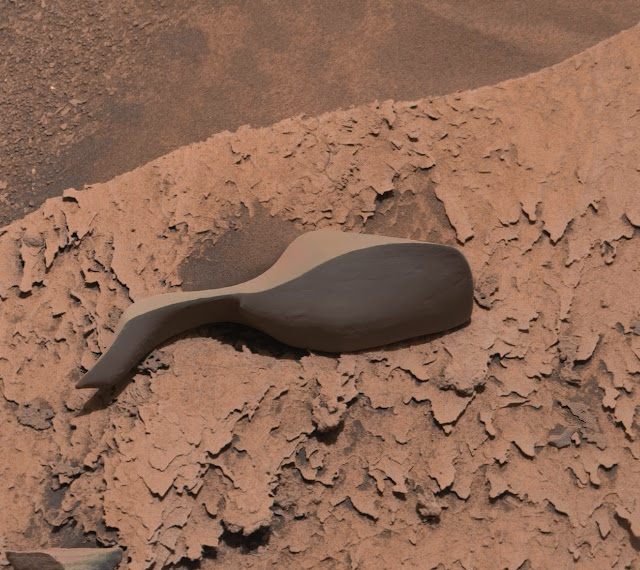
'Tadpole' Rock on Mars | NASA Mars Curiosity Rover

'Tadpole' Rock on Mars | NASA Mars Curiosity Rover

"Been following Mars missions since the Viking days, and I've seen a lot of weird rocks in that time, out on the plains, inside craters, on mountain tops, but this one, imaged by [the Mars Curiosity rover] is just . . . nuts. Beautiful, but nuts . . . " 

—Gill Stuart Atkinson - Citizen Scientist (Twitter)

Pareidolia. Dictionaries describe this term as a human tendency to see recognizable shapes in objects or data that are otherwise not familiar to us.

Learn about NASA's Mars Curiosity Rover:

https://mars.nasa.gov/msl/home/

Learn more about pareidolia and Martian "space oddities:"

https://mars.nasa.gov/multimedia/space-oddities/


Image Credit: NASA/JPL-Caltech/MSSS/Kevin M.

Image Date: Curiosity MSL - Sol 3385 - MastCam 

Release Date: February 15, 2022

#NASA #Space #Astronomy #Science #Mars #RedPlanet #Planet #Rock #Tadpole #Pareidolia #MountSharp #GaleCrater #Curiosity #Rover #MSL #Robotics #Technology #JPL #Pasadena #California #UnitedStates #JourneyToMars #CitizenScience #STEM #Education


Exploring New Worlds | European Space Agency

Exploring New Worlds | European Space Agency


As part of Agenda 2025, ESA will take preparatory steps towards a sample return mission from the moons of giant planets, and will foster innovation by challenging commercial companies to develop a next generation of competitively priced European space transportation systems.

Space science and planetary exploration have a unique inspirational power for engaging young generations in science, technology, engineering and mathematics, creating a highly educated workforce for the future.

Collaborating with the European space industry to foster innovation generates economic growth and new revenues, as well as creating new jobs for European citizens. All the money invested in space is spent on Earth.

Learn more: https://vision.esa.int


Credit: European Space Agency (ESA)

Duration: 2 minutes, 35 seconds

Release Date: February 16, 2022


#ESA #Space #Earth #Mars #Moon #Saturn #Enceladus #Jupiter #Europa #Science #Technology #Engineering #Mathematics #SolarSystem #Planetary #Exploration #Vision #Future #Europe #Citizens #STEM #Education #HD #Video


Planetary Defense: By the Numbers | NASA 360

Planetary Defense: By the Numbers | NASA 360

What do we know about the asteroids and comets in Earth's neighborhood? 
Planetary defense—which includes finding, tracking, & characterizing these near-Earth objects—is part of our mission. Here's what we've found so far.

Learn more: 

Planetary Defense at NASA: nasa.gov/planetarydefense

Sentry II - NASA's Next-Generation Impact Monitoring Algorithm

https://www.nasa.gov/feature/jpl/nasa-s-next-generation-asteroid-impact-monitoring-system-goes-online

Credit: NASA 360

Duration: 1 minute, 27 seconds

Release Date: February 1, 2022

#NASA #Space #Earth #Planet #PlanetaryDefense #Asteroids #AsteroidBelt #Comets #NEO #NEA #SolarSystem #Science #Technology #SentryII #Algorithm #Mathematics #Computing #JPL #UnitedStates #STEM #Education #HD #Video

How Do You Use Physics to Re-Enter Earth’s Atmosphere? | Lockheed Martin

How Do You Use Physics to Re-Enter Earth’s Atmosphere? | Lockheed Martin

Once NASA's Orion spacecraft completes its mission, it returns to Earth. Lockheed Martin heat shield engineer, Brian Hinde, explores how he uses physics to make sure astronauts can return to our planet safely.

Learn more about NASA's Orion spacecraft:

https://www.nasa.gov/specials/orionfirstflight/

Learn more about NASA's Artemis-1 Mission:

https://www.nasa.gov/artemis-1


Credit: Lockheed Martin

Duration: 3 minutes, 50 seconds

Release Date: January 26, 2022


#NASA #Space #Moon #Artemis #ArtemisI #Orion #Spacecraft #SLS #Rocket #Mars #JourneyToMars #Earth #Atmosphere #Science #Physics #Engineering #Technology #History #America #UnitedStates #STEM #Education #HD #Video

Tuesday, February 15, 2022

Landsat 9 Data Available! | NASA Goddard

Landsat 9 Data Available! | NASA Goddard

The data from Landsat 9 is available for anyone to download. With both Landsat 9 and Landsat 8 in orbit, there will be high-quality, medium-resolution images of Earth’s landscapes and coastal regions every eight days. 

Landsat Data Access

https://earthexplorer.usgs.gov/

https://www.usgs.gov/landsat-missions/landsat-data-access

Landsat 9 was launched on Sept. 27, 2021, and the mission team then tested and calibrated the new satellite and its instruments. One of the commissioning activities was flying Landsat 9 under its sister satellite, Landsat 8, which allowed the team to confirm that the data align as expected.

They also calibrated the instruments through a variety of methods, including tilting Landsat 9’s spacecraft to image the full Moon—a steady source of light to ensure the instruments are detecting light consistently.

The Landsat Program is a series of Earth-observing satellite missions jointly managed by NASA and the U.S. Geological Survey (USGS). Landsat satellites have been consistently gathering data about our planet since 1972. They continue to improve and expand this unparalleled record of Earth's changing landscapes for the benefit of all.

Music: Amazing Discoveries by Damien Deshayes [SACEM], published by KTSA Publishnig [SACEM]  available from Universal Production Music; The Troubleshooter by Anders Johan Greger Lewen [STIM], published by Primetime Productions, Ltd [PRS]; Bright Patterns by Gregg Lehrman [ASCAP] and John Christopher Nye [ASCAP], published by Soundcast Music [SESAC]


Credit: NASA's Goddard Space Flight Center 

Matthew R. Radcliff (KBR): Lead Producer 

Aaron E. Lepsch (ADNET): Technical Support 

Jeffrey Masek (NASA/GSFC): Lead Scientist

Chris J Crawford (USGS): Lead Scientist

Del Jenstrom (NASA/GSFC): Lead Project Manager

Duration: 3 minutes, 12 seconds

Release Date: Feb. 10, 2022

#NASA #Space #Earth #Satellite #EarthObservation #Landsat #Landsat9 #USGS #GSFC #Goddard #Technology #UnitedStates #STEM #Education #HD #Video


Orion Crew Module Designed to Take the Heat | Lockheed Martin

NASA Orion Crew Module Designed to Take the Heat | Lockheed Martin

NASA will send the uncrewed Orion spacecraft out to the Moon and back later this year as part of its Artemis I mission. To ensure a safe return, Orion engineers have developed the heat shield to withstand the extremes of re-entry into Earth's atmosphere.

Learn more about NASA's Artemis-1 Mission:

https://www.nasa.gov/artemis-1

Credit: Lockheed Martin

Duration: 43 seconds

Release Date: February 8, 2022

#NASA #Space #Moon #Artemis #ArtemisI #Orion #Spacecraft #SLS #Rocket #Mars #JourneyToMars #Science #Engineering #Technology #History #America #UnitedStates #STEM #Education 

Sea Level to Rise up to a Foot by 2050, Interagency Report Finds | NASA JPL

Sea Level to Rise up to a Foot by 2050, Interagency Report Finds | NASA JPL

Feb. 15, 2022: Coastal cities like Miami, shown, already experience high-tide flooding. But a new federal interagency report projects an uptick in the frequency and intensity of such events in the coming decades because of rising seas. 

NASA, NOAA, USGS, and other U.S. government agencies project that the rise in ocean height in the next 30 years could equal the total rise seen over the past 100 years.

Sea Level Rise Technical Report (2022)

https://oceanservice.noaa.gov/hazards/sealevelrise/sealevelrise-tech-report.html

Adobe PDF Direct Download Link: 

https://oceanservice.noaa.gov/hazards/sealevelrise/noaa-nos-techrpt01-global-regional-SLR-scenarios-US.pdf


Coastal flooding will increase significantly over the next 30 years because of sea level rise, according to a new report by an interagency sea level rise task force that includes NASA, the National Oceanic and Atmospheric Administration (NOAA), and other federal agencies. Titled Global and Regional Sea Level Rise Scenarios for the United States, the Feb. 15 report concludes that sea level along U.S. coastlines will rise between 10 to 12 inches (25 to 30 centimeters) on average above today’s levels by 2050.

The report—an update to a 2017 reportforecasts sea level to the year 2150 and, for the first time, offers near-term projections for the next 30 years. Agencies at the federal, state, and local levels use these reports to inform their plans on anticipating and coping with the effects of sea level rise.

“This report supports previous studies and confirms what we have long known: Sea levels are continuing to rise at an alarming rate, endangering communities around the world. Science is indisputable and urgent action is required to mitigate a climate crisis that is well underway,” said NASA Administrator Bill Nelson. “NASA is steadfast in our commitment to protecting our home planet by expanding our monitoring capabilities and continuing to ensure our climate data is not only accessible but understandable.”

The task force developed their near-term sea level rise projections by drawing on an improved understanding of how the processes that contribute to rising seas—such as melting glaciers and ice sheets as well as complex interactions between ocean, land, and icewill affect ocean height. “That understanding has really advanced since the 2017 report, which gave us more certainty over how much sea level rise we’ll get in the coming decades,” said Ben Hamlington, a research scientist at NASA’s Jet Propulsion Laboratory in Southern California and one of the update’s lead authors.

NASA’s Sea Level Change Team, led by Hamlington, has also developed an online mapping tool to visualize the report’s state-of-the-art sea level rise projections on a localized level across the U.S. “The hope is that the online tool will help make the information as widely accessible as possible,” Hamlington said.

The Interagency Sea Level Rise Task Force projects an uptick in the frequency and intensity of high-tide coastal flooding, otherwise known as nuisance flooding, because of higher sea level. It also notes that if greenhouse gas emissions continue to increase, global temperatures will become even greater, leading to a greater likelihood that sea level rise by the end of the century will exceed the projections in the 2022 update.

“It takes a village to make climate predictions. When you combine NASA’s scenarios of global sea level rise with NOAA’s estimates of extreme water levels and the U.S. Geological Survey’s impact studies, you get a robust national estimate of the projected future that awaits American coastal communities and our economic infrastructure in 20, 30, or 100 years from now,” said Nadya Vinogradova Shiffer, who directs the NASA Sea Level Change Team at NASA Headquarters in Washington.

“This is a global wake-up call and gives Americans the information needed to act now to best position ourselves for the future,” said NOAA Administrator Rick Spinrad, Ph.D. “As we build a Climate Ready Nation, these updated data can inform coastal communities and others about current and future vulnerabilities in the face of climate change and help them make smart decisions to keep people and property safe over the long run.”

Building on a Research Legacy

The Global and Regional Sea Level Rise report incorporates sea level projections from the latest Intergovernmental Panel on Climate Change (IPCC) assessment, released by the United Nations in August 2021. The IPCC reports, issued every five to seven years, provide global evaluations of Earth’s climate and use analyses based on computer simulations, among other data.

A separate forthcoming report known as the Fifth National Climate Assessment, produced by the U.S. Global Change Research Program, is the latest in a series summarizing the impacts of climate change on the U.S., and it will in turn use the results from the Global and Regional Sea Level Rise report in its analysis. The Climate Assessment is slated to publish in 2023.

NASA sea level researchers have years of experience studying how Earth’s changing climate will affect the ocean. Their work includes research forecasting how much coastal flooding U.S. communities will experience in 10 years, helping to visualize IPCC data on global sea level rise using an online visualization tool, and launching satellites that contribute data to a decades-long record of global sea surface height.

Learn more about sea level and climate change here: https://sealevel.nasa.gov/


Text Credit: NASA's Jet Propulsion Laboratory

Image Credit: B137 (CC-BY)

Release Date: February 15, 2022

#NASA #JPL #NOAA #USGS #Science #Earth #Atmosphere #Climate #ClimateChange #Sea #SeaLevel #Ocean #Flooding #GlobalHeating #Planet #Pasadena #California #UnitedStates #STEM #Education



Snowy Hills Aurora in Wyoming

Snowy Hills Aurora in Wyoming

Astrophotographer Kevin Palmer: "Last night was an unexpected treat in northern Wyoming. The show really got going after 1am."

"It was supposed to hit the previous night. But the aurora runs on its own schedule. Only after the solar storm watch was cancelled, most skywatchers had written it off as a bust, did the northern lights show. The late arrival ended up being a good thing because this night was crystal clear in Wyoming. Temperatures below zero and a bitter breeze brought frosted eyelashes and numb fingers. But I've been waiting 3 months for a night like this one." 

"Geomagnetic storms are less frequent in the winter and often hidden behind clouds when they do happen. So when conditions are perfect I have to take advantage. Pillars appeared briefly at 11:00 and faded, then the real show started after 1am. This is a location I found while exploring the local backroads. After marking it on a map, I waited until the time was right to return and capture the northerly view. In recent months more sunspots have been appearing on the Sun. As we head towards the maximum of the 11-year solar cycle, views like this will only become more common."

Learn more about aurora: 

https://www.nasa.gov/mission_pages/sunearth/aurora-news-stories/index.html

Image Credit & Copyright: Kevin Palmer

Kevin's website: www.kevin-palmer.com

Location: Wyoming, United States

Image Date: February 2, 2022

#NASA #Space #Science #Astronomy #Earth #Planet #Aurora #AuroraBorealis #NorthernLights #MagneticField #Magnetosphere #SolarWind #Sun #Wyoming #UnitedStates #Photography #Astrophotography #STEM #Education #KevinPalmer

NASA 2022: The Future is Now

NASA 2022: The Future is Now

Receiving the first images from the James Webb Space Telescope, sending the first uncrewed Artemis mission around the Moon and back to Earth, sending NASA science and technology to the surface of the Moon on three missions with our commercial partners, and flying our first quiet, supersonic plane are just a few of the things NASA has planned for 2022.

To learn more about the missions mentioned in this video, take a deep dive into these links:

Explore Beyond [00:13]

James Webb Space Telescope: https://www.jwst.nasa.gov/ 

DART: https://www.nasa.gov/dart 

IXPE: https://www.nasa.gov/ixpe 

Psyche: https://www.jpl.nasa.gov/missions/psyche

GUSTO: https://www.nasa.gov/press-release/nasa-selects-mission-to-study-churning-chaos-in-our-milky-way-and-beyond


At the Moon [00:35]

Artemis I: https://www.nasa.gov/artemis-1

Commercial Lunar Payload Services: https://www.nasa.gov/content/commercial-lunar-payload-services

CAPSTONE: https://www.nasa.gov/directorates/spacetech/small_spacecraft/capstone


Humans in Space [00:51]

Mark Vande Hei's Record: https://youtu.be/vsAAOuF2670

International Space Station Research and Technology: https://www.nasa.gov/mission_pages/station/research/index.html

Boeing Starliner: https://www.nasa.gov/subject/11845/starliner/

SpaceX Crew Dragon: https://www.nasa.gov/subject/11844/crew-dragon/


Space Technology [1:13]

Low-Earth Orbit Flight Test of an Inflatable Decelerator: https://www.nasa.gov/mission_pages/tdm/loftid/index.html

Advanced Composite Solar Sail System: https://www.nasa.gov/directorates/spacetech/small_spacecraft/ACS3

Laser Communications Relay Demonstration: https://www.nasa.gov/mission_pages/tdm/lcrd/index.html

Deep Space Optical Communications: https://www.nasa.gov/mission_pages/tdm/dsoc/index.html


Future of Flight [1:29]

X-59 QueSST: https://www.nasa.gov/specials/X59/

X-57 Maxwell: https://www.nasa.gov/specials/X57/


Our Earth [1:41]

SWOT: https://swot.jpl.nasa.gov/

TEMPO: http://tempo.si.edu/

TROPICS: https://weather.msfc.nasa.gov/tropics/

EMIT: https://earth.jpl.nasa.gov/emit/

Earth System Observatory: https://science.nasa.gov/earth-science/earth-system-observatory


Producer/Editor: Lacey Young

Music: Universal Production Music

Video Credit: National Aeronautics and Space Administration (NASA)

Duration: 2 minutes, 30 seconds

Release Date: December 31, 2021

#NASA #Hubble #Astronomy #Space #Science #Technology #Aerospace #JamesWebb #JWST #Earth #Moon #Mars #Artemis #ISS #Astronauts #Cosmos #Universe #Environment #ClimateChange #SolarSystem #Exploration #JourneyToMars #STEM #Education #HD #Video

How Do Spacecraft Deal with Dust Storms on Mars? | NASA JPL

How Do Spacecraft Deal with Dust Storms on Mars? | NASA JPL

NASA Mars Report: February 14, 2022

A large dust storm on Mars, nearly twice the size of the United States, covered the southern hemisphere of the Red Planet in early January 2022, leading to some of NASA’s explorers on the surface hitting pause on their normal activities. NASA’s Insight lander put itself in a "safe mode" to conserve battery power after dust prevented sunlight from reaching the solar panels. NASA's Ingenuity Mars Helicopter also had to postpone flights until conditions improved. 

A fleet of NASA orbiters monitor Martian dust storms like this one and serve as lifelines to Earth by relaying data from the rovers and lander on the ground back to the team. This includes the Mars Reconnaissance Orbiter, MAVEN, and Odyssey. 

Odyssey, while facing its technical issue, was able to recover quickly enough to come to InSight's aid during the dust storm. 

For more information on NASA's Mars missions, visit mars.nasa.gov.

Credit: NASA/JPL-Caltech/ASU/MSSS

Duration: 2 minutes, 40 seconds

Release Date: February 14, 2022

#NASA #Space #Astronomy #Science #Mars #RedPlanet #Planet #Atmosphere #DustStorm #Curiosity #Perseverance #Rover #MSL #Insight #Lander #Robotics #MRO #Odyssey #MAVEN #JPL #Pasadena #California #UnitedStates #JourneyToMars #STEM #Education #HD #Video

Monday, February 14, 2022

Kuiper Belt Object Arrokoth: New Place Names | NASA New Horizons Mission

Kuiper Belt Object Arrokoth: New Place Names | NASA New Horizons Mission


On Kuiper Belt Object Arrokoth, New Horizons Team Puts Names to the Places

Three prominent features on the Kuiper Belt object Arrokoth—the farthest planetary body ever explored, by NASA's New Horizons spacecraft in January 2019—now have official names. 

Proposed by the New Horizons team and approved by the International Astronomical Union, the new feature names follow a theme set by "Arrokoth" itself, which means "sky" in the Powhatan/Algonquin Native American language. The mission team tagged the nearly circular arc on the larger of Arrokoth two lobes, the bright "neck" connecting the lobes and a 4-mile-wide crater on the smaller lobe with variations of the word "sky." 

"Naming these features on Arrokoth is a milestone that the New Horizons team is very proud to reach," said New Horizons Principal Investigator Alan Stern, from the Southwest Research Institute in Boulder, Colorado. "It's a significant step in our discovery and exploration of this ancient object, in a distant region of the solar system we're just beginning to learn about."

Arrokoth orbits the Sun in the Kuiper Belt, more than a billion miles beyond Pluto and some four billion miles from Earth. The farthest object ever explored by spacecraft, the 22-mile (35-kilometer) long binary consists of a large, flat lobe connected to a smaller, rounder lobe. Nothing like it has been seen anywhere in the solar system, and that first close-up look provided by New Horizons in January 2019 yielded a range of images and data that are helping scientists understand how planetesimals like Arrokoththe building blocks of the planetsform.

Some of the scientific analyses on New Horizons' flyby data has focused on three key features: a nearly circular arc on Arrokoth's larger lobe; a bright "neck" connecting the lobes; and a large crater on the smaller lobe.

The team has named the arc "Ka'an," the word for sky in the Yucatec Mayan language spoken in parts of the Mexican Yucatan Peninsula and Belize. It also resembles the word for "snake" in this language—"kan"—and both terms derive from the classical Mayan word, "chan."

"Mayan paintings often show a snake arching over the scene, representing the sky or heaven," said Mark Showalter, a New Horizons co-investigator from the SETI Institute, and the mission's Nomenclature Working Group chair. "So we thought it was particularly appropriate to use ‘Ka'an' for this prominent, arc-shaped feature on Arrokoth."

The most reflective area on Arrokoth, the neck is named "Akasa," the word for sky in Bengali (Bangla), and derived from similar words in Sanskrit (ākāśam), Nepali (akās), Malayalam (ākāśaṃ), Oriya (akaśô), Sinhalese (ākāśaya), Tamil (ākāyam) and Telugu (ākāśamu).

The large crater, streaked with bright areas across its 4-mile-wide (7-kilometer-wide) floor, is officially named "Sky," in English. The team had nicknamed the crater "Maryland" soon after the flyby, in tribute to the location of the Johns Hopkins Applied Physics Laboratory, which built and operates the New Horizons spacecraft.

New Horizons itself remains healthy while continuing its exploration of the Kuiper Belt and outer heliosphere. The spacecraft is about 4.9 billion miles (7.8 billion kilometers) from home—more than 52 times farther from the Sun than Earth—in a region where a radio signal from New Horizons, even traveling at the speed of light, needs more than seven hours to reach Earth.

Three prominent features on the Kuiper Belt object Arrokothexplored by NASA's New Horizons spacecraft in January 2019—now have official names. The mission team tagged the nearly circular arc on the larger of Arrokoth two lobes, the bright "neck" connecting the lobes and a 4-mile-wide crater on the smaller lobe with variations of the word "sky." 

Credit: NASA/Johns Hopkins APL/Southwest Research Institute

Release Date: February 10, 2022

#NASA #Astronomy #Space #Science #NewHorizons #KuiperBelt #KBO #Arrokoth #IAU #Names #FirstNations #History #Algonquin #Powhatan #Mayan #Language #Spacecraft #JPL #SolarSystem #MSFC #JohnsHopkins #JHUAPL #APL #SwRI #SouthwestResearchInstitute #UnitedStates #Exploration #STEM #Education #Infographic

Happy Valentine's Day! | Free NASA eCards

Happy Valentine's Day! | Free NASA eCards

Looking for the perfect way to share love?  

NASA—the National Aeronautics and Space Administration—has you covered! 

Check out our out-of-this-world cards: go.nasa.gov/valentines


Credit: NASA

Release Date: February 14, 2022

#NASA #Space #Science #eCard #ValentinesDay #Free #Astronomy #Cosmos #Universe #SolarSystem #Exploration #STEM #Education #International


SpaceX Starbase Flyover with Polaris Dawn Crew

SpaceX Starbase Flyover with Polaris Dawn Crew


Polaris Program will Undertake a Series of Pioneering SpaceX Dragon Missions, Demonstrating New Technologies and Culminating in the First Human Spaceflight on Starship

Led by tech entrepreneur and Inspiration4 commander Jared Isaacman, this program will advance deep space exploration while raising global awareness for St. Jude Children’s Research Hospital®. 

Los Angeles, California (February 14, 2022) – Today Jared Isaacman, founder and CEO of Shift4 (NYSE: FOUR), announced the Polaris Program, a first-of-its-kind effort to rapidly advance human spaceflight capabilities, while continuing to raise funds and awareness for important causes here on Earth. The program will consist of up to three human spaceflight missions that will demonstrate new technologies, conduct extensive research, and ultimately culminate in the first flight of SpaceX’s Starship with humans on board. 

The first mission, Polaris Dawn, is targeted for no earlier than the fourth quarter of this year and will be commanded by Isaacman, an accomplished pilot and astronaut who led Inspiration4, the world’s first all-civilian mission to orbit that helped raise over $240 million for St. Jude Children’s Research Hospital®.

“The Polaris Program is an important step in advancing human space exploration while helping to solve problems through the use of innovative technology here on Earth,” said Isaacman. “On Polaris Dawn, we endeavor to achieve the highest Earth orbit ever flown in addition to conducting the world’s first commercial spacewalk and testing of Starlink laser-based communication. Alongside these important objectives, we will be supporting scientific research to advance both human health interests on Earth and our understanding of human health during future long-duration spaceflights.” Building upon the Inspiration4 mission, Polaris Dawn will continue to raise funds and awareness for St. Jude Children’s Research Hospital®. 

THE POLARIS DAWN MISSION 

SpaceX’s Falcon 9 rocket will launch the Polaris Dawn mission from Launch Complex 39A at Kennedy Space Center in Florida. Dragon and the Polaris Dawn crew will spend up to five days in orbit, flying higher than any Dragon mission to date and endeavoring to reach the highest Earth orbit ever flown. 

While in orbit, SpaceX mission control will carefully monitor Dragon and the crew as they: – Attempt the first-ever commercial spacewalk with SpaceX-designed extravehicular activity (EVA) spacesuits, upgraded from the current intravehicular (IVA) suit. The development of this suit and the execution of the EVA will be important steps toward a scalable design for spacesuits on future long-duration missions. 

Become the first crew to test Starlink laser-based communications in space, providing valuable data for future space communications systems necessary for human spaceflight to the Moon, Mars, and beyond. 

Conduct scientific research designed to advance both human health on Earth and our understanding of human health during future long-duration spaceflights. This includes, but is not limited to: 

Using ultrasound to monitor, detect, and quantify venous gas emboli (VGE), contributing to studies on human prevalence to decompression sickness; 

Gathering data on the radiation environment to better understand how space radiation affects human biological systems;

Providing biological samples towards multi-omics analyses for a long-term Biobank; and

Research related to Spaceflight Associated Neuro-Ocular Syndrome (SANS), which is a key risk to human health in long-duration spaceflight. 

SpaceX and Polaris Dawn will also collaborate with the Translational Research Institute for Space Health (TRISH), BioServe Space Technologies at the University of Colorado Boulder, Space Technologies Lab at Embry Riddle Aeronautical University, Weill Cornell Medicine, Johns Hopkins University Applied Physics Laboratory, the Pacific Northwest National Laboratory, and the U.S. Air Force Academy. 

Image Credit: Polaris Program/John Kraus
Caption Credit: Polaris Program

Image Date: February 11, 2022

#NASA #SpaceX #ElonMusk #Space #PolarisProgram #Polaris #Moon #Mars #Dragon #Starship #Spacecraft #SuperHeavy #Earth #Orbit #Spaceflight #Science #Technology #Engineering #Transportation #Commerce #BocaChica #Texas #Kennedy #KSC #Spaceport #CapeCanaveral #Florida #UnitedStates #STEM #Education


Ultralight Planet Found Next Door| European Southern Observatory (ESO)

Ultralight Planet Found Next Door | European Southern Observatory (ESO)

In this short video, we highlight the discovery of planet Proxima d around the star closest to the Sun.

A team of astronomers using the European Southern Observatory’s Very Large Telescope (ESO’s VLT) in Chile have found evidence of another planet orbiting Proxima Centauri, the closest star to our Solar System. This candidate planet is the third detected in the system and the lightest yet discovered orbiting this star. At just a quarter of Earth’s mass, the planet is also one of the lightest exoplanets ever found.

“The discovery shows that our closest stellar neighbour seems to be packed with interesting new worlds, within reach of further study and future exploration,” explains João Faria, a researcher at the Instituto de Astrofísica e Ciências do Espaço, Portugal and lead author of the study published today in Astronomy & Astrophysics. Proxima Centauri is the closest star to the Sun, lying just over four light-years away.

The newly discovered planet, named Proxima d, orbits Proxima Centauri at a distance of about four million kilometres, less than a tenth of Mercury’s distance from the Sun. It orbits between the star and the habitable zone — the area around a star where liquid water can exist at the surface of a planet — and takes just five days to complete one orbit around Proxima Centauri.

The star is already known to host two other planets: Proxima b, a planet with a mass comparable to that of Earth that orbits the star every 11 days and is within the habitable zone, and candidate Proxima c, which is on a longer five-year orbit around the star.

Proxima b was discovered a few years ago using the HARPS instrument on ESO’s 3.6-metre telescope. The discovery was confirmed in 2020 when scientists observed the Proxima system with a new instrument on ESO’s VLT that had greater precision, the Echelle SPectrograph for Rocky Exoplanets and Stable Spectroscopic Observations (ESPRESSO). It was during these more recent VLT observations that astronomers spotted the first hints of a signal corresponding to an object with a five-day orbit. As the signal was so weak, the team had to conduct follow-up observations with ESPRESSO to confirm that it was due to a planet, and not simply a result of changes in the star itself.

“After obtaining new observations, we were able to confirm this signal as a new planet candidate,” Faria says. “I was excited by the challenge of detecting such a small signal and, by doing so, discovering an exoplanet so close to Earth.”  

At just a quarter of the mass of Earth, Proxima d is the lightest exoplanet ever measured using the radial velocity technique, surpassing a planet recently discovered in the L 98-59 planetary system. The technique works by picking up tiny wobbles in the motion of a star created by an orbiting planet’s gravitational pull. The effect of Proxima d’s gravity is so small that it only causes Proxima Centauri to move back and forth at around 40 centimetres per second (1.44 kilometres per hour).

“This achievement is extremely important,” says Pedro Figueira, ESPRESSO instrument scientist at ESO in Chile. “It shows that the radial velocity technique has the potential to unveil a population of light planets, like our own, that are expected to be the most abundant in our galaxy and that can potentially host life as we know it.”

Credit: European Southern Observatory (ESO)

Directed by: Herbert Zodet and Martin Wallner.  

Editing: Herbert Zodet.  

Web and technical support: Gurvan Bazin and Raquel Yumi Shida.  

Written by: Anita Chandran and Juliet Hannay.  

Music: Stellardrone—The Divine Cosmos.  

Footage and photos: ESO, L. Calçada, Nick Risinger (skysurvey.org), F. Char and C. Malin (christophmalin.com).  

Scientific consultants: Paola Amico and Mariya Lyubenova.

Duration: 1 minute, 27 seconds

Release Date: Feb. 10, 2022

#NASA #ESO #Europe #Observatory #Proximad #Exoplanet #Planet #Star #ProximaCentauri #Science #Technology #VLT #Telescope #Earth #SolarSystem #Chile #STEM #Education #HD #Video