Friends of NASA (FoN) is an independent non-governmental organization (NGO) dedicated to building international support for peaceful space exploration, commerce, scientific discovery, and STEM education.
This ground-based image of the Large Magellanic Cloud was taken by the German astrophotographer Eckhard Slawik. It spans 10 x 10 degrees. Just to the left of the middle of this image the largest star-forming region in the Local Group of galaxies, 30 Doradus, is seen as a red patch. N11B itself is seen in the upper right part of the LMC.
Overview of The Large Magellanic Cloud (ground-based image)
This wide field view of part of the Large Magellanic Cloud includes the location of the N11 star formation region. This image was created from digitized photographs through red and blue filters. The field of view is about three degrees across.
Distance:150,000 light years
Credit: European Southern Observatory (ESO)/Digitized Sky Survey 2
Imagery Sources: Zoom on Star Formation Region N11B ( Large Magellanic Cloud)
Hubble observes the constellation Dorado and we zoom on the Large Magellanic Cloud (LM). We fade to Eckhard Slawik's ground-based image of the LMC and then fade to the Digitized Sky Survey 2 image of N11, and finally fade to the Hubble Space Telescope image of N11B.
Credit: European Space Agency (ESA)/Hubble (M. Kornmesser & L. L. Christensen)
Into the Storm: Stellar Nursery N159 in The Large Magellanic Cloud | Hubble
This shot from the NASA/European Space Agency Hubble Space Telescope shows a maelstrom of glowing gas and dark dust within one of the Milky Way’s satellite galaxies, the Large Magellanic Cloud (LMC).
This stormy scene shows a stellar nursery known as N159, an HII region over 150 light-years across. N159 contains many hot young stars. These stars are emitting intense ultraviolet light, which causes nearby hydrogen gas to glow, and torrential stellar winds, which are carving out ridges, arcs, and filaments from the surrounding material.
At the heart of this cosmic cloud lies the Papillon Nebula, a butterfly-shaped region of nebulosity. This small, dense object is classified as a High-Excitation Blob, and is thought to be tightly linked to the early stages of massive star formation.
N159 is located over 160,000 light-years away. It resides just south of the Tarantula Nebula (heic1402), another massive star-forming complex within the LMC. It was previously imaged by Hubble’s Wide Field Planetary Camera 2, which also resolved the Papillon Nebula for the first time.
Location of Star Formation Region N11B in The Large Magellanic Cloud | NASA
This panel is composed of three images of the Large Magellanic Cloud (LMC) with increasing magnification. To the upper left is a ground-based image take by the German astrophotographer Eckhard Slawik. It spans 10 x 10 degrees. Just to the left of the middle of this image the largest star-forming region in the Local Group of galaxies, 30 Doradus, is seen as a red patch. N11B itself is seen in the upper right part of the LMC. The rectangle indicates the field of the Digitized Sky Survey 2 image.
To the upper right is a ground-based image zoomed closer on N11B in the Large Magellanic Cloud. The image spans a square of one degree and was constructed from two images from the Digitized Sky Survey 2 taken through infrared and red filters (shown as blue and red respectively). The frame indicates the field of Hubble's Wide Field Planetary Camera 2 seen at the bottom of the panel.
Distance: ~160,000 light-year
Credit: NASA/European Space Agency (ESA), the Hubble Heritage Team (AURA/STScI)/HEIC, Eckhard Slawik and Digitized Sky Survey 2
NASA Astronaut Michael E. López-Alegría | Space Shuttle Flight STS-92
Astronaut Michael E. López-Alegría, mission specialist, is photographed in this close-up view during one of the STS-92 spacewalks on Oct. 18, 2000. During his NASA career, López-Alegría logged more than 257 days in space and performed 10 spacewalks totaling 67 hours and 40 minutes. He flew on the STS-73, STS-92 and STS-113 space shuttle missions and spent seven months on the International Space Station (ISS) as commander of Expedition 14. In 2022, he served as commander of Axiom Mission 1, the first private astronaut mission to the International Space Station.
López-Alegría holds the record for the most extravehicular activities (spacewalks) ever performed, at 10 different excursions. His various NASA achievements earned him an induction in the U.S. Astronaut Hall of Fame in 2020.
López-Alegría is a former president of the Commercial Spaceflight Federation, a former member of the Human Exploration and Operations Committee of the NASA Advisory Council, and former part of the Commercial Space Transportation Advisory Committee to the Federal Aviation Administration (FAA). Another of his many affiliations is past president of the Association of Space Explorers USA.
Throughout National Hispanic Heritage Month, the contributions of the brilliant Hispanic people of NASA are being celebrated.
Zooming on Star Formation Region N11B in The Large Magellanic Cloud | Hubble
Hubble observes the constellation Dorado and we zoom on the Large Magellanic Cloud (LMC). We fade to Eckhard Slawik's ground-based image of the LMC and then fade to the Digitized Sky Survey 2 image of N11, and finally fade to the Hubble Space Telescope image of N11B.
Distance: ~160,000 light-years
Credit: European Space Agency (ESA)/Hubble (M. Kornmesser & L. L. Christensen)
Star Formation Region N11B in The Large Magellanic Cloud | Hubble
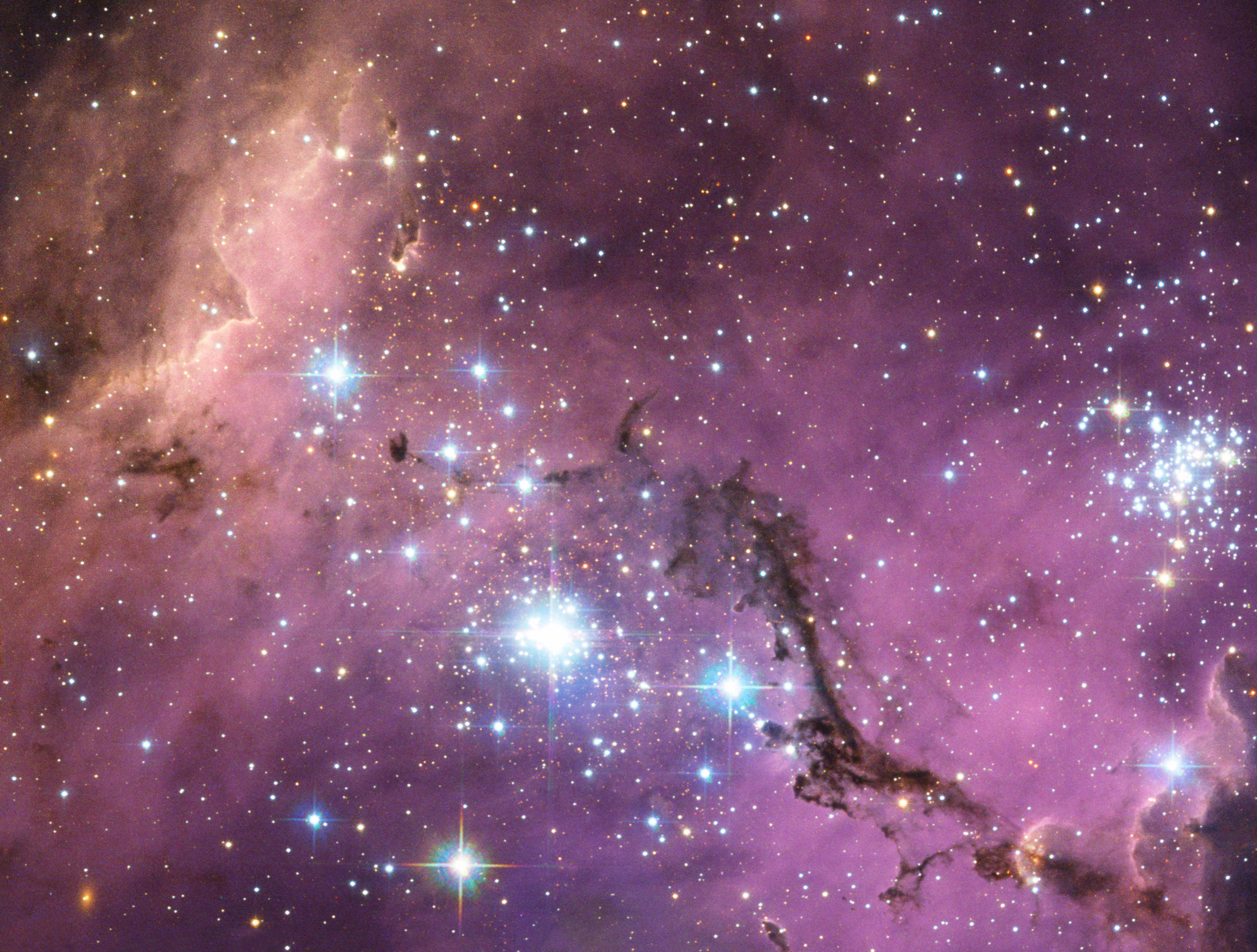
The NASA/European Space Agency Hubble Space Telescope captured the iridescent tapestry of star birth in a neighboring galaxy in this panoramic view of glowing gas, dark dust clouds, and young, hot stars. The star-forming region, catalogued as N11B lies in the Large Magellanic Cloud (LMC), located only 160,000 light-years from Earth. With its high resolution, the Hubble Space Telescope is able to view details of star formation in the LMC as easily as ground-based telescopes are able to observe stellar formation within our own Milky Way galaxy.
Our neighborhood galaxy the Large Magellanic Cloud (LMC) lies in the Constellation of Dorado and is sprinkled with a number of regions harboring recent and ongoing star formation. One of these star-forming regions, N11B, is shown in this Hubble image. It is a subregion within a larger area of star formation called N11. N11 is the second largest star-forming region in LMC. It is only surpassed in the size and activity by "the king of stellar nurseries", 30 Doradus, located at the opposite side of LMC.
Credit: NASA/European Space Agency (ESA) and the Hubble Heritage Team (AURA/STScI/HEIC)
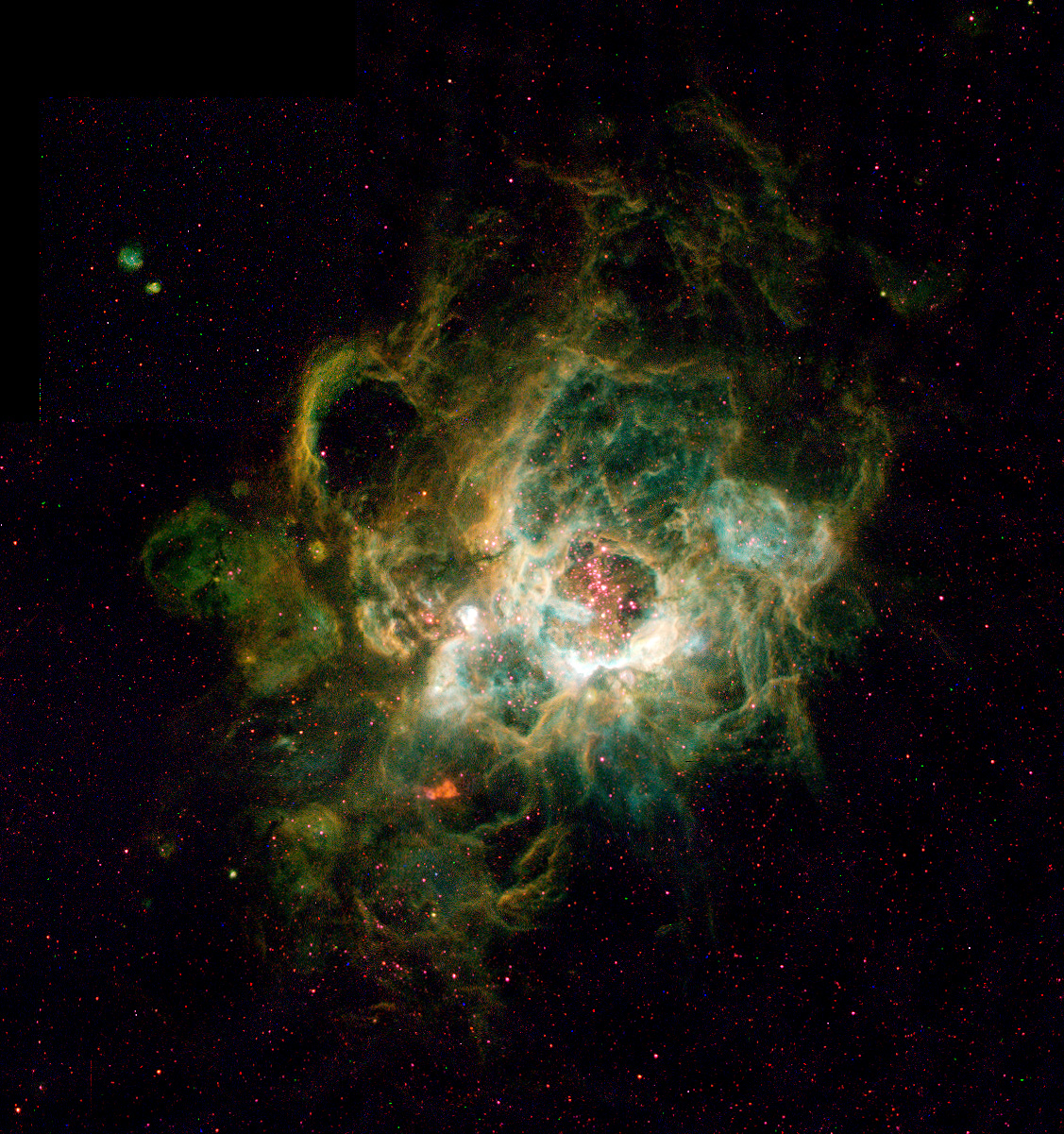
This is a Hubble Space Telescope image (right) of a vast nebula called NGC 604, which lies in the neighboring spiral galaxy Messier 33, located 2.7 million light-years away in the constellation Triangulum. It was discovered by German-born British astronomer and composer William Herschel on September 11, 1784.
Distance:~3 million light years
Credit: Hui Yang (University of Illinois) and NASA/European Space Agency (ESA)
Orbital Sunrise over Pacific Ocean | International Space Station
An orbital sunrise begins to illuminate the cloud tops in this photograph from the International Space Station as it orbited 258 miles above the Pacific Ocean south of the Hawaiian island chain.
Expedition 67 Crew
Commander Oleg Artemyev (Russia)
Roscosmos Flight Engineers: Denis Matveev and Sergey Korsakov (Russia)
NASA Flight Engineers: Kjell Lindgren, Bob Hines, Jessica Watkins (USA)
European Space Agency (ESA) Flight Engineer: Samantha Cristoforetti (Italy)
An international partnership of space agencies provides and operates the elements of the International Space Station (ISS). The principals are the space agencies of the United States, Russia, Europe, Japan, and Canada. The ISS has been the most politically complex space exploration program ever undertaken.
Planet Saturn: The Farewell | NASA Cassini Mission
The Cassini spacecraft ended its mission on Sept. 15, 2017. Cassini's end involved a series of close Saturn passes, approaching within the rings, then an entry into Saturn's atmosphere to destroy the spacecraft. This method was chosen because it is necessary to ensure protection and prevent biological contamination to any of the moons of Saturn thought to offer potential habitability.
The Cassini-Huygens mission was a cooperative project of NASA, the European Space Agency and the Italian Space Agency. The Jet Propulsion Laboratory, a division of the California Institute of Technology in Pasadena, California, managed the mission for NASA's Science Mission Directorate, Washington, D.C. The Cassini orbiter and its two onboard cameras were designed, developed and assembled at JPL. The imaging operations center was based at the Space Science Institute in Boulder, Colorado.
Image Credit: NASA/JPL-Caltech
Image Processing: Elisabetta Bonora & Marco Faccin
Star Formation Region LHA 120-N11 in The Large Magellanic Cloud | Hubble
Nearly 200,000 light-years from Earth, the Large Magellanic Cloud, a satellite galaxy of the Milky Way, floats in space, in a long and slow dance around our galaxy. As the Milky Way’s gravity gently tugs on its neighbor’s gas clouds, they collapse to form new stars. In turn, these light up the gas clouds in a kaleidoscope of colors, visible in this image from the NASA/European Space Agency Hubble Space Telescope.
Commemorating an Historic Event for Human Spaceflight | This Week @NASA
Week of September 16, 2022: Commemorating an historic event for human spaceflight, an update on plans for Artemis I, and what our Perseverance rover is up to on Mars . . . a few of the stories to tell you about—This Week at NASA!
Bubbles & Baby Stars in The Large Magellanic Cloud: A Closer Look| Hubble
This Hubblecast features a spectacular NASA/European Space Agency Hubble Space Telescope image—one of the largest ever released of a star-forming region. It highlights N11, part of a complex network of gas clouds and star clusters within our neighboring galaxy, the Large Magellanic Cloud. This region of energetic star formation is one of the most active in the nearby Universe.
Distance:170,000 light years
Credit: European Space Agency (ESA)/Hubble
Visual design & Editing: Martin Kornmesser
Animations: Martin Kornmesser
Web Technical Support: Lars Holm Nielsen & Raquel Yumi Shida
Written by: Richard Hook, Colleen Sharkey & Eric Schwartz


.jpg)

.jpg)
2di7%20&%20titanio44.jpg)