Friends of NASA (FoN) is an independent non-governmental organization (NGO) dedicated to building international support for peaceful space exploration, commerce, scientific discovery, and STEM education.
Panning across the Filaments of Galaxy NGC 1275 | Hubble
The red filaments seen near the center are fine threads of gas up to 20,000 light-years long, but only 200 light-years wide. They are sustained by magnetic fields, with the thinner threads requiring more support.
Distance: about 250 million light-years
Credit: European Space Agency (ESA)/Hubble (M. Kornmesser & L. L. Christensen)
The Perseus Cluster is found within the northern hemisphere constellation of Perseus, the Hero. NGC 1275 is situated near the center, approximately 250 million light-years from the Earth.
Credit: European Space Agency (ESA)/Hubble (M. Kornmesser & L. L. Christensen), Digitized Sky Survey 2, A. Fujii
This stunning image of NGC 1275 was taken using the NASA/European Space Agency Hubble Space Telescope's Advanced Camera for Surveys in July and August 2006. It provides amazing detail and resolution of the fragile filamentary structures, which show up as a reddish lacy structure surrounding the central bright galaxy NGC 1275. These filaments are cool despite being surrounded by gas that is around 55 million degrees Celsius hot. They are suspended in a magnetic field which maintains their structure and demonstrates how energy from the central black hole is transferred to the surrounding gas.
Distance:250 million light years
By observing the filamentary structure, astronomers were, for the first time, able to estimate the magnetic field's strength. Using this information they demonstrated how the extragalactic magnetic fields have maintained the structure of the filaments against collapse caused by either gravitational forces or the violence of the surrounding cluster during their 100-million-year lifetime.
This is the first time astronomers have been able to differentiate the individual threads making up such filaments to this degree. Astonishingly, they distinguished threads a mere 200 light-years across. By contrast, the filaments seen here can be a gaping 200,000 light-years long. The entire image is approximately 260,000 light-years across.
Also seen in the image are impressive lanes of dust from a separate spiral galaxy. It lies partly in front of the giant elliptical central cluster galaxy and has been completed disrupted by the tidal gravitational forces within the galaxy cluster. Several striking filaments of blue newborn stars are seen crossing the image.
Credit: NASA, European Space Agency (ESA) and Andy Fabian (University of Cambridge, UK)
Hubble's variable nebula is named (like the Hubble telescope itself) after the American astronomer Edwin P. Hubble, who carried out some of the early studies of this object. It is a fan-shaped cloud of gas and dust which is illuminated by R Monocerotis (R Mon), the bright star at the bottom end of the nebula. Dense condensations of dust near the star cast shadows out into the nebula, and as they move the illumination changes, giving rise to the variations first noted by Hubble.
The star itself, lying about 2,500 light-years from Earth, cannot be seen directly, but only through light scattered off of dust particles in the surrounding nebula. R Mon is believed to have a mass of about 10 times that of the Sun, and to have an age of only 300,000 years. There is probably a symmetrical counterpart of the fan-shaped nebula on the southern side of the star, but it is heavily obscured from view by dust lying between this lobe and our line of sight.
Distance:2,500 light years
The Hubble Heritage team made this image from observations of R Mon acquired by William Sparks (STScI), Sylvia Baggett (STScI) and collaborators.
Credit: NASA/European Space Agency (ESA) and The Hubble Heritage Team (AURA/STScI)
The World’s First-Ever Planetary Defense Test | This Week @NASA
Week of September 30, 2022: The world’s first-ever planetary defense test is a big hit, a major hurricane spotted from space, and moving our mega Moon rocket back inside ahead of that storm . . . a few of the stories to tell you about–This Week at NASA!
Credit: National Aeronautics and Space Administration (NASA)
Explore our Home Planet and The Universe with NASA Podcasts
Listen up! From long form interviews with astronauts and engineers to narrative shows that take you on a tour of the galaxy, NASA podcasts let you experience the thrill of space exploration without ever leaving Earth
What's Up: October 2022 | Skywatching Tips from NASA
What are some skywatching highlights in the northern hemisphere for October 2022?
Enjoy giant planets Jupiter and Saturn all night throughout the month. Then watch as Mars begins its retrograde motion, moving westward each night instead of eastward, for the next few months. Finally, check out the Orionid meteors overnight on Oct. 20, 2022.
This fulldome video is of an emission nebula in the star-forming region Sh 2-106, found in the constellation Cygnus. A massive young star at the center of the scene is responsible, in its tempestuous youth, for the wonderful, bipolar structure of dust and gas.
Distance:3,300 light years
Note: The full dome video display format is designed for projection systems in planetariums.
This video pans over star-forming region Sh 2-106, or S106 for short. This is a compact star forming region in the constellation Cygnus (The Swan). A newly-formed star called S106 IR is shrouded in dust at the center of the image, and is responsible for the the surrounding gas cloud’s hourglass-like shape and the turbulence visible within. Light from glowing hydrogen is colored blue in this image.
Distance:3,300 light years
Credit: NASA, European Space Agency (ESA) and the Hubble Heritage Team (STScI/AURA)
This video zooms in on star-forming region Sh 2-106, also known as S106. This is a compact star forming region in the constellation Cygnus (The Swan). A newly-formed star called S106 IR is shrouded in dust at the center of the image, and is responsible for the the surrounding gas cloud's hourglass-like shape and the turbulence visible within.
Distance:3,300 light years
Credit: NASA, European Space Agency (ESA), Digitized Sky Survey 2, National Astronomical Observatory of Japan (NAOJ) and Nick Risinger
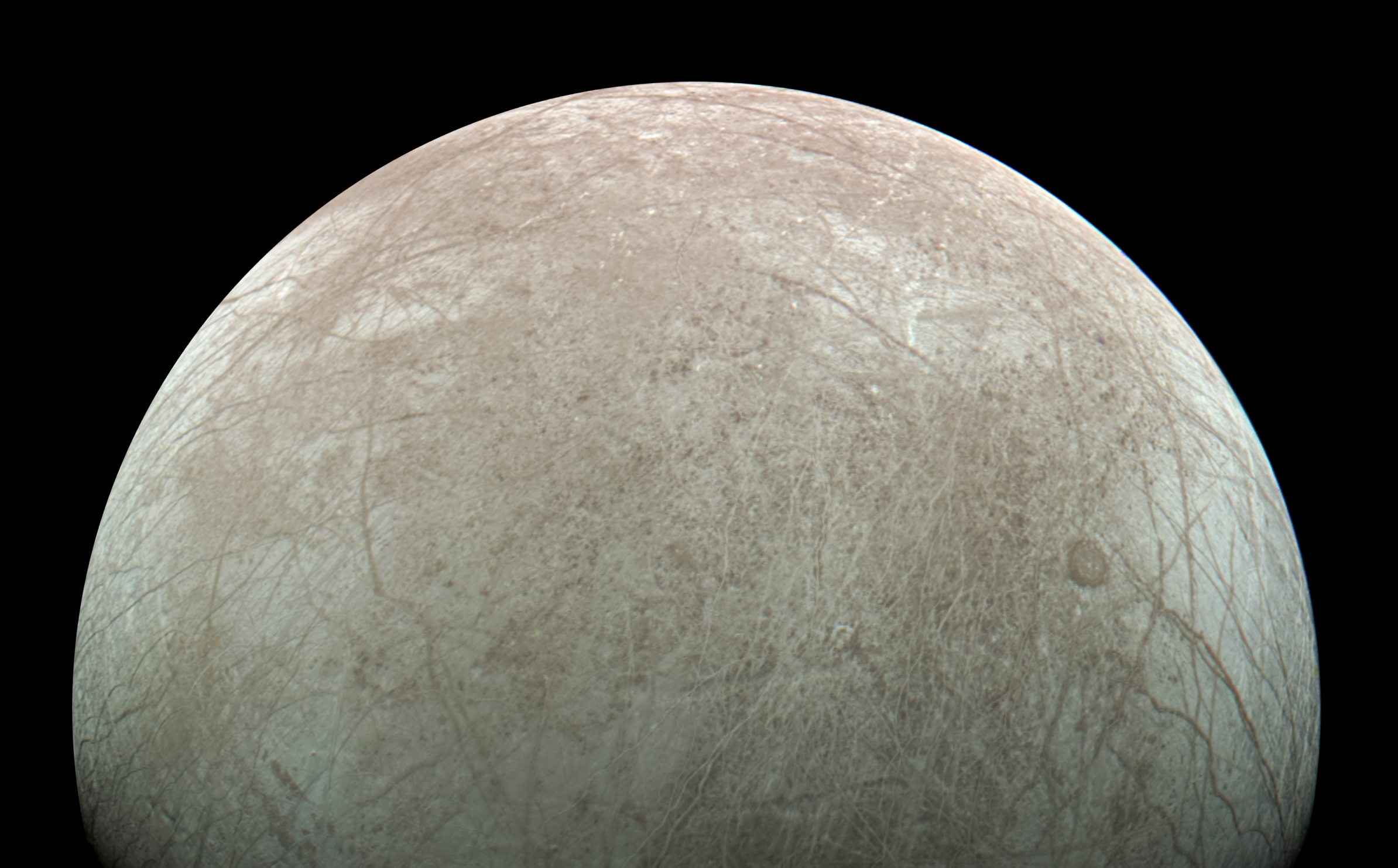
New Views of Jupiter's Icy Ocean Moon Europa | NASA's Juno Mission
Europa - PJ45-1
Europa - PJ45-2
Europa - PJ45-3
Europa - PJ45-4
Europa - PJ45-2/3/4 - Composite
Observations from the Juno spacecraft’s passes of Juputer's moon Europa have provided new views of this ocean world, resulting in remarkable imagery and unique science. Jupiter’s moon Europa has an icy crust covering a vast, global ocean.
NASA’s Jet Propulsion Laboratory, a division of Caltech in Pasadena, California, manages the Juno mission for the principal investigator, Scott J. Bolton, of the Southwest Research Institute in San Antonio. Juno is part of NASA’s New Frontiers Program, which is managed at NASA’s Marshall Space Flight Center in Huntsville, Alabama, for the agency’s Science Mission Directorate in Washington. Lockheed Martin Space in Denver built and operates the spacecraft.
This image from the NASA/European Space Agency Hubble Space Telescope shows Sh 2-106, or S106 for short. This is a compact star forming region in the constellation Cygnus (The Swan). A newly-formed star called S106 IR is shrouded in dust at the center of the image, and is responsible for the surrounding gas cloud’s hourglass-like shape and the turbulence visible within. Light from glowing hydrogen is colored blue in this image.
NASA's Space to Ground: Samantha Assumes Command | Week of Sept. 30, 2022
Week of September 30, 2022: NASA's Space to Ground is your weekly update on what's happening aboard the International Space Station. European Space Agency (ESA) astronaut Samantha Cristoforetti of Italy is the new Commander of the International Space Station. “Cristoforetti will lead the new Expedition 68 crew until she and three of her SpaceX Crew Dragon Freedom crewmates depart the space station in October.”
Roscosmos cosmonauts Oleg Artemyev, Denis Matveev, and Sergey Korsakov of Russia landed on Earth, Thursday, Sept. 29, 2022, in Kazakhstan. The trio returned after 195 days in space that spanned 3,120 orbits of Earth and over 78 million miles.
During the mission, Artemyev completed five spacewalks totaling 33 hours, 12 minutes. He has now logged 561 days in space on his three flights.
Matveev completed four spacewalks totaling 26 hours, 7 minutes during the mission. He logged 195 days in space on his first flight.
Korsakov also logged 195 days in space on his first flight.
Remaining aboard the station is the seven-person crew of Expedition 66 with Station Commander Samantha Cristoforetti of the European Space Agency (ESA), NASA astronauts Bob Hines, Kjell Lindgren, Frank Rubio, and Jessica Watkins, and Roscosmos cosmonauts Sergey Prokopyev and Dmitri Petelin.
In October, NASA’s SpaceX Crew-5 members—NASA astronauts Nicole Mann and Josh Cassada, Japan Aerospace Exploration Agency (JAXA) astronaut Koichi Wakata, and Roscosmos cosmonaut Anna Kikina—will join the Expedition 68 members aboard the station. Crew-5 will be the fifth crew rotation mission of SpaceX’s human space transportation system, and its sixth flight with astronauts, to the International Space Station for NASA’s Commercial Crew Program.
An international partnership of space agencies provides and operates the elements of the International Space Station (ISS). The principals are the space agencies of the United States, Russia, Europe, Japan, and Canada. The ISS has been the most politically complex space exploration program ever undertaken.
Learn more about the important research being operated on Station:
Moon Rocks: Meet NASA’s Rock Detectives | NASA Explorers
Meet NASA’s rock detectives. Using tiny samples of lunar rock brought back by Apollo astronauts, these NASA Explorers are looking into the origins of our Moon, our planet, and ourselves. They might be among the first scientists to study samples from the Moon’s South Pole that will be delivered to Earth by Artemis astronauts.
In episode 2 of “NASA Explorers: Artemis Generation,” we’re joining scientists like Natalie Curran and Jose Aponte, who are looking at clues buried in Moon rocks.
Credit: NASA
Series Executive Producers: Katy Mersmann/Lauren Ward
Season Producers: Lonnie Shekhtman/Stephanie Sipila/James Tralie/Molly Wasser
Some of the most stunning views of our sky occur at sunset, when sunlight pierces the clouds, creating a mixture of bright and dark rays formed by the clouds’ shadows and the beams of light scattered by the atmosphere. Astronomers studying the nearby galaxy IC 5063 are tantalized by a similar effect in this image from the NASA/European Space Agency Hubble Space Telescope. In this case, a collection of narrow bright rays and dark shadows is seen beaming out of the blazingly bright center of the active galaxy, shooting across at least 36,000 light-years.
Astronomers have traced the rays back to the galaxy’s core, the location of an active supermassive black hole. The black hole is feeding on infalling material, producing a powerful gusher of light from superheated gas near it. Although the researchers have developed several plausible theories for the lightshow, the most intriguing idea suggests that the shadows are being cast into space by an inner tube-shaped ring, or torus, of dusty material surrounding the black hole.
IC 5063 resides 156 million light-years from Earth.
Credit: NASA, European Space Agency (ESA), and W.P. Maksym (CfA) Release Date: November 23, 2020