Thursday, October 27, 2022

Chasing Sprites in Electric Skies | NASA Goddard

Chasing Sprites in Electric Skies | NASA Goddard

Paul Smith is a night-sky fanatic and photographer. His obsession is sprites: immense jolts of light that flicker high above thunderstorms. Last October, he guided NASA scientist Dr. Burcu Kosar through the backroads of Oklahoma to catch one herself. Although she had studied sprites for more than 15 years, she had not yet chased one.


Read more about chasing sprites with Paul and Burcu: https://blogs.nasa.gov/sunspot/2022/10/27/the-great-sprites-chase/


Learn about NASA’s citizen science project Spritacular: https://www.nasa.gov/feature/goddard/2022/sun/spritacular-nasa-s-new-citizen-science-project-to-capture-elusive-upper-atmospheric


Learn about the Heliophysics Big Year: https://solarsystem.nasa.gov/solar-system/sun/helio-big-year/


Credit: NASA's Goddard Space Flight Center

Producer: Joy Ng (KBRwyle)

Scientist: Burcu Kosar (Catholic University of America)

Photographer: Paul Smith 

Photographer: Frankie Lucena

Photographer: Panagiotis Tsouras

Photographer: Thomas Ashcroft

Videographer: Joy Ng, Thomas Smith

Writer: Lina Tran

Image Credits: Paul Smith, Frankie Lucena, Panagiotis Tsouras, Thomas Ashcraft. 

All imagery of sprites is copyrighted and used with permission.

Duration: 8 minutes

Release Date: Oct. 27, 2022


#NASA #Earth #Science #EarthScience #Atmosphere #Physics #AtmosphericPhysics #Weather #Meteorology #Lightning #LightningStorms #Thunderstorms #Sprites #GSFC #Oklahoma #UnitedStates #CitizenScience #Photography #Art #STEM #Education #HD #Video

Sound of Biggest Martian Meteoroid Impact Ever Recorded | NASA Insight Mission

Sound of Biggest Martian Meteoroid Impact Ever Recorded | NASA Insight Mission

This video includes a seismogram and sonification of the signals recorded by NASA’s InSight Mars lander, which detected a giant meteoroid strike on Dec. 24, 2021, the 1,094th Martian day, or sol, of the mission. 

InSight’s seismometer records seismic signals that are not in the range of human hearing. In order to make the signals audible, the data was sped up 100 times.

Figure A is a standalone audio file of the sonification of the signals.

NASA’s Jet Propulsion Laboratory manages InSight for the agency’s Science Mission Directorate. 

InSight is part of NASA’s Discovery Program, managed by the agency’s Marshall Space Flight Center in Huntsville, Alabama. Lockheed Martin Space in Denver built the InSight spacecraft, including its cruise stage and lander, and supports spacecraft operations for the mission.

A number of European partners, including France’s Centre National d’Études Spatiales (CNES) and the German Aerospace Center (DLR), are supporting the InSight mission. CNES provided the Seismic Experiment for Interior Structure (SEIS) instrument to NASA, with the principal investigator at IPGP (Institut de Physique du Globe de Paris). Significant contributions for SEIS came from IPGP; the Max Planck Institute for Solar System Research (MPS) in Germany; the Swiss Federal Institute of Technology (ETH Zurich) in Switzerland; Imperial College London and Oxford University in the United Kingdom; and JPL. DLR provided the Heat Flow and Physical Properties Package (HP3) instrument, with significant contributions from the Space Research Center (CBK) of the Polish Academy of Sciences and Astronika in Poland. Spain’s Centro de Astrobiología (CAB) supplied the temperature and wind sensors.


Credit: NASA/JPL-Caltech/CNES/Imperial College London

Duration: 57 seconds

Release Date: Oct. 27, 2022


#NASA #Astronomy #Space #Science #Mars #Planet #RedPlanet #InSightLander #Marsquake #Meteor #MeteoroidImpact #AmazonisPlanitia #Geoscience #Geology #Sound #Audio #SolarSystem #Exploration #DLR #Deutschland #CNES #France #JPL #Caltech #UnitedStates #STEM #Education #HD #Video

Flyover: Mars Meteoroid Impact Crater—Orbital View (animation) | NASA MRO

Flyover: Mars Meteoroid Impact CraterOrbital View (animation) | NASA MRO

This animation depicts a flyover of a meteoroid impact crater on Mars that’s surrounded by boulder-size chunks of ice. The animation was created using data from the High-Resolution Imaging Science Experiment (HiRISE) camera aboard NASA’s Mars Reconnaissance Orbiter. The impact occurred on Dec. 24, 2021.

The meteoroid is estimated to have spanned 16 to 39 feet (5 to 12 meters)—small enough that it would have burned up in Earth’s atmosphere, but not in Mars’ thin atmosphere, which is just 1% as dense as our planet’s. The impact, in a region called Amazonis Planitia, blasted a crater roughly 492 feet (150 meters) across and 70 feet (21 meters) deep. Some of the ejecta thrown by the impact flew as far as 23 miles (37 kilometers) away.

Subsurface ice will be a vital resource for astronauts, who could use it for a variety of needs, including drinking water, agriculture, and rocket propellant. Buried ice has never been spotted this close to the Martian equator, which, as the warmest part of Mars, is an appealing location for astronauts.

The University of Arizona, in Tucson, operates HiRISE, which was built by Ball Aerospace & Technologies Corp., in Boulder, Colorado. NASA’s Jet Propulsion Laboratory, a division of Caltech in Pasadena, California, manages the Mars Reconnaissance Orbiter Project for NASA's Science Mission Directorate in Washington.


Credit: NASA/JPL-Caltech/University of Arizona

Duration: 36 seconds

Release Date: October 27, 2022


#NASA #Astronomy #Space #Science #Mars #Planet #RedPlanet #InSightLander #MRO #Spacecraft #HiRISE #Marsquake #Meteor #MeteoroidImpact #AmazonisPlanitia #Geoscience #Geology #SolarSystem #Exploration #DLR #Deutschland #CNES #France #JPL #Caltech #UniversityofArizona #UnitedStates #STEM #Education #Animation #HD #Video

NASA’s Mars InSight Lander Detects Biggest Meteoroid Impact Ever Recorded | JPL

NASA’s Mars InSight Lander Detects Biggest Meteoroid Impact Ever Recorded | JPL


Image Description: Boulder-size blocks of water ice can be seen around the rim of an impact crater on Mars, as viewed by the High-Resolution Imaging Science Experiment (HiRISE camera) aboard NASA’s Mars Reconnaissance Orbiter (MRO). The crater was formed Dec. 24, 2021, by a meteoroid strike in the Amazonis Planitia region. The agency’s InSight lander felt the ground shake during the impact while cameras aboard the Mars Reconnaissance Orbiter spotted the yawning new crater from space.

NASA’s InSight lander recorded a magnitude 4 marsquake last Dec. 24, 2021, but scientists learned only later the cause of that quake: a meteoroid strike estimated to be one of the biggest seen on Mars since NASA began exploring the cosmos. What’s more, the meteoroid excavated boulder-size chunks of ice buried closer to the Martian equator than ever found before—a discovery with implications for NASA’s future plans to send astronauts to the Red Planet.

Scientists determined the quake resulted from a meteoroid impact when they looked at before-and-after images from NASA’s Mars Reconnaissance Orbiter (MRO) and spotted a new, yawning crater. Offering a rare opportunity to see how a large impact shook the ground on Mars, the event and its effects are detailed in two papers published Thursday, Oct. 27, in the journal Science.

The meteoroid is estimated to have spanned 16 to 39 feet (5 to 12 meters)—small enough that it would have burned up in Earth’s atmosphere, but not in Mars’ thin atmosphere, which is just 1% as dense as our planet’s. The impact, in a region called Amazonis Planitia, blasted a crater roughly 492 feet (150 meters) across and 70 feet (21 meters) deep. Some of the ejecta thrown by the impact flew as far as 23 miles (37 kilometers) away.

With images and seismic data documenting the event, this is believed to be one of the largest craters ever witnessed forming any place in the solar system. Many larger craters exist on the Red Planet, but they are significantly older and predate any Mars mission.

“It’s unprecedented to find a fresh impact of this size,” said Ingrid Daubar of Brown University, who leads InSight’s Impact Science Working Group. “It’s an exciting moment in geologic history, and we got to witness it.”

InSight has seen its power drastically decline in recent months due to dust settling on its solar panels. The spacecraft now is expected to shut down within the next six weeks, bringing the mission’s science to an end.

InSight is studying the planet’s crust, mantle, and core. Seismic waves are key to the mission and have revealed the size, depth, and composition of Mars’ inner layers. Since landing in November 2018, InSight has detected 1,318 marsquakes, including several caused by smaller meteoroid impacts.

However, the quake resulting from last December’s impact was the first observed to have surface waves —a kind of seismic wave that ripples along the top of a planet’s crust. The second of the two Science papers related to the big impact describes how scientists use these waves to study the structure of Mars’ crust.

Crater Hunters

In late 2021, InSight scientists reported to the rest of the team they had detected a major marsquake on Dec. 24. The crater was first spotted on Feb. 11, 2022, by scientists working at Malin Space Science Systems (MSSS), which built and operates two cameras aboard MRO. The Context Camera (CTX) provides black-and-white, medium-resolution images, while the Mars Color Imager (MARCI) produces daily maps of the entire planet, allowing scientists to track large-scale weather changes like the recent regional dust storm that further diminished InSight’s solar power.

The impact’s blast zone was visible in MARCI data that allowed the team to pin down a 24-hour period within which the impact occurred. These observations correlated with the seismic epicenter, conclusively demonstrating that a meteoroid impact caused the large Dec. 24 marsquake.

“The image of the impact was unlike any I had seen before, with the massive crater, the exposed ice, and the dramatic blast zone preserved in the Martian dust,” said Liliya Posiolova, who leads the Orbital Science and Operations Group at MSSS. “I couldn’t help but imagine what it must have been like to witness the impact, the atmospheric blast, and debris ejected miles downrange.”

Establishing the rate at which craters appear on Mars is critical for refining the planet’s geologic timeline. On older surfaces, such as those of Mars and our Moon, there are more craters than on Earth; on our planet, the processes of erosion and plate tectonics erase older features from the surface.

New craters also expose materials below the surface. In this case, large chunks of ice scattered by the impact were viewed by MRO’s High-Resolution Imaging Science Experiment (HiRISE) color camera.

Subsurface ice will be a vital resource for astronauts, who could use it for a variety of needs, including drinking water, agriculture, and rocket propellant. Buried ice has never been spotted this close to the Martian equator, which, as the warmest part of Mars, is an appealing location for astronauts.

More About the Missions

JPL manages InSight and the Mars Reconnaissance Orbiter for NASA’s Science Mission Directorate. InSight is part of NASA’s Discovery Program, managed by the agency’s Marshall Space Flight Center in Huntsville, Alabama. Lockheed Martin Space in Denver built the Mars Reconnaissance Orbiter, InSight spacecraft (including its cruise stage and lander), and supports spacecraft operations for both missions.


Credit: NASA/JPL-Caltech/University of Arizona

Release Date: Oct. 27, 2022


#NASA #Astronomy #Space #Science #Mars #Planet #RedPlanet #InSightLander #MRO #Spacecraft #HiRISE #Marsquake #Meteor #MeteoroidImpact #AmazonisPlanitia #Geoscience #Geology #Sound #Audio #SolarSystem #Exploration #DLR #Deutschland #CNES #France #JPL #Caltech #UnitedStates #STEM #Education

NASA's Mars Curiosity & Perseverance Rovers: New October 2022 Images | JPL

NASA's Mars Curiosity & Perseverance Rovers: New October 2022 Images | JPL

MSL - sol 3633 - MAHLI

Mars2020 - sol 594 - Watson

Mars2020 - sol 594 - Watson

MSL - sol 3631 - Mastcam

Mars2020 - sol 596 - Mastcam-Z

MSL - MastCam - sol 3626 - Image B

MSL - MastCam - sol 3626 - Image A

Celebrating 10 Years on Mars! (2012-2022)

Mission Name: Mars Science Laboratory (MSL)

Rover Name: Curiosity

Main Job: To determine if Mars was ever habitable to microbial life. 

Launch: Nov. 6, 2011

Landing Date: Aug. 5, 2012, Gale Crater, Mars


Mission Name: Mars 2020

Rover Name: Perseverance

Main Job: Seek signs of ancient life and collect samples of rock and regolith (broken rock and soil) for possible return to Earth.

Launch: July 30, 2020    

Landing: Feb. 18, 2021, Jezero Crater, Mars


For more information on NASA's Mars missions, visit: mars.nasa.gov


Image Credits: NASA/JPL-Caltech/ASU/MSSS/Kevin M. Gill/PipploIMP

Image Release Dates: Oct. 18-26, 2022


#NASA #Space #Astronomy #Science #Mars #RedPlanet #Planet #Astrobiology #Geology #CuriosityRover #MSL #MountSharp #GaleCrater #PerseveranceRover #Mars2020 #JezeroCrater #Robotics #Technology #Engineering #JPL #California #UnitedStates #JourneyToMars #CitizenScience #STEM #Education

First-ever Close-up High-res Views of Our Sun | ESA/NASA Solar Orbiter

First-ever Close-up High-res View of Our Sun | ESA/NASA Solar Orbiter

[Look carefully for detailed changes of motion.] The European Space Agency-led Solar Orbiter mission has experienced its second close encounter with the Sun. It is delivering more stunning data, and at higher resolution than ever before. The moment of closest approach took place on October 12, 2022, at 19:12 UTC (21:12 CEST), when Solar Orbiter was just 29% of the Earth’s distance from the Sun. This movie comes from October 13, when the spacecraft’s Extreme Ultraviolet Imager (EUI) returned the highest resolution movie of the quiet corona ever taken with any instrument.

Each pixel on this movie spans 105 km on the surface of the Sun. This means that if EUI were to look at the Earth from this distance, our entire planet would span just 120 pixels across. The movie itself contains 2048 across, meaning that 17 Earths would fit side by side across this image.

The corona is the Sun’s outer atmosphere. It is termed quiet when there is little appreciable solar activity such as flares or coronal mass ejections. This movie, and others taken during the encounter, show the dynamic nature of the Sun's million degree-hot corona. The electrically charged gas here, known as plasma, is in constant motion, guided and accelerated by changes of the Sun's magnetic field. The arches of bright plasma in the movie are being held in place by loops of magnetism that burst up into the corona from the Sun’s interior.

The Sun is currently ramping up for a peak in its activity levels, known as solar maximum, in 2025. So views of a quiet corona are likely to become rarer in the coming few years.

The Sun launches a solar wind of particles that streams out through the Solar System. It originates in the corona but the precise mechanism by which this happens is poorly understood. Investigating this phenomenon is a key focus for solar physicists, and one of Solar Orbiter’s main scientific objectives.

This particular encounter benefited from Solar Orbiter rapidly flying in the direction of Earth. This allowed much more data to be downlinked. It also allowed for coordinated observations of solar features to be made with Earth-based telescopes, from October 21 onwards.

“I am very much looking forward to data from all ten instruments being downloaded during the next few weeks, and then the world-wide science community will be very busy discovering new things using this unique data set,” says Daniel Müller, ESA Project Scientist for Solar Orbiter.

Solar Orbiter is a space mission of international collaboration between the European Space Agency (ESA) and NASA, operated by ESA.

This movie was enhanced with Wavelet Optimized Whitening technique.


Credit: ESA & NASA/Solar Orbiter/EUI Team; acknowledgement: Frédéric Auchère, IAS

Duration: 1 minute, 27 seconds

Release Date: October 27, 2022


#NASA #ESA #Astronomy #Science #Space #Star #Sun #Corona #Atmosphere #Plasma #Physics #Astrophysics #Heliophysics #Ultraviolet #SolarOrbiter #Satellite #Spacecraft #Earth #Europe #GSFC #UnitedStates #STEM #Education #HD #Video

New Expedition 68 Crew Photos for October 2022 | International Space Station

New Expedition 68 Crew Photos for October 2022 | International Space Station

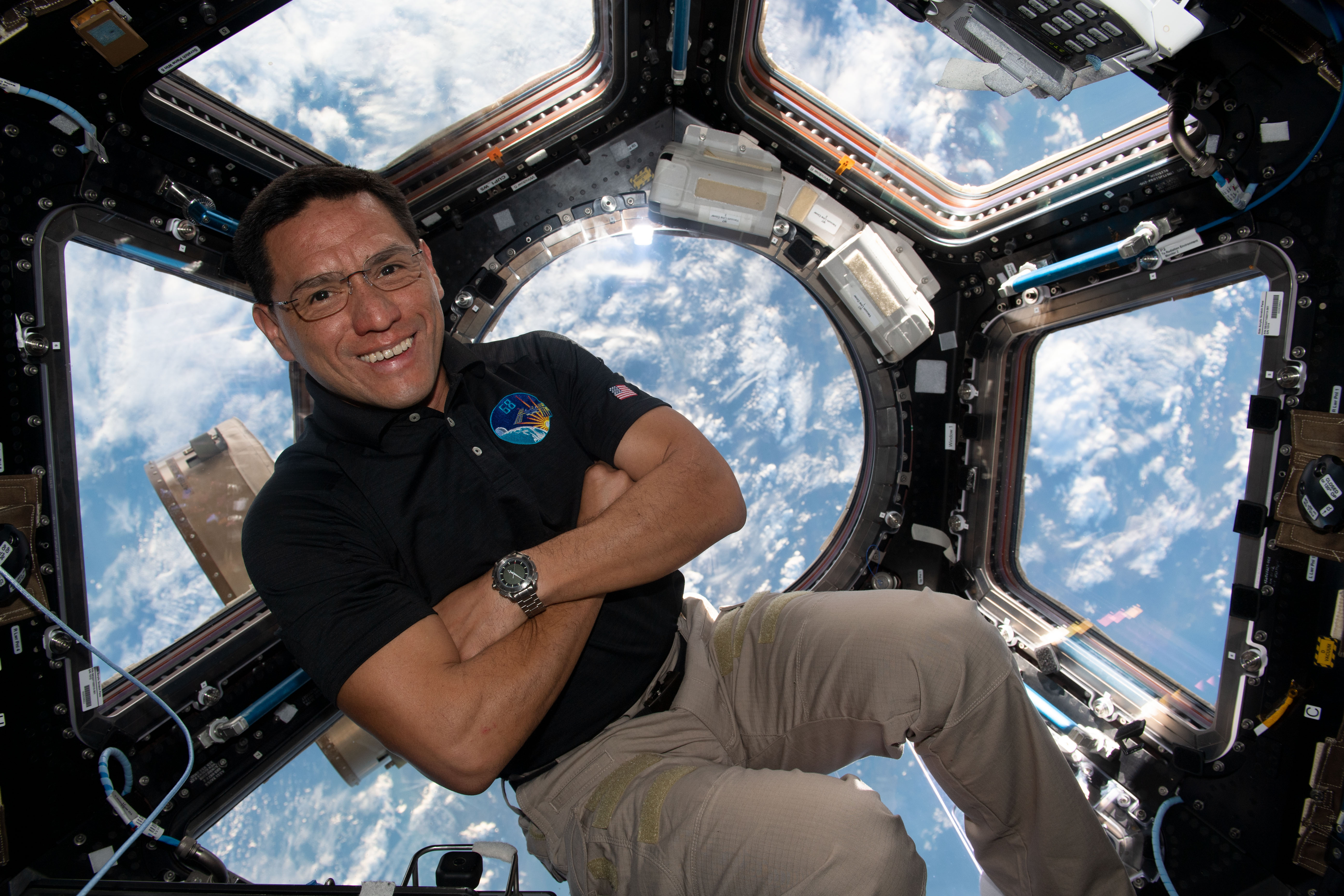
NASA Flight Engineer Frank Rubio inside cupola
NASA Flight Engineer Josh Cassada inside cupola
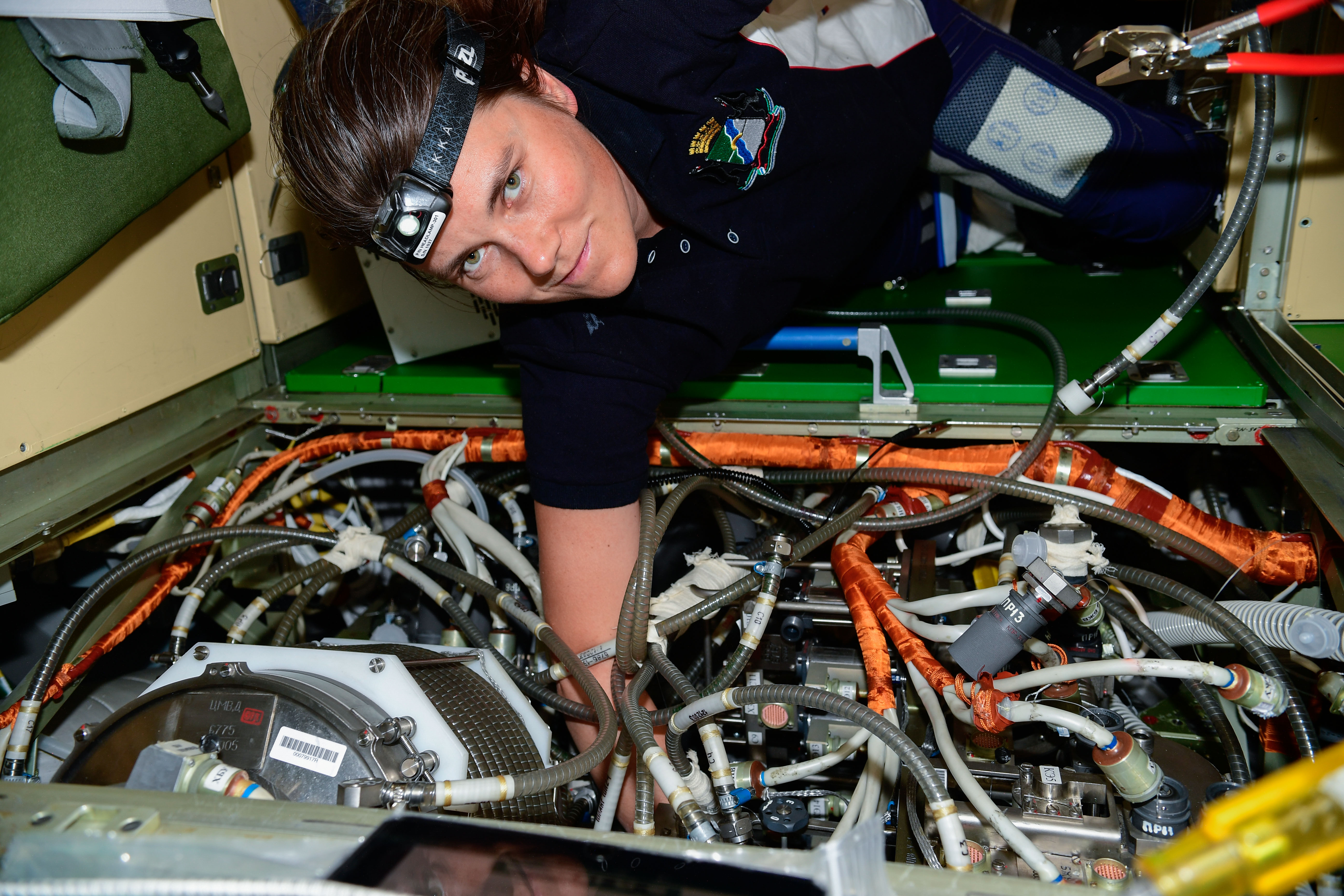
Roscosmos Flight Engineer Anna Kikina (Russia) performing electronics & comms maintenance
JAXA Flight Engineer Koichi Wakata (Japan) giving 'thumbs up'
Station Commander Sergey Prokopyev of Roscosmos (Russia) inside the Zvezda service module 
NASA Flight Engineer Josh Cassada inside Columbus laboratory
Roscosmos Flight Engineer Anna Kikina (Russia) wearing headphones for hearing test
JAXA Flight Engineer Koichi Wakata (Japan) checks out the robotics console 

Expedition 68 Crew
Station Commander Sergey Prokopyev of Roscosmos (Russia)
Roscosmos (Russia): Flight Engineers Anna Kikina & Dmitri Petelin
NASA: Flight Engineers Nicole Mann, Frank Rubio & Josh Cassada
JAXA (Japan): Flight Engineer Koichi Wakata

An international partnership of space agencies provides and operates the elements of the  International Space Station (ISS). The principals are the space agencies of the United States, Russia, Europe, Japan, and Canada. The ISS has been the most politically complex space exploration program ever undertaken.

Learn more about the important research being operated on ISS: https://www.nasa.gov/iss-science 

Credit: NASA's Johnson Space Center (JSC)
Image Dates: October 1-24, 2022

#NASA #Space #ISS #Astronauts #NicoleMann #FrankRubio #JoshCassada #KoichiWakata #JAXA #Japan #日本 #Cosmonauts #SergeyProkopyev #AnnaKikina #DmitriPetelin #Roscosmos #Роскосмос #Russia #Россия #Science #HumanSpaceflight #Expedition68 #JSC #UnitedStates #International #Research #Laboratory #STEM #Education

Wednesday, October 26, 2022

Proba-2 Satellite Captures Two Partial Eclipses | European Space Agency

Proba-2 Satellite Captures Two Partial Eclipses | European Space Agency

European Space Agency’s Proba-2 captured two partial solar eclipses on October 25, 2022. A solar eclipse is caused by the movement of the Moon around Earth. Despite their much different sizes, due to their separation, the Moon appears to be about the same size as the significantly larger Sun in the sky. Occasionally, the Moon passes in front of the Sun, blocking its light, so that part of the Earth’s surface is in the Moon’s shadow. The line-up is not always perfect, and so not every eclipse is a total solar eclipse.

On October 25 only part of the Sun’s light was blocked by the Moon, creating what is known as a partial eclipse. It was visible from most of Europe, North Africa, the Middle East and parts of Asia, with the Moon blocking 82% of the sunlight near the North Pole. In Europe up to 40% of the sunlight was obscured during the event.

This partial eclipse was observed by ESA’s Proba-2 mission from its unique vantage point in space. Its SWAP instrument studies the Sun in the extreme ultraviolet (EUV) light where it focuses on the solar corona—the Sun’s hot turbulent atmosphere—at temperatures of about a million degrees. The corona is seen in the background of this video.

For us on Earth, the Moon passes only once in front of the Sun during a solar eclipse. Since Proba-2 orbits the Earth in about 100 minutes, it was able to observe this eclipse not once but twice.

Additionally, the Moon was first observed while traversing the field of view in the upper right corner, but not blocking any solar light. The first observation of the eclipse around 10:30 UTC (12:30 CEST) was cut short as Proba-2 experienced an occultation. Such an occultation occurs when Proba-2 flies through the Earth’s atmosphere and the SWAP instrument is not active. The second partial eclipse was captured around 12:25 UTC (14:25 CEST). This video shows both eclipses.

The European Space Agency's sun-watching spacecraft monitors the Sun's behavior to better understand the influence of space weather on our home planet. The ESA-led Solar Orbiter mission, in partnership with NASA, is orbiting the Sun from closer than ever before and will provide the first high resolution images of the Sun's poles.

Meanwhile ESA Vigil will be the first mission to keep a constant eye on brewing space weather events, to better protect vital infrastructure on Earth and in orbit.


Credit: European Space Agency (ESA)/ROB

Duration: 38 seconds

Release Date: October 26, 2022


#NASA #ESA #Space #Astronomy #Science #Planet #Earth #Sun #Star #Moon #Shadow #Eclipses #PartialEclipses #ESA #Proba2 #Satellite #Spacecraft #Europe #NorthAfrica #MiddleEast #Asia #STEM #Education #HD #Video

How to Bring Mars Sample Tubes Safely to Earth | NASA/JPL

How to Bring Mars Sample Tubes Safely to Earth | NASA/JPL


Mars News Report: NASA’s Perseverance Mars rover is filling sample tubes with rocky material on the Red Planet as the agency works on the next steps to get them safely back to Earth. 


The Mars Sample Return campaign would bring samples collected by the Perseverance rover to Earth for detailed study. The campaign involves an international interplanetary relay team, including the European Space Agency (ESA). These samples could answer a key question: did life ever exist on Mars? 


Aaron Yazzie, who works on the Mars Sample Return campaign, explains the work being done at NASA’s Jet Propulsion Laboratory to ensure the safe return of the sample tubes.  


For more information on Mars Sample Return, visit: mars.nasa.gov/msr/ 


Credit: NASA/JPL-Caltech

Duration: 3 minutes

Release Date: October 26, 2022


#NASA #Space #Astronomy #Science #Planet #Mars #RedPlanet #PerseveranceRover #JezeroCrater #SearchForLife #MarsSampleReturn #Astrobiology #JetPropulsionLaboratory #JPL #UnitedStates #SolarSystem #Exploration #STEM #Education #HD #Video


Jupiter in Ganymede’s Shadow | NASA's Juno Mission

Jupiter in Ganymede’s Shadow | NASA's Juno Mission


NASA’s Juno spacecraft captured this view of Jupiter during the mission’s 40th close pass by the giant planet on Feb. 25, 2022. The large, dark shadow on the left side of the image was cast by Jupiter’s moon Ganymede.

During its 40th close pass by Jupiter, our Juno spacecraft saw Ganymede cast a large, dark spot on the planet on Feb. 25, 2022.

JunoCam captured this image from very close to Jupiter, making Ganymede’s shadow appear especially large. At the time the raw image was taken, the Juno spacecraft was about 44,000 miles (71,000 kilometers) above Jupiter’s cloud tops and 15 times closer to the planet than Ganymede.

An observer at Jupiter’s cloud tops within the oval shadow would experience a total eclipse of the Sun. Total eclipses are more common on Jupiter than Earth for several reasons: Jupiter has four major moons (Ganymede, Io, Callisto, and Europa) that often pass between Jupiter and the Sun, and since Jupiter’s moons orbit in a plane close to Jupiter’s orbital plane, the moon shadows are often cast upon the planet.

NASA’s Jet Propulsion Laboratory, a division of Caltech in Pasadena, California, manages the Juno mission for the principal investigator, Scott J. Bolton, of the Southwest Research Institute in San Antonio. Juno is part of NASA’s New Frontiers Program, which is managed at NASA’s Marshall Space Flight Center in Huntsville, Alabama, for the agency’s Science Mission Directorate in Washington. Lockheed Martin Space in Denver built and operates the spacecraft.

More information about Juno is available at:

https://www.nasa.gov/juno

and

https://www.missionjuno.swri.edu


Image Credit: Data: NASA/JPL-Caltech/SwRI/MSSS 

Image Processing: Thomas Thomopoulos © CC 

Release Date: October 24, 2022


#NASA #Astronomy #Space #Science #Jupiter #Planet #Ganymede #Shadow #Moon #Juno #Spacecraft #JunoMission #SolarSystem #Exploration #JPL #Caltech #UnitedStates #CitizenScience #ThomasThomopoulos #STEM #Education

Pinwheel Firework: Spiral Galaxy NGC 4254 | ESO

Pinwheel Firework: Spiral Galaxy NGC 4254 | ESO


In this picture, we can see the well-defined arms of spiral galaxy NGC 4254, also known as the Coma Pinwheel or Messier 99. It is called a grand design spiral galaxy because of its distinctive pinwheel shape with prominent arms. Since Charles Messier first observed it in the 18th century, modern technology has allowed us to observe galaxies like this in significantly greater detail.

This image is a composite of data taken with the European Southern Observatory’s Very Large Telescope (VLT) and the Atacama Large Millimeter/submillimeter Array (ALMA), co-owned by ESO. The VLT data, shown in blue and purple tones, was captured with the Multi-Unit Spectroscopic Explorer (MUSE) instrument, mapping the distribution of stars. The ALMA data ––shown here by the red and orange regions–– originates from cold clouds of gas which can eventually collapse into stars. Comparing these two datasets allows for a better understanding of how stars form.

This image was taken as part of the Physics at High Angular resolution in Nearby GalaxieS (PHANGS) survey, which produces high-resolution images of nearby galaxies across all wavelengths of light. This will allow astronomers to learn more about the diverse range of galactic environments found in our Universe.


Credit: European Southern Observatory (ESO)/PHANGS

Release Date: October 24, 2022


#NASA #ESO #Astronomy #Space #Science #Galaxy #NGC4254 #ComaPinwheel #Messier99 #ComaBerenices #Constellation #Cosmos #Universe #Telescope #VLT #MUSE #ALMA #Chile #Europe #STEM #Education

Galaxy Cluster MACS0647 | Webb & Hubble Space Telescope Comparison

Galaxy Cluster MACS0647 | Webb & Hubble Space Telescope Comparison

This animation compares the 2022 James Webb Space Telescope images of galaxy cluster MACS0647 and the very distant galaxy MACS0647-JD with 2012 Hubble Space Telescope images of the same objects. In both the Webb and Hubble pictures, the cluster appears as a sea of galaxies on a black background. Both images are punctuated by a few foreground stars. Unlike the galaxies, the stars are identified by their prominent spikes, which are caused by diffracted light. The animation blinks back and forth between the Webb and Hubble images.

In both the Webb and Hubble views, the massive galaxy cluster MACS0647 is pictured on the left side of the screen. Also in both views, three small boxes outlined in white borders mark the locations of the three images of galaxy MACS0647-JD. These boxes are numbered 1, 2, and 3. If the galaxy cluster were a clock face, Image 1 of MACS0647-JD would be at about the 7 o’clock position, Image 2 would be between the 6 o’clock and 7 o’clock positions, and Image 3 would be at the 11 o’clock position. Also in both the Webb and Hubble images, three boxes, each featuring an image of MACS0647-JD, appear in a column going down the right side of the screen. These images are labeled JD 1, JD 2, and JD 3.

The Webb images reveals far more detail than the corresponding Hubble images. In the MACS0647 galaxy cluster, Webb detects many more galaxies than Hubble. Most notably, the three images of MACS0647-JD from Webb show two, distinct features that are differently colored, with the larger area appearing redder and the smaller one appearing bluer. In comparison, the Hubble images show only a single, pale, red, pixelated dot.

Note: This video depicts data from Webb science in progress, which has not yet been through the peer-review process.

[Video Description: Animation blinks between the James Webb Space Telescope and Hubble Space Telescope images of galaxy cluster MACS0647 and the very distant galaxy MACS0647-JD. In both views, the cluster appears as a sea of galaxies on a black background. In the MACS0647 galaxy cluster, Webb detects many more galaxies than Hubble.]


Credit: NASA, European Space Agency (ESA)/Canadian Space Agency (CSA), and Space Telescope Science Institute (STScI), Alyssa Pagan (STScI)

Duration: 10 seconds

Release Date: October 26, 2022


#NASA #Astronomy #Space #Science #Galaxies #GalaxyCluster #MACS0647 #Galaxy #MACS0647JD #GravitationalLensing #JamesWebb #SpaceTelescope #JWST #Cosmos #Universe #UnfoldTheUniverse #ESA #Europe #CSA #Canada #GSFC #STScI #UnitedStates #STEM #Education #Animation #HD #Video
Never-Before-Seen Details of The Early Universe | James Webb Space Telescope

Never-Before-Seen Details of The Early Universe | James Webb Space Telescope


The massive gravity of galaxy cluster MACS0647 acts as a cosmic lens to bend and magnify light from the more distant MACS0647-JD system. It also triply lensed the JD system, causing its image to appear in three separate locations. These images, which are highlighted with white boxes, are marked JD1, JD2, and JD3. MACS0647-JD has a redshift of about 11, which puts it in the first 400 million years after the Big Bang. The long, diagonal line traversing the image is a diffraction spike from a bright star located just off the frame.

Image Description: A James Webb Space Telescope image of galaxy cluster MACS0647 and the very distant galaxy MACS0647-JD. At left, the cluster appears as a sea of galaxies on a black background and three small boxes outlined in white mark the locations of the three images of galaxy MACS0647-JD. Enlarged images of these boxes appear in a column down the right side of the screen


Credit: NASA, European Space Agency (ESA), Canadian Space Agency (CSA), and Space Telescope Science Institute (STScI), Alyssa Pagan (STScI)

Release Date: October 26, 2022


#NASA #Astronomy #Space #Science #Galaxies #GalaxyCluster #MACS0647 #Galaxy #MACS0647JD #GravitationalLensing #JamesWebb #SpaceTelescope #JWST #Cosmos #Universe #UnfoldTheUniverse #ESA #Europe #CSA #Canada #GSFC #STScI #UnitedStates #STEM #Education

How Do Spacecraft Slow Down? We Asked a NASA Technologist

How Do Spacecraft Slow Down? We Asked a NASA Technologist

How do spacecraft slow down? Rigid heat shields and retropropulsion have been the favorites of engineers for years. Now NASA is testing a new inflatable heat shield technology that could allow us to carry even larger payloads to worlds with atmospheres called Low-Earth Orbit Flight Test of an Inflatable Decelerator (LOFTID): https://www.nasa.gov/loftid

Launching on Nov. 1 aboard a United Launch Alliance Atlas V rocket along with NOAA’s JPSS-2 mission, the Low-Earth Orbit Flight Test of an Inflatable Decelerator, or LOFTID, will demonstrate the heat shield’s ability to slow down and survive atmospheric entry: https://go.nasa.gov/3N7yzBG


Credit: National Aeronautics and Space Administration (NASA)

Producers: Scott Bednar, Jessica Wilde

Editor: Daniel Salazar

Duration: 1 minute, 47 seconds

Release Date: October 26, 2022


#NASA #Space #Science #Technology #Engineering #Spacecraft #Propulsion #HeatShields #LOFTID #Planets #Mars #Atmospheres #SolarSystem #Exploration #UnitedStates #STEM #Education #HD #Video
Tonight's Sky: November 2022 (Northern Hemisphere)

Tonight's Sky: November 2022 (Northern Hemisphere)

In November, hunt for the fainter constellations of fall, including Pisces, Aries, and Triangulum. They will guide you to find several galaxies and a pair of white stars. Stay tuned for space-based views of spiral galaxy M74 and the Triangulum Galaxy, which are shown in visible, infrared, and ultraviolet light.


About this Series

“Tonight’s Sky” is a monthly video of constellations you can observe in the night sky. The series is produced by the Space Telescope Science Institute, home of science operations for the Hubble Space Telescope, in partnership with NASA’s Universe of Learning. 


Credit: Space Telescope Science Institute (STScI) 

Duration: 4 minutes, 39 seconds

Release Date: October 26, 2022


#NASA #Space #Astronomy #Science #Earth #Hubble #Spitzer #GALEX #Galaxies #M74 #TriangulumGalaxy #Stars #Pisces #Aries #Triangulum #Constellations #Galaxy #MilkyWay #Planets #SolarSystem #Skywatching #STScI #UnitedStates #Canada #Mexico #NorthernHemisphere #STEM #Education #HD #Video

Russian Progress 82 Cargo Spacecraft Launch | International Space Station

Russian Progress 82 Cargo Spacecraft Launch | International Space Station 

The uncrewed Roscosmos Progress 82 is safely in orbit headed for the International Space Station following launch at 8:20 p.m. EDT (5:20 a.m. Baikonur time) Tuesday, Oct. 25, 2022, on a Russian Soyuz rocket from the Baikonur Cosmodrome in Kazakhstan. Progress will deliver almost three tons of food, fuel and supplies to the International Space Station.

The resupply ship reached preliminary orbit and deployed its solar arrays and navigational antennas as planned on its way to meet up with the orbiting laboratory and its Expedition 68 crew members.

Progress will dock to the space-facing side of the Poisk module on Thursday, Oct. 27, at 10:49 p.m. EDT Live coverage on NASA TV of rendezvous and docking will begin at 10:15 p.m. EDT.

An international partnership of space agencies provides and operates the elements of the International Space Station (ISS). The principals are the space agencies of the United States, Russia, Europe, Japan, and Canada. The ISS has been the most politically complex space exploration program ever undertaken.


Credit: NASA/Roscosmos

Acknowledgement: SciNews

Duration: 4 minutes, 25 seconds

Capture Date: October 25, 2022


#NASA #Space #Science #Earth #ISS #Soyuz #Союз #Rocket #Progress #Прогресс #Progress82 #Cargo #Spacecraft #Roscosmos #Роскосмос #Russia #Россия #ResupplyMission #Research #Astronauts #Cosmonauts #HumanSpaceflight #BaikonurCosmodrome #Kazakhstan #Қазақстан #UnitedStates #International #STEM #Education #HD #Video