Sunday, July 05, 2026

The Large Magellanic Cloud's Crimson Nebula LH 95 | Hubble Space Telescope

The Large Magellanic Cloud's Crimson Nebula LH 95 | Hubble Space Telescope

A glowing landscape of gas and dust is heated and illuminated by a thriving population of young stars in the LH 95 region of the Large Magellanic Cloud. Like fresh fireworks launched against a background of dissipating smoke, blue and white stars shine brilliantly against a crimson background of glowing gas in this image of stellar nursery LH 95 from the NASA/European Space Agency Hubble Space Telescope. LH 95 is a region in the Large Magellanic Cloud, a dwarf galaxy that orbits the Milky Way. Low-mass infant stars live alongside massive blue giant stars in what is known as a stellar association, one of many in the Large Magellanic Cloud.

The LH 95 region's most massive stars, possessing at least three times the mass of the Sun and visible here as the largest and brightest blue stars, expel ultraviolet radiation and stellar winds that heat and shape the surrounding hydrogen gas. Dark filaments stand out in sharp contrast against the glowing hydrogen where denser dust lanes resist erosion.

In this image, blue indicates the shorter wavelengths that are visible light, while red depicts the longer wavelengths of visible light, as well as some near-infrared light. Colors in Hubble images are chosen based on standard image processing techniques to best represent the wavelengths of light that pass through the filters used in the observation. The gas of the nebula glows crimson due to hydrogen-alpha emissions.

Hydrogen-alpha is an excellent indicator of star formation, allowing astronomers to identify very young stars embedded in this glowing gas. Researchers found developing stars still gathering material from the disks of gas and dust around them. In fact, LH 95 is home to an extraordinary 2,500 stars that have accumulated almost all of their critical mass but have not yet “turned on” by beginning fusion reactions. These stars, called “pre-main-sequence stars,” have formed from collapsing clouds of gas and are still contracting. They will soon begin burning hydrogen in their cores to become full stars.

By studying these forming stars, researchers confirmed that the stars’ accretion rate―the rate at which they accumulate matter―decreased with age, as expected. However, they also learned that accretion can persist for several million years, longer than sometimes assumed. This information helps refine our understanding of how young stars keep growing and how their disks evolve.

Researchers noted that distinct generations of stars in LH 95 exist side-by-side, indicating that rather than forming stars in a single event, the region produces multiple stellar generations over an extended period.

The most massive star in LH 95 (above center, slightly left) has about 60-70 times the mass of the Sun and is about a million years younger than the rest of stars in the system that appear to be around 4 million years old. Massive stars like these burn through their fuel quickly and die in supernova explosions.

With its rich stellar population, LH 95 is valued by astronomers for providing a way to observe forming stars at relatively close range in an environment with less obscuring dust than similar regions of the Milky Way.

Image Description: A Hubble image of blue and white stars are sprinkled throughout a landscape of red clouds of gas and dark, swirling lanes of dust. Many additional stars are visible in the dark background of space.


Image Credit: NASA, ESA, and N. Da Rio (The University of Virginia), G. De Marchi (European Space Agency - ESTEC), and D. Gouliermis (Universitat Heidelberg); Processing: Gladys Kober (NASA/Catholic University of America)
Release Date: July 3, 2026

#NASA #Hubble #Astronomy #Space #Science #Stars #Nebulae #LH95 #LMC #DwarfGalaxies #DoradoConstellation #MensaConstellation #Cosmos #Universe #HubbleSpaceTelescope #HST #ESA #Europe #GSFC #STScI #UnitedStates #STEM #Education

NASA's Artemis II Moon Crew Joins America's 250th Birthday Celebrations

NASA's Artemis II Moon Crew Joins America's 250th Birthday Celebrations

NASA Apollo astronaut Harrison "Jack" Schmitt, left, NASA astronauts Reid Wiseman, commander; Victor Glover, pilot; Christina Koch, mission specialist; and Canadian Space Agency (CSA) astronaut Jeremy Hansen, mission specialist, right, during the “Salute to America” event, Saturday, July 4, 2026, on the National Mall in Washington, D.C. The United States Semiquincentennial celebrates the 250th anniversary of the adoption of the Declaration of Independence.
NASA astronaut Reid Wiseman, commander; left, Canadian Space Agency (CSA) astronaut Jeremy Hansen, mission specialist; Christina Koch, mission specialist; and Victor Glover, pilot, right, along with members of the Jr. Nats Kids Club, are seen as they give the call to “play ball” at the beginning of a baseball game between the Pittsburgh Pirates and the Washington Nationals, Saturday, July 4, 2026, at Nationals Park in Washington.
Artemis II astronauts: Canadian Space Agency (CSA) astronaut Jeremy Hansen, mission specialist, left, NASA astronauts Christina Koch, mission specialist; Victor Glover, pilot; and Reid Wiseman, commander, right, celebrate as they throw the ceremonial first pitches before the start of a baseball game between the Pittsburgh Pirates and the Washington Nationals, Saturday, July 4, 2026, at Nationals Park in Washington.
Artemis II astronauts; Canadian Space Agency (CSA) astronaut Jeremy Hansen, mission specialist, left, NASA astronauts Reid Wiseman, commander; Victor Glover, pilot; and Christina Koch, mission specialist, right, pose for a photograph with Nationals jerseys before the start of a baseball game between the Pittsburgh Pirates and the Washington Nationals, Saturday, July 4, 2026, at Nationals Park in Washington.
NASA astronaut Reid Wiseman, Artemis II commander, fist bumps an audience member after participating in a panel discussion during the Great American State Fair, Saturday, July 4, 2026, on the National Mall in Washington, D.C.
NASA astronaut Christina Koch, Artemis II mission specialist, participates in a panel discussion during the Great American State Fair, Saturday, July 4, 2026, on the National Mall in Washington, D.C.
NASA astronaut Victor Glover, Artemis II pilot, participates in a panel discussion during the Great American State Fair, Saturday, July 4, 2026, on the National Mall in Washington, D.C.
Canadian Space Agency (CSA) astronaut Jeremy Hansen, Artemis II mission specialist, participates in a panel discussion during the Great American State Fair, Saturday, July 4, 2026, on the National Mall in Washington, D.C.

See images of NASA's Artemis II Moon crew members during the United States’ 250th birthday activities in Washington, DC, on July 4, 2026. 📷

NASA's Artemis II Moon Mission took NASA astronauts Reid Wiseman, Victor Glover, Christina Koch, and Canadian Space Agency (CSA) astronaut Jeremy Hansen on a nearly 10-day journey around the Moon and back to Earth.

The Orion spacecraft successfully splashed down on Friday, April 10, 2026, in the Pacific Ocean following its journey around the Moon.

The first crewed test flight of NASA’s Artemis Program lifted off from Launch Pad 39B at the agency’s Kennedy Space Center in Florida on April 1, 2026, carrying the first astronauts to travel to the Moon in more than half a century. 

The crew completed a record-setting lunar flyby, taking them 252,756 miles at their farthest distance from Earth and 4,067 miles above the lunar surface at their closest approach. 

Under Artemis, NASA will send astronauts on increasingly difficult missions to explore more of the Moon for scientific discovery, economic benefits, and to build on our foundation for the first crewed missions to Mars.

Learn more about NASA's Artemis II Mission:
https://www.nasa.gov/mission/artemis-ii/


Image Credits: NASA/Keegan Barber/Bill Ingalls
Date: July 4, 2026

#NASA #Space #Science #Earth #Moon #ArtemisProgram #ArtemisII #OrionSpacecraft #Astronauts #ReidWiseman #VictorGlover #ChristinaKoch #JeremyHansen #HumanSpaceflight #SolarSystem #SpaceExploration #CSA #Canada #IndependenceDay #FourthOfJuly #America250 #WashingtonDC #UnitedStates #STEM #Education

Shenzhou 23 Crew Installs Greenhouse Gas Detector | China Space Station

Shenzhou 23 Crew Installs Greenhouse Gas Detector | China Space Station

The Shenzhou-23 crew aboard China's Tiangong Space Station completed the assembly, testing and extravehicular installation of the Multi-Spectral Imaging Carbon Observatory (MUSICO), the first spaceborne greenhouse gas detector of the space station, in the past week.

This compact, high-resolution and high-precision detector can monitor concentrations of carbon dioxide and methane in key regions across the mid-and-low latitude regions on the Earth.

It is expected to provide data for tracking global greenhouse gas emissions and for conducting ecological environment research.

In addition to equipment installation, The three astronauts, Zhu Yangzhu, Zhang Zhiyuan and Lai Ka-ying, carried out experiments on microgravity physics and explored how the light environment affects human psychological perception and work efficiency in space environment.

They also performed maintenance work for the space station and used equipment to measure their noise exposure.

To monitor their physiological changes in the microgravity environment, the astronauts collected, centrifuged, and stored blood samples, underwent cardiovascular function tests, intraocular pressure and fundus examinations, as well as ultrasound scans of multiple body parts, completed bone density measurements, and used a special weighing scale to measure their body mass in orbit.

Shenzhou-23 Crew
Zhu Yangzhu 朱杨柱, Commander & Flight Engineer (second spaceflight)
Zhang Zhiyuan 张志远, Pilot (first spaceflight)
Lai Ka-ying/Li Jiaying 黎家盈, Payload Specialist (first spaceflight) [Hong Kong SAR]

Video Credit: CCTV
Duration: 1 minute, 16 seconds
Release Date: July 5, 2026

#NASA #Space #Science #China #中国 #Shenzhou23Mission #神舟二十三号 #Shenzhou23 #GreenhouseGases #MUSICO #Taikonauts #Astronauts #ZhuYangzhu #ZhangZhiyuan #LiJiaying #LaiKaying #ChinaSpaceStation #中国空间站 #TiangongSpaceStation #MicrogravityExperiments #SpaceLaboratory #CMSA #中国载人航天工程办公室 #HumanSpaceflight #STEM #Education #HD #Video

Saturday, July 04, 2026

China Long March 6A Rocket Launch of Qianfan Mega-constellation Satellite

China Long March 6A Rocket Launch of Qianfan Mega-constellation Satellites

A China Long March 6A rocket blasted off from Launch Complex 9A at the Taiyuan Satellite Launch Center in northern Shanxi province at 17:30 pm China Standard Time (09:30 am Universal Coordinated Time) on July 4, 2026. Eighteen more space-based Internet connectivity satellites were successfully placed into a near-polar orbit to expand the constellation ahead of the start of consumer services.

Those were the thirteenth overall group of the Qianfan constellation, consisting of eighteen satellites manufactured by Genesat for the fifth contract with the commercial space firm. With this deployment, Qianfan now has 218 satellites in orbit.

The Qianfan mega-constellation, sometimes referred to as SpaceSail, is operated by Shanghai Spacesail Technologies Co. Ltd.. It aims to provide space-based Internet connectivity services in China and abroad in places including Brazil, Malaysia, Kazakhstan, Türkiye, and via airlines, around the fourth quarter of this year. As of December 2025, the deployment aims to have 324 satellites launched in 2026.

Costing under 10 million Yuan (~1.47 million USD, as of July 4th), each Qianfan satellite weighs 300 kilograms with a ‘flat pack’ design using a single solar array to fit as many satellites as possible inside the rocket fairing within two parallel stacks. For maneuvering in orbit, each satellite has an electric hall-effect thruster burning krypton to generate 20 millinewtons of thrust with a specific impulse of 1,385 seconds.

Today’s launch was the 25th mission for the Long March 6A, the 271st Long March vehicle from the Shanghai Academy of Spaceflight Technology (SAST), and the 655th launch of the Long March launch vehicle series. This was also the 46th launch from China in 2026.


Video Credit: SAST
Text Credit: Jack C.
Duration: 31 seconds
Date: July 4, 2026


#NASA #Space #Science #Earth #Satellites #Genesat #格思航天 #SpaceSailConstellation #SpaceSailGroup13 #QianfanConstellation #千帆星座 #China #中国 #Rockets #LongMarch6Rockets #长征六号运载火箭 #LongMarch6ARockets #SAST #CASC #SpaceTechnology #CommercialSpace #TSLC #二十五基地 #Spaceports #Shanxi #STEM #Education #HD #Video

Aurora and Thunderstorms by Starlight: Views from Colorado | Earth Science

Aurora and Thunderstorms by Starlight: Views from Colorado | Earth Science


Photographer Roger Hill: "Holy smokes, what can you say???? KP shot to a 7 as a cluster of severe thunderstorms formed just east of our house near Bennett, CO last night. The result? REALLY COOL PHOTOGRAPHY!!!! Auroras? check... Lightning? check....Wish I had the time to get away from the lights, but, I had just returned from our marathon tour season and was too tired. 😀😀😀 "

Auroras happen when charged particles from the Sun interact with Earth's magnetic field, creating dazzling light shows in the sky. The aurora borealis, also known as the northern lights, occurs in an upper layer of Earth’s atmosphere called the ionosphere.

Learn more about auroras: 
https://science.nasa.gov/sun/auroras/

Track auroras worldwide: 
https://www.aurorasaurus.org


Colorado is a state in the Western United States. It is one of the Mountain states, and Southwestern region of the United States, sharing the Four Corners region with Arizona, New Mexico, and Utah. It is also bordered by Wyoming to the north, Nebraska to the northeast, Kansas to the east, and Oklahoma to the Southeast.

Image Credit: Roger Hill
Location: Bennett, Colorado, United States
Date: July 3, 2026

#NASA #Astronomy #Space #Science #Sun #SolarSystem #SolarWind #Planets #Earth #Magnetosphere #GeomagneticStorms #Aurora #AuroraBorealis #NorthernLights #Atmospheres #Weather #Meteorology #ThunderStorms #Astrophotography #RogerHill #Astrophotographers #Bennett #Colorado #UnitedStates #STEM #Education

Mars Images: June 30-July 4, 2026 | NASA's Curiosity & Perseverance Rovers

Mars Images: June 30-July 4, 2026 | NASA's Curiosity & Perseverance Rovers

MSL - sol 4942
Mars 2020 - sol 1908
MSL - sol 4941
MSL - sol 4941
MSL - sol 4935
MSL - sol 4944
MSL - sol 4938

Become a monthly Friends of NASA supporter on our website:
Friends of NASA (FoN) is an independent non-governmental organization (NGO) dedicated to building international support for peaceful space exploration, commerce, scientific discovery, and STEM education. 
We depend on public donations.
One-time Donations to Friends of NASA (PayPal) accepted here: 

Celebrating 13+ Years on Mars (2012-2025)
Mission Name: Mars Science Laboratory (MSL)
Rover Name: Curiosity
Main Job: To determine if Mars was ever habitable to microbial life. 
Launch: Nov. 6, 2011
Landing Date: Aug. 5, 2012, Gale Crater, Mars

Celebrating 5+ Years on Mars
Mission Name: Mars 2020
Rover Name: Perseverance
Main Job: Seek signs of ancient life and collect samples of rock and regolith (broken rock and soil) for return to Earth.
Launch: July 30, 2020
Landing: Feb. 18, 2021, Jezero Crater, Mars

For more information on NASA's Mars missions, visit: mars.nasa.gov

Image Credits: NASA/JPL-Caltech/ASU/MSSS
Processing: Kevin M. Gill
Release Dates: June 30-July 4, 2026

#NASA #Space #Astronomy #Science #Planets #Mars #Astrobiology #Geology #CuriosityRover #MSL #MountSharp #GaleCrater #PerseveranceRover #Mars2020 #JezeroCrater #Robotics #SpaceTechnology #SpaceEngineering #MSSS #JPL #Caltech #UnitedStates #CitizenScience #KevinGill #SpaceExploration #SolarSystem #STEM #Education

A Stellar July 4th Sparkler: Globular Star Cluster NGC 6426 in Ophiuchus | Hubble

A Stellar July 4th Sparkler: Globular Star Cluster NGC 6426 in Ophiuchus | Hubble

Ancient stars shine in red, white and blue from a globular cluster almost as old as the universe itself in this image from the NASA/European Space Agency Hubble Space Telescope.

NASA released this image to celebrate the United States’ 250th anniversary, as the agency carries forward America’s legacy of exploration.

Located in the outer halo of our Milky Way galaxy, globular cluster NGC 6426 is a spherical collection of stars bound together by their mutual gravity, one of 150 known globular clusters in our galaxy. These groups of stars are thought to form as a unit from the same collapsing cloud of gas, and thus the stars in them typically have similar ages. The stars in globular clusters tend to be ancient. At approximately 13 billion years old, NGC 6426 is one of the Milky Way’s oldest globular clusters and almost as old as the universe itself (13.7 billion years).

In this image, blue indicates the shorter wavelengths that are visible light, while red depicts the longer wavelengths of visible light, as well as some near-infrared light. Colors in Hubble images are chosen based on standard image processing techniques to best represent the wavelengths of light that pass through the filters used in the observation. Because the color and temperature of stars are directly related, we know that the blue stars in this image are hotter and the red stars are cooler.

The stars of NGC 6426 have low metallicity, which means they have fewer elements that are heavier than hydrogen and helium. These conditions resemble those of the early universe, when matter was mostly helium and hydrogen and heavier elements were just beginning to form via nuclear fusion within massive stars.

Researchers have found evidence for two chemically distinct populations of stars in NGC 6426, indicating that the slightly younger and more metallic stars were enriched with material from the explosive deaths of the cluster’s earlier stars. Massive stars that explode as supernovae fling elements heavier than hydrogen and helium into the universe, seeding it with materials to build new stars and planets.

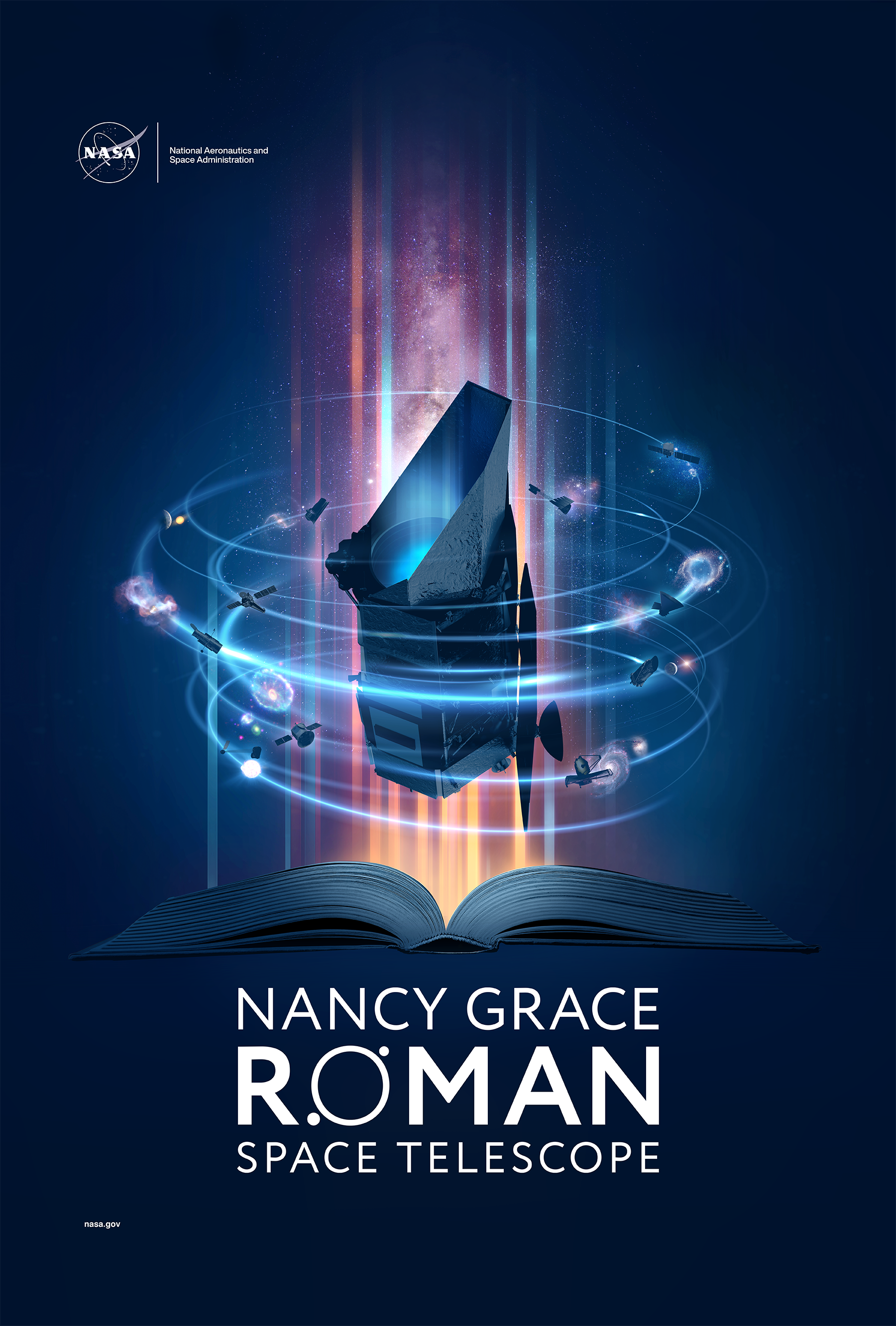
Hubble took this image as part of a study of globular clusters in the Milky Way’s halo intended to determine their ages and shed light on the formation and evolution of the galaxy. Over the past three decades in orbit, Hubble has fundamentally changed our understanding of the universe. Its discoveries are expanded upon and complemented by observations from other NASA missions like the infrared-detecting James Webb Space Telescope and the Nancy Grace Roman Space Telescope, scheduled to launch in late summer.

Image Description: NGC 6426 is a compact grouping of a multitude of stars shine in red, white and blue against the dark background of space. The stars are more densely collected toward the center of the cluster.


Image Credit: NASA, ESA, and A. Dotter (Dartmouth College)
Processing: Gladys Kober (NASA/Catholic University of America)
Release Date: July 4, 2026

#NASA #Hubble #Astronomy #Space #Science #Stars #StarClusters #NGC6426 #GlobularStarClusters #OphiuchusConstellation #MilkyWayGalaxy #Universe #HubbleSpaceTelescope #HST #ESA #Europe #GSFC #STScI #UnitedStates #JulyTheFourth #IndependenceDay #America250 #STEM #Education

NASA's Nancy Grace Roman Space Telescope: Launch Prep | Kennedy Space Center

NASA's Nancy Grace Roman Space Telescope: Launch Prep | Kennedy Space Center

🤩Here’s to 250 years of American ingenuity! Happy July 4th!

For the first time since arriving in Florida, NASA's Nancy Grace Roman Space Telescope is on full display after being unboxed and raised to its vertical position inside the high bay of the Payload Hazardous Servicing Facility at NASA’s Kennedy Space Center. And what a sight she is! Launching as early as August, Roman is set to transform how we explore the cosmos. Its sweeping surveys will help reveal billions of cosmic objects.

The Roman telescope and the discoveries it will support:
https://www.stsci.edu/roman


You can send your name along with NASA's Nancy Grace Roman Space Telescope that will be placed a million miles away for planet Earth. It is currently scheduled to launch on August 30, 2026. 
Sign up here: https://go.nasa.gov/4ejkRcR
Submissions close July 12.

Image Credit: NASA/Sydney Rohde (Rocz)
Image Date: June 25, 2026

#NASA #Space #Astronomy #Science #NASARoman #RomanSpaceTelescope #NancyGraceRomanSpaceTelescope #NancyGraceRoman #Exoplanets #Planets #SolarSystem #Stars #MilkyWayGalaxy #Galaxies #Cosmos #Universe #SpaceTelescopes #NASAGoddard #GSFC #STScI #NASAKennedy #Florida #UnitedStates #STEM #Education

American Independence Day Wishes | International Space Station

American Independence Day Wishes | International Space Station

Happy 250th to the U.S.A., from 250 miles above Earth! NASA astronauts Jessica Meir, Jack Hathaway, and Chris Williams celebrate the Fourth of July from the International Space Station and look ahead to America’s next chapter of exploration through the Artemis Program.

Independence Day, known colloquially as the Fourth of July, is a federal holiday in the United States that commemorates the adoption of the Declaration of Independence on July 4, 1776, establishing the United States of America. By doing this, the delegates to the Second Continental Congress declared that the Thirteen Colonies were no longer subject (and subordinate) to the monarch of Britain, King George III, and were now united, free, and independent states. The Congress voted to approve independence by passing the Lee Resolution on July 2 and adopted the Declaration of Independence two days later, on July 4.

Follow Expedition 74:

Expedition 74 Crew
Station Commander: Sergey-Kud Sverchkov (Russia)
Roscosmos (Russia) Flight Engineers:
Andrey Fedyaev, Sergei Mikaev
European Space Agency Flight Engineer: Sophie Adenot
NASA Flight Engineers: Jessica Meir, Jack Hathaway, Chris Williams

An international partnership of space agencies provides and operates the elements of the International Space Station (ISS). The principals are the space agencies of the United States, Russia, Europe, Japan, and Canada.


Credit: NASA
Duration: 1 minute, 16 seconds
Release Date: June 26, 2026


#NASA #Space #Science #Astronomy #ISS #Planets #Earth #America #IndependenceDay #FourthOfJuly #America250 #Astronauts #Jessica Meir #JackHathaway  #ChrisWilliams #Europe #France #ESA #Cosmonauts #Russia #Россия #Roscosmos #Роскосмос #HumanSpaceflight #InternationalCooperation #UnitedStates #STEM #Education #HD #Video    

SpaceX Starship 60-second Engine Static Fire Test | Starbase Texas

SpaceX Starship 60-second Engine Static Fire Test | Starbase Texas

A 60-second static fire test of Starship engines ahead of the 13th flight test.

The 12th flight test of SpaceX's Starship lifted off May 22, 2026, from Pad 2 at Starbase, Texas. Learn about the flight test results and watch a replay of the launch webcast here: 
https://www.spacex.com/launches/starship-flight-12

This was the first flight of the "next generation Starship and Super Heavy vehicles, powered by the next evolution of the Raptor engine." 

Read more about the key upgrades designed to enhance performance and unlock Starship's full capabilities here: https://www.spacex.com/updates/starship-v3

NASA plans to use a lunar lander version of Starship to deliver astronauts and cargo to the Moon during the Artemis IV mission and beyond through the Human Landing System (HLS) Program.

Download the Free Starship User Guide (PDF):
https://www.spacex.com/media/starship_users_guide_v1.pdf


Credit: Space Exploration Technologies Corporation (SpaceX)
Duration: 1 minute, 14 seconds
Date: July 2, 2026

#NASA #SpaceX #Space #Earth #Mars #Moon #MoonToMars #ArtemisProgram #ArtemisIII #ArtemisIV #Starship #StarshipV3 #StaticFireEngineTest #ReusableSpacecraft #SuperHeavy #SuperHeavyV3 #ElonMusk #Engineering #SpaceTechnology #HumanSpaceflight #CommercialSpace #SpaceExploration #StarbaseTexas #UnitedStates #STEM #Education #HD #Video

Friday, July 03, 2026

NASA Artemis III Rocket RS-25 Engines Arrive at Kennedy Space Center

NASA Artemis III Rocket RS-25 Engines Arrive at Kennedy Space Center

Two of the four RS-25 Space Launch System (SLS) rocket engines built by L3 Harris Technologies that will help launch the NASA Artemis III Mission arrived inside the Vehicle Assembly Building (VAB) at NASA’s Kennedy Space Center in Florida on Tuesday, June 23, 2026. Together, the engines generate over 2 million pounds of thrust at liftoff, powering the SLS rocket for the first 8 minutes of flight. 

The SLS rocket will use four RS-25 engines in the core stage to propel the Orion spacecraft into orbit providing over two million pounds of thrust at liftoff. NASA plans to send Artemis astronauts on increasingly difficult missions to explore more of the Moon for scientific discovery and economic benefits, to establish an enduring human presence on the lunar surface, and to build on our foundation for the first crewed missions to Mars.

The Artemis III Mission is coming together, piece by piece . . .

Planned to launch in 2027, the Artemis III Mission will practice docking the Orion spacecraft with two lunar landers in low Earth orbit. 

On future missions, including Artemis IV in 2028, landers will bring astronauts to the lunar surface. While Artemis III will not land on the Moon, it will test the complex capabilities NASA needs to return—this time to stay.

Learn more about NASA’s Artemis program:

Credit: NASA
Duration: 39 seconds
Date: June 23, 2026

#NASA #Space #Science #Earth #Moon #ArtemisProgram #ArtemisIII #ArtemisIIIMission #LunarLanders #HLS #NASASLS #RS25RocketEngines #OrionSpacecraft #Astronauts #Italy #Italia #Europe #HumanSpaceflight #SolarSystem #SpaceExploration #NASAKennedy #VAB #MerrittIsland #Florida #UnitedStates #STEM #Education #HD #Video

NASA Artemis II Orion Spacecraft Views of The Moon and Earth: New Images

NASA Artemis II Orion Spacecraft Views of The Moon and Earth: New Images

NASA’s Orion spacecraft captures the Moon and the Earth in one frame during the Artemis II crew’s deep space journey on the sixth day of the mission. The right side of NASA’s Orion spacecraft is seen lit up by the Sun. A waxing crescent Moon is visible behind it. And then, a crescent Earth, tiny compared to the Moon, is about to set below the Moon’s horizon on the right.
The solar eclipse captured from a camera mounted on one of the Orion spacecraft’s solar array wings during the Artemis II crew’s flyby of the Moon’s far side. The science community is investigating whether the glow around the Moon is from zodiacal light—interstellar dust that’s reflecting sunlight—the solar corona, or a combination of the two. Unlike minutes-long eclipses as viewed from Earth, the Artemis II crew saw the Sun hide behind the Moon for nearly an hour. In this image, Venus can be spotted on the left, and Saturn on the right of the Moon.

NASA's Artemis II Mission took NASA astronauts Christina Koch, Reid Wiseman, and Victor Glover, plus Canadian Space Agency (CSA) astronaut JeremyHansen on a nearly 10-day journey around the Moon and back to Earth.

The Orion spacecraft successfully splashed down on Friday, April 10, 2026, in the Pacific Ocean following its journey around the Moon.

The first crewed test flight of NASA’s Artemis Program lifted off from Launch Pad 39B at the agency’s Kennedy Space Center in Florida on April 1, 2026, carrying the first astronauts to travel to the Moon in more than half a century. 

The crew completed a record-setting lunar flyby, taking them 252,756 miles at their farthest distance from Earth and 4,067 miles above the lunar surface at their closest approach. 

Under Artemis, NASA will send astronauts on increasingly difficult missions to explore more of the Moon for scientific discovery, economic benefits, and to build on our foundation for the first crewed missions to Mars.

Learn more about NASA's Artemis II Mission:
https://www.nasa.gov/mission/artemis-ii/


Credit: NASA
Image Date: April 6, 2026
Release Date: July 1, 2026


#NASA #Space #Science #Earth #Moon #SolarEclipse #ZodiacalLight #ArtemisProgram #ArtemisII #OrionSpacecraft #Astronauts #ReidWiseman #VictorGlover #ChristinaKoch #JeremyHansen #HumanSpaceflight #SolarSystem #SpaceExploration #CSA #Canada #UnitedStates #History #STEM #Education

China Long March 4B Launch of Haiyang-2E Earth Ocean Observation Satellite

China Long March 4B Launch of Haiyang-2E Earth Ocean Observation Satellite


At China's Jiuquan Satellite Launch Center Launch Site 94 in the Inner Mongolia Autonomous Region, a Long March 4B lifted off to fly towards a sun-synchronous orbit at 07:46 am China Standard Time on July 2, 2026, (23:46 pm Universal Coordinated Time on July 1st), carrying a new ocean monitoring spacecraft.

The Haiyang2E satellite will replace the Haiyang-2B launched in 2018 and work with the Haiyang-2C, 2D and other orbiting satellites in a network serving maritime rights, disaster mitigation, resource exploitation, and marine research.

The Long March 4B, also known as the Chang Zheng 4B, CZ-4B, and LM-4B, is a Chinese expendable orbital launch vehicle. It is mostly used to place satellites into low Earth orbit and Sun-synchronous orbits.

Atop of the launch vehicle was the China Academy of Space Technology-built 1,500-kilogram Haiyang-2E on behalf of China’s National Satellite Ocean Application Service, under the State Oceanic Administration. The spacecraft will monitor the environment of the world’s oceans, measuring their waves, temperatures, and winds. To do that, a handful of instruments are onboard:

A 1,600-kilometer swath Microwave Radiometer Imager for surface temperature, wind, and vapor monitoring; a dual-beam, 1,300-kilometer swath Scatterometer for collecting wind data; a 25-kilometer resolution Calibration Microwave Radiometer for measuring water vapor; a 16-kilometer resolution Radar Altimeter for tracking wave height; and a Laser Retroreflector Array to enable accurate distance measurements.

To assist the spacecraft with its tasks, France’s Doppler Orbitography and Radiopositioning Integrated by Satellite (DORIS) system is onboard as part of a regular collaboration for the Haiyang-2 series. This system assists the spacecraft by measuring its location in orbit with centimeter accuracy, allowing teams on the ground to better understand instrument data collected.

Haiyang-2E joins eight other spacecraft of its series currently in orbit, while being the eleventh deployed since the first launch in May 2002. The last addition was Haiyang-4-01 in November 2024 for monitoring ocean salinity. Across the current spacecraft, those designated under Haiyang-11 for measuring ocean color, Haiyang-22 keeps track of the marine environment, and Haiyang-33 performs general monitoring of the oceans.

Today’s Haiyang-2 spacecraft is also part of a new trio that will be launched this year and next, at least with Haiyang-2F and Haiyang-2G set to be added. Those will replace the aging Haiyang-2B, Haiyang-2C, and Haiyang-2D, respectively.

Finally, today’s launch was the 57th mission for the Long March 4B, the 118th launch for the Long March 4 series, the 270th Long March vehicle from the Shanghai Academy of Spaceflight Technology, and the 654th launch of the Long March launch vehicle series. This was also the 45th launch from China in 2026.


Image Credit: Shanghai Academy of Spaceflight Technology
Text Credit: Jack C.
Date: July 1, 2026


#NASA #Space #Science #Earth #Satellites #Haiyang2ESatellite #EarthObservation #RemoteSensing #国家卫星海洋应用中心 #China #中国 #RocketLaunches #LongMarch4BRockets #长征四号乙火箭 #SAST #CASC #SpaceTechnology #CommercialSpace #JSLC #酒泉卫星发射中心 #Spaceports #InnerMongolia #InternationalCooperation #France #STEM #Education

China Long March 4B Launch of Haiyang-2E Earth Ocean Observation Satellite

China Long March 4B Launch of Haiyang-2E Earth Ocean Observation Satellite

At China's Jiuquan Satellite Launch Center Launch Site 94 in the Inner Mongolia Autonomous Region, a Long March 4B lifted off to fly towards a sun-synchronous orbit at 07:46 am China Standard Time on July 2, 2026, (23:46 pm Universal Coordinated Time on July 1st), carrying a new ocean monitoring spacecraft.

The Haiyang2E satellite will replace the Haiyang-2B launched in 2018 and work with the Haiyang-2C, 2D and other orbiting satellites in a network serving maritime rights, disaster mitigation, resource exploitation, and marine research.

The Long March 4B, also known as the Chang Zheng 4B, CZ-4B, and LM-4B, is a Chinese expendable orbital launch vehicle. It is mostly used to place satellites into low Earth orbit and Sun-synchronous orbits.

Atop of the launch vehicle was the China Academy of Space Technology-built 1,500-kilogram Haiyang-2E on behalf of China’s National Satellite Ocean Application Service, under the State Oceanic Administration. The spacecraft will monitor the environment of the world’s oceans, measuring their waves, temperatures, and winds. To do that, a handful of instruments are onboard:

A 1,600-kilometer swath Microwave Radiometer Imager for surface temperature, wind, and vapor monitoring; a dual-beam, 1,300-kilometer swath Scatterometer for collecting wind data; a 25-kilometer resolution Calibration Microwave Radiometer for measuring water vapor; a 16-kilometer resolution Radar Altimeter for tracking wave height; and a Laser Retroreflector Array to enable accurate distance measurements.

To assist the spacecraft with its tasks, France’s Doppler Orbitography and Radiopositioning Integrated by Satellite (DORIS) system is onboard as part of a regular collaboration for the Haiyang-2 series. This system assists the spacecraft by measuring its location in orbit with centimeter accuracy, allowing teams on the ground to better understand instrument data collected.

Haiyang-2E joins eight other spacecraft of its series currently in orbit, while being the eleventh deployed since the first launch in May 2002. The last addition was Haiyang-4-01 in November 2024 for monitoring ocean salinity. Across the current spacecraft, those designated under Haiyang-11 for measuring ocean color, Haiyang-22 keeps track of the marine environment, and Haiyang-33 performs general monitoring of the oceans.

Today’s Haiyang-2 spacecraft is also part of a new trio that will be launched this year and next, at least with Haiyang-2F and Haiyang-2G set to be added. Those will replace the aging Haiyang-2B, Haiyang-2C, and Haiyang-2D, respectively.

Finally, today’s launch was the 57th mission for the Long March 4B, the 118th launch for the Long March 4 series, the 270th Long March vehicle from the Shanghai Academy of Spaceflight Technology, and the 654th launch of the Long March launch vehicle series. This was also the 45th launch from China in 2026.


Video Credit: Shanghai Academy of Spaceflight Technology
Text Credit: Jack C.
Duration: 37 seconds
Date: July 1, 2026


#NASA #Space #Science #Earth #Satellites #Haiyang2ESatellite #EarthObservation #RemoteSensing #国家卫星海洋应用中心 #China #中国 #RocketLaunches #LongMarch4BRockets #长征四号乙火箭 #SAST #CASC #SpaceTechnology #CommercialSpace #JSLC #酒泉卫星发射中心 #Spaceports #InnerMongolia #InternationalCooperation #France #STEM #Education #HD #Video

Emerald-colored Auroral 'Ribbons' over Planet Earth | International Space Station

Emerald-colored Auroral 'Ribbons' over Planet Earth | International Space Station

Expedition 74 flight engineer and European Space Agency astronaut Sophie Adenot of France: "Watching this glowing green ribbon shimmer and dance, it's easy to lose yourself completely in the magic of the moment. Turn the sound on for the full experience—the music was carefully chosen to bring you as close as possible to what I felt watching this from space 💚."

Follow Expedition 74:

Expedition 74 Crew
Station Commander: Sergey-Kud Sverchkov (Russia)
Roscosmos (Russia) Flight Engineers:
Andrey Fedyaev, Sergei Mikaev
European Space Agency Flight Engineer: Sophie Adenot
NASA Flight Engineers: Jessica Meir, Jack Hathaway, Chris Williams

An international partnership of space agencies provides and operates the elements of the International Space Station (ISS). The principals are the space agencies of the United States, Russia, Europe, Japan, and Canada.


Video Credit: NASA's Johnson Space Center, European Space Agency (ESA), S. Adenot
Duration: 1 minute, 17 seconds
Release Date: July 3, 2026

#NASA #Space #Science #Astronomy #ISS #Stars #Sun #Planets #Earth #Aurorae #Auroras #Astronauts #SophieAdenot #AstronautVideography #Europe #France #ESA #Cosmonauts #Russia #Россия #Roscosmos #Роскосмос #HumanSpaceflight #InternationalCooperation #UnitedStates #Expedition74 #STEM #Education #HD #Video

Close-up: Distant Galaxy Cluster MACS J0553.4-3342 in Columba | Webb Telescope

Close-up: Distant Galaxy Cluster MACS J0553.4-3342 in Columba | Webb Telescope

In this NASA/European Space Agency/Canadian Space Agency James Webb Space Telescope picture, we are taken on a visit to a "building site" of significant scale. The "project" is a galaxy cluster named MACS J0553.4-3342, located in the constellation Columba (the Dove). 

Distance from Earth: 4 billion light years

MACS J0553.4-3342 is situated at a redshift of 0.412. Redshift is a measure of how much the cluster’s light has been stretched by the expansion of the Universe over the course of its long journey to Webb’s mirrors; this unassuming number tells us that we are seeing MACS J0553.4-3342 as it was 4.4 billion years in the past. However, for a galaxy cluster, this is relatively young. In fact, observations with the NASA/European Space Agency Hubble Space Telescope and other telescopes show a cluster still in the process of being built.

MACS J0553.4-3342 is composed of two sub-clusters—roughly equal in mass—that are actively merging. The two subclusters have already slammed through each other and traveled over one million light-years apart, but they will eventually come back together again and again until they finally merge. The construction process is messy, and MACS J0553.4-3342 is filled with extremely hot gas that radiates powerful X-rays. Each subcluster is anchored on an immensely bright and massive elliptical galaxy. These are easily identifiable as the two brightest points in the center of this scene with the largest glowing halos around them. The many smaller white elliptical galaxies are bound to one of the two subclusters by gravity, and will be incorporated into the final galaxy cluster. This image also features many foreground galaxies—spirals and dusty discs that are unrelated to MACS J0553.4-3342—and prominent bright stars in our own Milky Way galaxy.

Even mid-way through its construction, the titanic clumps of matter swirling around in this galaxy cluster have built a device that is already very useful for us here on Earth: a gravitational lens. The extreme and concentrated mass in MACS J0553.4-3342 curves light with its gravity, similar to how a glass lens bends and focuses light. In this image you can see prominent orange, stretched-out arcs alongside each of the subclusters. These arcs are images of distant background galaxies, whose light has been warped by the galaxy cluster’s gravitational pull. The arc on the left side, three bright spots joined together, is actually three images of a single background galaxy. A forest of smaller arcs and lines are scattered across the image too; such a fantastic view appears in few other places in the Universe.

Look in the right spot, however, and this galaxy cluster turns from a distorting funhouse mirror into a precision scientific device. The gravitational lensing focuses light, magnifying objects and enhancing their brightness so if they lie in exactly the right place, background galaxies and even individual stars that would have been far too faint and distant to spot will be made visible. By carefully mapping out the mass of the cluster, researchers can reconstruct where and how strongly it distorts light from our point of view, then search for serendipitously-magnified distant objects to study. The arcs we can see in MACS J0553.4-3342 already show a few galaxies from less than a billion years after the Big Bang.

This image, taken with Webb’s Near-Infrared Camera (NIRCam), stems from a survey program named VENUS (#6882). Astronomers aimed to create a collection of deep, high-quality images of massive galaxy clusters like MACS J0553.4-3342 across a wide range of infrared wavelengths, greatly expanding the area covered by Webb’s sensitive instruments. Researchers can then scour the clusters for distant and faint objects that have been brightened through gravitational lensing, from young galaxies and low-mass black holes to supernova explosions and individual stars. Gravitational lensing has been key to many of Webb’s most dramatic discoveries in recent years, and having many more examples of it allows us to systematically study the distant past and the evolutionary stages of the galaxies, stars and black holes we see today.

Image Description: A galaxy cluster in deep space. It is filled with elliptical galaxies: small, bright white glowing ovals. The two largest elliptical galaxies, left and right of center, are bright cores that radiate light. Unrelated, distant galaxies are scattered around as red smudges and dots. Many of these are stretched out into red arcs and lines by the galaxy cluster’s strong gravity, creating multiple images in places. Numerous spiral galaxies and bright stars appear in the foreground.


Credit: ESA/Webb, NASA & CSA, S. Fujimoto, N. Bartmann (ESA/Webb)
Duration: 30 seconds
Release Date: July 3, 2026


#NASA #ESA #Astronomy #Space #Science #Galaxies #GravitationalLensing #GalaxyClusters #MACSJ055343342 #ColumbaConstellation #Cosmos #Universe #JWST #NIRCam #InfraredAstronomy #SpaceTelescopes #Europe #GSFC #STScI #UnitedStates #CSA #Canada #STEM #Education #HD #Video