Sunday, August 30, 2026

NASA's Nancy Grace Roman Space Telescope Launch | Kennedy Space Center

NASA's Nancy Grace Roman Space Telescope Launch | Kennedy Space Center


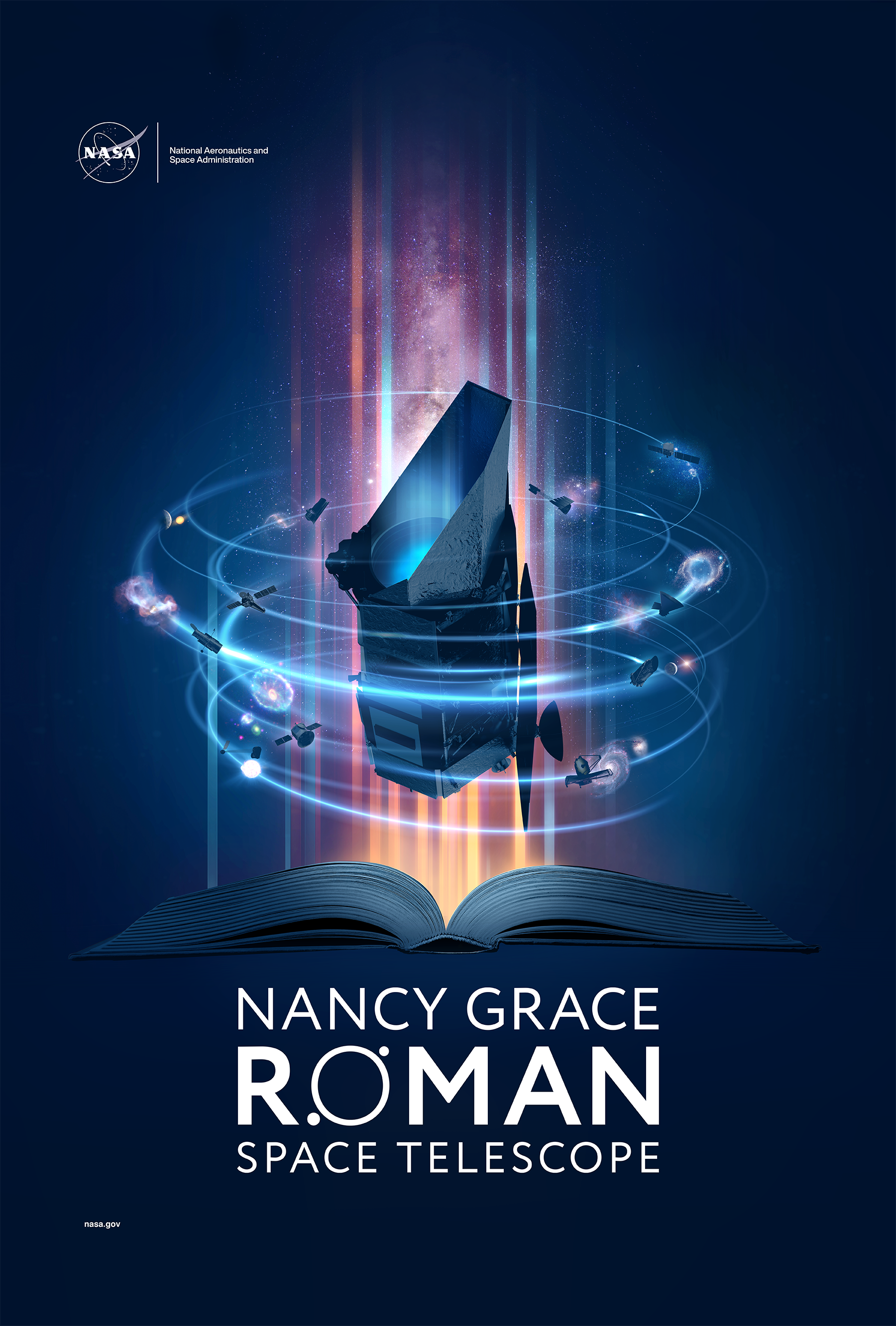
Now on a three-month, million-mile journey to its final orbit, NASA’s Nancy Grace Roman Space Telescope will soon reveal the universe’s darkest secrets. The mission launched at 7:26 a.m. EDT Sunday aboard a SpaceX Falcon Heavy rocket from Launch Complex 39A at the agency’s Kennedy Space Center in Florida.

Roman pairs a large field of view with crisp infrared vision to explore vast swaths of the sky and probe deeply into cosmic history. This flagship mission will help astronomers explore dark matter, dark energy, and worlds outside of our solar system, known as exoplanets. Its surveys will support a broad range of research extending far beyond the mission’s main science goals.

The ground control team at NASA’s Goddard Space Flight Center in Greenbelt, Maryland, began receiving telemetry data from Roman seven minutes after launch. The Falcon Heavy rocket performed as expected, separating from the observatory 31 minutes into the flight. After separating from the center core, the rocket’s boosters safely returned to the launch site for refurbishment.

During launch and early orbit, Roman uses the Near Space Network’s ground stations and relay satellites to exchange tracking, telemetry, and command data with ground controllers. About 70 minutes after launch, the Deep Space Network takes over communications and guides Roman toward the second Sun-Earth Lagrange point, or L2, about one million miles from Earth. Roman connects to that network through the Canberra Deep Space Communication Complex in Australia first. Approximately six hours later it will transfer to the Madrid Deep Space Communication Complex in Spain and then to the Goldstone Deep Space Communication Complex in California, ensuring continuous contact with Roman throughout its journey.

The Roman team also confirmed successful deployment of the observatory’s solar panels and lower instrument sun shade an hour and 23 minutes after launch. Within the upcoming days, Roman’s high-gain antenna and visor-like deployable aperture cover will deploy, ground controllers will initiate the first of two-mid-course corrections, and the Coronagraph Instrument will power on. This instrument will demonstrate the technology that future missions like NASA’s Habitable Worlds Observatory concept could use to image Earth-like planets in the search for life in the universe. Roman’s Coronagraph will take a giant step in that direction by snapping pictures of Jupiter-like planets.

A few weeks into Roman’s voyage, its primary instrument, the Wide Field Instrument, will activate. This 300-megapixel infrared camera has 18 4K detectors, each about the size of a saltine cracker. These detectors collect photons of light that will be decoded into crisp cosmic panoramas. Thanks to the observatory’s rigid design and stable optical performance, it will rapidly scan the sky without needing substantial time between separate observations. The Roman telescope is designed to survey the universe a thousand times faster than NASA’s Hubble Space Telescope.

Throughout the rest of Roman’s three-month commissioning period, scientists will run the instruments through a series of calibrations and tests. NASA anticipates releasing Roman’s first images by early 2027.

Roman will send back 1.4 terabytes of data every day, the highest data rate of any NASA astrophysics mission, so far. Machine learning, artificial intelligence, and citizen scientists will help sift through it and flag significant findings, which astronomers can then study.

“We’ve never been able to view the universe with eyes like Roman’s before,” said Julie McEnery, Roman’s senior project scientist at NASA Goddard. “There’s no telling what more we’ll know and have seen by this time next year.”

Roman is the fourth primary mission NASA has launched on a Falcon Heavy rocket. Earlier this year, the agency’s Launch Services Program worked with SpaceX to accelerate the launch date to accommodate the space telescope’s early completion.

The telescope is managed at NASA Goddard with participation by the agency’s Jet Propulsion Laboratory in Southern California; Caltech/IPAC in Pasadena, California; the Space Telescope Science Institute in Baltimore; and a team of scientists from various research institutions. The primary industrial partners are BAE Systems Inc., L3Harris Technologies, and Teledyne Scientific & Imaging. Contributions to Roman also are made by ESA, JAXA, the French space agency CNES (Centre National d’Études Spatiales), and the Max Planck Institute for Astronomy in Germany.

To learn more about the Roman mission, visit:
https://www.nasa.gov/roman


Image Credit: SpaceX, NASA/John Kraus
Text Credit: NASA's Goddard Space Flight Center
Date: Aug. 30, 2026

#NASA #Space #Astronomy #Science #SpaceX #FalconHeavyRocket #NASARoman #RomanSpaceTelescope #Encapsulation #NancyGraceRomanSpaceTelescope #NancyGraceRoman #Exoplanets #Planets #SolarSystem #Stars #MilkyWayGalaxy #Galaxies #Cosmos #Universe #SpaceTelescopes #NASAGoddard #GSFC #STScI #NASAKennedy #Florida #UnitedStates #STEM #Education

Liftoff: Nancy Grace Roman Space Telescope on Falcon Heavy | NASA Kennedy

Liftoff: Nancy Grace Roman Space Telescope on Falcon Heavy | NASA Kennedy

A SpaceX Falcon Heavy rocket launched successfully with NASA’s Nancy Grace Roman Space Telescope onboard from Launch Complex 39A, Sunday, Aug. 30, 2026, at NASA’s Kennedy Space Center in Florida. Launch occurred at 7:26 a.m. Eastern Daylight Time (EDT).

This was the first and third flight for the two first stage side boosters supporting this mission. They previously launched the SpaceX GOES-U and Viasat-3 F3 missions. Following stage separation, Falcon Heavy’s two side boosters landed on SpaceX’s Landing Zones 2 and 40 (LZ-2 and LZ-40) at Cape Canaveral in Florida.

→ Watch the launch replay here: https://spacex.com/launches/roman

Roman’s primary mission is to settle essential questions about dark energy, exoplanets, and infrared astrophysics by conducting wide-field surveys that explore the universe’s structure, evolution, and composition. 

The Roman telescope and the discoveries it will support:
https://www.stsci.edu/roman

Roman’s namesake—Dr. Nancy Grace Roman, NASA’s first chief astronomer—made it her personal mission to make cosmic vistas readily accessible to all by paving the way for telescopes based in space.

“The mission will acquire enormous quantities of astronomical imagery that will permit scientists to make groundbreaking discoveries for decades to come, honoring Dr. Roman’s legacy in promoting scientific tools for the broader community,” said Jackie Townsend, Roman’s deputy project manager at NASA Goddard. “I like to think Dr. Roman would be extremely proud of her namesake telescope and thrilled to see what mysteries it will uncover in the coming years.”


Image Credit: SpaceX
Duration: 22 seconds
Date: Aug. 30, 2026

#NASA #Space #Astronomy #Science #SpaceX #FalconHeavyRocket #NASARoman #RomanSpaceTelescope #Encapsulation #NancyGraceRomanSpaceTelescope #NancyGraceRoman #Exoplanets #Planets #SolarSystem #Stars #MilkyWayGalaxy #Galaxies #Cosmos #Universe #SpaceTelescopes #NASAGoddard #GSFC #STScI #NASAKennedy #Florida #UnitedStates #STEM #Education #HD #Video

Nancy Grace Roman Space Telescope Launch on Falcon Heavy | NASA Kennedy

Nancy Grace Roman Space Telescope Launch on Falcon Heavy | NASA Kennedy


A SpaceX Falcon Heavy rocket launched successfully with NASA’s Nancy Grace Roman Space Telescope onboard from Launch Complex 39A, Sunday, Aug. 30, 2026, at NASA’s Kennedy Space Center in Florida. Launch occurred at 7:26 a.m. Eastern Daylight Time (EDT).

This was the first and third flight for the two first stage side boosters supporting this mission. They previously launched the SpaceX GOES-U and Viasat-3 F3 missions. Following stage separation, Falcon Heavy’s two side boosters landed on SpaceX’s Landing Zones 2 and 40 (LZ-2 and LZ-40) at Cape Canaveral in Florida.

→ Watch the launch replay here: https://spacex.com/launches/roman

Roman’s primary mission is to settle essential questions about dark energy, exoplanets, and infrared astrophysics by conducting wide-field surveys that explore the universe’s structure, evolution, and composition. 

The Roman telescope and the discoveries it will support:
https://www.stsci.edu/roman

Roman’s namesake—Dr. Nancy Grace Roman, NASA’s first chief astronomer—made it her personal mission to make cosmic vistas readily accessible to all by paving the way for telescopes based in space.

“The mission will acquire enormous quantities of astronomical imagery that will permit scientists to make groundbreaking discoveries for decades to come, honoring Dr. Roman’s legacy in promoting scientific tools for the broader community,” said Jackie Townsend, Roman’s deputy project manager at NASA Goddard. “I like to think Dr. Roman would be extremely proud of her namesake telescope and thrilled to see what mysteries it will uncover in the coming years.”


Image Credit: NASA/Joel Kowsky
Date: Aug. 30, 2026

#NASA #Space #Astronomy #Science #SpaceX #FalconHeavyRocket #NASARoman #RomanSpaceTelescope #Encapsulation #NancyGraceRomanSpaceTelescope #NancyGraceRoman #Exoplanets #Planets #SolarSystem #Stars #MilkyWayGalaxy #Galaxies #Cosmos #Universe #SpaceTelescopes #NASAGoddard #GSFC #STScI #NASAKennedy #Florida #UnitedStates #STEM #Education

Nancy Grace Roman Space Telescope Launch on Falcon Heavy | NASA Kennedy

Nancy Grace Roman Space Telescope Launch on Falcon Heavy | NASA Kennedy


A SpaceX Falcon Heavy rocket launched successfully with NASA’s Nancy Grace Roman Space Telescope onboard from Launch Complex 39A, Sunday, Aug. 30, 2026, at NASA’s Kennedy Space Center in Florida. Launch occurred at 7:26 a.m. Eastern Daylight Time (EDT).

This was the first and third flight for the two first stage side boosters supporting this mission. They previously launched the SpaceX GOES-U and Viasat-3 F3 missions. Following stage separation, Falcon Heavy’s two side boosters landed on SpaceX’s Landing Zones 2 and 40 (LZ-2 and LZ-40) at Cape Canaveral in Florida.

→ Watch the launch replay here: https://spacex.com/launches/roman

Roman’s primary mission is to settle essential questions about dark energy, exoplanets, and infrared astrophysics by conducting wide-field surveys that explore the universe’s structure, evolution, and composition. 

The Roman telescope and the discoveries it will support:
https://www.stsci.edu/roman

Roman’s namesake—Dr. Nancy Grace Roman, NASA’s first chief astronomer—made it her personal mission to make cosmic vistas readily accessible to all by paving the way for telescopes based in space.

“The mission will acquire enormous quantities of astronomical imagery that will permit scientists to make groundbreaking discoveries for decades to come, honoring Dr. Roman’s legacy in promoting scientific tools for the broader community,” said Jackie Townsend, Roman’s deputy project manager at NASA Goddard. “I like to think Dr. Roman would be extremely proud of her namesake telescope and thrilled to see what mysteries it will uncover in the coming years.”


Image Credit: NASA/Joel Kowsky
Date: Aug. 30, 2026

#NASA #Space #Astronomy #Science #SpaceX #FalconHeavyRocket #NASARoman #RomanSpaceTelescope #Encapsulation #NancyGraceRomanSpaceTelescope #NancyGraceRoman #Exoplanets #Planets #SolarSystem #Stars #MilkyWayGalaxy #Galaxies #Cosmos #Universe #SpaceTelescopes #NASAGoddard #GSFC #STScI #NASAKennedy #Florida #UnitedStates #STEM #Education

Nancy Grace Roman Space Telescope Launch on Falcon Heavy | NASA Kennedy

Nancy Grace Roman Space Telescope Launch on Falcon Heavy | NASA Kennedy


A SpaceX Falcon Heavy rocket launched successfully with NASA’s Nancy Grace Roman Space Telescope onboard from Launch Complex 39A, Sunday, Aug. 30, 2026, at NASA’s Kennedy Space Center in Florida. Launch occurred at 7:26 a.m. Eastern Daylight Time (EDT).

This was the first and third flight for the two first stage side boosters supporting this mission. They previously launched the SpaceX GOES-U and Viasat-3 F3 missions. Following stage separation, Falcon Heavy’s two side boosters landed on SpaceX’s Landing Zones 2 and 40 (LZ-2 and LZ-40) at Cape Canaveral in Florida.

→ Watch the launch replay here: https://spacex.com/launches/roman

Roman’s primary mission is to settle essential questions about dark energy, exoplanets, and infrared astrophysics by conducting wide-field surveys that explore the universe’s structure, evolution, and composition. 

The Roman telescope and the discoveries it will support:
https://www.stsci.edu/roman

Roman’s namesake—Dr. Nancy Grace Roman, NASA’s first chief astronomer—made it her personal mission to make cosmic vistas readily accessible to all by paving the way for telescopes based in space.

“The mission will acquire enormous quantities of astronomical imagery that will permit scientists to make groundbreaking discoveries for decades to come, honoring Dr. Roman’s legacy in promoting scientific tools for the broader community,” said Jackie Townsend, Roman’s deputy project manager at NASA Goddard. “I like to think Dr. Roman would be extremely proud of her namesake telescope and thrilled to see what mysteries it will uncover in the coming years.”


Image Credit: NASA/Joel Kowsky
Date: Aug. 30, 2026

#NASA #Space #Astronomy #Science #SpaceX #FalconHeavyRocket #NASARoman #RomanSpaceTelescope #Encapsulation #NancyGraceRomanSpaceTelescope #NancyGraceRoman #Exoplanets #Planets #SolarSystem #Stars #MilkyWayGalaxy #Galaxies #Cosmos #Universe #SpaceTelescopes #NASAGoddard #GSFC #STScI #NASAKennedy #Florida #UnitedStates #STEM #Education

Liftoff: Nancy Grace Roman Space Telescope on Falcon Heavy | NASA Kennedy

Liftoff: Nancy Grace Roman Space Telescope on Falcon Heavy | NASA Kennedy

A SpaceX Falcon Heavy rocket lifted off successfully at Launch Pad 39A in Florida with NASA’s Nancy Grace Roman Space Telescope mission on August 30, 2026 at 7:26 a.m. Eastern Time.

This was the first and third flight for the two first stage side boosters supporting this mission. They previously launched the GOES-U and Viasat-3 F3 missions. Following stage separation, Falcon Heavy’s two side boosters landed on SpaceX’s Landing Zones 2 and 40 (LZ-2 and LZ-40) at Cape Canaveral in Florida.

→ Watch a launch replay here: https://spacex.com/launches/roman

Roman’s primary mission is to settle essential questions about dark energy, exoplanets, and infrared astrophysics by conducting wide-field surveys that explore the universe’s structure, evolution, and composition. 

The Roman telescope and the discoveries it will support:
https://www.stsci.edu/roman

Roman’s namesake—Dr. Nancy Grace Roman, NASA’s first chief astronomer—made it her personal mission to make cosmic vistas readily accessible to all by paving the way for telescopes based in space.

“The mission will acquire enormous quantities of astronomical imagery that will permit scientists to make groundbreaking discoveries for decades to come, honoring Dr. Roman’s legacy in promoting scientific tools for the broader community,” said Jackie Townsend, Roman’s deputy project manager at NASA Goddard. “I like to think Dr. Roman would be extremely proud of her namesake telescope and thrilled to see what mysteries it will uncover in the coming years.”


Video Credit: SpaceX
Duration: 25 seconds
Date: Aug. 30, 2026

#NASA #Space #Astronomy #Science #SpaceX #FalconHeavyRocket #NASARoman #RomanSpaceTelescope #Encapsulation #NancyGraceRomanSpaceTelescope #NancyGraceRoman #Exoplanets #Planets #SolarSystem #Stars #MilkyWayGalaxy #Galaxies #Cosmos #Universe #SpaceTelescopes #NASAGoddard #GSFC #STScI #NASAKennedy #Florida #UnitedStates #STEM #Education #HD #Video

Saturday, August 29, 2026

Star Trails | International Space Station

Star Trails | International Space Station

Expedition 71/72 flight engineer and NASA astronaut Don Pettit: "Star trails from the ISS! Lots of cool physics to see in these. Stars moving as thin lines in the direction of our orbital path but forming arcs to the left of our velocity vector. Lightning flashes making  purple spots into the time history. A faint red glow is seen as part of our upper atmosphere. Surreal!"

NASA astronaut Don Pettit returned to Earth on April 19, 2025, concluding a seven-month science mission aboard the International Space Station. Pettit spent 220 days in space, earning him a total of 590 days in space over the course of his four spaceflights. He orbited the Earth 3,520 times, traveling 93.3 million miles in low-Earth orbit.


Expedition 75 Crew
Station Commander: Jessica Meir
Roscosmos (Russia) Flight Engineers:
Andrey Fedyaev,
Anna Kikina, Pyotr Dubrov
European Space Agency Flight Engineer: Sophie Adenot
NASA Flight Engineers: Jack Hathaway, Anil Menon

An international partnership of space agencies provides and operates the elements of the International Space Station (ISS). The principals are the space agencies of the United States, Russia, Europe, Japan, and Canada.


Video Credits: NASA/JSC/D. Pettit
Duration: 10 seconds
Release Date: Aug. 29, 2026

#NASA #Space #Science #ISS #Stars #Earth #Airglow #StarTrails #Astronauts #DonPettit #AstronautPhotography #Cosmonauts #Russia #Россия #Roscosmos #Роскосмос #HumanSpaceflight #Expedition75 #InternationalCooperation #UnitedStates #STEM #Education #HD #Video

Profile: A Telescope Engineer for NASA's Nancy Grace Roman Space Telescope

Profile: A Telescope Engineer for NASA's Nancy Grace Roman Space Telescope


Space telescopes help us understand the origins of the universe. For Caroline Griffin, space telescopes were the origin of her career. Now, she is a mechanical engineer at NASA working on the Nancy Grace Roman Space Telescope. Find out how Caroline contributed to this next-generation telescope and how she hopes to inspire the next generation of engineers in this episode of Surprisingly STEM. 

Science, Technology, Engineering, Math (STEM)

NASA is sharing exciting missions and a broad range of unique career opportunities with students. 

Join us as we apply science, technology, engineering, and mathematics to explore space, improve aeronautics, examine Earth, and strive to land more humans on the Moon with the Artemis Program.

NASA STEM resources: https://www.nasa.gov/learning-resources/

The Roman telescope and the discoveries it will support:
https://www.stsci.edu/roman

Roman’s namesake—Dr. Nancy Grace Roman, NASA’s first chief astronomer—made it her personal mission to make cosmic vistas readily accessible to all by paving the way for telescopes based in space.


Video Credit: NASA Education
Duration: 5 minutes, 44 seconds
Release Date: Aug. 26, 2026

#NASA #Space #Astronomy #Science #NASARoman #RomanSpaceTelescope #Encapsulation #NancyGraceRomanSpaceTelescope #NancyGraceRoman #MechanicalEngineers #Women #WomenInSTEM #Exoplanets #Planets #SolarSystem #Stars #MilkyWayGalaxy #Galaxies #Cosmos #Universe #SpaceTelescopes #NASAGoddard #GSFC #STScI #UnitedStates #STEM #Education #HD #Video

Prelaunch: Nancy Grace Roman Space Telescope on Falcon Heavy | NASA Kennedy

Prelaunch: Nancy Grace Roman Space Telescope on Falcon Heavy | NASA Kennedy


Dr. Nancy Grace Roman (1925-2018) visited the James Webb Space Telescope (JWST) and the Hubble Project Team on March 31, 2017.

A SpaceX Falcon Heavy rocket was rolled out and made vertical at Launch Pad 39A in Florida for NASA’s Nancy Grace Roman Space Telescope mission early this morning, August 29, 2026, ahead of Sunday’s launch.

→ Watch here: https://spacex.com/launches/roman

Roman’s primary mission is to settle essential questions about dark energy, exoplanets, and infrared astrophysics by conducting wide-field surveys that explore the universe’s structure, evolution, and composition. 

The Roman telescope and the discoveries it will support:
https://www.stsci.edu/roman

Roman’s namesake—Dr. Nancy Grace Roman, NASA’s first chief astronomer—made it her personal mission to make cosmic vistas readily accessible to all by paving the way for telescopes based in space.

“The mission will acquire enormous quantities of astronomical imagery that will permit scientists to make groundbreaking discoveries for decades to come, honoring Dr. Roman’s legacy in promoting scientific tools for the broader community,” said Jackie Townsend, Roman’s deputy project manager at NASA Goddard. “I like to think Dr. Roman would be extremely proud of her namesake telescope and thrilled to see what mysteries it will uncover in the coming years.”


Image Credit: SpaceX
Date: Aug. 29, 2026

#NASA #Space #Astronomy #Science #SpaceX #FalconHeavyRocket #NASARoman #RomanSpaceTelescope #Encapsulation #NancyGraceRomanSpaceTelescope #NancyGraceRoman #Exoplanets #Planets #SolarSystem #Stars #MilkyWayGalaxy #Galaxies #Cosmos #Universe #SpaceTelescopes #NASAGoddard #GSFC #STScI #NASAKennedy #Florida #UnitedStates #STEM #Education

NASA Artemis II Moon Mission Astronauts Awarded American Medals of Honor

NASA Artemis II Moon Mission Astronauts Awarded American Medals of Honor

NASA astronaut Artemis II commander Reid Wiseman speaks during an event to award the Congressional Space Medal of Honor to the Artemis II crew, Friday, Aug. 28, 2026, at NASA's Johnson Space Center in Houston, Texas.
NASA astronaut Artemis II mission specialist Christina Koch is seen during an event to award the Congressional Space Medal of Honor to the Artemis II crew, Friday, Aug. 28, 2026, at NASA's Johnson Space Center in Houston, Texas.
The Congressional Space Medal of Honor awarded to NASA astronaut Artemis II pilot Victor Glover is seen, Friday, Aug. 28, 2026, at NASA's Johnson Space Center in Houston, Texas.
Canadian Space Agency (CSA) astronaut Artemis II mission specialist Jeremy Hansen is seen during an event to award the Congressional Space Medal of Honor to the Artemis II crew, Friday, Aug. 28, 2026, at NASA's Johnson Space Center in Houston, Texas.
The Artemis II crew, consisting of Candian Space Agency astronaut mission specialist Jeremy Hansen and NASA astronauts mission specialist Christina Koch, pilot Victor Glover, and commander Reid Wiseman are seen during an event to award the Congressional Space Medal of Honor to them on Friday, Aug. 28, 2026, at NASA's Johnson Space Center in Houston, Texas.
Vanessa Wyche, director of NASA's Johnson Space Center, speaks during an event to award the Congressional Space Medal of Honor to the Artemis II crew, Friday, Aug. 28, 2026, at NASA's Johnson Space Center in Houston, Texas.
Artemis II Mission Emblem

In early April 2026, the Artemis II crew became the first to travel beyond the Moon in more than 50 years and traveled farther in space than humans have ever before. For their achievements, each was awarded with the United States Congressional Space Medal of Honor on Friday, August 28, 2026. They are the 31st, 32nd, 33rd, and 34th astronauts to receive the award. Congratulations! 

These are sample outtakes of that event . . .

The Congressional Space Medal of Honor was authorized by the United States Congress in 1969 to recognize "any astronaut who in the performance of his or her duties has distinguished himself or herself by exceptionally meritorious efforts and contributions to the welfare of the Nation and mankind". It is awarded by the president of the United States in Congress's name based on recommendations from the administrator of the National Aeronautics and Space Administration (NASA). 

The Artemis II Mission involved a ten-day test flight that carried NASA’s Reid Wiseman, Victor Glover, Christina Koch, and Canadian Space Agency (CSA) astronaut Jeremy Hansen 252,756 miles from Earth before splashing down off the coast of San Diego. This mission tested Orion’s life-support, navigation, and deep-space systems and set the stage for future U.S.-crewed lunar landings and, eventually, the first missions to Mars.

Learn more at: https://www.nasa.gov/artemis-ii


Image Credit: NASA/John Kraus
Date: Aug. 28, 2026

#NASA #Space #Science #Earth #Moon #ArtemisProgram #ArtemisII #OrionSpacecraft #Astronauts #ReidWiseman #VictorGlover #ChristinaKoch #JeremyHansen #HumanSpaceflight #SolarSystem #SpaceExploration #CSA #Canada #NASAJohnson #JSC #UnitedStates #STEM #Education

Planet Mars Images: Aug. 26-28, 2026 | NASA's Curiosity & Perseverance Rovers

Planet Mars Images: Aug. 26-28, 2026 | NASA's Curiosity & Perseverance Rovers

MSL - sol 4995
Mars 2020 - sol 1960
Mars 2020 - sol 1961
MSL - sol 4995
MSL - sol 4995
Mars 2020 - sol 1960
MSL - sol 4998

We invite you to become a monthly Friends of NASA supporter on our website:
https://www.friendsofnasa.org/p/friends-of-nasa.html

Friends of NASA (FoN) is an independent non-governmental organization (NGO) dedicated to building international support for peaceful space exploration, commerce, scientific discovery, and STEM education. 
We rely on public donations.
One-time Donations to Friends of NASA (PayPal) accepted here: 

Celebrating 14+ Years on Mars (2012-2026)
Mission Name: Mars Science Laboratory (MSL)
Rover Name: Curiosity
Main Job: To determine if Mars was ever habitable to microbial life. 
Launch: Nov. 6, 2011
Landing Date: Aug. 5, 2012, Gale Crater, Mars

Celebrating 5+ Years on Mars
Mission Name: Mars 2020
Rover Name: Perseverance
Main Job: Seek signs of ancient life and collect samples of rock and regolith (broken rock and soil) for return to Earth.
Launch: July 30, 2020
Landing: Feb. 18, 2021, Jezero Crater, Mars

For more information on NASA's Mars missions, visit: mars.nasa.gov

Image Credits: NASA/JPL-Caltech/ASU/MSSS
Release Dates: Aug. 26-28, 2026

#NASA #Space #Astronomy #Science #Planets #Mars #Astrobiology #Geology #CuriosityRover #MSL #MountSharp #GaleCrater #PerseveranceRover #Mars2020 #JezeroCrater #Robotics #SpaceTechnology #SpaceEngineering #MSSS #JPL #Caltech #UnitedStates #CitizenScience #KevinGill #SpaceExploration #SolarSystem #STEM #Education