Thursday, August 25, 2022

Hot Gas Giant Exoplanet WASP-39 b: CO2 Found | James Webb Space Telescope
Hot Gas Giant Exoplanet WASP-39 b: CO2 Found | James Webb Space Telescope

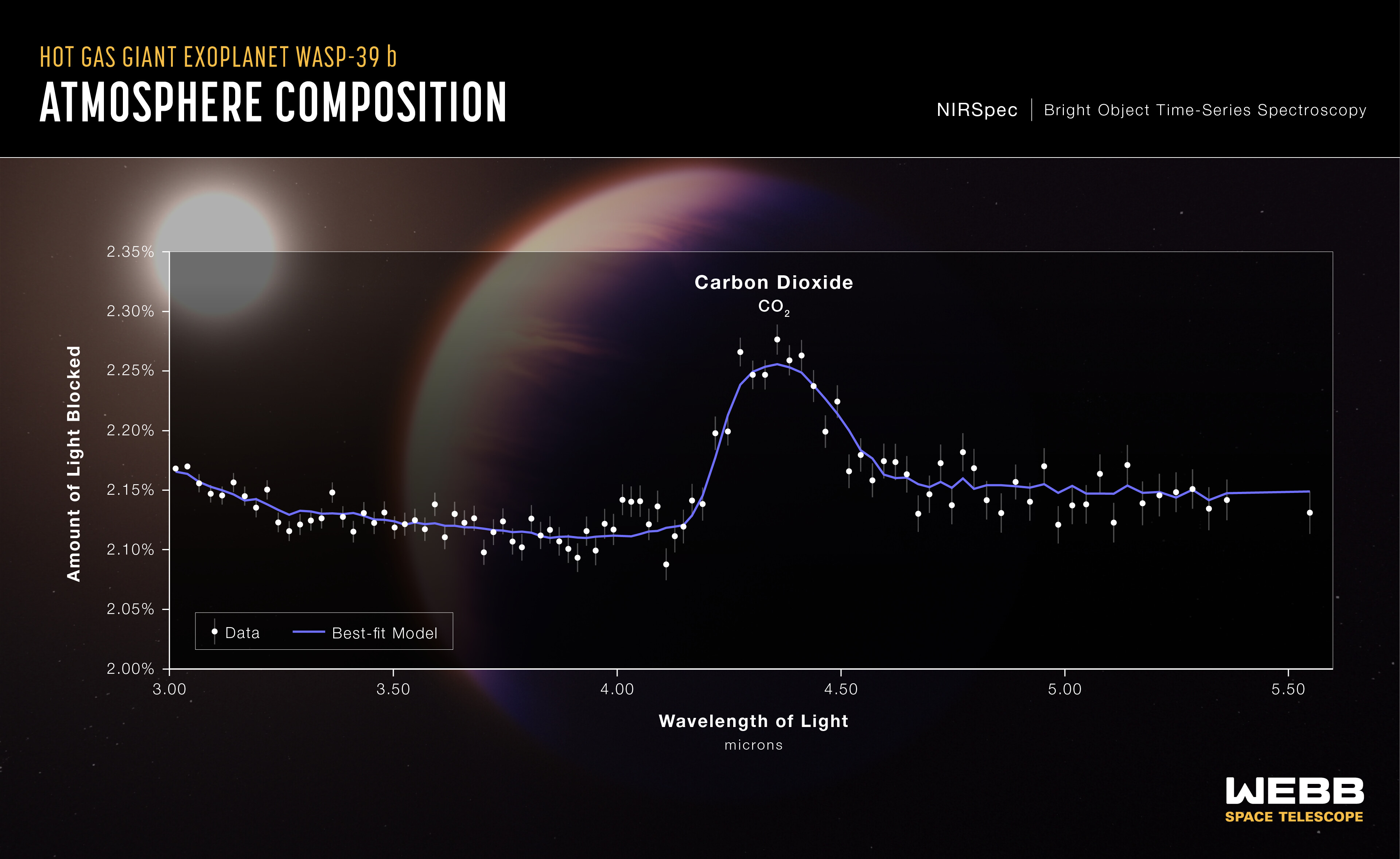
A transmission spectrum of the hot gas giant exoplanet WASP-39 b, captured by Webb’s Near-Infrared Spectrograph (NIRSpec) on July 10, 2022, reveals the first definitive evidence for carbon dioxide in the atmosphere of a planet outside the Solar System. This is the first detailed transmission spectrum ever captured that covers wavelengths between 3 and 5.5 microns.

A transmission spectrum is made by comparing starlight filtered through a planet’s atmosphere as it moves in front of the star, to the unfiltered starlight detected when the planet is beside the star. Each of the 95 data points (white circles) on this graph represents the amount of a specific wavelength of light that is blocked by the planet and absorbed by its atmosphere.

This spectrum was made by measuring the change in brightness of each wavelength over time as the planet transited its star. The planet’s atmosphere absorbs some wavelengths more than others.

Wavelengths absorbed by the atmosphere appear as peaks in the transmission spectrum. The hill centered around 4.3 microns represents the light absorbed by carbon dioxide.

The grey lines extending above and below each data point are error bars that show the uncertainty of each measurement, or the reasonable range of possible values. For a single observation, the error on these measurements is extremely small.

The blue line is a best-fit model that takes into account the data, the known properties of WASP-39 b and its star (e.g., size, mass, temperature), and the assumed characteristics of the atmosphere. Researchers can vary the parameters in the model —changing unknown characteristics like cloud height in the atmosphere and abundances of various gases—to get a better fit and further understand what the atmosphere is really like. The model shown here assumes that the planet is made primarily of hydrogen and helium with small amounts of water and carbon dioxide, with a thin veil of clouds.

The observation was made using the NIRSpec PRISM bright object time-series mode, which involves using a prism to spread out light from a single bright object (like the star WASP-39) and measuring the brightness of each wavelength at set intervals of time.

WASP-39 b is a hot gas giant exoplanet that orbits a Sun-like star roughly 700 light-years away, in the constellation Virgo. The planet orbits extremely close to its star (less than 1/20 of the distance between Earth and the Sun) and completes one orbit in just over four Earth-days. The planet’s discovery, based on ground-based observations, was announced in 2011. The star, WASP-39, is roughly the same size, mass, temperature, and color as the Sun.

The background illustration of WASP-39 b and its star is based on current understanding of the planet from Webb spectroscopy and previous ground- and space-based observations. Webb has not captured a direct image of the planet or its atmosphere.

NIRSpec was built for the European Space Agency (ESA) by a consortium of European companies led by Airbus Defence and Space (ADS) with NASA’s Goddard Space Flight Center providing its detector and micro-shutter subsystems.


Credit: NASA, European Space Agency, Canadian Space Agency, and L. Hustak (STScI)

Science: The JWST Transiting Exoplanet Community Early Release Science Team

Release Date: August 25, 2022


#NASA #ESA #Astronomy #Space #JWST #NIRSpec #Star #WASP39 #WASP39b #Exoplanet #Atmosphere #CarbonDioxide #Science #JamesWebb #WebbTelescope #UnfoldTheUniverse #Europe #CSA #Canada #Goddard #GSFC #STScI #UnitedStates #Infographic #STEM #Education

James Webb Space Telescope Detects Carbon Dioxide in Exoplanet Atmosphere

James Webb Space Telescope Detects Carbon Dioxide in Exoplanet Atmosphere


The NASA/European Space Agency/Canadian Space Agency James Webb Space Telescope has found definitive evidence for carbon dioxide in the atmosphere of a gas giant planet orbiting a Sun-like star 700 light-years away. The result provides important insights into the composition and formation of the planet, and is indicative of Webb’s ability to also detect and measure carbon dioxide in the thinner atmospheres of smaller rocky planets.

This is an illustration (artist’s impression) showing what the exoplanet WASP-39 b could look like, based on current understanding of the planet.

WASP-39 b is a hot, puffy gas giant planet with a mass 0.28 times that of Jupiter (0.94 times that of Saturn) and a diameter 1.3 times that of Jupiter, orbiting just 0.0486 astronomical units (4 520 000 miles) from its host star. The star, WASP-39, is fractionally smaller and less massive than the Sun. Because it is so close to its star, WASP-39 b is very hot and is likely to be tidally locked, meaning that one side faces the star at all times.

Data collected by Webb’s Near-Infrared Spectrograph (NIRSpec) show unambiguous evidence for carbon dioxide in the atmosphere, while previous observations from Hubble, Spitzer, and other telescopes indicate the presence of water vapour, sodium, and potassium, as well. The planet probably has clouds and some form of weather, but may not have atmospheric bands like those of Jupiter and Saturn.

This illustration is based on indirect transit observations from Webb as well as other space and ground-based telescopes. Webb has not captured a direct image of this planet.

NIRSpec was built for the European Space Agency (ESA) by a consortium of European companies led by Airbus Defence and Space (ADS) with NASA’s Goddard Space Flight Centre providing its detector and micro-shutter subsystems.


Credit: NASA, ESA, CSA, and J. Olmsted (STScI)

Release Date: August 25, 2022


#NASA #ESA #Astronomy #Space #JWST #NIRSpec #Star #WASP39 #WASP39b #Exoplanet #Atmosphere #CarbonDioxide #Science #JamesWebb #WebbTelescope #UnfoldTheUniverse #Europe #CSA #Canada #Goddard #GSFC #STScI #UnitedStates #Illustration #STEM #Education

James Webb Space Telescope Detects Carbon Dioxide in Exoplanet Atmosphere

James Webb Space Telescope Detects Carbon Dioxide in Exoplanet Atmosphere

Space Sparks Episode 4: Watch this Space Sparks episode to learn more about how the James Webb Space Telescope has found definitive evidence for carbon dioxide in the atmosphere of a gas giant planet orbiting a Sun-like star 700 light-years away.


Credits: NASA/ESA/CSA/STScI

Directed by: Bethany Downer and Nico Bartmann  

Editing: Nico Bartmann  

Web and technical support: Enciso Systems  

Written by: Bethany Downer  

Music: STAN DART - Organic Life  

Footage and photos: NASA, ESA, CSA, and STScI, NASA's Goddard Space Flight Center Conceptual Image Lab, ESO, E. Slawik, N. Risinger, D. De Martin, D. Lennon, E. Sabbi, N. Bartmann, M. Zamani

Duration: 2 minutes

Release Date: August 25, 2022


#NASA #ESA #Astronomy #Space #JWST #NIRSpec #Star #WASP39 #WASP39b #Exoplanet #Atmosphere #CarbonDioxide #Science #JamesWebb #WebbTelescope #UnfoldTheUniverse #Europe #CSA #Canada #Goddard #GSFC #STScI #UnitedStates #STEM #Education #HD #Video

Galaxy Pair Arp 116: Wide-field View | Hubble

Galaxy Pair Arp 116: Wide-field View | Hubble


This image from a ground-based telescope shows the galaxy pair Arp 116 (made up of the elliptical galaxy M60 and the spiral galaxy NGC 4647) and its surroundings.

Distance: 50 million light years


Credit: NASA, European Space Agency, Digitized Sky Survey 2 

Acknowledgement: Davide De Martin

Release Date: September 6, 2012


#NASA #ESA #Astronomy #Space #Science #Hubble #Galaxies #Galaxy #EllipticalGalaxy #Arp116 #Messier60 #M60UCD1 #Virgo #Constellation #SMC #Galaxy #Cosmos #Universe #SpaceTelescope #GSFC #STScI #UnitedStates #Europe #STEM #Education

Galaxy Pair Arp 116 (annotated) | Hubble

Galaxy Pair Arp 116 (annotated) | Hubble


This image shows Arp 116, which is composed of a giant elliptical galaxy known as Messier 60, and a much smaller spiral galaxy, NGC 4647. Also included in the image is an annotated pointer to their even smaller neighbor M60-UCD1.

Lying about 50 million light-years away, M60-UCD1 is a tiny galaxy with a diameter of 300 light-years—just 1/500th of the diameter of the Milky Way! Despite its size it is pretty crowded, containing some 140 million stars.

An international team of astronomers have found a supermassive black hole at the center of M60-UCD1 with the mass of 20 million Suns.


Credit: European Space Agency, NASA and the Hubble Heritage (STScI/AURA)

Release Date: September 6, 2012


#NASA #ESA #Astronomy #Space #Science #Hubble #Galaxies #Galaxy #EllipticalGalaxy #Arp116 #Messier60 #M60UCD1 #Virgo #Constellation #SMC #Galaxy #Cosmos #Universe #SpaceTelescope #GSFC #STScI #UnitedStates #Europe #STEM #Education

Pan across Galaxy Pair Arp 116 | Hubble

Pan across Galaxy Pair Arp 116 | Hubble

This video shows Hubble observations of Arp 116, a pair of galaxies in the constellation of Virgo. It is made up of M60, a large elliptical galaxy, and a smaller, bluer spiral galaxy, NGC 4647. It has long been unclear whether the two galaxies are actually interacting, or whether they simply appear close together from our distant vantage point. However, detailed studies of Hubble pictures suggest that the pair are beginning to experience tidal forces.

Distance: 50 million light years


Credit: NASA, European Space Agency

Duration: 1 minute

Release Date: September 6, 2012


#NASA #ESA #Astronomy #Space #Science #Hubble #Galaxies #Galaxy #EllipticalGalaxy #Arp116 #Messier60 #M60 #M60UCD1 #NGC4647 #Virgo #Constellation #SMC #Galaxy #Cosmos #Universe #SpaceTelescope #GSFC #STScI #UnitedStates #Europe #STEM #Education #HD #Video

Zoom into Galaxy Pair Arp 116 | Hubble

Zoom into Galaxy Pair Arp 116 | Hubble

This video zooms in from a view of the night sky, through the constellation of Virgo, and into a Hubble view of galaxy pair Arp 116.

Distance: 50 million light years


Credit: NASA, European Space Agency, A. Fujii, Digitized Sky Survey 2

Duration: 1 minute

Release Date: September 6, 2012


#NASA #ESA #Astronomy #Space #Science #Hubble #Galaxies #Galaxy #EllipticalGalaxy #Arp116 #Messier60 #M60UCD1 #Virgo #Constellation #SMC #Galaxy #Cosmos #Universe #SpaceTelescope #GSFC #STScI #UnitedStates #Europe #STEM #Education #HD #Video

Galaxy Pair Arp 116 | Hubble

Galaxy Pair Arp 116 | Hubble


This NASA/ESA Hubble Space Telescope image shows the peculiar galaxy pair called Arp 116. 

Distance: 50 million light years

Arp 116 is composed of a giant elliptical galaxy known as Messier 60, and a much smaller spiral galaxy, NGC 4647.

Astronomers have long tried to determine whether these two galaxies are actually interacting. Although they overlap as seen from Earth, there is no evidence of new star formation, which would be one of the clearest signs that the two galaxies are indeed interacting. However, recent studies of very detailed Hubble images suggest the onset of some tidal interaction between the two.

Also included in the image, just below and to the right of M60, is their even smaller neighbor M60-UCD1.

M60-UCD1 is a very tiny galaxy, just 1/500th of the diameter of our Milky Way, that lies about 50 million light-years away. Despite its size, it is pretty crowded, with about 140 million stars crammed into its diameter of just 300 light-years.

An international team of astronomers have found a supermassive black hole at the centre of M60-UCD1 with the mass of 20 million Suns.


Credit: European Space Agency, NASA

Release Date: September 6, 2012


#NASA #ESA #Astronomy #Space #Science #Hubble #Galaxies #Galaxy #EllipticalGalaxy #Arp116 #Messier60 #M60UCD1 #Virgo #Constellation #SMC #Galaxy #Cosmos #Universe #SpaceTelescope #GSFC #STScI #UnitedStates #Europe #STEM #Education

Zoom in on Glowing Nebula NGC 248 | Hubble

Zoom in on Glowing Nebula NGC 248 | Hubble

This zoom video starts with a wide-field view of both the Small and the Large Magellanic Clouds before zooming into the emission nebula NGC 248, located on the southern end of the Small Magellanic Cloud, as it is seen with the NASA/European Space Agency Hubble Space Telescope.

Distance: 200,000 light years


Credit: NASA, European Space Agency/Hubble, A. Fujii and Digitized Sky Survey 2 

Duration: 50 seconds

Release Date: December 20, 2016


#NASA #ESA #ESO #Astronomy #Space #Hubble #Nebula #NGC248 #EmissionNebula #Tucana #Constellation #SMC #Galaxy #Cosmos #Universe #SpaceTelescope #GSFC #STScI #UnitedStates #Europe #STEM #Education

Glowing Nebula NGC 248 in The Small Magellanic Cloud | Hubble

Glowing Nebula NGC 248 in The Small Magellanic Cloud | Hubble

This glowing nebula, named NGC 248, is located within the Small Magellanic Cloud, a satellite galaxy of the Milky Way and about 200,000 light-years from Earth. The nebula was observed with Hubble’s Advanced Camera for Surveys in September 2015, as part of a survey called the Small Magellanic cloud Investigation of Dust and Gas Evolution (SMIDGE).


Credit: NASA, European Space Agency, Space Telescope Science Institute, K. Sandstrom (University of California, San Diego), and the SMIDGE team

Release Date: December 20, 2016


#NASA #ESA #ESO #Astronomy #Space #Hubble #Nebula #NGC248 #Tucana #Constellation #SMC #Galaxy #Cosmos #Universe #SpaceTelescope #GSFC #STScI #UnitedStates #Europe #STEM #Education

Light and Dark in Taurus | Hubble

Light and Dark in Taurus | Hubble

This NASA/European Space Agency Hubble Space Telescope image shows a variety of intriguing cosmic phenomena.

Surrounded by bright stars, towards the upper middle of the frame we see a small young stellar object (YSO) known as SSTC2D J033038.2+303212. Located in the constellation of Perseus, this star is in the early stages of its life and is still forming into a fully grown star. In this view from Hubble’s Advanced Camera for Surveys (ACS) it appears to have a murky chimney of material emanating outwards and downwards, framed by bright bursts of gas flowing from the star itself. This fledgling star is actually surrounded by a bright disc of material swirling around it as it forms—a disc that we see edge-on from our perspective.

However, this small bright speck is dwarfed by its cosmic neighbor towards the bottom of the frame, a clump of bright, wispy gas swirling around as it appears to spew dark material out into space. The bright cloud is a reflection nebula known as [B77] 63, a cloud of interstellar gas that is reflecting light from the stars embedded within it. There are actually a number of bright stars within [B77] 63, most notably the emission-line star LkHA 326, and its very near neighbor LZK 18.

These stars are lighting up the surrounding gas and sculpting it into the wispy shape seen in this image. However, the most dramatic part of the image seems to be a dark stream of smoke piling outwards from [B77] 63 and its stars—a dark nebula called Dobashi 4173. Dark nebulae are incredibly dense clouds of pitch-dark material that obscure the patches of sky behind them, seemingly creating great rips and eerily empty chunks of sky. The stars speckled on top of this extreme blackness actually lie between us and Dobashi 4173.


Credit: ESA/Hubble & NASA

Release Date: August 25, 2014

#NASA #ESA #Hubble #Astronomy #Space #Science #Stars #YoungStellarObject #YSO #Perseus #B7763 #ReflectionaNebula #Nebula #Dobashi4173 #DarkNebula #Taurus #Constellations #MilkyWayGalaxy #Cosmos #Universe #SpaceTelescope #GSFC #STScI #UnitedStates #Europe #STEM #Education

Wednesday, August 24, 2022

Panning across The XZ Tauri Star System

Panning across The XZ Tauri Star System

This video pans over NASA/European Space Agency Hubble Space Telescope observations of multiple star system XZ Tauri.

Distance: 450 light years

XZ Tauri is blowing a hot bubble of gas into the surrounding space, which is filled with bright and beautiful clumps that are emitting strong winds and jets. These objects illuminate the region, creating a truly dramatic scene.


Credit: European Space Agency/Hubble and NASA

Acknowledgement: Judy Schmidt

Duration: 56 seconds

Release Date: November 6, 2014


#NASA #ESA #Hubble #Astronomy #Space #Science #StarSystems #Jets #Gas #HLTauri #XZTauri #Taurus #Constellation #Cosmos #Universe #SpaceTelescope #GSFC #STScI #UnitedStates #Europe #STEM #Education #HD #Video

The XZ Tauri Star System: Wide-field View (ground-based image)

The XZ Tauri Star System: Wide-field View (ground-based image)

This image from the Digitized Sky Survey shows the area around multiple star system XZ Tauri.

XZ Tauri is blowing a hot bubble of gas into the surrounding space, which is filled with bright and beautiful clumps that are emitting strong winds and jets.

Distance: 450 light years


Credit: NASA, European Space Agency, Digitized Sky Survey 2 

Acknowledgement: Davide De Martin

Release Date: November 6, 2014


#NASA #ESA #Hubble #Astronomy #Space #Science #StarSystems #Jets #Gas #HLTauri #XZTauri #Taurus #Constellation #Cosmos #Universe #SpaceTelescope #GSFC #STScI #UnitedStates #Europe #STEM #Education

Zooming in on XZ Tauri | Hubble

Zooming in on XZ Tauri Star System | Hubble

This video begins with a ground-based view of the night sky, before zooming in on multiple star system XZ Tauri as the NASA/European Space Agency Hubble Space Telescope sees it.

Distance: 450 light years

XZ Tauri is blowing a hot bubble of gas into the surrounding space, which is filled with bright and beautiful clumps that are emitting strong winds and jets. These objects illuminate the region, creating a truly dramatic scene.


Credit: NASA, European Space Agency, Digitized Sky Survey 2, N. Risinger

Duration: 59 seconds

Release Date: November 6, 2014


#NASA #ESA #Hubble #Astronomy #Space #Science #StarSystems #Jets #Gas #HLTauri #XZTauri #Taurus #Constellation #Cosmos #Universe #SpaceTelescope #GSFC #STScI #UnitedStates #Europe #STEM #Education #HD #Video

Jets, Bubbles and Bursts of Light in Taurus | Hubble

Jets, Bubbles and Bursts of Light in Taurus | Hubble


The NASA/European Space Agency Hubble Space Telescope has snapped a striking view of a multiple star system called XZ Tauri, its neighbor HL Tauri and several nearby young stellar objects. XZ Tauri is blowing a hot bubble of gas into the surrounding space, which is filled with bright and beautiful clumps that are emitting strong winds and jets. These objects illuminate the region, creating a truly dramatic scene.

Distance: 450 light years


Credit: European Space Agency/Hubble and NASA

Acknowledgement: Judy Schmidt

Release Date: November 6, 2014


#NASA #ESA #Hubble #Astronomy #Space #Science #StarSystems #Jets #Gas #HLTauri #XZTauri #Taurus #Constellation #Cosmos #Universe #SpaceTelescope #GSFC #STScI #UnitedStates #Europe #Infographic #STEM #Education

Brilliant Aurora Streams above Earth's Indian Ocean | International Space Station

Brilliant Aurora Streams above Earth's Indian Ocean | International Space Station


A brilliant aurora streams above Earth's horizon in this photograph from the International Space Station as it orbited 270 miles above the Indian Ocean northeast of the French Southern and Antarctic Lands.

Expedition 67 Crew

Commander Oleg Artemyev (Russia)
Roscosmos Flight Engineers: Denis Matveev and Sergey Korsakov (Russia)
NASA Flight Engineers: Kjell Lindgren, Bob Hines, Jessica Watkins (USA)
European Space Agency (ESA) Flight Engineer: Samantha Cristoforetti (Italy)

An international partnership of space agencies provides and operates the elements of the International Space Station (ISS). The principals are the space agencies of the United States, Russia, Europe, Japan, and Canada. The ISS has been the most politically complex space exploration program ever undertaken.

Learn more about the important research being operated on Station:

For more information about STEM on Station:
Science, Technology, Engineering, Math (STEM) Education

Credit: NASA's Johnson Space Center (JSC)
Release Date: August 17, 2022

#NASA #Space #Earth #Sun #Star #ISS #IndianOcean #Aurora #Astronauts #Europe #Italia #Italy #Canada #Japan #日本 #Russia #Россия #Science #Research #International #Expedition67 #STEM #Education