Sunday, September 18, 2022

A Great Ball of Stars: NGC 1806 | Hubble

A Great Ball of Stars: NGC 1806 | Hubble


The NASA/European Space Agency Hubble Space Telescope has turned its sharp eye towards a tight collection of stars, first seen 174 years ago. The result is a sparkling image of NGC 1806, tens of thousands of stars gravitationally bound into a rich cluster. Commonly called globular clusters, most of these objects are very old, having formed in the distant past when the Universe was only a fraction of its current age. NGC 1806 lies within the Large Magellanic Cloud, a satellite galaxy of our own Milky Way. It can be observed within the constellation of Dorado (the dolphin-fish), an area of the sky best seen from the Earth’s southern hemisphere.

NGC 1806 was discovered in 1836 by the British astronomer John Herschel. He had travelled to South Africa in order to catalog astronomical objects visible best from southern latitudes, and thereby complete work begun by his father William, the man who coined the term “globular cluster”. Using a large telescope John Herschel carefully scanned the night sky and noted objects of interest, of which NGC 1806 was one. In the same year that he documented NGC 1806 he was visited by the naturalist Charles Darwin after the HMS Beagle stopped over in Cape Town. Darwin later referred to John Herschel as “one of our greatest philosophers”.

The Wide Field Channel of Hubble's Advanced Camera for Surveys was used to obtain this picture that was created from images taken through blue (F435W, colored blue), yellow (F555W, colored green) and near-infrared (F814W, colored red) filters. The exposure times were 770 s, 720 s and 688 s, respectively, and the field of view is  3.1 by 1.9 arcminutes. Surely Herschel, who made great contributions to the sciences of both astronomy and photography, would have been immensely impressed by this glittering Hubble picture.


Credit: European Space Agency (ESA)/Hubble & NASA

Release Date: October 25, 2010


#NASA #ESA #Astronomy #Space #Science #Hubble #StarCluster #GlobularCluster #NGC1806 #Dorado #Constellation #LMC #Galaxy #Cosmos #Universe #SpaceTelescope #STScI #GSFC #UnitedStates #Europe #Astronomer #JohnHerschel #History #STEM #Education

Different Generations Standing Together: Star Cluster NGC 1866 | Hubble

Different Generations Standing Together: Star Cluster NGC 1866 | Hubble

Star clusters are common structures throughout the Universe, each made up of hundreds of thousands of stars all bound together by gravity. This star-filled image, taken with the NASA/European Space Agency Hubble Space Telescope’s Wide Field Camera 3 (WFC3), shows one of them: NGC 1866.

NGC 1866 is found at the very edges of the Large Magellanic Cloud, a small galaxy located near to the Milky Way. The cluster was discovered in 1826 by Scottish astronomer James Dunlop, who catalogued thousands of stars and deep-sky objects during his career.

However, NGC 1866 is no ordinary cluster. It is a surprisingly young globular cluster situated close enough to us that its stars can be studied individually—no mean feat given the mammoth distances involved in studying the cosmos! There is still debate over how globular clusters form, but observations such as this have revealed that most of their stars are old and have a low metallicity. In astronomy, ‘metals’ are any elements other than hydrogen and helium; since stars form heavier elements within their core as they carry out nuclear fusion throughout their lifetimes, a low metallicity indicates that a star is very old, as the material from which it formed was not enriched with many heavy elements. It is possible that the stars within globular clusters are so old that they were actually some of the very first to form after the Big Bang.

In the case of NGC 1866, though, not all stars are the same. Different populations, or generations, of stars are thought to coexist within the cluster. Once the first generation of stars formed, the cluster may have encountered a giant gas cloud that sparked a new wave of star formation and gave rise to a second, younger, generation of stars—explaining why it seems surprisingly youthful.


Credit: European Space Agency (ESA)/Hubble & NASA

Release Date: November 19, 2018


#NASA #ESA #Astronomy #Space #Science #Hubble #Stars #GlobularStarCluster #StarCluster #NGC1866 #Dorado #Constellation #LMC #Galaxy #Cosmos #Universe #SpaceTelescope #STScI #GSFC #UnitedStates #Europe #History #STEM #Education

Pan across a Scattering of Stars: Open Star Cluster NGC 330 | Hubble

Pan across a Scattering of Stars: Open Star Cluster NGC 330 | Hubble

This video showcases the open star cluster NGC 330, which lies around 180,000 light-years away inside the Small Magellanic Cloud. The cluster—which is in the constellation Tucana (The Toucan)—contains a multitude of stars, many of which are scattered across this striking image.


Credit: ESA/Hubble & NASA, J. Kalirai, A. Milone  

Duration: 30 seconds

Release Date: July 25, 2021


#NASA #ESA #Astronomy #Space #Science #Hubble #Stars #OpenStarCluster #StarClusters #NGC330 #GALFOR1 #Tucana #Constellation #LMC #Galaxy #Cosmos #Universe #SpaceTelescope #STScI #GSFC #UnitedStates #Europe #STEM #Education #HD #Video

A Scattering of Stars: Open Star Cluster NGC 330 | Hubble

A Scattering of Stars: Open Star Cluster NGC 330 | Hubble


This image depicts the open star cluster NGC 330, which lies around 180,000 light-years away inside the Small Magellanic Cloud. The cluster—which is in the constellation Tucana (The Toucan)—contains a multitude of stars, many of which are scattered across this striking image.

The most stunning object in this image is actually the very small star cluster in the lower left corner of the image, surrounded by a nebula of ionized hydrogen (red) and dust (blue). Named GALFOR 1, the cluster was discovered in 2018 in Hubble's archival data, which was used to create this latest image from Hubble. To better understand this star cluster, specifically whether the nebula surrounding the cluster also contains a bow shock, scientists will need high resolution infrared imagery from the upcoming NASA/European Space Agency/Canadian Space Agency James Webb Space Telescope.

This image also contains clues about the inner workings of Hubble itself. The criss-cross patterns surrounding the stars in this image—known as diffraction spikes—were created when starlight interacted with the four thin vanes supporting Hubble’s secondary mirror.

As star clusters form from a single primordial cloud of gas and dust, all the stars they contain are roughly the same age. This makes them useful natural laboratories for astronomers to learn how stars form and evolve. This image uses observations from Hubble’s Wide Field Camera 3, and incorporates data from two very different astronomical investigations. The first aimed to understand why stars in star clusters appear to evolve differently from stars elsewhere, a peculiarity first observed by the Hubble Space Telescope. The second aimed to determine how large stars can be before they become doomed to end their lives in cataclysmic supernova explosions.


Credit: European Space Agency (ESA)/Hubble & NASA, J. Kalirai, A. Milone

Release Date: June 28, 2021


#NASA #ESA #Astronomy #Space #Science #Hubble #Stars #OpenStarCluster #StarClusters #NGC330 #GALFOR1 #Tucana #Constellation #LMC #Galaxy #Cosmos #Universe #SpaceTelescope #STScI #GSFC #UnitedStates #Europe #STEM #Education

A Pocketful of Stars: Globular Cluster NGC 1805 | Hubble

A Pocketful of Stars: Globular Cluster NGC 1805 | Hubble

Many colorful stars are packed close together in this image of the globular cluster NGC 1805, taken by the NASA/European Space Agency Hubble Space Telescope. This tight grouping of thousands of stars is located near the edge of the Large Magellanic Cloud, a satellite galaxy of our own Milky Way. The stars orbit closely to one another, like bees swarming around a hive. In the dense center of one of these clusters, stars are 100 to 1000 times closer together than the nearest stars are to our Sun, making planetary systems around them unlikely.

The striking difference in star colors is illustrated beautifully in this image, which combines two different types of light: blue stars, shining brightest in near-ultraviolet light, and red stars, illuminated in red and near-infrared. Space telescopes like Hubble can observe in the ultraviolet because they are positioned above Earth’s atmosphere, which absorbs most of this wavelength, making it inaccessible to ground-based facilities.

This young globular cluster can be seen from the southern hemisphere, in the Dorado constellation, which is Portugese for dolphinfish. Usually, globular clusters contain stars which are born at the same time. However, NGC 1805 is unusual as it appears to host two different populations of stars with ages millions of years apart. Observing such clusters of stars can help astronomers understand how stars evolve, and what factors determine whether they end their lives as white dwarfs, or explode as supernovae.


Credit: European Space Agency (ESA)/Hubble & NASA, J. Kalirai

Release Date: September 7, 2020


#NASA #ESA #Astronomy #Space #Science #Hubble #Ultraviolet #Infrared #Stars #GlobularCluster #NGC1805 #Dorado #Constellation #LMC #Galaxy #Cosmos #Universe #SpaceTelescope #STScI #GSFC #UnitedStates #Europe #STEM #Education

Faint Afterglow of Nearby Stellar Explosion: Supernova Remnant N132D | Hubble

Faint Afterglow of Nearby Stellar Explosion: Supernova Remnant N132D | Hubble


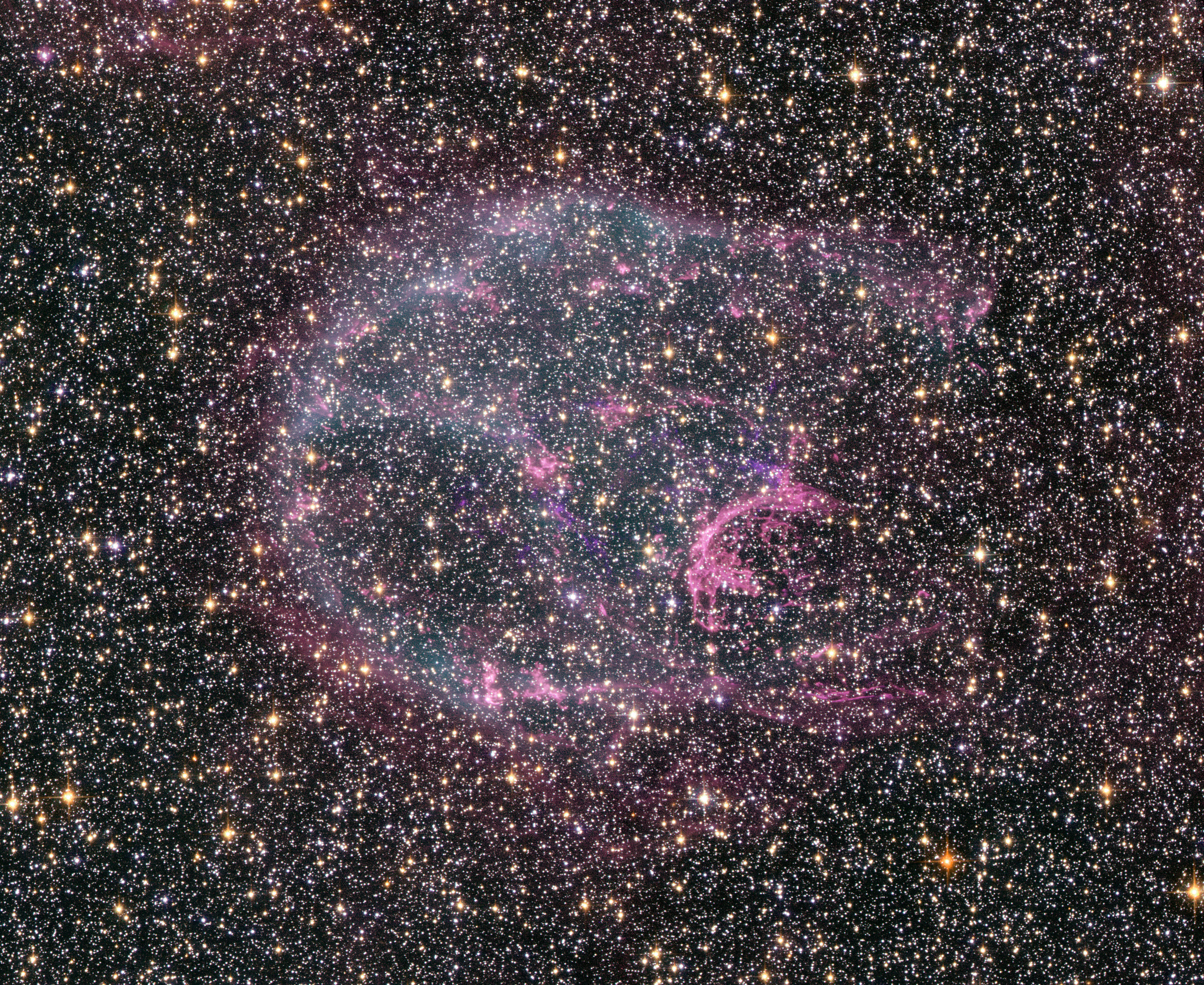
Intricate wisps of glowing gas float amid a myriad of stars in this image created by combining data from the NASA/European Space Agency Hubble Space Telescope and Chandra X-ray Observatory. The gas is a supernova remnant, cataloged as N132D, ejected from the explosion of a massive star that occurred some 3,000 years ago. This titanic explosion took place in the Large Magellanic Cloud, a nearby neighbor galaxy of our own Milky Way.

Distance: 170,000 light years


Credit: NASA, European Space Agency (ESA), and The Hubble Heritage Team STScI/AURA

Release Date: October 4, 2005


#NASA #ESA #Astronomy #Space #Science #Hubble #Chandra #Observatory #Xray #Star #Supernova #SupernovaRemnant #Nebula #N132D #Dorado #Constellation #LMC #Galaxy #Cosmos #Universe #SpaceTelescopes #STScI #GSFC #UnitedStates #Europe #STEM #Education

A Vapor of Stars: Galaxy DDO 82 | Hubble

A Vapor of Stars: Galaxy DDO 82 | Hubble


Relatively few galaxies possess the sweeping, luminous spiral arms or brightly glowing center of our home galaxy the Milky Way. In fact, most of the Universe's galaxies look like small, amorphous clouds of vapor. One of these galaxies is DDO 82, captured here in an image from the NASA/European Space Agency Hubble Space Telescope. Though tiny compared to the Milky Way, such dwarf galaxies still contain between a few million and a few billion stars.

DDO 82, also known by the designation UGC 5692, is not without a hint of structure, however. Astronomers classify it as an Sm galaxy, or Magellanic spiral galaxy, named after the Large Magellanic Cloud, a dwarf galaxy that orbits the Milky Way. That galaxy, like DDO 82, is said to have one spiral arm.

In the case of DDO 82, gravitational interactions over its history seem to have discombobulated it so that this structure is not as evident as in the Large Magellanic Cloud. Accordingly, astronomers also refer to DDO 82 and others of a similar unshapely nature as dwarf irregular galaxies.       

DDO 82 can be found in the constellation of Ursa Major (the Great Bear) approximately 13 million light-years away. The object is considered part of the M81 Group of around three dozen galaxies. DDO 82 gets its name from its entry number in the David Dunlap Observatory Catalogue. Canadian astronomer Sidney van den Bergh originally compiled this list of dwarf galaxies in 1959.

The image is made up of exposures taken in visible and infrared light by Hubble’s Advanced Camera for Surveys. The field of view is approximately 3.3 by 3.3 arcminutes.


Credit: European Space Agency (ESA)/Hubble & NASA

Distance: 13 million light years

Release Date: June 25, 2012


#NASA #ESA #Astronomy #Space #Science #Hubble #Stars #Galaxy #DDO82 #UGC5692 #SmGalaxy #MagellanicSpiralGalaxy #UrsaMajor #Constellation #Cosmos #Universe #SpaceTelescope #STScI #GSFC #UnitedStates #Europe #DavidDunlapObservatory #Canada #History #STEM #Education

NASA Astronaut Frank Rubio Prepares for Russian Soyuz Rocket Launch

NASA Astronaut Frank Rubio Prepares for Russian Soyuz Rocket Launch

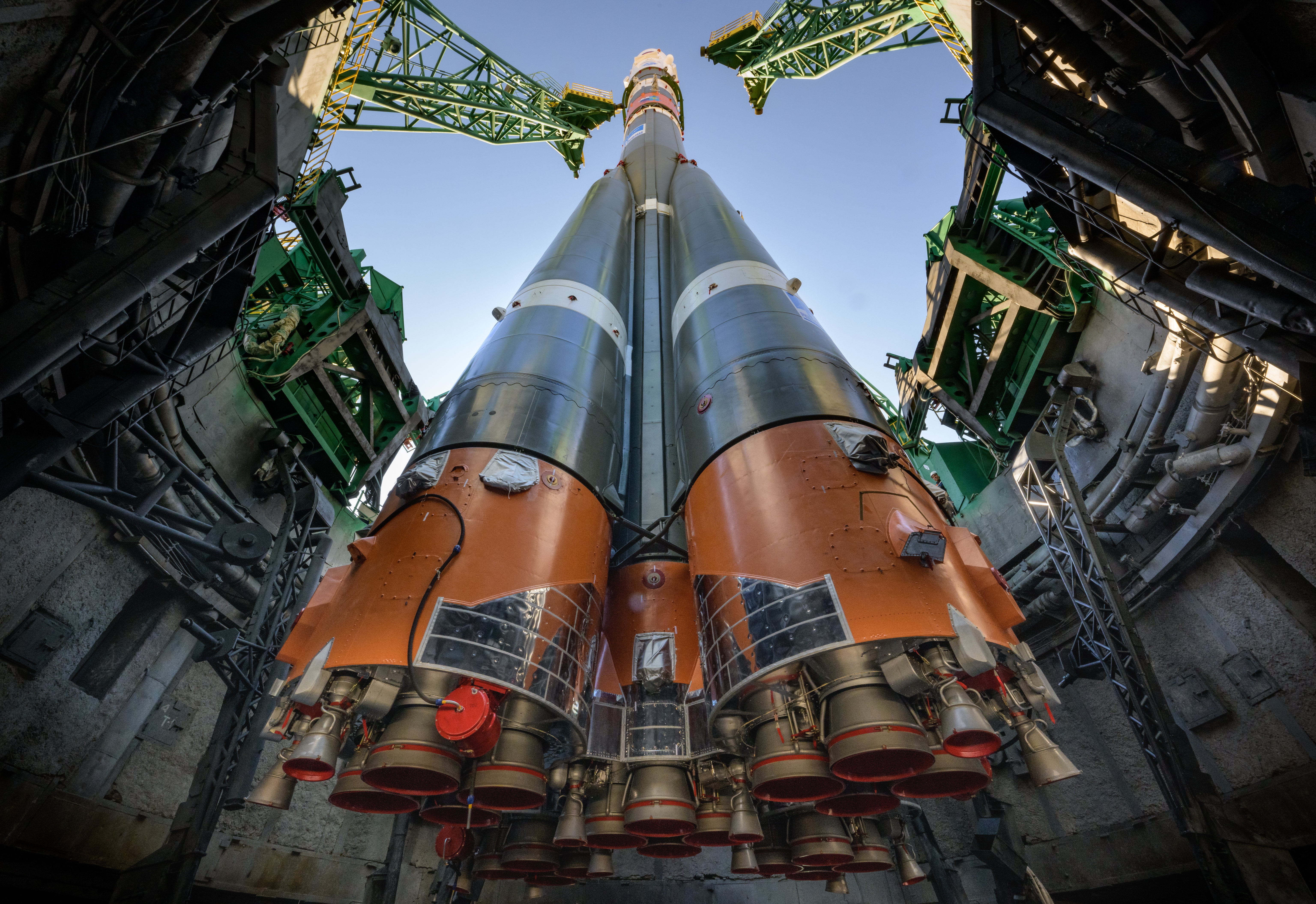
U.S. astronaut Frank Rubio prepares for launch to the International Space Station on a Russian Soyuz rocket. Expedition 68 astronaut Frank Rubio of NASA, and cosmonauts Sergey Prokopyev and Dmitri Petelin of Roscosmos are scheduled to launch aboard their Soyuz MS-22 spacecraft on Sept. 21, 2022. In this image, Frank Rubio performs preflight checkouts in the Soyuz MS-22 spacecraft at the Baikonur Cosmodrome in Kazakhstan. Rubio is scheduled for a six-month mission on the International Space Station.

A Soyuz rocket was raised to vertical after having rolled out by train to the launch pad, Sunday, Sept. 18, at site 31 of the Baikonur Cosmodrome in Kazakhstan. 

Launch coverage will begin at 9 a.m. on NASA Television’s Public Channel, the NASA app, and on the agency’s website. 

Watch the Soyuz MS-22 launch online at: https://www.nasa.gov/live


An international partnership of space agencies provides and operates the elements of the  International Space Station (ISS). The principals are the space agencies of the United States, Russia, Europe, Japan, and Canada. The ISS has been the most politically complex space exploration program ever undertaken.


Credit: NASA/Victor Zelentsov

Release Date: September 16, 2022


#NASA #ISS #Earth #Science #Soyuz #Rocket #SoyuzMS22 #Spacecraft #Cosmonauts #Commander #SergeyProkopyev #DmitriPetelin #Russia #Россия #Astronaut #FrankRubio #UnitedStates #JSC #BaikonurCosmodrome #Kazakhstan ##Қазақстан #Human #Spaceflight #Expedition68 #STEM #Education

Expedition 68 Soyuz Rocket Rollout in Kazakhstan | International Space Station

Expedition 68 Soyuz Rocket Rollout in Kazakhstan | International Space Station


U.S. astronaut Frank Rubio prepares for launch to the International Space Station on a Russian Soyuz rocket. A Soyuz rocket is raised to vertical after having rolled out by train to the launch pad, Sunday, Sept. 18, 2022, at site 31 of the Baikonur Cosmodrome in Kazakhstan. Expedition 68 astronaut Frank Rubio of NASA, and cosmonauts Sergey Prokopyev and Dmitri Petelin of Roscosmos are scheduled to launch aboard their Soyuz MS-22 spacecraft on Sept. 21.

Coverage will begin at 9 a.m. on NASA Television’s Public Channel, the NASA app, and on the agency’s website. 

Watch the Soyuz MS-22 launch online at: https://www.nasa.gov/live


An international partnership of space agencies provides and operates the elements of the  International Space Station (ISS). The principals are the space agencies of the United States, Russia, Europe, Japan, and Canada. The ISS has been the most politically complex space exploration program ever undertaken.


Image Credit: NASA/Bill Ingalls/Victor Zelentsov

Image Date: September 18, 2022


#NASA #ISS #Earth #Science #Soyuz #Rocket #SoyuzMS22 #Spacecraft #Cosmonauts #Commander #SergeyProkopyev #DmitriPetelin #Russia #Россия #Astronaut #FrankRubio #UnitedStates #JSC #BaikonurCosmodrome #Kazakhstan #Қазақстан #Human #Spaceflight #Expedition68 #STEM #Education

New Views of The Tarantula Nebula | James Webb Space Telescope

New Views of The Tarantula Nebula | James Webb Space Telescope


The Tarantula Nebula, also known as 30 Doradus, is more than a thousand light-years in diameter, a giant star forming region within nearby satellite galaxy the Large Magellanic Cloud. About 180 thousand light-years away, it is the largest, most violent star forming region known in the whole Local Group of galaxies. The cosmic arachnid sprawls across this magnificent view, an assembly of image data from large space- and ground-based telescopes. Within the Tarantula (NGC 2070), intense radiation, stellar winds, and supernova shocks from the central young cluster of massive stars cataloged as R136 energize the nebular glow and shape the spidery filaments. 

Around the Tarantula are other star forming regions with young star clusters, filaments, and blown-out bubble-shaped clouds. If the Tarantula Nebula was closer, say 1,500 light-years distant like the Milky Way's own star forming Orion Nebula, it would take up half the sky.


Image Credit & Copyright: Processing Roberto Colombari

Data - Hubble Tarantula Treasury, European Southern Observatory, James Webb Space Telescope, Amateur Sources

Release Date: September 16, 2022


#NASA #ESA #Astronomy #Space #Science #Nebula #TarantulaNebula #30Doradus #LargeMagellanicCloud #LMC #Dorado #Constellation #JamesWebb #SpaceTelescope #JWST #Cosmos #Universe #UnfoldTheUniverse #Europe #CSA #Canada #GSFC #STScI #UnitedStates #STEM #Education

Multiple generations of Stars in The Tarantula Nebula | Hubble

Multiple Generations of Stars in The Tarantula Nebula | Hubble


The star cluster Hodge 301 is an old cluster. Many of its stars have already exploded as supernovae. The filaments in the upper left corner have been compressed by the explosions of these stars. Elsewhere in the picture news stars are being born.

In the most active starburst region in the local universe lies a cluster of brilliant, massive stars, known to astronomers as Hodge 301.

Hodge 301, seen in the lower right hand corner of this image, lives inside the Tarantula Nebula in our galactic neighbor, the Large Magellanic Cloud.

Distance: 170,000 light years


Credit: Hubble Heritage Team (AURA/STScI/NASA/ESA)

Release Date: April 1, 1999


#NASA #ESA #Astronomy #Space #Science #Hubble #Stars #StarFormation #Nebula #R136 #30Doradus #TarantulaNebula #StarCluster #Hodge301 #Dorado #Constellation #LMC #Galaxy #Cosmos #Universe #SpaceTelescope #STScI #GSFC #UnitedStates #Europe #STEM #Education


Saturday, September 17, 2022

30 Doradus Nebula in Infrared | Hubble

30 Doradus Nebula in Infrared | Hubble


This image is the most detailed view of the largest stellar nursery in our local galactic neighborhood. The stellar grouping, called R136, is only a few million years old and resides in the 30 Doradus Nebula, a turbulent star-birth region in the Large Magellanic Cloud (LMC), a satellite galaxy of our Milky Way. There is no known star-forming region in our galaxy as large or as prolific as 30 Doradus. Many of the diamond-like stars are among the most massive stars known. Several of them are over 100 times more massive than our Sun.

Distance: 170,000 light years


Credit: NASA, European Space Agency (ESA), F. Paresce (INAF-IASF, Bologna, Italy), R. O'Connell (University of Virginia, Charlottesville), and the Wide Field Camera 3 Science Oversight Committee

Release Date: December 15, 2009


#NASA #ESA #Astronomy #Space #Science #Hubble #Stars #StarFormation #Nebula #R136 #30Doradus #Infrared #TarantulaNebula #Dorado #Constellation #LMC #Galaxy #Cosmos #Universe #SpaceTelescope #STScI #GSFC #UnitedStates #Europe #STEM #Education

30 Doradus Nebula in Ultraviolet, Visible, and Red Light | Hubble

30 Doradus Nebula in Ultraviolet, Visible, and Red Light | Hubble


This image of hundreds of brilliant blue stars wreathed by warm glowing clouds is the most detailed view of the largest stellar nursery in our local galactic neighborhood. The stellar grouping, called R136, is only a few million years old and resides in the 30 Doradus Nebula, a turbulent star-birth region in the Large Magellanic Cloud (LMC), a satellite galaxy of our Milky Way. There is no known star-forming region in our galaxy as large or as prolific as 30 Doradus. Many of the diamond-like icy blue stars are among the most massive stars known. Several of them are over 100 times more massive than our Sun.

Distance: 170,000 light years

The image, taken in ultraviolet, visible, and red light by Hubble's Wide Field Camera 3, spans about 100 light-years. The nebula is close enough to Earth that Hubble can resolve individual stars, giving astronomers important information about the birth and evolution of stars in the universe.


Credit: NASA, European Space Agency (ESA), F. Paresce (INAF-IASF, Bologna, Italy), R. O'Connell (University of Virginia, Charlottesville), and the Wide Field Camera 3 Science Oversight Committee

Release Date: December 15, 2009


#NASA #ESA #Astronomy #Space #Science #Hubble #Stars #StarFormation #Nebula #R136 #30Doradus #TarantulaNebula #Dorado #Constellation #LMC #Galaxy #Cosmos #Universe #SpaceTelescope #STScI #GSFC #UnitedStates #Europe #STEM #Education

Celestial Fireworks: Supernova Remnant DEM L 190 | Hubble

Celestial Fireworks: Supernova Remnant DEM L 190 | Hubble


Resembling the puffs of smoke and sparks from a summer fireworksdisplay in this image from the NASA/European Space Agency Hubble Space Telescope, these delicate filaments are actually sheets of debris from a stellar explosion in a neighboring galaxy. Hubble's target was a supernova remnant within the Large Magellanic Cloud (LMC), a nearby, small companion galaxy to the Milky Way visible from the southern hemisphere.

Distance: 170,000 light years

Denoted N 49, or DEM L 190, this remnant is from a massive star that died in a supernova blast whose light would have reached Earth thousands of years ago. This filamentary material will eventually be recycled into building new generations of stars in the LMC. Our own Sun and planets are constructed from similar debris of supernovae that exploded in the Milky Way billions of years ago.


Credit: NASA/European Space Agency (ESA) and The Hubble Heritage Team (STScI/AURA)

Release Date: July 3, 2003


#NASA #ESA #Astronomy #Space #Science #Hubble #Star #WhiteDwarfStar #Supernova #SupernovaRemnant #Nebula #DEML190 #Dorado #Constellation #LMC #Galaxy #Cosmos #Universe #SpaceTelescope #STScI #GSFC #UnitedStates #Europe #STEM #Education

Stellar Shrapnel: Supernova Remnant DEM L71 | Hubble

Stellar Shrapnel: Supernova Remnant DEM L71 | Hubble


Several thousand years ago, a star some 160,000 light-years away from us exploded, scattering stellar shrapnel across the sky. The aftermath of this energetic detonation is shown here in this striking image from the NASA/European Space Agency Hubble Space Telescope’s Wide Field Camera 3.

The exploding star was a white dwarf located in the Large Magellanic Cloud, one of our nearest neighboring galaxies. Around 97% of stars within the Milky Way that are between a tenth and eight times the mass of the Sun are expected to end up as white dwarfs. These stars can face a number of different fates, one of which is to explode as supernovae, some of the brightest events ever observed in the Universe. If a white dwarf is part of a binary star system, it can siphon material from a close companion. After gobbling up more than it can handle—and swelling to approximately one and a half times the size of the Sun—the star becomes unstable and ignites as a Type Ia supernova.

This was the case for the supernova remnant pictured here, which is known as DEM L71. It formed when a white dwarf reached the end of its life and ripped itself apart, ejecting a superheated cloud of debris in the process. Slamming into the surrounding interstellar gas, this stellar shrapnel gradually diffused into the separate fiery filaments of material seen scattered across this skyscape.


Credit: European Space Agency (ESA)/Hubble & NASA, Y. Chu

Release Date: August 15, 2016


#NASA #ESA #Astronomy #Space #Science #Hubble #Star #WhiteDwarfStar #Supernova #SupernovaRemnant #Nebula #DEML71 #Dorado #Constellation #LMC #Galaxy #Cosmos #Universe #SpaceTelescope #STScI #GSFC #UnitedStates #Europe #STEM #Education

Peeking inside a Stellar Cloud | Hubble

Peeking inside a Stellar Cloud | Hubble


These bright stars shining through what looks like a haze in the night sky are part of a young stellar grouping in one of the largest known star formation regions of the Large Magellanic Cloud (LMC), a dwarf satellite galaxy of the Milky Way. The image was captured by the NASA/European Space Agency Hubble Space Telescope’s Wide Field Planetary Camera 2.

The stellar grouping is known to stargazers as NGC 2040 or LH 88. It is essentially a very loose star cluster whose stars have a common origin and are drifting together through space. There are three different types of stellar associations defined by their stellar properties. NGC 2040 is an OB association, a grouping that usually contains 10–100 stars of type O and B—these are high-mass stars that have short but brilliant lives. It is thought that most of the stars in the Milky Way were born in OB associations.

There are several such groupings of stars in the LMC. Just like the others, LH 88 consists of several high-mass young stars in a large nebula of partially ionized hydrogen gas, and lies in what is known to be a supergiant shell of gas called LMC 4.

Over a period of several million years, thousands of stars may form in these supergiant shells, which are the largest interstellar structures in galaxies. The shells themselves are believed to have been created by strong stellar winds and clustered supernova explosions of massive stars that blow away surrounding dust and gas, and in turn trigger further episodes of star formation.

The LMC is the third closest galaxy to our Milky Way. It is located some 160,000 light-years away, and is about 100 times smaller than our own.

This image, which shows ultraviolet, visible and infrared light, covers a field of view of approximately 1.8 by 1.8 arcminutes.

A version of this image was entered into the Hubble’s Hidden Treasures Image Processing Competition by contestant Eedresha Sturdivant. Hidden Treasures is an initiative to invite astronomy enthusiasts to search the Hubble archive for stunning images that have never been seen by the general public.


Credit: ESA/Hubble, NASA and D. A Gouliermis

Acknowledgement: Eedresha Sturdivant

Release Date: April 16, 2012


#NASA #ESA #Astronomy #Space #Science #Hubble #Stars #StarFormation #Nebula #NGC2040 #LH88 #Dorado #Constellation #LMC #Galaxy #Cosmos #Universe #SpaceTelescope #STScI #GSFC #UnitedStates #Europe #STEM #Education