Tuesday, September 27, 2022

DART Spacecraft's Asteroid Impact Viewed from Earth | European Space Agency

DART Spacecraft's Asteroid Impact Viewed from Earth | European Space Agency

Last night at 23:14 UTC, NASA's DART spacecraft successfully struck asteroid Dimorphos, the 160-meter moonlet orbiting around the larger Didymos asteroid. About 38 seconds later, the time it took for the light to arrive at Earth, people all over the world saw the abrupt end of the livestream from the spacecraft, signalling that the impact had happened successfully—DART was no more. 

Astronomers on a small slice of our planet’s surface, extending from southern and eastern Africa to the Indian Ocean and the Arabian Peninsula, could actually watch it live with their telescopes. Among those were a half dozen stations joined together for a dedicated observing campaign organized by the European Space Agency’s Planetary Defence Office and coordinated by the team of observers of the Agency’s Near-Earth Object Coordination Center (NEOCC). As usual, when such a timely astronomical event happens, not all stations were successful in their observations: clouds, technical problems and other issues always affect real-life observations.

However, a few of the European Space Agency’s collaborating stations could immediately report a successful direct confirmation of DART’s impact. Among them was the team of the Les Makes Observatory, on the French island of La Reunion in the Indian Ocean. The sequence of images they provided in real time was impressive. The asteroid immediately started brightening upon impact, and within a few seconds it was already noticeably brighter. Within less than a minute a cloud of ejected material became visible and could be followed while it drifted eastwards and slowly dissipated. 

This video is from observations by the Les Makes Observatory in Le Reunion and shows in a few seconds what took place in under half an hour.

“Something like this has never been done before, and we weren’t entirely sure what to expect. It was an emotional moment for us as the footage came in,” explains Marco Micheli, Astronomer at ESA’s NEOCC.

Dora Föhring, another NEOCC Astronomer adds: 

“This was the conclusion of weeks of discussions, meetings, accurate planning and observational design by our team, together with local observers and scientists at all our collaborating stations. This fantastic campaign has produced data that our astronomers, together with the whole DART collaboration, will now begin to analyze to extract valuable scientific information on the effects of the impact.” 

As DART’s mission ends, the work begins for astronomers and scientists around the globe, and a new chapter opens for ESA’s Hera mission which now takes a leading role in studying up close the first-ever test of asteroid deflection.  

“The results from DART will prepare us for Hera’s visit to the Didymos binary system to examine the aftermath of this impact a few years from now,” says Ian Carnelli, Hera Mission Manager. 

“Hera will help us understand what happened to Dimorphos, the first celestial body to be measurably moved by humankind, and ultimately to protect ourselves from space rocks that could one day do the same.” 


Credit: European Space Agency (ESA)

Duration: 28 seconds

Release Date: September 27, 2022


#NASA #ESA #Space #Astronomy #Science #LesMakesObservatory #LaReunion #IndianOcean #Spacecraft #DARTMission #Asteroids #Dimorphos #Didymos #Earth #PlanetaryDefense #DeepSpace #SolarSystem #Exploration #JHUAPL #UnitedStates #Europe #STEM #Education #HD #Video

Spiral Galaxy IC 5332 | Hubble & Webb Views

Spiral Galaxy IC 5332: Hubble & Webb Views

Webb’s icy instrument reveals complex structures

The Hubble image shows dark regions that seem to separate the spiral arms, whereas the Webb image shows more of a continual tangle of structures that echo the spiral arms’ shape. This difference is due to the presence of dusty regions in the galaxy.

Ultraviolet and visible light are far more prone to being scattered by interstellar dust than infrared light. Therefore dusty regions can be identified easily in the Hubble image as the darker regions that much of the galaxy’s ultraviolet and visible light has not been able to travel through. Those same dusty regions are no longer dark in the Webb image, however, as the mid-infrared light from the galaxy has been able to pass through them.

Different stars are visible in the two images, which can be explained because certain stars shine brighter in the ultraviolet, visible and infrared regimes respectively. The images complement one another in a remarkable way, each telling us more about IC 5332’s structure and composition.


Credits: ESA/Webb, NASA & CSA, J. Lee and the PHANGS-JWST and PHANGS-HST Teams; CC BY 4.0

Release Date: September 27, 2022


#NASA #ESA #Astronomy #Space #Hubble #JWST #Galaxy #IC5332 #Sculptor #Constellation #Cosmos #Universe #SpaceTelescopes #GSFC #STScI #UnitedStates #CSA #Canada #Europe #STEM #Education

Hera Probe to Revisit Asteroid after NASA's DART Mission | European Space Agency

Hera Probe to Revisit Asteroid after NASA's DART Mission | European Space Agency

The night of September 26, 2022, made space history. NASA's DART spacecraft impacted the Dimorphos asteroid in an attempt to divert its course—humankind's first planetary defence test. In 2024, the European Space Agency launches its Hera spacecraft to investigate the post-impact asteroid. In fact, Hera is not one spacecraft but three. It carries with it Europe's first deep-space CubeSats to make extra observations of its target. 

With the Hera mission, the European Space Agency (ESA) is assuming even greater responsibility for protecting our planet and ensuring that Europe plays a leading role in the common effort to tackle asteroid risks.  

In this video, Ian Carnelli, Hera mission manager, and members of the Hera team, reflects on the DART impact and introduces Hera, including its Milani and Juventas CubeSats.

After the world’s first test of asteroid deflection, Hera will perform a detailed post-impact survey of the target asteroid, Dimorphos—the orbiting Moonlet in a binary asteroid system known as Didymos. Hera will turn this grand-scale experiment into a well-understood and repeatable planetary defence technique.

Demonstrating new technologies from autonomous navigation around an asteroid to low gravity proximity operations, Hera will be humankind’s first probe to rendezvous with a binary asteroid system and Europe’s flagship Planetary Defender.

Hera's Planned Launch Date: October 2024

Target: Dimorphos

Impact Date: September 26, 2022

Hera rendezvous: December 2026

Learn more: https://www.esa.int/Space_Safety/Hera


Credit: European Space Agency (ESA)

Duration: 3 minutes, 15 seconds

Release Date: September 27, 2022


#NASA #ESA #Space #Astronomy #Science #Hera #Spacecraft #CubeSats #Milani #Juventas #DART #DARTMission #Asteroids #Dimorphos #Didymos #Earth #PlanetaryDefense #DeepSpace #SolarSystem #Exploration #JHUAPL #UnitedStates #Europe #STEM #Education #HD #Video

Space Exploration Firsts | Johns Hopkins University Applied Physics Lab

Space Exploration Firsts | Johns Hopkins University Applied Physics Lab 

Friends of NASA: "Congratulations Johns Hopkins APL on the success of NASA's DART Mission!" 

Johns Hopkins APL: "In 1946, Johns Hopkins APL took the first pictures of the Earth from space. We have never looked back."

"From the first color photo from space to the first planetary defense mission, APL does space firsts. At Johns Hopkins APL, we have explored the boundaries of space, and defined the future of spacecraft engineering, since the early days of the Lab. For nearly 80 years, the Civil Space Mission Area has been making critical contributions to NASA and international missions to meet the challenges of space science. Our work includes conducting research and space exploration; development and application of space science, engineering, and technology; and production of one-of-a-kind spacecraft, instruments, and subsystems."

Learn more: https://civspace.jhuapl.edu/


Credit: JHU Applied Physics Laboratory (APL)

Duration: 4 minutes

Release Date: September 12, 2022


#NASA #Space #Astronomy #Science #Sun #Earth #Pluto #Planets #Atmosphere #SpaceWeather #PlanetaryDefense #DARTMission #Spacecraft #Asteroids #SolarSystem #Exploration #Engineering #Technology #JHUAPL #JohnsHopkinsAPL #Baltimore #Maryland #UnitedStates #CivilianSpace #CarlSagan #History #STEM #Education #HD #Video

Monday, September 26, 2022

NASA's DART Spacecraft: Final Asteroid Images Prior to Impact

NASA's DART Spacecraft: Final Asteroid Images Prior to Impact

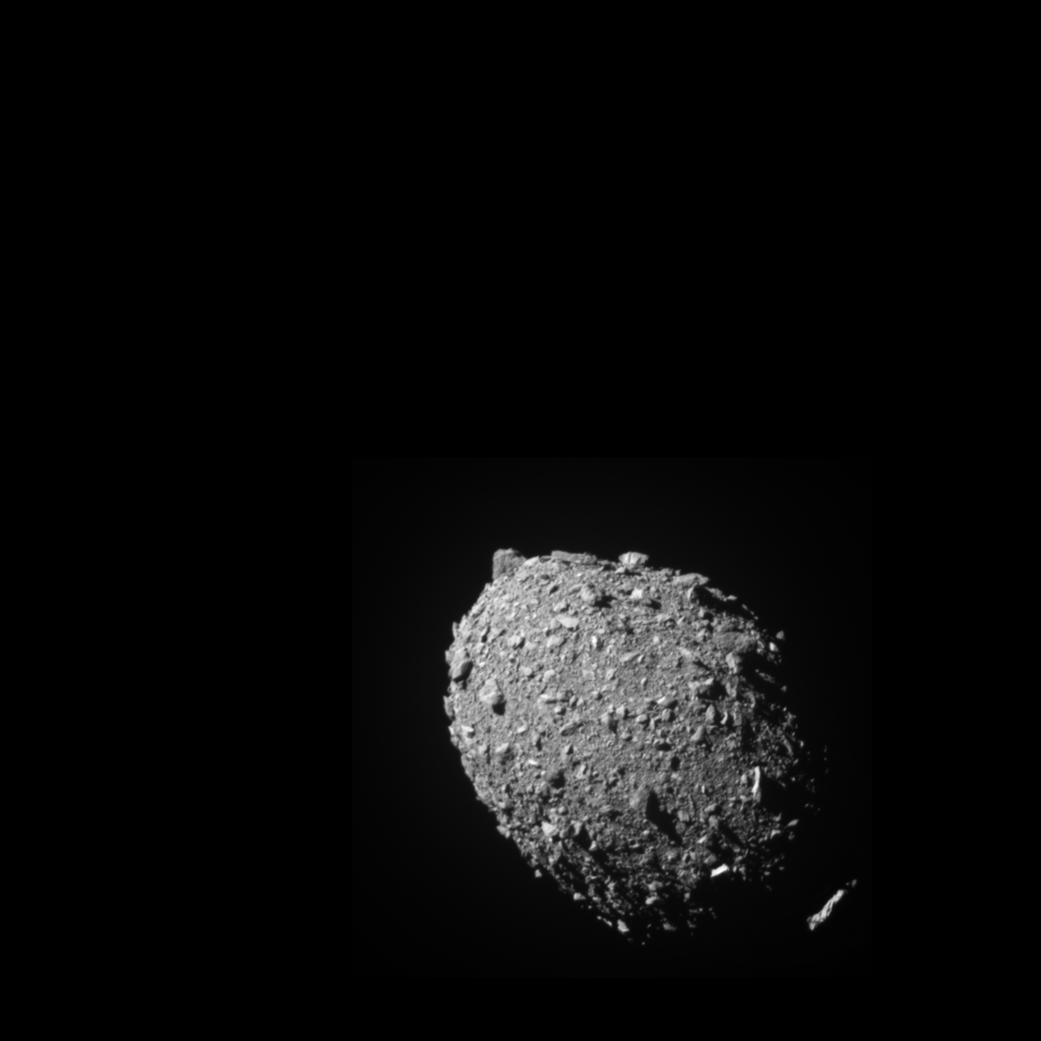
Asteroid Didymos (top left) and its moonlet, Dimorphos, about 2.5 minutes before the impact of NASA’s DART spacecraft. The image was taken by the on board DRACO imager from a distance of 570 miles (920 kilometers). This image was the last to contain a complete view of both asteroids. Didymos is roughly 2,500 feet (780 meters) in diameter; Dimorphos is about 525 feet (160 meters) in length. Didymos’ and Dimorphos’ north is toward the top of the image.

Asteroid moonlet Dimorphos as seen by the DART spacecraft 11 seconds before impact. DART’s on board DRACO imager captured this image from a distance of 42 miles (68 kilometers). This image was the last to contain all of Dimorphos in the field of view. Dimorphos is roughly 525 feet (160 meters) in length. Dimorphos’ north is toward the top of the image.

The last complete image of asteroid moonlet Dimorphos, taken by the DRACO imager on NASA’s DART mission from ~7 miles (12 kilometers) from the asteroid and 2 seconds before impact. The image shows a patch of the asteroid that is 100 feet (31 meters) across. Dimorphos’ north is toward the top of the image.

NASA’s Double Asteroid Redirection Test, also known as DART, is humanity’s first attempt to change the motion of a non-hazardous asteroid in space by intentionally crashing a spacecraft into it. Post impact, ground-based observatories across the globe are turning their eyes to the skies to determine if this planetary defense test was successful. 

Mission control at the Johns Hopkins Applied Physics Lab (APL) announced the successful impact at 7:14 p.m. EDT on Monday, September 26, 2022.

DART was a spacecraft designed to impact an asteroid as a test of technology. DART’s target asteroid is NOT a threat to Earth. This asteroid system is a perfect testing ground to see if intentionally crashing a spacecraft into an asteroid is an effective way to change its course, should a hazardous asteroid be discovered in the future.

For more on DART, visit https://nasa.gov/dart


Credit: NASA/Johns Hopkins Applied Physics Lab (JHUAPL)

Release Date: September 26, 2022


#NASA #Space #Astronomy #Science #DART #DARTMission #Spacecraft #DRACO #SpaceX #USSF #Asteroids #Dimorphos #Didymos #Earth #PlanetaryDefense #Test #SolarSystem #JHUAPL #UnitedStates #STEM #Education

NASA's DART Spacecraft: The Final Moments Before Asteroid Impact

NASA's DART Spacecraft: The Final Moments Before Asteroid Impact

After 10 months of flying in space, NASA’s Double Asteroid Redirection Test (DART)—the world’s first planetary defense technology demonstration—successfully impacted its asteroid target on Monday, the agency’s first attempt to move an asteroid in space. 

Mission control at the Johns Hopkins Applied Physics Lab (APL) announced the successful impact at 7:14 p.m. EDT on Monday, September 26, 2022.

NASA’s Double Asteroid Redirection Test (DART) mission has attempted humanity’s first-ever test of planetary defense! The DART spacecraft intentionally crashed into asteroid Dimorphos to see if kinetic force can change its orbit. Why? If this test is successful, the same technique could be used to deflect an Earth-threatening asteroid in the future, should one ever be discovered. The DART Mission's target asteroid is NOT a threat to Earth before, during or after the impact event.

DART is a joint mission between NASA and the Johns Hopkins University Applied Physics Laboratory (JHUAPL).

For more, visit nasa.gov/dart


Credit: Johns Hopkins University Applied Physics Laboratory (JHUAPL) 

Duration: 15 seconds

Release Date: September 26, 2022


#NASA #Space #Astronomy #Science #DART #Spacecraft #SpaceX #USSF #Asteroids #Dimorphos #Didymos #Earth #PlanetaryDefense #Test #SolarSystem #JHUAPL #UnitedStates #STEM #Education #Timelapse #HD #Video

NASA's DART Mission Post-Asteroid-Impact News Briefing

NASA's DART Mission Post-Asteroid-Impact News Briefing

NASA’s Double Asteroid Redirection Test (DART) mission has attempted humanity’s first-ever test of planetary defense! The DART spacecraft intentionally crashed into asteroid Dimorphos at 7:14 p.m. EDT on Monday, September 26, 2022, to see if kinetic force can change its orbit. Why? If this test is successful, the same technique could be used to deflect an Earth-threatening asteroid in the future, should one ever be discovered. The DART Mission's target asteroid is NOT a threat to Earth before, during or after the impact event.

DART is a joint mission between NASA and the Johns Hopkins University Applied Physics Laboratory (JHUAPL).

For more, visit nasa.gov/dart


Credit: NASA

Duration: 32 minutes

Release Date: September 26, 2022


#NASA #Space #Astronomy #Science #DART #Spacecraft #SpaceX #USSF #Asteroids #Dimorphos #Didymos #Earth #PlanetaryDefense #Test #SolarSystem #JHUAPL #UnitedStates #STEM #Education #HD #Video

NASA's DART Spacecraft Successfully Impacts Asteroid Dimorphos

NASA's DART Spacecraft Successfully Impacts Asteroid Dimorphos  

For NASA’s Double Asteroid Redirection Test (DART), the DART spacecraft impacted asteroid Dimorphos in the binary asteroid system Didymos, on September 26, 2022, at 23:14 UTC (19:14 EDT). The binary asteroid system Didymos is NOT a threat to Earth, making it an ideal testing ground to see if intentionally crashing a spacecraft into an asteroid is an effective way of changing its course. The asteroid Dimorphos is the size of a football stadium.


Credit: NASA

Acknowledgement: SciNews

Duration: 4 minutes, 37 seconds

Release Date: September 26, 2022


#NASA #Space #Astronomy #Science #DART #Spacecraft #SpaceX #USSF #Asteroids #Dimorphos #Didymos #Earth #PlanetaryDefense #Test #SolarSystem #JHUAPL #UnitedStates #STEM #Education #HD #Video

NASA's DART Spacecraft Colliding with Asteroid on September 26, 2022

NASA's DART Spacecraft Colliding with Asteroid on September 26, 2022


Looking Back at DART’s Unboxing

Image Description: Technicians prepare to move NASA’s Double Asteroid Redirection Test (DART) spacecraft onto a work stand inside the Astrotech Space Operations Facility at Vandenberg Space Force Base in California following its arrival at the facility on Oct. 4, 2021.

DART was launched on Nov. 23, 2021, aboard a SpaceX Falcon 9 rocket from Vandenberg. The spacecraft will intentionally smash into the moonlet Didymos on Sept. 26, 2022, to see if this method of asteroid deflection—known as the kinetic impactor technique—would be a viable way to protect our planet if an asteroid on a collision course with Earth were discovered in the future.


Image Credit: United States Space Force (USSF) 30th Space Wing/Aaron Taubm

Release Date: September 26, 2022


#NASA #Space #Astronomy #Science #DART #Spacecraft #SpaceX #USSF #Asteroids #Earth #PlanetaryDefense #Test #SolarSystem #JHUAPL #UnitedStates #STEM #Education

Hurricane Ian Flyover | International Space Station

Hurricane Ian Flyover | International Space Station

The International Space Station passed approximately 260 statute miles overhead Hurricane Ian at approximately 3 p.m. EDT Monday, Sept. 26, 2022. External cameras on the orbiting laboratory captured views of the storm as it gained strength south of Cuba while moving toward the north-northwest. The storm is expected to intensify before approaching the west coast of Florida on Wednesday into Thursday. 

NASA managers met Monday morning and made the decision to roll the Artemis I Space Launch System rocket and Orion spacecraft back to the Vehicle Assembly Building after additional data gathered overnight did not show improving expected conditions for the Kennedy Space Center area. The decision allows time for employees to address the needs of their families and protect the integrated rocket and spacecraft system.


Credit: NASA's Johnson Space Center (JSC)

Duration: 11 minute

Release Date: September 26, 2022


#NASA #Space #ISS #Earth #Planet #Atmosphere #Weather #HurricaneIan #Hurricane #Meteorology #CaribbeanSea #AtlanticOcean #Cuba #Artemis #ArtemisI #Astronauts #Photography #Art #Science #HumanSpaceflight #Expedition67 #Florida #UnitedStates #International #STEM #Education #HD #Video

Jupiter's Closest Approach to Earth in 59 Years! | NASA

Jupiter's Closest Approach to Earth in 59 Years! | NASA


Stargazers can expect excellent views of Jupiter the entire night of Monday, Sept. 26, 2022, when the giant planet reaches opposition. From the viewpoint of Earth’s surface, opposition happens when an astronomical object rises in the east as the Sun sets in the west, placing the object and the Sun on opposite sides of Earth.

Jupiter’s opposition occurs every 13 months, making the planet appear larger and brighter than any other time of the year. But that’s not all. Jupiter will also make its closest approach to Earth since 1963—almost six decades ago! This happens because Earth and Jupiter do not orbit the Sun in perfect circles—meaning the planets will pass each other at different distances throughout the year. Jupiter’s closest approach to Earth rarely coincides with opposition, which means this year’s views will be extraordinary. At its closest approach, Jupiter will be approximately 367 million miles in distance from Earth, about the same distance it was in 1963. The massive planet is approximately 600 million miles away from Earth at its farthest point.

“With good binoculars, the banding (at least the central band) and three or four of the Galilean satellites (moons) should be visible,” said Adam Kobelski, a research astrophysicist at NASA’s Marshall Space Flight Center in Huntsville, Alabama. “It’s important to remember that Galileo observed these moons with 17th century optics. One of the key needs will be a stable mount for whatever system you use.”

Kobelski recommends a larger telescope to see Jupiter’s Great Red Spot and bands in more detail; a 4 inch-or-larger telescope and some filters in the green to blue range would enhance the visibility of these features.

According to Kobelski, an ideal viewing location will be at a high elevation in a dark and dry area.

“The views should be great for a few days before and after Sept. 26,” Kobelski said. “So, take advantage of good weather on either side of this date to take in the sight. Outside of the Moon, it should be one of the (if not the) brightest objects in the night sky.”

Jupiter has 53 named moons, but scientists believe that 79 moons have been detected in total. The four largest moons, Io, Europa, Ganymede, and Callisto, are called the Galilean satellites. They are named after the man who first observed them in 1610, Galileo Galilei. In binoculars or a telescope, the Galilean satellites should appear as bright dots on either side of Jupiter during opposition.

NASA’s Juno spacecraft, which has been orbiting Jupiter for six years, is dedicated to exploring the planet and its moons. Juno began its journey in 2011 and reached Jupiter five years later. Since 2016, the spacecraft has provided incredible images and data about Jupiter’s lively atmosphere, interior structures, internal magnetic field, and magnetosphere.

Scientists believe studying Jupiter can lead to breakthrough discoveries about the formation of the solar system. Juno’s mission was recently extended until 2025 or until the end of the spacecraft’s life. Learn more about Juno: 

https://go.nasa.gov/3r9WsOL

The next major project for Jupiter exploration is the Europa Clipper. This spacecraft will explore Jupiter’s iconic moon, Europa, which is known for its icy shell and vast ocean that lies beneath its surface. NASA scientists aim to find whether Europa has conditions able to sustain life.  Europa Clipper’s targeted launch is currently scheduled for no earlier than October 2024.


Credit: National Aeronautics and Space Administration (NASA)

Release Date: Sept. 16, 2022


#NASA #ESA #Space #Astronomy #Science #Hubble #Jupiter #Planet #Earth #SolarSystem #Skywatching #SpaceTelescope #GSFC #STScI #Juno #Spacecraft #UnitedStates #Europe #STEM #Education

How Will We Know if NASA’s DART Mission Changed an Asteroid’s Orbit?

How Will We Know if NASA’s DART Mission Changed an Asteroid’s Orbit?

NASA’s Double Asteroid Redirection Test, also known as DART, is humanity’s first attempt to change the motion of a non-hazardous asteroid in space by intentionally crashing a spacecraft into it. After impact, ground-based observatories across the globe will turn their eyes to the skies to determine if this planetary defense test was successful. In this video, NASA visits Lowell Observatory to learn more about how astronomers have been tracking this double asteroid over the course of many years, and how they will document the orbital change post-impact.

DART is a spacecraft designed to impact an asteroid as a test of technology. DART’s target asteroid is NOT a threat to Earth. This asteroid system is a perfect testing ground to see if intentionally crashing a spacecraft into an asteroid is an effective way to change its course, should a hazardous asteroid be discovered in the future.


For more on DART, visit https://nasa.gov/dart

https://dart.jhuapl.edu/


Credit: National Aeronautics and Space Administration (NASA)

Duration: 4 minutes

Release Date: September 6, 2022

#NASA #Space #Astronomy #Science #DART #Spacecraft #Asteroids #Earth #PlanetaryDefense #Test #SolarSystem #JHUAPL #LowellObservatory #UnitedStates #STEM #Education #HD #Video

Todays' Asteroid Test | Defending the Planet: NASA’s DART Mission

Todays' Asteroid Test | Defending the Planet: NASA’s DART Mission

Launched in November 2021, NASA's Double Asteroid Redirection Test (DART) will be the world’s first mission to test planetary defense techniques, demonstrating one mitigation method of asteroid deflection, called kinetic impact. DART will impact the small asteroid moonlet Dimorphos, which orbits a larger companion, Didymos, in a binary asteroid system to change its orbital period. Although neither asteroid poses a threat to Earth, the collision with Dimorphos enables researchers to demonstrate the deflection technique along with several new technologies, and collect important data to enhance our modeling and predictive capabilities for asteroid deflection. Those enhancements will help us better prepare should an asteroid ever be discovered as a threat to Earth.

NASA’s Double Asteroid Redirection Test (DART), the world’s first mission to test technology for defending Earth against potential asteroid or comet hazards, will impact its target asteroid—which poses no threat to Earth—on Monday evening, Sept. 26, 2022.

5:30 p.m. EDT (21:30 UTC):  Live feed from the DART spacecraft as it approaches asteroid Didymos: https://www.nasa.gov/multimedia/nasatv/index.html#media

6 p.m. EDT (22:00 UTC): Live broadcast coverage of the DART mission as the spacecraft attempts to deflect an asteroid from its path (impact targeted for 7:14 p.m. EDT)

https://www.nasa.gov/multimedia/nasatv/index.html#public


The Johns Hopkins Applied Physics Laboratory manages the DART mission for NASA's Planetary Defense Coordination Office as a project of the agency’s Planetary Missions Program Office. 

For more information about DART, visit:

https://dart.jhuapl.edu/

https://www.nasa.gov/dartmission


Credit: Johns Hopkins University Applied Physics Laboratory (JHUAPL)

Duration: 2 minutes, 48 seconds 

Release Date: November 23, 2021


#NASA #Space #Astronomy #Science #DART #Spacecraft #Asteroids #Earth #PlanetaryDefense #Test #SolarSystem #JHUAPL #UnitedStates #STEM #Education #HD #Video

Behind the Spacecraft: NASA's DART—The Double Asteroid Redirection Test Today

Behind the Spacecraft: NASA's DART—The Double Asteroid Redirection Test Today

NASA is crashing a spacecraft into an asteroid . . . on purpose! Our DART mission is a first-of-its-kind planetary defense test to change the motion of an asteroid in space so that we could use this technique if an asteroid were ever discovered to be a threat to Earth. 

Follow DART: www.nasa.gov/DART

The DART mission is a test of a technique that could be used to mitigate the threat of an asteroid on a collision course with Earth should one be discovered in the future. DART’s target is not a threat to Earth. While no known asteroid larger than 140 meters in size has a significant chance to hit Earth for the next 100 years, only about 40 percent of those asteroids have been found as of October 2021.

NASA’s Double Asteroid Redirection Test (DART), the world’s first mission to test technology for defending Earth against potential asteroid or comet hazards, will impact its target asteroid—which poses no threat to Earth—on Monday evening, Sept. 26, 2022.

5:30 p.m. EDT (21:30 UTC):  Live feed from the DART spacecraft as it approaches asteroid Didymos: https://www.nasa.gov/multimedia/nasatv/index.html#media

6 p.m. EDT (22:00 UTC): Live broadcast coverage of the DART mission as the spacecraft attempts to deflect an asteroid from its path (impact targeted for 7:14 p.m. EDT)

https://www.nasa.gov/multimedia/nasatv/index.html#public

This test will show a spacecraft can autonomously navigate to a target asteroid and intentionally collide with it to change the asteroid’s motion in a way that can be measured using ground-based telescopes. DART will provide important data to help better prepare for an asteroid that might pose an impact hazard to Earth, should one ever be discovered.


Credits: NASA

Producer/Editor: Jessica Wilde

Producer: Scott Bednar

Videographers: James Lucas and Seth Robinson

Duration: 2 minutes, 29 seconds

Release Date: October 24, 2021


#NASA #Space #Astronomy #Science #DART #Spacecraft #Asteroids #Earth #PlanetaryDefense #Test #SolarSystem #JHUAPL #UnitedStates #STEM #Education #HD #Video

A Close-up Look at The Antennae Galaxies | Hubble

A Close-up Look at The Antennae Galaxies | Hubble

The Antennae Galaxies—also known as NGC 4038 and NGC 4039—are locked in a deadly embrace. Once normal, sedate spiral galaxies like the Milky Way, the pair have spent the past few hundred million years sparring with one another. This clash is so violent that stars have been ripped from their host galaxies to form a streaming arc between the two. In wide-field images of the pair the reason for their name becomes clear—far-flung stars and streamers of gas stretch out into space, creating long tidal tails reminiscent of antennae.

This image of the Antennae Galaxies shows obvious signs of chaos. Clouds of gas are seen in bright pink and red, surrounding the bright flashes of blue star-forming regions—some of which are partially obscured by dark patches of dust. The rate of star formation is so high that the Antennae Galaxies are said to be in a state of starburst, a period in which all of the gas within the galaxies is being used to form stars. This cannot last forever and neither can the separate galaxies; eventually the nuclei will coalesce, and the galaxies will begin their retirement together as one large elliptical galaxy.


Credit: European Space Agency (ESA)/Hubble (M. Kornmesser & L. L. Christensen)

Duration: 46 seconds

Release Date: February 16, 2016


#NASA #ESA #Astronomy #Space #Hubble #Antennae #Galaxies #AntennaeGalaxies #NGC4038 #NGC4039 #Corvus #Constellation #MilkyWay #Galaxy #Cosmos #Universe #SpaceTelescope #GSFC #STScI #UnitedStates #Europe #STEM #Education #SD #Video

Zooming in on The Tail of The Antennae Galaxies | Hubble

Zooming in on The Tail of The Antennae Galaxies | Hubble

This video shows the constellation of Corvus, the Crow, and a zoom into the tidal tail of the Antennae Galaxies.


Credit: NASA, European Space Agency (ESA), R. Gendler and A. Fujii

Duration: 58 seconds

Release Date: February 17, 2016


#NASA #Astronomy #Space #Antennae #Galaxies #AntennaeGalaxies #NGC4038 #NGC4039 #Corvus #Constellation #MilkyWay #Galaxy #Cosmos #Universe #NOAO #Telescope #UnitedStates #STEM #Education #HD #Video