Friends of NASA (FoN) is an independent non-governmental organization (NGO) dedicated to building international support for peaceful space exploration, commerce, scientific discovery, and STEM education.
Free-floating Evaporating Gaseous Globules (frEGGs) in Cassiopeia | Hubble
Galaxies are well known as the birthplaces of stars and planets thanks to the overwhelmingly large amount of dust and gas within them. Over time, cold gas coalesces into molecular clouds, leading to the further emergence of star-forming regions.
This image taken with the NASA/European Space Agency Hubble Space Telescope depicts a fantastic new class of star-forming nursery, known as Free-floating Evaporating Gaseous Globules, or frEGGs for short. This object, known as J025027.7+600849, is located in the constellation of Cassiopeia.
When a massive new star (or stars) starts to shine while still within the cool molecular cloud from which it formed, its energetic radiation can ionize the cloud’s hydrogen and create a large, hot bubble of ionized gas. Amazingly, located within this bubble of hot gas around a nearby massive star are the frEGGs: dark compact globules of dust and gas, some of which are also giving birth to low-mass stars. The boundary between the cool, dusty frEGG and hot gas bubble is seen as the glowing purple/blue edges in this fascinating image.
Learning more about these odd objects can help astronomers understand how stars like our Sun form under external influences. In fact, our Sun may have even been born in a frEGG.
Credit: European Space Agency (ESA)/Hubble & NASA, R. Sahai
Hurricane Ian Flyover: Sept. 28, 2022 | International Space Station
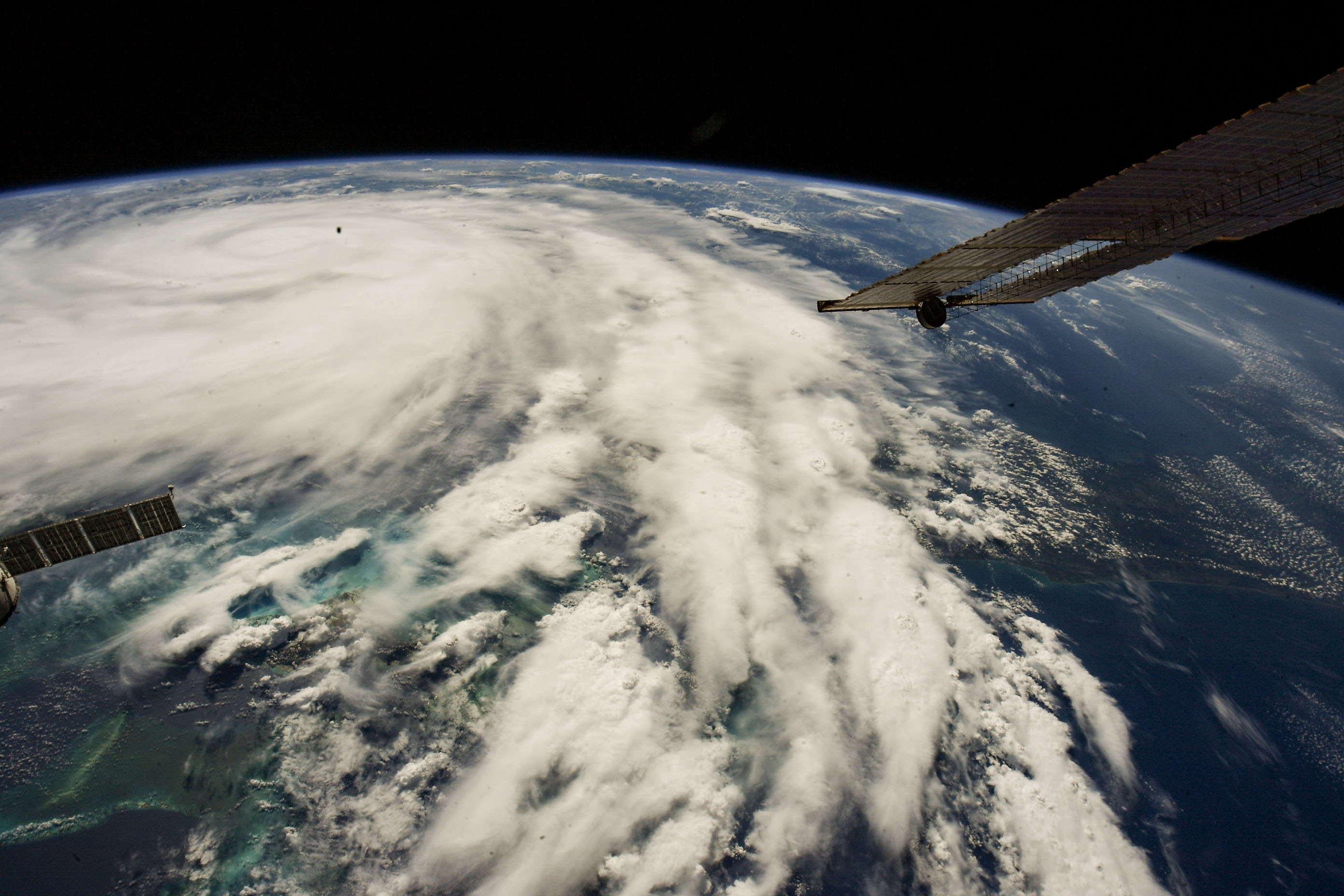
The International Space Station flew 260 miles over Hurricane Ian at 3:05 p.m. EDT Wednesday, Sept. 28, 2022. External cameras on the orbiting laboratory captured views of the storm as it made landfall in Florida near Fort Myers, Florida, with winds of 155 miles an hour as it moved to the northeast across the Florida peninsula.
Astronaut Samantha Cristoforetti Takes Command | International Space Station
Sept. 28, 2022: European Space Agency (ESA) astronaut Samantha Cristoforetti of Italy is the new Commander of the International Space Station. “Cristoforetti will lead the new Expedition 68 crew until she and three of her SpaceX Crew Dragon Freedom crewmates depart the space station in October.”
Three cosmonauts are set to board their Soyuz MS-21 crew ship and undock from the Prichal module at 3:34 a.m. EDT Thursday, Sept. 29. Soyuz Commander Oleg Artemyev, flanked by Flight Engineers Denis Matveev and Sergey Korsakov, will then soar through Earth’s atmosphere and parachute inside the Soyuz vehicle to a landing in Kazakhstan at 6:57 a.m. (4:57 p.m. Kazakh time) ending a six-month mission that began on March 18. Live undocking coverage begins at 3:15 a.m. on NASA TV, the agency’s app and its website.
Expedition 67/68 Crew
Commander: Samantha Cristoforetti of the European Space Agency (Italy)
NASA Flight Engineers: Kjell Lindgren, Bob Hines, Jessica Watkins, Frank Rubio (USA)
An international partnership of space agencies provides and operates the elements of the International Space Station (ISS). The principals are the space agencies of the United States, Russia, Europe, Japan, and Canada. The ISS has been the most politically complex space exploration program ever undertaken.
The Challenge of NASA's DART Mission—Doing Something That's Never Been Done
On September 26th, 2022 NASA's Double Asteroid Redirection Test, or DART, did something that has never been done—crashed into the moon of an asteroid to change its speed and orbit. This might sound like an easy target-based, seek-and-impact kind of mission, but the reality is quite complicated. The asteroid is very small, very far away, and space is very dark.
Why are we doing this? To prove that we can use kinetic impactor as a technique to deflect an oncoming object in order to defend the Earth from an oncoming asteroid.
This video explains the incredible and complex work that went into making the world's first planetary defense mission.
ULA Delta IV Heavy NROL-91 Launch Highlights | Vandenberg Space Force Base
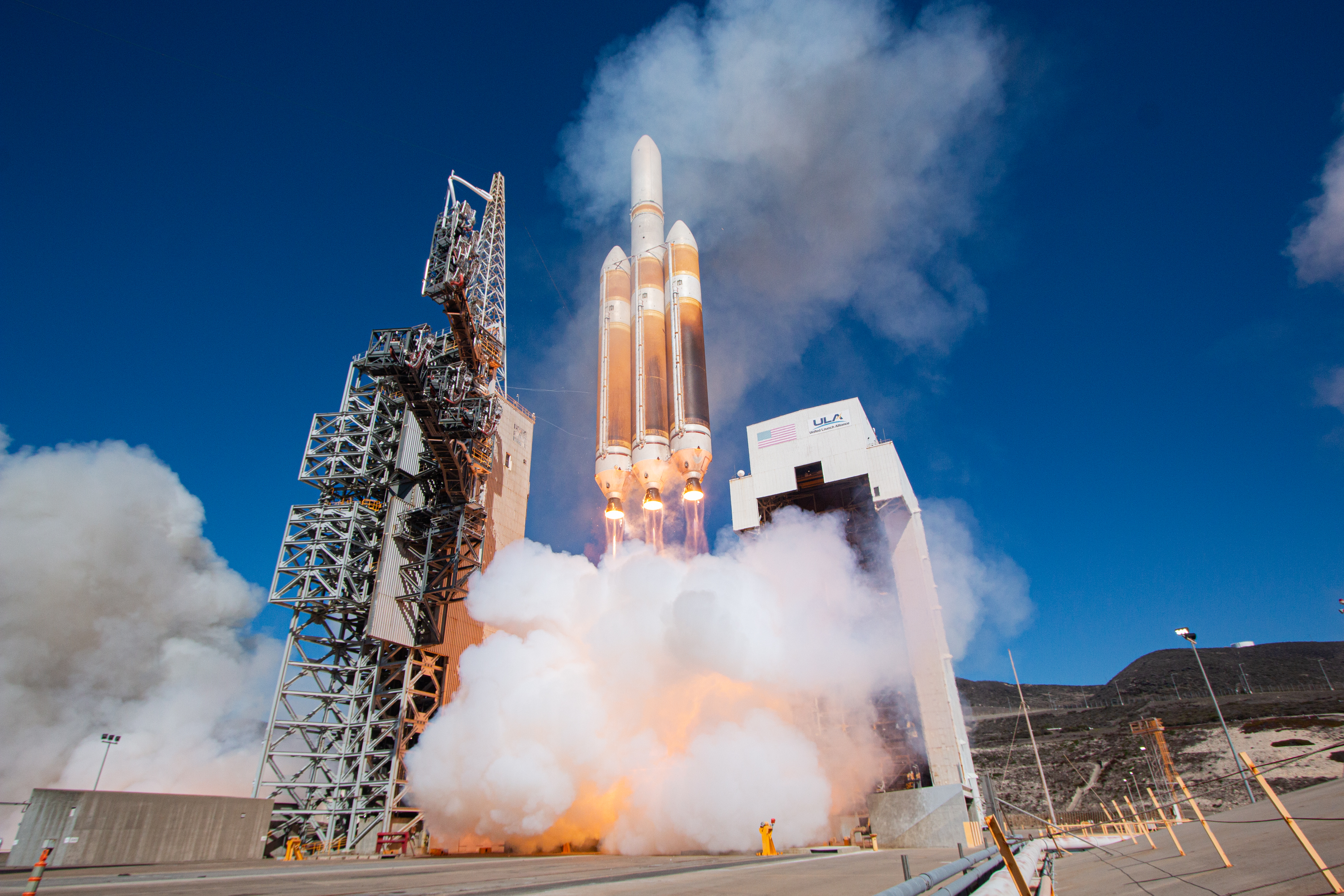
Vandenberg Space Force Base, California, (Sept. 24, 2022) – A United Launch Alliance (ULA) Delta IV Heavy rocket carrying the NROL-91 mission for the National Reconnaissance Office (NRO) lifted off on Sept. 24, 2022, at 3:25 p.m. PDT from Space Launch Complex-6 at Vandenberg Space Force Base. To date ULA has launched 153 times with 100 percent mission success.
"The NRO has been, and continues to be, a phenomenal partner through 32 collaborative launch campaigns, stemming from ULA’s very first launch in 2006," said Gary Wentz, ULA vice president of Government and Commercial Programs. “This mission was ULA’s 96th National Security mission and the NRO’s 10th mission on board a Delta IV Heavy launch vehicle—a history that we are very proud of.”
“This was also ULA’s 95th Delta mission from Vandenberg Space Force Base and our fifth and final Delta IV Heavy from the West Coast, completing a long, successful tenure of delivering critical national security payloads,” added Wentz. “We look forward to preparing Space Launch Complex-3 for future Vulcan flights from the West Coast.”
ULA’s next launch is a commercial launch of the SES-20 and SES-21 mission, planned for Sept. 30 from Cape Canaveral Space Force Station, Florida.
The National Reconnaissance Office launched its NROL-91 mission aboard a United Launch Alliance (ULA) Delta IV Heavy rocket from Vandenberg Space Force Base, California on Sept. 24, 2022. Carrying a national security payload designed, built and operated by NRO, NROL-91 supports the overall national security mission to provide intelligence data to the United States’ senior policy makers, the Intelligence Community and Department of Defense. NROL-91 is NRO’s fifth launch of 2022, and is part of more than a half-dozen planned launches for the year.
United Launch Alliance’s Delta IV Heavy is a heavy-lift launch vehicle, the largest type of the Delta IV family and one of the world’s most powerful rockets. The Delta IV Heavy configuration is comprised of a common booster core (CBC), a cryogenic upper stage and a 5-meter-diameter payload fairing (PLF). The Delta IV Heavy employs two additional CBCs as liquid rocket boosters to augment the first-stage CBC. The Delta IV Heavy can lift 28,370 kg (62,540 lbs) to low Earth orbit and 13,810 kg (30,440 lbs) to geostationary transfer orbit. It is an all liquid-fueled rocket, consisting of an upper stage, one main booster and two strap-on boosters.
Fireworks in the Sky: Supernova Remnant Cassiopeia A | Hubble
Glowing gaseous streamers of red, white, and blue—as well as green and pink—illuminate the heavens like Fourth of July fireworks. The colorful streamers that float across the sky in this photo taken by the NASA/European Space Agency Hubble Space Telescope were created by the universe's biggest firecracker, the titanic supernova explosion of a massive star.
The light from the exploding star reached Earth 320 years ago. The dead star's shredded remains are called Cassiopeia A, or 'Cas A' for short. Cas A is the youngest known supernova remnant in our Milky Way Galaxy and resides 10,000 light-years away in the constellation Cassiopeia, so the star actually blew up 10,000 years before the light reached Earth in the late 1600s.
Credit: NASA/European Space Agency (ESA) and The Hubble Heritage Team (STScI/AURA)
The Filamentous Remains of an Exploded Star: Full Dome View | Hubble
This fulldome clip shows the branching, almost organic appearance of the gas expelled by a recently deceased star. This object is call Cassiopeia A and is the result of a recent supernova explosion—the youngest such object known to exist in our Milky Way galaxy. The gas will be rich in heavier elements, like calcium and iron, which will fertilize the interstellar medium for new stars and planetary systems in the distant future.
Zooming on Supernova Remnant Cassiopeia A | Hubble
This video shows a zoom into the remnant of the supernova explosion known as Cassiopeia A (Cas A), located ten thousand light-years away from Earth in the constellation of Cassiopeia. It is the youngest known remnant from a supernova explosion in the Milky Way. The new Hubble image shows the complex and intricate structure of the star's shattered fragments.
Credit: Akira Fujii, Digitized Sky Survey 2 and European Space Agency (ESA)/Hubble
Cassiopeia A—The Colorful Aftermath of a Violent Stellar Death | Hubble
A new image taken with the NASA/European Space Agency Hubble Space Telescope provides a detailed look at the tattered remains of a supernova explosion known as Cassiopeia A (Cas A). It is the youngest known remnant from a supernova explosion in the Milky Way. The new Hubble image shows the complex and intricate structure of the star's shattered fragments.
Distance:11,000 light years
Credit: NASA, European Space Agency (ESA), and the Hubble Heritage (STScI/AURA)-ESA/Hubble Collaboration
Acknowledgement: Robert A. Fesen (Dartmouth College, USA) and James Long (ESA/Hubble)
This NASA/European Space Agency Hubble Space Telescope image shows a spiral galaxy known as NGC 7331. First spotted by the prolific galaxy hunter William Herschel in 1784, NGC 7331 is located about 45 million light-years away in the constellation of Pegasus (The Winged Horse). Facing us partially edge-on, the galaxy showcases its beautiful arms which swirl like a whirlpool around its bright central region.
Astronomers took this image using Hubble’s Wide Field Camera 3 (WFC3), as they were observing an extraordinary exploding star—a supernova—which can still be faintly seen as a tiny red dot near the galaxy’s central yellow core. Named SN2014C, it rapidly evolved from a supernova containing very little Hydrogen to one that is Hydrogen-rich—in just one year. This rarely observed metamorphosis was luminous at high energies and provides unique insight into the poorly understood final phases of massive stars.
NGC 7331 is similar in size, shape, and mass to the Milky Way. It also has a comparable star formation rate, hosts a similar number of stars, has a central supermassive black hole and comparable spiral arms. The primary difference between our galaxies is that NGC 7331 is an unbarred spiral galaxy—it lacks a “bar” of stars, gas and dust cutting through its nucleus, as we see in the Milky Way. Its central bulge also displays a quirky and unusual rotation pattern, spinning in the opposite direction to the galactic disc itself.
By studying similar galaxies, we hold a scientific mirror up to our own, allowing us to build a better understanding of our galactic environment which we cannot always observe, and of galactic behavior and evolution as a whole.
Credit: European Space Agency (ESA)/Hubble & NASA/D. Milisavljevic (Purdue University)
Crisp, clear October nights are full of celestial showpieces. Find Pegasus, the flying horse of Greek myth, to pinpoint dense globular star clusters and galaxies, and keep watching for space-based views of M15, NGC 7331, and the Andromeda Galaxy.
“Tonight’s Sky” is a monthly video of constellations you can observe in the night sky. The series is produced by the Space Telescope Science Institute, home of science operations for the Hubble Space Telescope, in partnership with NASA’s Universe of Learning.
This product is based on work supported by NASA under award numbers NNX16AC65A to the Space Telescope Science Institute, working in partnership with Caltech/IPAC, the Jet Propulsion Laboratory, the Smithsonian Astrophysical Observatory, and Sonoma State University.
ULA Delta IV Heavy Launch: NRO Payload | Vandenberg Space Force Base
Vandenberg Space Force Base, California, (Sept. 24, 2022) – A United Launch Alliance (ULA) Delta IV Heavy rocket carrying the NROL-91 mission for the National Reconnaissance Office (NRO) lifted off on Sept. 24, 2022, at 3:25 p.m. PDT from Space Launch Complex-6 at Vandenberg Space Force Base. To date ULA has launched 153 times with 100 percent mission success.
"The NRO has been, and continues to be, a phenomenal partner through 32 collaborative launch campaigns, stemming from ULA’s very first launch in 2006," said Gary Wentz, ULA vice president of Government and Commercial Programs. “This mission was ULA’s 96th National Security mission and the NRO’s 10th mission on board a Delta IV Heavy launch vehicle—a history that we are very proud of.”
“This was also ULA’s 95th Delta mission from Vandenberg Space Force Base and our fifth and final Delta IV Heavy from the West Coast, completing a long, successful tenure of delivering critical national security payloads,” added Wentz. “We look forward to preparing Space Launch Complex-3 for future Vulcan flights from the West Coast.”
ULA’s next launch is a commercial launch of the SES-20 and SES-21 mission, planned for Sept. 30 from Cape Canaveral Space Force Station, Florida.
The National Reconnaissance Office launched its NROL-91 mission aboard a United Launch Alliance (ULA) Delta IV Heavy rocket from Vandenberg Space Force Base, California on Sept. 24, 2022. Carrying a national security payload designed, built and operated by NRO, NROL-91 supports the overall national security mission to provide intelligence data to the United States’ senior policy makers, the Intelligence Community and Department of Defense. NROL-91 is NRO’s fifth launch of 2022, and is part of more than a half-dozen planned launches for the year.
United Launch Alliance’s Delta IV Heavy is a heavy-lift launch vehicle, the largest type of the Delta IV family and one of the world’s most powerful rockets. The Delta IV Heavy configuration is comprised of a common booster core (CBC), a cryogenic upper stage and a 5-meter-diameter payload fairing (PLF). The Delta IV Heavy employs two additional CBCs as liquid rocket boosters to augment the first-stage CBC. The Delta IV Heavy can lift 28,370 kg (62,540 lbs) to low Earth orbit and 13,810 kg (30,440 lbs) to geostationary transfer orbit. It is an all liquid-fueled rocket, consisting of an upper stage, one main booster and two strap-on boosters.
Hurricane Ian pictured from the International Space Station as it orbited 258 miles above the Caribbean Sea east of Belize on September 26, 2022. At the time of this photograph, Ian was just south of Cuba gaining strength and heading toward Florida.
NASA DART Mission Asteroid Collision Images | LICIACube Spacecraft
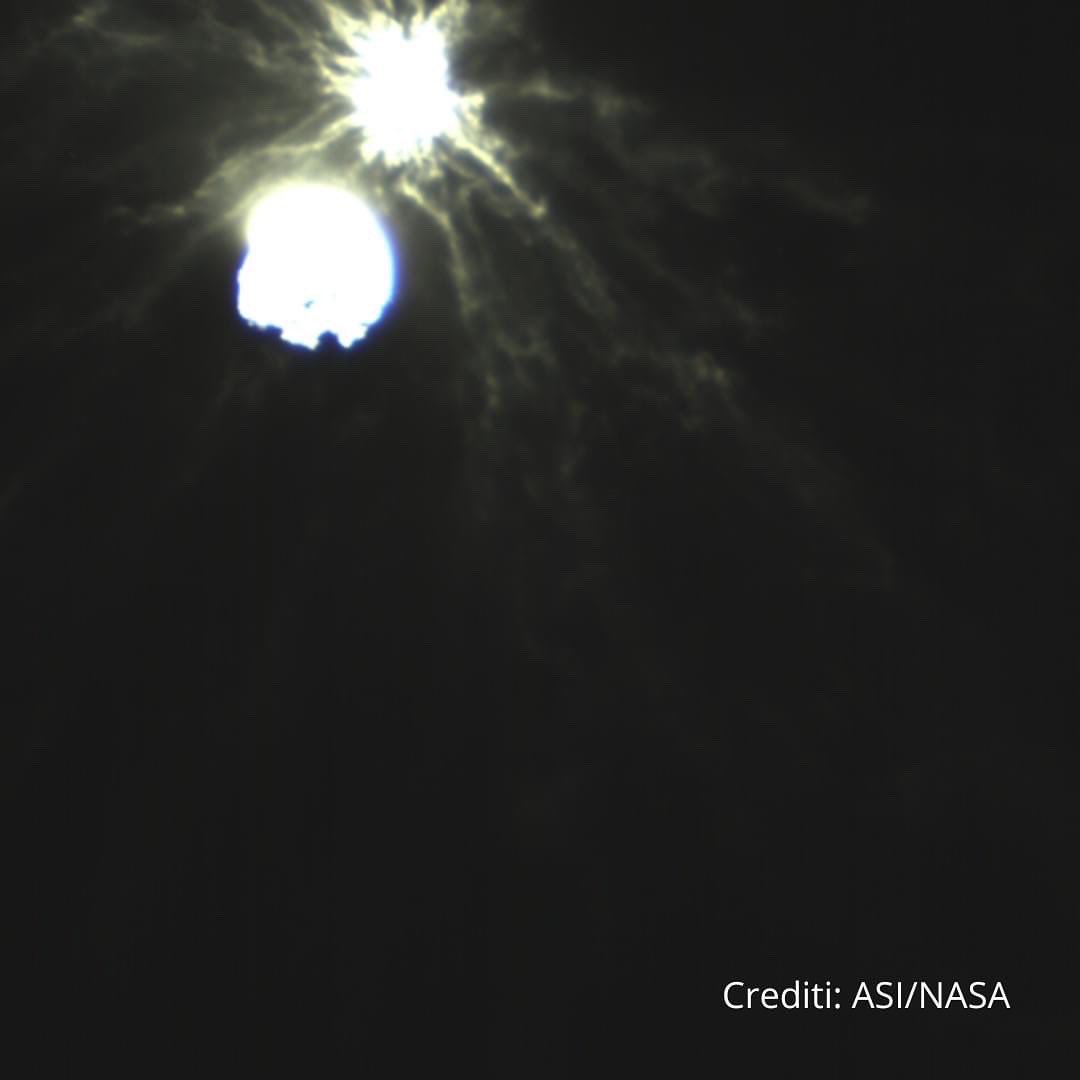
Here are the first images taken in deep space by the Italian space agency's LICIACube during the impact of NASA's DART Mission on asteroid Dimorphos. These show the resulting cloud of ejected matter. The LICIACube’s images will help researchers better characterize the effectiveness of kinetic impacts in deflecting asteroids.
Light Italian CubeSat for Imaging of Asteroids (LICIACube) is a 6-unit CubeSat of the Italian Space Agency (ASI). LICIACube is a part of the Double Asteroid Redirection Test (DART) mission and is built to carry out observational analysis of the Didymos asteroid binary system after DART's impact. It communicates directly with Earth. It is sending back images of the ejecta and plume of DART's impact as well as performing asteroidal studies during its flyby of the Didymos system from a distance of 55.3 km (34.4 mi), 165 seconds after DART's impact. LICIACube is the first purely Italian autonomous spacecraft in deep space.
NASA’s Double Asteroid Redirection Test, also known as DART, is humanity’s first attempt to change the motion of a non-hazardous asteroid in space by intentionally crashing a spacecraft into it. Post impact, ground-based observatories across the globe are turning their eyes to the skies to determine if this planetary defense test was successful.
Mission control at the Johns Hopkins Applied Physics Lab (APL) announced the successful impact at 7:14 p.m. EDT on Monday, September 26, 2022.
DART was a spacecraft designed to impact an asteroid as a test of technology. DART’s target asteroid is NOT a threat to Earth. This asteroid system is a perfect testing ground to see if intentionally crashing a spacecraft into an asteroid is an effective way to change its course, should a hazardous asteroid be discovered in the future.
Expedition 67: New Crew & Research Photos | International Space Station
NASA astronauts greet new U.S. crew member Frank Rubio
NASA astronauts Jessica Watkins and Bob Hines work on XROOTS, a hydroponic and aeroponic plant investigation
Astronaut Samantha Cristoforetti reconfigures combustion research components
Image 1
Sept. 21, 2022: NASA astronaut Frank Rubio (center) is greeted by fellow NASA astronauts Jessica Watkins and Bob Hines shortly after he arrived at the International Space Station. Rubio docked to the orbiting lab's Rassvet module earlier with Roscosmos cosmonauts (out of frame) Sergey Prokopyev and Dmitri Petelin aboard the Soyuz MS-22 crew ship beginning a six-month space research mission.
Image 2
Hydroponic and aeroponic plant investigation on ISS
June 24, 2022: NASA astronauts Jessica Watkins and Bob Hines work on XROOTS, which used the station’s Veggie facility to test liquid- and air-based techniques to grow plants rather than traditional growth media. These techniques could enable production of crops on a larger scale for future space exploration.
Image 3
Astronaut Samantha Cristoforetti reconfigures combustion research components
Sept. 15, 2022: European Space Agency (ESA) astronaut and Expedition 67 Flight Engineer Samantha Cristoforetti of Italy works inside the International Space Station's Unity module reconfiguring components for the Solid Fuel Ignition and Extinction investigation that explores fire growth and fire safety techniques in space.
Expedition 67 Crew
Commander Oleg Artemyev (Russia)
Roscosmos Flight Engineers: Denis Matveev and Sergey Korsakov, Dmitri Petelin, Sergey Prokopyev (Russia)
NASA Flight Engineers: Kjell Lindgren, Bob Hines, Jessica Watkins, Frank Rubio (USA)
European Space Agency (ESA) Flight Engineer: Samantha Cristoforetti (Italy)
An international partnership of space agencies provides and operates the elements of the International Space Station (ISS). The principals are the space agencies of the United States, Russia, Europe, Japan, and Canada. The ISS has been the most politically complex space exploration program ever undertaken.
Hurricane Ian: Full Disc View | NOAA GOES-EAST Weather Satellite
Sept. 27, 2022 Update: Major Hurricane Ian is centered over the southeastern Gulf of Mexico near 23.5N 83.3W at 27/1800 UTC, or 75 nm SSW of the Dry Tortugas, FL, moving N at 9 kt. Minimum central pressure is 955 mb. Maximum sustained wind speed is 105 kt with gusts to 125 kt.
San Juan y Martinez, Cuba recorded a peak wind gust of 112 kt when Ian passed over Cuba earlier this morning. The same station measured 7.95 inches of rain during the 24 hr period ending at 27/1200 UTC. The city of Pinar del Rio experienced the calm eye of Hurricane Ian. The calm lasted for 1 hr 30 min. Tropical storm force winds extend outward 120 nm from the center.
Seas of 12 ft or greater are occurring over the far NW Caribbean, western Straits of Florida and southeastern Gulf of Mexico, in the area from 20.5N to 25N between 81W and 86W. Peak seas are reaching 25 ft.
Credit: National Oceanic and Atmospheric Administration (NOAA)