Friends of NASA (FoN) is an independent non-governmental organization (NGO) dedicated to building international support for peaceful space exploration, commerce, scientific discovery, and STEM education.
NASA's SpaceX Crew-5 Astronauts on Launch Day | Kennedy Space Center
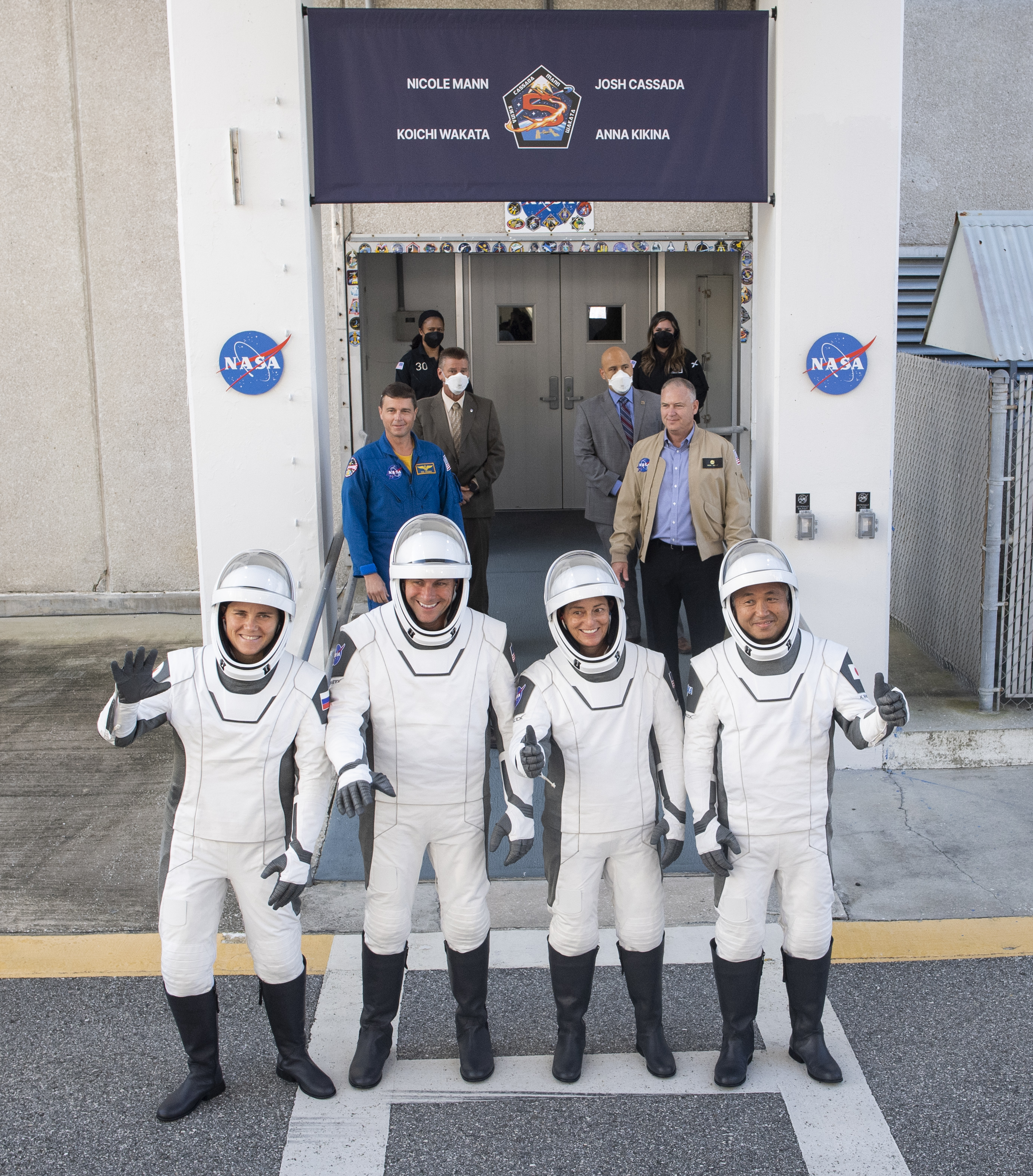
NASA's SpaceX Crew-5 astronauts walked out of the Neil A. Armstrong Operations and Checkout Building at NASA's Kennedy Space Center in Florida on Oct. 5, 2022. The Crew-5 flight carried NASA astronauts Nicole Aunapu Mann and Josh Cassada, JAXA (Japan Aerospace Exploration Agency) astronaut Koichi Wakata, and Roscosmos cosmonaut Anna Kikina (Russia) on the Dragon spacecraft, Endurance. They greeted family and friends before boarding Tesla Model X cars that took them to Launch Complex 39A. They successfully launched to orbit today on a SpaceX Dragon spacecraft atop a Falcon 9 rocket and are on their way to the International Space Station.
Tracing Interstellar Dust Within a Galactic Pair | Webb & Hubble
Image Description: The background of this Webb and Hubble composite image of galaxy pair VV 191 is black. Two large, very bright galaxies dominate the center of the image. The elliptical galaxy at left is extremely bright at its circular core, with dimmer white light extending to its transparent circular edges. At right is a bright spiral galaxy. It also has a bright white core, but has red and light purple spiral arms that start at the center and turn clockwise going outward. They end in faint red and appear to overlap the elliptical galaxy at left. Throughout the scene are a range of distant galaxies, the majority of which are very tiny and red, appearing as splotches.
Two galaxies and two telescopes come together in this image of galaxy pair VV 191, merging Hubble’s ultraviolet and visible-light view with Webb’s infrared vision.
Webb allowed researchers to trace light emitted from the bright elliptical galaxy on the left through the spiral galaxy on the right. In doing so, astronomers were able to study the effects of interstellar dust in the spiral galaxy.
See that faint, red arc around 10 o’clock at the core of the elliptical galaxy (left)? That’s actually a distant galaxy that has been gravitationally lensed, meaning the elliptical galaxy’s gravity is so great it has stretched and magnified the background galaxy’s appearance! The distant galaxy is also duplicated as a tiny, hard-to-see dot around 4 o’clock at the center of the elliptical galaxy. Webb reveals this far-off galaxy clearly for the first time, as it was so faint that it went undetected in Hubble’s data.
By teaming up, Webb and Hubble are able to bring us an even more comprehensive view of the universe.
Note: The data here is from Webb science in progress, which has not yet been peer reviewed.
Credit: NASA, European Space Agency/Canadian Space Agency, Space Telescope Science Institute (STScI), R. Windhorst (Arizona State University), W. Keel (University of Alabama), S. Wyithe (University of Melbourne, Australia), and the JWST PEARLS Team
NASA’s SpaceX Crew-5 Prelaunch | Kennedy Space Center
From left are NASA astronaut Josh Cassada, Roscosmos cosmonaut Anna Kikina (Russia), NASA astronaut Nicole Aunapu Mann, and JAXA (Japan Aerospace Exploration Agency) astronaut Koichi Wakata
From left are NASA astronaut Josh Cassada, pilot; Roscosmos cosmonaut Anna Kikina (Russia), mission specialist; NASA astronaut Nicole Mann, commander; and JAXA (Japan Aerospace Exploration Agency) astronaut Koichi Wakata, mission specialist
Roscosmos cosmonaut Anna Kikina (Russia), left, NASA astronaut Josh Cassada, second from left, NASA astronaut Nicole Mann, second from right, and Japan Aerospace Exploration Agency (JAXA) astronaut Koichi Wakata, right
Roscosmos cosmonaut Anna Kikina (Russia), left, NASA astronaut Josh Cassada, second from left, NASA astronaut Nicole Mann, second from right, and Japan Aerospace Exploration Agency (JAXA) astronaut Koichi Wakata, right
A SpaceX Falcon 9 rocket with the company's Crew Dragon spacecraft onboard is seen on the launch pad at Launch Complex 39A as preparations continue for the Crew-5 mission, Tuesday, Oct. 4, 2022, at NASA’s Kennedy Space Center in Florida
A SpaceX Falcon 9 rocket with the company's Crew Dragon spacecraft onboard is seen on the launch pad at Launch Complex 39A
The American flag and a flag bearing the patch for NASA’s SpaceX Crew-5 mission are seen at the Press Site and NASA’s Kennedy Space Center, Tuesday, Oct. 4, 2022, in Florida.
NASA’s SpaceX Crew-5 mission is the fifth crew rotation mission of the SpaceX Crew Dragon spacecraft and Falcon 9 rocket to the International Space Station as part of the agency’s Commercial Crew Program. NASA astronauts Nicole Mann and Josh Cassada, Japan Aerospace Exploration Agency (JAXA) astronaut Koichi Wakata, and Roscosmos cosmonaut Anna Kikina (Russia) are scheduled to launch at 12:00 p.m. EDT on Oct. 5, 2022, from Launch Complex 39A at the Kennedy Space Center.
An international partnership of space agencies provides and operates the elements of the International Space Station (ISS). The principals are the space agencies of the United States, Russia, Europe, Japan, and Canada. The ISS has been the most politically complex space exploration program ever undertaken.
Snoopy is Going to Space on NASA's Artemis I Moon Mission
There may not be any humans aboard NASA's Artemis I test flight, but there will be a special canine: Snoopy! Learn why Astronaut Snoopy is flying to space when Artemis launches on its historic mission around the Moon and back.
Artemis I is the first integrated flight test of the Space Launch System (SLS) rocket that will send the uncrewed Orion spacecraft around the Moon and back to Earth. The mission will check out all spacecraft systems for the first time before crew fly aboard Artemis II. It's one more step toward taking the next giant leap: sending the first astronauts to Mars.
An Active Center: Spiral Galaxy ESO 021-G004 | Hubble
This swirling mass of celestial gas, dust, and stars is a moderately luminous spiral galaxy named ESO 021-G004, located just under 130 million light-years away.
This galaxy has something known as an active galactic nucleus. While this phrase sounds complex, this simply means that astronomers measure a lot of radiation at all wavelengths coming from the center of the galaxy. This radiation is generated by material falling inwards into the very central region of ESO 021-G004, and meeting the behemoth lurking there—a supermassive black hole. As material falls towards this black hole it is dragged into orbit as part of an accretion disc; it becomes superheated as it swirls around and around, emitting characteristic high-energy radiation until it is eventually devoured.
The data comprising this image were gathered by the Wide Field Camera 3 aboard the NASA/ESA Hubble Space Telescope.
Credit: European Space Agency (ESA)/Hubble & NASA, D. Rosario et al.
A Cosmic Couple: Star Hen 2-427 & Nebula M1-67 | Hubble
Here we see the spectacular cosmic pairing of the star Hen 2-427—more commonly known as WR 124—and the nebula M1-67 which surrounds it. Both objects, captured here by the NASA/European Space Agency Hubble Space Telescope are found in the constellation of Sagitta and lie 15,000 light-years away.
The star Hen 2-427 shines brightly at the very center of this explosive image and around the hot clumps of gas are ejected into space at over 150,000 kilometers per hour.
Hen 2-427 is a Wolf–Rayet star, named after the astronomers Charles Wolf and Georges Rayet. Wolf–Rayet are super-hot stars characterized by a fierce ejection of mass.
The nebula M1-67 is estimated to be no more than 10,000 years old—just a baby in astronomical terms—but what a beautiful and magnificent sight it makes.
What looks like two glowing eyes and a crooked carved smile in this NASA/European Space Agency Hubble Space Telescope snapshot is the early stages of a collision between two galaxies. Residing in the constellation Canis Major, the entire view is 109,000 light-years across, approximately the diameter of our Milky Way.
The overall pumpkin-ish color corresponds to the glow of aging red stars in two galaxies, cataloged as NGC 2292 and NGC 2293, which only have a hint of spiral structure.
The ghostly arm making the “smile” may be just the beginning of the process of rebuilding a spiral galaxy, say researchers. The arm embraces both galaxies. It most likely formed when interstellar gas was compressed as the two galaxies began to merge. The higher density precipitates new star formation.
Credit: NASA, European Space Agency (ESA), and W. Keel (University of Alabama)
Huge waves are sculpted in this two-lobed nebula some 3,000 light-years away in the constellation of Sagittarius. This warm planetary nebula harbors one of the hottest stars known and its powerful stellar winds generate waves 100 billion kilometers high.
The waves are caused by supersonic shocks, formed when the local gas is compressed and heated in front of the rapidly expanding lobes. The atoms caught in the shock emit the spectacular radiation seen in this image.
Credit: European Space Agency (ESA) & Garrelt Mellema (Leiden University, the Netherlands)
This spectacular image from Hubble shows the majestic galaxy NGC 1015, found nestled within the constellation of Cetus (The Whale) 118 million light-years from Earth. In this image, we see NGC 1015 face-on, with its beautifully symmetrical swirling arms and bright central bulge creating a scene akin to a sparkling Catherine wheel firework.
NGC 1015 has a bright, fairly large center and smooth, tightly wound spiral arms and a central “bar” of gas and stars. This shape leads NGC 1015 to be classified as a barred spiral galaxy—just like our home, the Milky Way. Bars are found in around two-thirds of all spiral galaxies, and the arms of this galaxy swirl outwards from a pale yellow ring encircling the bar itself. Scientists believe that any hungry black holes lurking at the center of barred spirals funnel gas and energy from the outer arms into the core via these glowing bars, feeding the black hole, fueling star birth at the center and building up the galaxy’s central bulge.
In 2009, a Type Ia supernova named SN 2009ig was spotted in NGC 1015—one of the bright dots to the upper right of the galaxy’s center. These types of supernovae are extremely important: they are all caused by exploding white dwarfs which have companion stars, and always peak at the same brightness—5 billion times brighter than the Sun. Knowing the true brightness of these events, and comparing this with their apparent brightness, gives astronomers a unique chance to measure distances in the Universe.
Credit: European Space Agency (ESA)/Hubble & NASA, A. Riess (STScl/JHU)
Cosmic Ice Sculptures: Dust Pillars in The Carina Nebula | Hubble
Enjoying a frozen treat on a hot summer day can leave a sticky mess as it melts in the Sun and deforms. In the cold vacuum of space, there is no edible ice cream, but there is radiation from massive stars that is carving away at cold molecular clouds, creating bizarre, fantasy-like structures.
These one-light-year-tall pillars of cold hydrogen and dust, imaged by the Hubble Space Telescope, are located in the Carina Nebula. Violent stellar winds and powerful radiation from massive stars are sculpting the surrounding nebula. Inside the dense structures, new stars may be born.
This image of dust pillars in the Carina Nebula is a composite of 2005 observations taken of the region in hydrogen light (light emitted by hydrogen atoms) along with 2010 observations taken in oxygen light (light emitted by oxygen atoms), both times with Hubble's Advanced Camera for Surveys. The immense Carina Nebula is an estimated 7,500 light-years away in the southern constellation Carina.
Credit: NASA, European Space Agency (ESA), and the Hubble Heritage Project (STScI/AURA)
Acknowledgment: M. Livio (STScI) and N. Smith (University of California, Berkeley, USA)
Staring into Hurricane Ian's Eye | Landsat 8 Satellite
On September 28, 2022, the Landsat 8 satellite passed directly over Hurricane Ian’s eye as the storm approached southwest Florida.
The Operational Land Imager aboard the Landsat 8 satellite captured this natural-color image of Hurricane Ian’s eye on Sept. 28, 2022 at 11:57 a.m. EDT (15:57 UTC), three hours before the storm crashed into the coast in Caya Costa, Florida.
When Ian’s eyewall made landfall, its maximum sustained winds were 150 miles (240 kilometers) per hour, according to the National Hurricane Center. That is the equivalent of a category 4 storm on the Saffir-Simpson wind scale and fast enough to tear the roofs off homes and snap power lines.
The eye of a hurricane is a circular zone of fair weather at the storm’s center. It is surrounded by a towering ring of extremely powerful thunderstorms called an eyewall, the part of the hurricane with the strongest winds. The swirling clouds along the edges of the eyewall are mesovortices—small-scale rotational features found in hurricanes with unusually strong winds.
The Glowing Eye of Planetary Nebula NGC 6751 | Hubble
The Hubble telescope has spied a giant celestial 'eye', known as planetary nebula NGC 6751. The Hubble Heritage Project is releasing this picture to commemorate the Hubble telescope's tenth anniversary. Glowing in the constellation Aquila, the nebula is a cloud of gas ejected several thousand years ago from the hot star visible in its center.
Distance:6,500 light years
Planetary nebulae have nothing to do with planets. They are shells of gas thrown off by Sun-like stars nearing the ends of their lives. The star's loss of its outer gaseous layers exposes the hot stellar core, whose strong ultraviolet radiation then causes the ejected gas to fluoresce as the planetary nebula.
Credit: NASA/ESA, The Hubble Heritage Team (STScI/AURA)
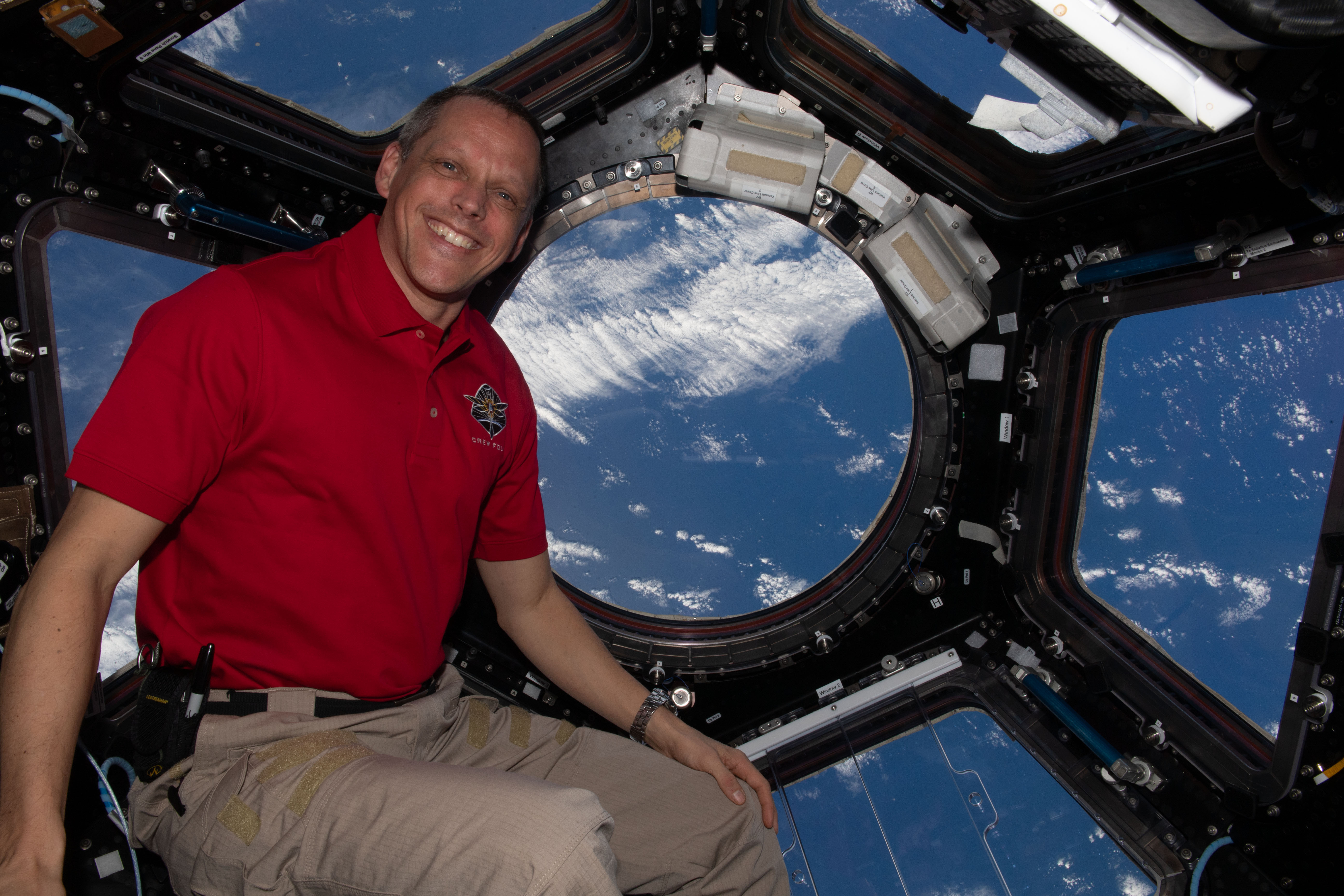
Astronauts Bob, Frank, Jessica, Samantha & Kjell | International Space Station
NASA Astronauts Bob Hines, Frank Rubio, and Jessica Watkins
European astronaut Samantha Cristoforetti looks at Earth
Astronaut Bob Hines looks at Earth
Astronaut Samantha Cristoforetti has fun with fluid physics
Astronaut Bob Hines has fun with fluid physics
Astronaut Frank Rubio has fun with fluid physics
Astronaut Jessica Watkins has fun with fluid physics
Astronaut Kjell Lindgren has fun with fluid physics
Expedition 68 Crew
Commander: Samantha Cristoforetti (European Space Agency-Italy)
Roscosmos Flight Engineers: Sergey Prokopyev (Russia) and Dmitri Petelin (Russia)
NASA Flight Engineers: Kjell Lindgren, Bob Hines, Jessica Watkins, Frank Rubio (USA)
An international partnership of space agencies provides and operates the elements of the International Space Station (ISS). The principals are the space agencies of the United States, Russia, Europe, Japan, and Canada. The ISS has been the most politically complex space exploration program ever undertaken.
In the summer of 2022, NASA’s James Webb Space Telescope released images from some of its first observations. Almost instantaneously, these stunning images landed everywhere from the front pages of news outlets to larger-than-life displays in Times Square.
Webb, however, will not pursue its exploration of the universe on its own. It is designed to work in concert with NASA’s many other telescopes as well as facilities both in space and on the ground. These new versions of the Webb images combine its infrared data with X-rays collected by NASA’s Chandra X-ray Observatory. They underscore how the power of any of these telescopes is only enhanced when joined with others. Let’s take a look at each.
Webb brilliantly shows how the galaxy cluster SMACS J0723, located about 4.2 billion light-years away, contains hundreds of individual galaxies. Galaxy clusters, however, contain far more than their galaxies alone. As some of the largest structures in the universe, they are filled with vast reservoirs of superheated gas that is seen only in X-ray light. The Chandra data reveal gas with temperatures of tens of millions of degrees, possessing a total mass of about 100 trillion times that of the Sun, several times higher than the mass of all the galaxies in the cluster. Invisible dark matter makes up an even larger fraction of the total mass in the cluster.
The four galaxies within Stephan’s Quintet are undergoing an intricate dance choreographed by gravity. (The fifth galaxy is an interloping galaxy at a different distance.) The Webb image of this object features never-seen-before details of the results of these interactions, including sweeping tails of gas and bursts of star formation. The Chandra data of this system has uncovered a shock wave that heats gas to tens of millions of degrees, as one of the galaxies passes through the others at speeds of around 2 million miles per hour. This new composite also includes data from NASA’s now-retired Spitzer Space Telescope.
Chandra’s data of the “Cosmic Cliffs” reveal over a dozen individual X-ray sources. These are mostly stars located in the outer region of a star cluster in the Carina Nebula with ages between 1 and 2 million years old, which is very young in stellar terms. Young stars are much brighter in X-rays than old stars, making X-ray studies an ideal way to distinguish stars in the Carina Nebula from the many stars of different ages from our Milky Way galaxy along our line of sight to the nebula. The diffuse X-ray emission in the top half of the image likely comes from hot gas from the three hottest, most massive stars located in the star cluster outside the field of view of the Webb image.
Finally, the Cartwheel galaxy gets its shape from a collision with another smaller galaxy — located outside the field of this image — about 100 million years ago. When this smaller galaxy punched through the Cartwheel, it triggered star formation that appears around an outer ring and elsewhere throughout the galaxy. X-rays seen by Chandra come from superheated gas, individual exploded stars, and neutron stars and black holes pulling material from companion stars. Webb’s infrared view shows the Cartwheel galaxy plus two smaller companion galaxies — not part of the collision — against a backdrop of many more distant galactic cousins.
Shenzhou-14 Mission: New Photos for National Day | China Space Station
A new batch of stunning photos taken by China's in-orbit Shenzhou-14 taikonauts was released by the China Manned Space Agency on October 4, 2022. The crew, who were sent to China's space station on June 5 for a six-month mission, became the first Chinese citizens to celebrate National Day, which falls on October 1, in outer space. The photos show the taikonauts saluting the Chinese national flag, as well as the spectacular views of Earth, the moon and the plants they have grown aboard the space station.

.png)




.jpg)