NASA's SpaceX Crew-6 Checks Out Dragon Spacecraft Prelaunch
Credit: Space Exploration Technologies Corp. (SpaceX)
Friends of NASA (FoN) is an independent non-governmental organization (NGO) dedicated to building international support for peaceful space exploration, commerce, scientific discovery, and STEM education.
NASA's SpaceX Crew-6 Checks Out Dragon Spacecraft Prelaunch
Credit: Space Exploration Technologies Corp. (SpaceX)
Hobbies: Astronaut Samantha Cristoforetti | International Space Station
What hobbies do you take part in during your free time?
European Space Agency (ESA) astronaut Samantha Cristoforetti’s day onboard the International Space Station usually starts at around 7:00 Greenwich Mean Time (GMT). During a typical day, she will run experiments and maintenance, exercise, and participate in daily task meetings. Once all the work is done, she gets free time to relax. Find out what she likes to do in her free time.
Learn about Samantha's Minerva Mission: https://bit.ly/MissionMinerva
Samantha Cristoforetti's Biography (ESA)
Credit: European Space Agency (ESA)
Release Date: October 17, 2022
#NASA #ESA #Space #Earth #Science #ISS #SpaceX #CrewDragon #SpaceXCrew4 #Hobbies #Astronaut #SamanthaCristoforetti #MinervaMission #Italy #Italia #Commander #Pioneer #Leader #HumanSpaceflight #Europe #STEM #Education #HD #Video
Samantha Arrives in Cologne, Germany after International Space Station Mission
Samantha’s Minerva mission began on April 27, 2022, when she was launched from Florida’s Kennedy Space Center, USA, as part of Crew-4. While this mission was not her first to the International Space Station, it was packed full of groundbreaking moments.
On July 21, 2022, Samantha completed her first spacewalk, outfitting the European Robotic Arm alongside Russian cosmonaut, Oleg Artemyev. This European project is capable of ‘walking’ between locations on the Station, offering grappling, transport, and installation assistance for payloads. Beyond this activity being a personal milestone, this extravehicular activity also made her the first European woman to spacewalk.
Samantha assumed the role of commander on September 28, 2022, making her the fifth European, and first European woman, to hold the leadership position of the International Space Station. As commander, Samantha was responsible for the performance and well-being of her colleagues in space, maintaining effective communication with the teams on Earth, and coordinating crew response in case of emergencies. At the end of her mission, she assured a smooth transition between Expedition 67 and Expedition 68.
SpaceX’s Crew Dragon Freedom transporting Crew-4 autonomously undocked from the International Space Station and after a series of burns, entered Earth’s atmosphere and deployed parachutes for a soft water-landing. Samantha and Crew-4 splashed down on October 14, 2022 at 21:55 BST (22:55 CEST).
Learn about Samantha's Minerva Mission: https://bit.ly/MissionMinerva
Samantha Cristoforetti's Biography (ESA)
Credits: European Space Agency - S. Corvaja/N. Ivanova
Image Date: October 15, 2022
#NASA #ESA #Space #Earth #Science #ISS #SpaceX #CrewDragon #SpaceXCrew4 #Freedom #Astronaut #SamanthaCristoforetti #MinervaMission #Italy #Italia #EVA #Commander #Pioneer #Leader #HumanSpaceflight #Cologne #Germany #Deutschland #Europe #STEM #Education
Zoom on Galaxy Cluster MACS J0647.7+7015 (annotated) | Hubble
This video zooms in on Hubble observations of massive galaxy cluster MACS J0647.7+7015. Astronomers used the powerful gravity from the cluster to magnify the light from a very distant distant galaxy (highlighted at the end of the video), an effect called gravitational lensing. The estimated distance of the galaxy would make it the most distant seen to date, with a redshift of around 11.
Credit: NASA, European Space Agency (ESA), G. Bacon
Duration: 51 seconds
Release Date: February 17, 2016
#NASA #ESA #Astronomy #Space #Science #Hubble #Galaxies #GalaxyCluster #MACSJ0647 #MACSJ064777015 #Camelopardalis #Constellation #Cosmos #Universe #SpaceTelescope #STScI #GSFC #UnitedStates #Europe #STEM #Education #HD #Video
Galaxy Cluster MACS J0647: Gravitational Lensing in Action | Hubble
The bright yellow galaxies near the center of the image are cluster members; due to the gravitational lensing technique, astronomers observed three magnified images of a far more distant galaxy called MACS0647-JD with the Hubble telescope. These are visible as small red dots in this image.
This is the latest discovery from a large program, called the Cluster Lensing And Supernova survey with Hubble (CLASH), that uses natural zoom lenses to reveal distant galaxies in the early Universe.
This image is a composite taken with Hubble’s Wide Field Camera 3 and the Advanced Camera for Surveys. The observations were taken October 5 and November 29, 2011.
Credit: NASA, European Space Agency, and M. Postman and D. Coe (Space Telescope Science Institute), and the CLASH team
Release Date: November 15, 2012
#NASA #ESA #Astronomy #Space #Science #Hubble #Galaxies #GalaxyCluster #MACSJ0647 #MACSJ064777015 #Camelopardalis #Constellation #Cosmos #Universe #SpaceTelescope #STScI #GSFC #UnitedStates #Europe #Infographic #STEM #Education
A Turbulent Stellar Nursery: Herbig–Haro Objects HH1 & HH2 | Hubble
Herbig–Haro objects are glowing clumps found around some newborn stars, and are created when jets of gas thrown outwards from these young stars collide with surrounding gas and dust at incredibly high speeds. In 2002, Hubble observations revealed that parts of HH 1 are moving at more than 400 kilometers per second!
This scene from a turbulent stellar nursery was captured with Hubble’s Wide Field Camera 3 using 11 different filters at infrared, visible, and ultraviolet wavelengths. Each of these filters is sensitive to just a small slice of the electromagnetic spectrum, and they allow astronomers to pinpoint interesting processes that emit light at specific wavelengths.
In the case of HH 1/2, two groups of astronomers requested Hubble observations for two different studies. The first delved into the structure and motion of the Herbig–Haro objects visible in this image, giving astronomers a better understanding of the physical processes occurring when outflows from young stars collide with surrounding gas and dust. The second study instead investigated the outflows themselves to lay the groundwork for future observations with the NASA/European Space Agency/Canadian Space Agency James Webb Space Telescope. Webb, with its ability to peer past the clouds of dust enveloping young stars, will revolutionize the study of outflows from young stars.
[Image description: Two wispy, gaseous clouds occupy the corners of this image, HH 1 in the upper right, and HH 2 in the lower left. Both are light blue and surrounded by dimmer multi-colored clouds, while the background is dark black due to dense gas. A very bright orange star lies just to the lower left of HH 1, and beyond that star is a narrow jet, emerging from the dark center of the field.]
Credit: European Space Agency (ESA)/Hubble & NASA, B. Reipurth, B. Nisini
Release Date: October 17, 2022
#NASA #ESA #Astronomy #Space #Science #Hubble #LightWavelengths #Infrared #Ultraviolet #Visible #HerbigHaroObjects #HH1 #HH2 #Jets #Orion #Constellation #Cosmos #Universe #SpaceTelescope #STScI #GSFC #UnitedStates #Europe #STEM #Education
The Icy Blue Wings of Planetary Nebula Hen 2-437 | Hubble
Located within the faint northern constellation of Vulpecula (The Fox), Hen 2-437 was first identified in 1946 by Rudolph Minkowski, who later also discovered the famous and equally beautiful M2-9 (otherwise known as the Twin Jet Nebula). Hen 2-437 was added to a catalogue of planetary nebula over two decades later by astronomer and NASA astronaut Karl Gordon Henize.
Planetary nebulae, such as Hen 2-437, form when an aging low-mass star—such as the Sun—reaches the final stages of life. The star swells to become a red giant, before casting off its gaseous outer layers into space. The star itself then slowly shrinks to form a white dwarf, while the expelled gas is slowly compressed and pushed outwards by stellar winds. As shown by its remarkably beautiful appearance, Hen 2-437 is a bipolar nebula—the material ejected by the dying star has streamed out into space to create the two icy blue lobes pictured here.
Credit: European Space Agency/Hubble & NASA
Acknowledgement: Judy Schmidt (Geckzilla)
Release Date: February 8, 2016
#NASA #ESA #Astronomy #Space #Science #Hubble #Nebula #PlanetaryNebula #Hen2437 #Bipolar #Vulpecula #Constellation #Cosmos #Universe #SpaceTelescope #STScI #GSFC #UnitedStates #Europe #STEM #Education
The Final Frontier: Galaxy Clusters | Hubble
Hubblecast 90: Since October 2013, the NASA/European Space Agency Hubble Space Telescope has been observing some of the most massive structures in the Universe—galaxy clusters. Using the magnification effect caused by their mass, Hubble can look deeper into the Universe than ever before. In this new Hubblecast, Dr J talks about the goals and the achievements of this campaign, called the Frontier Fields program.
Credit:
Directed by: Mathias Jäger
Visual design and editing: Martin Kornmesser
Written by: Rebecca Louise Davies, Carl Mundy
Presented by: Joe Liske (Dr J)
Narration: Sara Mendes da Costa
Images: NASA, ESA and the HST Frontier Fields team (STScI); S. Rodney (John Hopkins University, USA) and the FrontierSN team; T. Treu (University of California Los Angeles, USA), P. Kelly (University of California Berkeley, USA) and the GLASS team; J. Lotz (STScI) and the Frontier Fields team; M. Postman (STScI) and the CLASH team; and Z. Levay (STScI)
Videos: NASA, European Space Agency (ESA)/Hubble
Animations: NASA, ESA/Hubble, M. Kornmesser, L. Calçada
Web and technical support: Mathias Andre and Raquel Yumi Shida
Executive producer: Lars Lindberg Christensen
Duration: 6 minutes, 23 seconds
Release Date: February 9, 2016
#NASA #ESA #Astronomy #Space #Science #Hubble #Galaxies #GravitationalLensing #DarkMatter #GalaxyClusters #Cosmos #Universe #SpaceTelescope #STScI #GSFC #UnitedStates #Europe #STEM #Education #HD #Video
Fade Through of Galaxy Cluster Images | Hubble
This video fades through NASA/European Space Agency Hubble Space Telescope images of six different galaxy clusters. The clusters were observed in a study of how dark matter in clusters of galaxies behaves when the clusters collide. 72 large cluster collisions were studied in total.
The clusters shown here are, in order of appearance: MACS J0416.1–2403, MACS J0152.5-2852, MACS J0717.5+3745, Abell 370, Abell 2744 and ZwCl 1358+62
Credit: NASA, ESA, D. Harvey (École Polytechnique Fédérale de Lausanne, Switzerland), R. Massey (Durham University, UK), the Hubble SM4 ERO Team, ST-ECF, ESO, D. Coe (STScI), J. Merten (Heidelberg/Bologna), HST Frontier Fields, Harald Ebeling(University of Hawaii at Manoa), Jean-Paul Kneib (LAM)and Johan Richard (Caltech, USA)
Duration: 30 seconds
Release Date: March 26, 2015
#NASA #ESA #Astronomy #Space #Science #Hubble #Galaxies #MACSJ0416 #Abell370 #GalaxyClusters #Cosmos #Universe #SpaceTelescopes #ChandraObservatory #Xray #STScI #GSFC #UnitedStates #Europe #STEM #Education #HD #Video
Galaxy Cluster MACS J0416: Full Dome View | Hubble
This fulldome video shows the galaxy cluster MACS J0416.1–2403, which was observed by the European Space Agency/Hubble Space Telescope as part of the Frontier Fields program.
Distance: 4 billion light years
Using the effect of gravitational lensing caused by the mass of the cluster, this program allows astronomers to study some of the earliest galaxies in the Universe.
Note: The full dome video display format is designed for projection systems in planetariums.
Credit: Hubble/T. Matsopoulos
Duration: 20 seconds
Release Date: December 10, 2015
#NASA #ESA #Astronomy #Space #Science #Hubble #Galaxies #GalaxyCluster #MACSJ0416 #Eridanus #Constellation #Cosmos #Universe #SpaceTelescopes #Xray #ChandraObservatory #Radio #NRAO #VLA #STScI #GSFC #UnitedStates #Europe #STEM #Education #FullDome #HD #Video
Intracluster Light: Galaxy Cluster MACS J0416 | Hubble
This animation switches between an original image of the galaxy cluster MACS J0416.1–2403, as it was observed by the Frontier Field team, and a version, in which the intracluster light (in blue) is highlighted.
Distance: 4 billion light years
Intracluster light is a byproduct of interactions between galaxies. It can be used to make the distribution of dark matter in galaxy clusters visible.
Credit: European Space Agency (ESA)/Hubble, NASA, HST Frontier Fields team (STScI), and M. Montes & I. Trujillo
Duration: 20 seconds
Release Date: December 20, 2018
A Cosmic Kaleidoscope: Galaxy Cluster MACS J0416 | Hubble
As with all galaxy clusters, MACS J0416 contains a significant amount of dark matter, which leaves a detectable imprint in visible light by distorting the images of background galaxies. In this image, this dark matter appears to align well with the blue-hued hot gas, suggesting that the two clusters have not yet collided; if the clusters had already smashed into one another, the dark matter and gas would have separated. MACS J0416 also contains other features—such as a compact core of hot gas—that would likely have been disrupted had a collision already occurred.
Together with five other galaxy clusters, MACS J0416 is playing a leading role in the Hubble Frontier Fields program, for which this data was obtained. Owing to its huge mass, the cluster is in fact bending the light of background objects, acting as a magnifying lens. Astronomers can use this phenomenon to find galaxies that existed only hundreds of million years after the big bang.
Credit: NASA, European Space Agency (ESA), Chandra X-ray Center (CXC), National Radio Astronomy Observatory (NRAO)/AUI/NSF, Space Telescope Science Institute (STScI), and G. Ogrean (Stanford University)
Acknowledgment: NASA, ESA, and J. Lotz (STScI), and the HFF team
Release Date: March 21, 2016
#NASA #ESA #Astronomy #Space #Science #Hubble #Galaxies #GalaxyCluster #MACSJ0416 #Eridanus #Constellation #Cosmos #Universe #SpaceTelescopes #Xray #ChandraObservatory #Radio #NRAO #VLA #STScI #GSFC #UnitedStates #Europe #STEM #Education
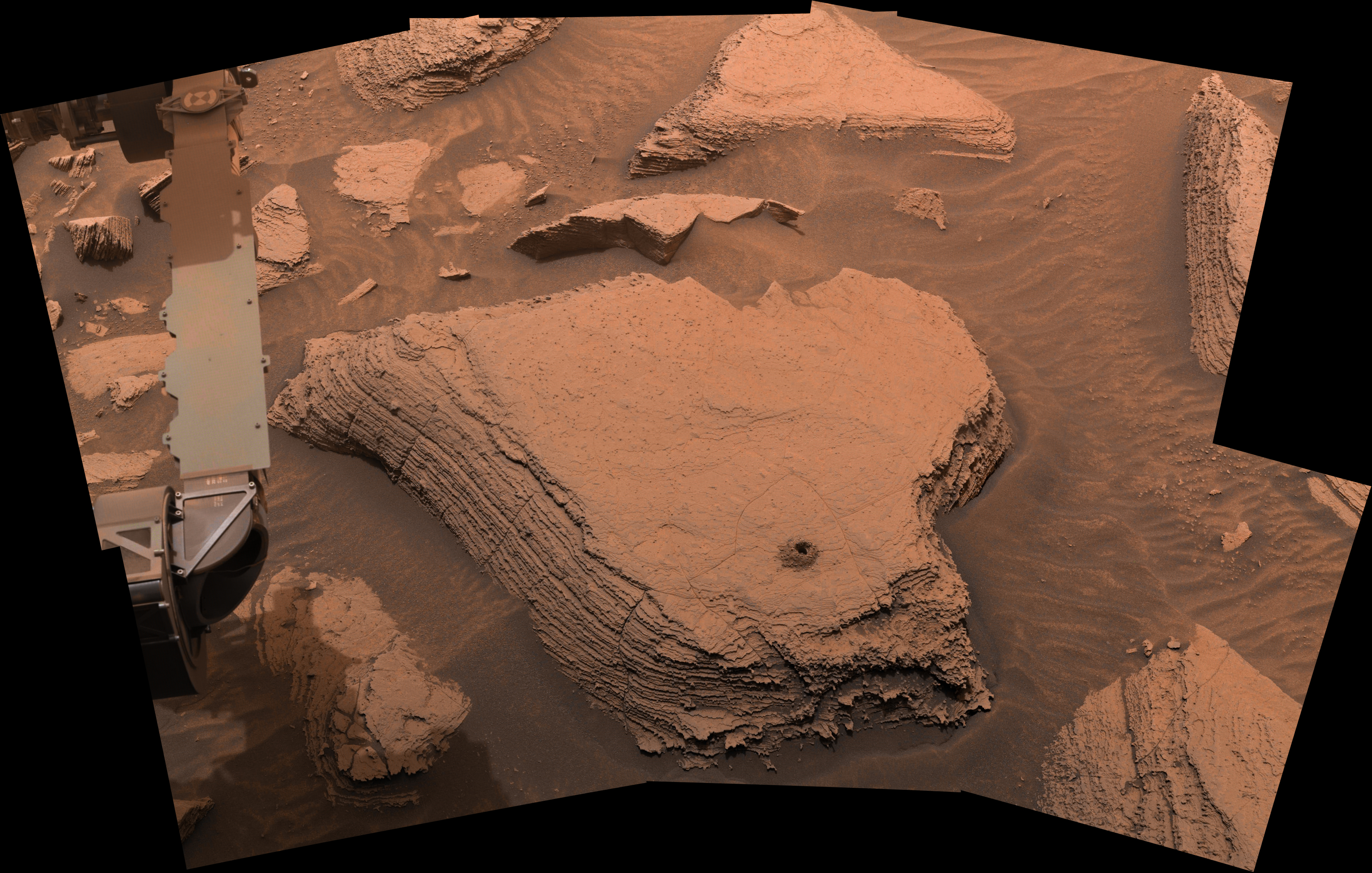
New Mars Images: NASA's Perseverance & Curiosity Rovers | JPL
Mars 2020 - Mastcam-Z - sols 484 & 492
Credit: NASA/JPL-Caltech/ASU/MSSS
Mars 2020 - Mastcam-Z - sol 518
Credit: NASA/JPL-Caltech/ASU/MSSS
Mars 2020 - Mastcam-Z - sol 518
Credit: NASA/JPL-Caltech/ASU/MSSS
MSL - MAHLI - sol 3605
Credit: NASA/JPL-Caltech/MSSS
MSL - Mastcam - sol 3621
Credit: NASA/JPL-Caltech/SwRI/MSSS/Kevin M. Gill
Credit: NASA/JPL-Caltech/ASU/PipploIMP
NASA’s Perseverance rover is well into its second science campaign, collecting rock-core samples from features within an area long considered by scientists to be a top prospect for finding signs of ancient microbial life on Mars. The rover has collected four samples from an ancient river delta in the Red Planet’s Jezero Crater since July 7, bringing the total count of scientifically compelling rock samples to 12.
“We picked the Jezero Crater for Perseverance to explore because we thought it had the best chance of providing scientifically excellent samples—and now we know we sent the rover to the right location,” said Thomas Zurbuchen, NASA’s associate administrator for science in Washington. “These first two science campaigns have yielded an amazing diversity of samples to bring back to Earth by the Mars Sample Return campaign.”
Twenty-eight miles (45 kilometers) wide, Jezero Crater hosts a delta—an ancient fan-shaped feature that formed about 3.5 billion years ago at the convergence of a Martian river and a lake. Perseverance is currently investigating the delta’s sedimentary rocks, formed when particles of various sizes settled in the once-watery environment. During its first science campaign, the rover explored the crater’s floor, finding igneous rock, which forms deep underground from magma or during volcanic activity at the surface.
“The delta, with its diverse sedimentary rocks, contrasts beautifully with the igneous rocks—formed from crystallization of magma—discovered on the crater floor,” said Perseverance project scientist Ken Farley of Caltech in Pasadena, California. “This juxtaposition provides us with a rich understanding of the geologic history after the crater formed and a diverse sample suite. For example, we found a sandstone that carries grains and rock fragments created far from Jezero Crater—and a mudstone that includes intriguing organic compounds.”
SHERLOC’s analysis indicates the samples feature a class of organic molecules that are spatially correlated with those of sulfate minerals. Sulfate minerals found in layers of sedimentary rock can yield significant information about the aqueous environments in which they formed.
Organic molecules consist of a wide variety of compounds made primarily of carbon and usually include hydrogen and oxygen atoms. They can also contain other elements, such as nitrogen, phosphorus, and sulfur. While there are chemical processes that produce these molecules that don’t require life, some of these compounds are the chemical building blocks of life. The presence of these specific molecules is considered to be a potential biosignature—a substance or structure that could be evidence of past life but may also have been produced without the presence of life.
For more about Perseverance: mars.nasa.gov/mars2020/
For more about Curiosity:
https://mars.nasa.gov/msl/home/
For more about the Mars Sample Return campaign: mars.nasa.gov/msr
For more information on NASA's Mars missions, visit: mars.nasa.gov
Story Credit: NASA/JPL-Caltech/ASU/MSSS
Release Date: September 15, 2022
SpaceX: Eutelsat Satellite Launch | Cape Canaveral Space Force Station
This was the third launch and landing of this booster, which previously supported the launch of CRS-24 and one Starlink mission.
Eutelsat Hotbird-13F and its sister satellite Hotbird-13G are slated to replace three existing satellites at the 13 degrees East longitude geosynchronous orbital slot. These satellites are designed to provide up to 1,000 television channels, including 4K video, to over 160 million homes in Europe, North Africa, and the Middle East.
The Hotbird-13F and 13G satellites, massing 4,500 kilograms each, are equipped with 80 Ku-band transponders. These satellites, designed to operate for 15 years, use all-electric propulsion and have 22 kilowatts of power capability provided by two large solar panels. The all-electric propulsion system enables a reduced launch mass for the satellites, which do not have to carry large amounts of liquid fuel.
Both Hotbird satellites were built by Airbus Defence and Space. Hotbird 13F was the first satellite built under the European Space Agency’s Eurostar Neo program. This program was enabled by an ESA Partnership Project with Airbus, which is an effort by ESA to improve European space industry innovation and competitiveness in the world market.
Credit: Space Exploration Technologies Corp. (SpaceX)
Image Date: October 15, 2022
#NASA #Space #Astronomy #Science #SpaceX #ElonMusk #Satellite #Eutelsat #Hotbird13F #Hotbird13G #Airbus #ESA #Europe #Spaceflight #Technology #Engineering #CommercialSpace #Spaceport #CapeCanaveral #Florida #SpaceForce #UnitedStates #STEM #Education
The Milky Way Galaxy over Gilgering, Western Australia
The Fading Milky Way
Light pollution is a growing environmental problem that threatens to erase the night sky before its time. A recent study revealed that perhaps two-thirds of the world's population can no longer look upwards at night and see the Milky Way—a hazy swath of stars that on warm summer nights spans the sky from horizon to horizon.
The Milky Way is dimming, not because the end of the Universe is near, but rather as a result of light pollution: the inadvertent illumination of the atmosphere from street lights, outdoor advertising, homes, schools, airports and other sources. Every night billions of bulbs send their energy skyward where microscopic bits of matter—air molecules, airborne dust, and water vapor droplets—reflect much of the wasted light back to Earth.
(Source: NASA)
Learn more:
International Dark-Sky Association
https://www.darksky.org/light-pollution
Globe at Night
Night Sky Network (NASA JPL)
https://nightsky.jpl.nasa.gov/index.cfm
Tourism Australia: https://www.australia.com
Nikon d810a, 50mm, ISO 6400, f/2.8
Foreground: 6 x 30 seconds
Sky: 14 x 30 seconds
IOptron SkyTracker
Hoya Red Intensifier filter
Credit: Trevor Dobson
Trevor's Instagram: trevordobson_astro
Location: Gilgering, Western Australia
Image Date: August 20, 2022
#NASA #Space #Astronomy #Science #MilkyWay #Galaxy #Stars #LightPollution #CitizenScience #Astrophotographer #TrevorDobson #Astrophotography #Skywatching #Cosmos #Universe #SolarSystem #Earth #Gilgering #WesternAustralia #Australia #STEM #Education
Europa & Ganymede: The Icy Moons of Jupiter | ESO
This image shows two of Jupiter’s moons, the icy Ganymede and Europa, which have been imaged in the infrared using the SPHERE instrument on the European Southern Observatory’s Very Large Telescope (VLT). Whilst Europa is quite similar in size to our own Moon, Ganymede is the largest moon in the whole Solar System—it is even bigger than the planet Mercury!
Their orbits around Jupiter are slightly elliptical, so they get closer and further away from the planet as they orbit it. This results in the moons being stretched and squeezed by the gravitational pull from Jupiter at periodical intervals. This creates frictional heat, warming the insides of the moons, which has made them geologically active. Europa in particular is likely to have active plumes and geysers erupting from the oceans of liquid water beneath the thick ice cover that makes up the surface.
Estimates on the abundances of chemical species on the marble-like surfaces of these moons could be made thanks to these new images and also spectra, which have been published in two studies by Oliver King and Leigh N. Fletcher at the University of Leicester in the United Kingdom. They found that the bright regions of Ganymede consist mainly of water in the form of ice with hints of various salts, and that they have formed more recently than the older darker patches, whose composition still remains a mystery to astronomers.
Observing these moons with ground-based telescopes is challenging, because they look as small as a 1 Euro coin seen from 3-5 km away. Earth’s atmosphere would completely blur these images, but SPHERE’s adaptive optics system corrects these distortions, delivering very sharp images with details as small as 150 km.
Credit: European Southern Observatory (ESO)/King & Fletcher. Jupiter background image: NASA, European Space Agency (ESA), A. Simon (Goddard Space Flight Center), and M. H. Wong (University of California, Berkeley) and the OPAL team.
Release Date: October 10, 2022
#NASA #Astronomy #Space #Science #ESO #Planet #Jupiter #Moons #Europa #Ganymede #Ice #Water #SolarSystem #Exploration #Telescope #AdaptiveOptics #VLT #Infrared #SPHERE #Chile #Europe #STEM #Education