Friends of NASA (FoN) is an independent non-governmental organization (NGO) dedicated to building international support for peaceful space exploration, commerce, scientific discovery, and STEM education.
Celebrating the Success of Artemis I: A Japanese Good Luck Token | NASA Kennedy
Artemis Launch Director Charlie Blackwell-Thompson (left) and Associate Administrator of NASA’s Space Operations Mission Directorate Kathryn Lueders finish coloring in the other eye of the Japanese Daruma doll
Artemis Launch Director Charlie Blackwell-Thompson and Associate Administrator of NASA’s Space Operations Mission Directorate Kathryn Lueders finish coloring in the other eye of the Japanese Daruma doll to highlight the successful Artemis I mission on Dec. 20, 2022, in Firing Room 1 of the Rocco A. Petrone Launch Control Center at NASA’s Kennedy Space Center in Florida.
The Japan Aerospace Exploration Agency (JAXA) gave a Daruma doll to both Lueders and Associate Administrator for the Exploration Systems Development Mission Directorate, Jim Free, as a token of good luck prior to the Artemis I launch. Free filled in his eye on Dec. 11, 2022, with Artemis I Ascent and Entry Flight Director Judd Frieling in Mission Control Center at NASA’s Johnson Space Center in Houston, Texas.
Black Hole Destroys a Star (Animation) | Science Communication Lab
Multiple NASA telescopes recently observed a massive black hole tearing apart an unlucky star that wandered too close. Located about 250 million light-years from Earth in the center of another galaxy, it was the fifth-closest example of a black hole destroying a star ever observed. Once the star had been thoroughly ruptured by the black hole’s gravity, astronomers saw a dramatic rise in high-energy X-ray light around the black hole. This indicated that as the stellar material was pulled toward its doom, it formed an extremely hot structure above the black hole called a corona.
The destruction of a star by a black hole—a process formally known as a tidal disruption event— could be used to better understand what happens to material that is captured by one of these behemoths before it is fully devoured.
A wayward star is ripped to shreds by a black hole in this animation from the Science Communication Lab for DESY, the Deutsches Elektronen-Synchrotron. Known as a tidal disruption event, the star is first stretched out by the black hole’s intense gravity, until it no longer resembles a star. The river of stellar material wraps around the black hole, and forms an existing accretion disk (or add to an existing one). These events can also produce coronae (clouds of ultra-hot plasma that radiate hard X-ray light) and jets that spew material away from the black hole at its poles.
These events emit wavelengths spanning almost the entire electromagnetic spectrum from radio waves to high-energy X-rays. They are studied by many space and ground-based telescopes including the Zwicky Transient Facility (ZTF), located at the Palomar Observatory in Southern California, and NASA’s NuSTAR (Nuclear Spectroscopic Telescopic Array) observatory.
NuSTAR is a Small Explorer mission led by Caltech and managed by NASA's Jet Propulsion Laboratory for NASA's Science Mission Directorate in Washington. NuSTAR was developed in partnership with the Danish Technical University and the Italian Space Agency (ASI). The spacecraft was built by Orbital Sciences Corp., Dulles, Virginia. NuSTAR's mission operations center is at UC Berkeley, and the official data archive is at NASA's High Energy Astrophysics Science Archive Research Center. ASI provides the mission's ground station and a mirror archive. JPL is managed by Caltech for NASA.
Honoring the 50th Anniversary of NASA's Apollo 17 Moon Mission
On Dec. 7, 1972, NASA astronauts Harrison Schmitt, Eugene Cernan, and Ronald Evans lifted off on Apollo 17—the final mission of the Apollo program. Cernan and Schmitt landed on the Moon on Dec. 11, spending three days on the lunar surface before rejoining Evans in orbit and returning to Earth, splashing down in the Pacific Ocean on Dec. 19.
Apollo 17 was the most recent mission to land humans on the Moon—and our next one isn't far away. As our Artemis missions prepare to return humans to the Moon and build a sustainable lunar presence, join us for a look back at Apollo 17.
On Sept. 26, 2022, after ten months of journeying through space, NASA's experimental Double Asteroid Redirection Test (DART) spacecraft—roughly the size of a vending machine—hurtled toward a binary asteroid some 7 million miles (11 million kilometers) from Earth at a speed of roughly 14,000 miles (22,530 kilometers) per hour. Equipped with a state-of-the-art imaging system that worked in tandem with a sophisticated onboard set of targeting, guidance, navigation and control algorithms, DART autonomously identified and distinguished between the two asteroids in its final moments, targeted the smaller body (which could not be seen from Earth) and crashed into it.
The intentional impact marked the world’s first planetary defense technology demonstration and humanity’s first successful attempt to move a celestial object.
The Johns Hopkins Applied Physics Laboratory manages the DART mission for NASA's Planetary Defense Coordination Office as a project of the agency’s Planetary Missions Program Office.
Planet Mars: South Pole Water Ice Deposits | NASA's Mars Reconnaissance Orbiter
A wide variety of south polar terrains are on display in this spectacular HiRISE color image. The reddish material in the upper two thirds of the image is the South Polar layered deposits (SPLD). These deposits are a stack of layered, dusty water ice. Scientists believe that these layers record previous climatic conditions on Mars, much like terrestrial ice-sheets provide a record of climate change on the Earth.
This image shows the face of one of the many scarps or shallow cliffs that cut into the polar layered deposits. These scarps expose the internal layers within the SPLD.
This is a non-narrated clip with ambient sound. The image is less than 1 km (under 1 mi) across and the spacecraft altitude was 248 km (154 mi).
This image was captured by NASA's Mars Reconnaissance Orbiter (MRO) using the High Resolution Imaging Science Experiment (HiRISE) instrument.
Malin Space Science Systems built the Mars Color Imager (MARCI), Context Camera (CTX) systems for MRO.
The University of Arizona, Tucson, operates HiRISE, which was built by Ball Aerospace & Technologies Corp., Boulder, Colorado.
NASA's Jet Propulsion Laboratory, a division of Caltech in Pasadena, California, manages the Mars Reconnaissance Orbiter Project for NASA's Science Mission Directorate, Washington.
What a year it has been for Webb! It feels like just yesterday we were getting ready to launch, and now Webb has hit the ground running in its mission to Unfold The Universe. Break out your box of tissues and relive the magic with us.
Happy Birthday, Webb!
Credit: NASA's Goddard Space Flight Center
Michael McClare (KBRwyle): Lead Producer
Aaron E. Lepsch (ADNET): Technical Support
Michael McClare (KBRwyle): Lead Editor
Michael McClare (KBRwyle): Lead Videographer
Sophia Roberts (AIMM): Videographer
Michael P. Menzel (AIMM): Videographer
Adriana Manrique Gutierrez (KBRwyle): Lead Animator
Diving into the Cosmic Cliffs of The Carina Nebula | James Webb Space Telescope
Scientists taking a “deep dive” into one of the iconic first images from the NASA/European Space Agency/Canadian Space Agency James Webb Space Telescope have discovered dozens of energetic jets and outflows from young stars previously hidden by dust clouds. The discovery marks the beginning of a new era of investigating how stars like our Sun form, and how the radiation from nearby massive stars might affect the development of planets.
Dozens of previously hidden jets and outflows from young stars are revealed in this new image from Webb’s Near-Infrared Camera (NIRCam). This image separates out several wavelengths of light from the First Image revealed on July 12, 2022, which highlights molecular hydrogen, a vital ingredient for star formation. Insets on the right-hand side highlight three regions of the Cosmic Cliffs with particularly active molecular hydrogen outflows.
The Cosmic Cliffs, a region at the edge of a gigantic, gaseous cavity within the star cluster NGC 3324, has long intrigued astronomers as a hotbed for star formation. While well-studied by the NASA/ESA Hubble Space Telescope, many details of star formation in NGC 3324 remain hidden at visible-light wavelengths. Webb is perfectly primed to tease out these long-sought-after details since it is built to detect jets and outflows seen only in the infrared at high resolution. Webb’s capabilities also allow researchers to track the movement of other features previously captured by Hubble.
[Video Description: The image featured is divided horizontally by an undulating line between a orange-burgundy cloudscape forming a nebula along the bottom portion and a comparatively blue upper portion. Speckled across both portions is a starfield, showing innumerable stars of many sizes.]
Recently, by analyzing data from a specific wavelength of infrared light (4.7 microns), astronomers discovered two dozen previously unknown outflows from extremely young stars revealed by molecular hydrogen. Webb’s observations uncovered a gallery of objects ranging from small fountains to burbling behemoths that extend light-years from the forming stars. Many of these protostars are poised to become low mass stars, like our Sun.
Molecular hydrogen is a vital ingredient for making new stars and an excellent tracer of the early stages of their formation. As young stars gather material from the gas and dust that surround them, most also eject a fraction of that material back out again from their polar regions in jets and outflows. These jets then act like a snowplow, bulldozing into the surrounding environment. Visible in Webb’s observations is the molecular hydrogen getting swept up and excited by these jets.
Previous observations of jets and outflows looked mostly at nearby regions and more evolved objects that are already detectable in the visual wavelengths seen by Hubble. The unparalleled sensitivity of Webb allows observations of more distant regions, while its infrared optimization probes into the dust-sampling younger stages. Together this provides astronomers with an unprecedented view into environments that resemble the birthplace of our solar system.
In analyzing the new Webb observations, astronomers are also gaining insights into how active these star-forming regions are, even in a relatively short time span. By comparing the position of previously known outflows in this region caught by Webb, to archival data by Hubble from 16 years ago, the scientists were able to track the speed and direction in which the jets are moving.
This science was conducted on observations collected as part of Webb’s Early Release Observations Program. The paper was published in the Monthly Notices of the Royal Astronomical Society in December 2022.
In this image, red, green, and blue were assigned to Webb’s NIRCam data at 4.7, 4.44, and 1.87 microns (F470N, F444W, and F187N filters, respectively).
Credit: NASA, ESA, CSA, Space Telescope Science Institute (STScI), M. Reiter (Rice University), J. DePasquale (STScI)
Inner Ring of Galaxy NGC 1097: NACO versus ERIS Infrared View | ESO
ERIS, the Very Large Telescope’s newest infrared eye on the sky, reveals the inner ring of the galaxy NGC 1097 in stunning detail. This galaxy is located 45 million light-years away from Earth, in the constellation Fornax. ERIS has captured the gaseous and dusty ring that lies at the very center of the galaxy. The bright spots in the ring are stellar nurseries, shown in unprecedented detail.
This image has been taken through four different filters by ERIS’s state-of-the-art infrared imager, the Near Infrared Camera System—or NIX, which will take over the role of the very successful NACO imager. NACO also used adaptive optics to correct for the blurring caused by atmospheric turbulence, but ERIS’s more modern capabilities, coupled with the VLT’s Adaptive Optics Facility, deliver much sharper images. To put NIX’s resolution in perspective, this image shows, in detail, a portion of the sky less than 0.03% the size of the full Moon.
The Inner Ring of Galaxy NGC 1097 | European Southern Observatory
The European Southern Observatory’s newest scientific instrument, the Enhanced Resolution Imager and Spectrograph (ERIS) has successfully completed its first test observations. One of them exposed the heart of the galaxy NGC 1097 in mesmerizing detail. Installed on ESO’s Very Large Telescope (VLT) at Cerro Paranal in northern Chile, this infrared instrument will be able to see further and in finer detail, leading the way in Solar System, exoplanet and galaxy observations.
ERIS sees first light, capturing a detailed view of the inner ring of NGC 1097
The image consists of a ring of bright pink and blue dusty material. The ring has bright spots, showing where stars are forming. There are darker patches in the ring, where the dust is too dense for light to pass through. In the middle of the ring, there is a bright pink-yellow glow, with a very bright center. There is a gap between this glow in the middle and the ring, where the background dark Universe peers through.
ERIS, the Very Large Telescope’s newest infrared eye on the sky, captured this stunning image of the inner ring of the galaxy NGC 1097. This galaxy is located 45 million light-years away from Earth, in the constellation Fornax. ERIS has captured the gaseous and dusty ring that lies at the very center of the galaxy. The bright spots in the ring are stellar nurseries, shown in unprecedented detail. The center of this galaxy is active, with a supermassive black hole that feeds off its surroundings.
This image has been taken through four different filters by ERIS’s state-of-the-art infrared imager, the Near Infrared Camera System—or NIX. The filters have been represented here by blue, green, red and magenta, where the last one highlights the compact regions in the ring. To put NIX’s resolution in perspective, this image shows, in detail, a portion of the sky less than 0.03% the size of the full Moon.
Just in time for the festive season, this new Picture of the Week from the NASA/European Space Agency Hubble Space Telescope features a glistening scene in holiday red. This image shows a small region of the well-known nebula Westerhout 5, which lies about 7,000 light-years from Earth. Suffused with bright red light, this luminous image hosts a variety of interesting features, including a free-floating Evaporating Gaseous Globule (frEGG). The frEGG in this image is the small tadpole-shaped dark region in the upper center-left. This buoyant-looking bubble is lumbered with two rather uninspiring names—[KAG2008] globule 13 and J025838.6+604259.
Image Description: The background is filled with bright orange-red clouds of varying density. Towards the top-left several large, pale blue stars with prominent cross-shaped spikes are scattered. A small, tadpole-shaped dark patch floats near one of these stars. More of the same dark, dense gas fills the lower-right, resembling black smoke. A bright yellow star and a smaller blue star shine in front of this.
FrEGGs are a particular class of Evaporating Gaseous Globules (EGGs). Both frEGGs and EGGs are regions of gas that are sufficiently dense that they photoevaporate less easily than the less compact gas surrounding them. Photoevaporation occurs when gas is ionized and dispersed away by an intense source of radiation—typically young, hot stars releasing vast amounts of ultraviolet light. EGGs were only identified fairly recently, most notably at the tips of the Pillars of Creation, which were captured by Hubble in iconic images released in 1995. FrEGGs were classified even more recently, and are distinguished from EGGs by being detached and having a distinct ‘head-tail’ shape. FrEGGs and EGGs are of particular interest because their density makes it more difficult for intense UV radiation, found in regions rich in young stars, to penetrate them. Their relative opacity means that the gas within them is protected from ionization and photoevaporation. This is thought to be important for the formation of protostars, and it is predicted that many FrEGGs and EGGs will play host to the birth of new stars.
The frEGG in this image is a dark spot in the sea of red light. The red color is caused by a particular type of light emission known as H-alpha emission. This occurs when a very energetic electron within a hydrogen atom loses a set amount of its energy, causing the electron to become less energetic and this distinctive red light to be released.
Credit: European Space Agency (ESA)/Hubble & NASA, R. Sahai
Phobos Moon over Mars | European Space Agency's Mars Express
The European Space Agency's Mars Express spacecraft captured this image of the Martian moon, Phobos, and of the Peridier Crater, Syrtis Major quadrangle on the planet Mars. Phobos is the innermost and larger of the two natural satellites of Mars, the other being Deimos. The two moons were discovered in 1877 by American astronomer Asaph Hall. It is named after Phobos, the Greek god of fear and panic, who is the son of Ares (Mars) and twin brother of Deimos.
Phobos is a small, irregularly shaped object with a mean radius of 11 km (7 mi). Phobos orbits 6,000 km (3,700 mi) from the Martian surface, closer to its primary body than any other known planetary moon. It is so close that it orbits Mars much faster than Mars rotates, and completes an orbit in just 7 hours and 39 minutes. As a result, from the surface of Mars it appears to rise in the west, move across the sky in 4 hours and 15 minutes or less, and set in the east, twice each Martian day.
Phobos is one of the least reflective bodies in the Solar System, with an albedo of just 0.071. Surface temperatures range from about −4 °C (25 °F) on the sunlit side to −112 °C (−170 °F) on the shadowed side. The defining surface feature is the large impact crater, Stickney, which takes up a substantial proportion of the moon's surface. The surface is also home to many grooves, with there being numerous theories as to how these grooves were formed.
Jupiter's Ocean Moon Europa Close-Up | NASA Juno Mission
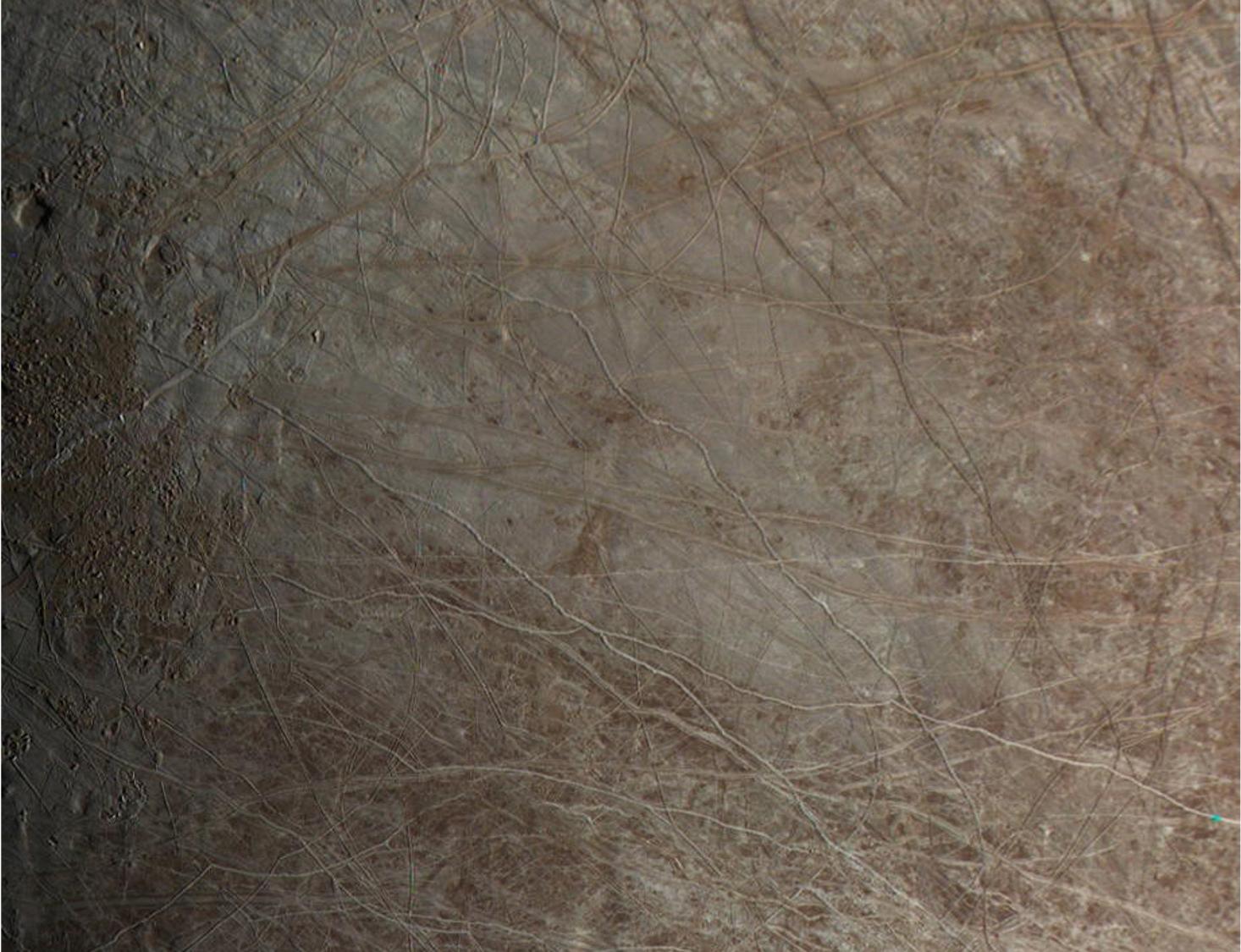
The surface of Jupiter's moon Europa is shown in an image from the JunoCam color public engagement camera aboard NASA's Juno spacecraft. The data for this image was taken Sept. 29, 2022. During its flybys in the late 1990s and 2000, NASA's Galileo mission mapped much of Jupiter's moon Europa at a resolution of 0.6 miles per pixel (1 kilometer per pixel) or better, but there are some patches that were imaged only at low resolution. Images from JunoCam have now filled in one of those regions, shown here. Cracks, ridges, and bands show up clearly, and can be visually traced across images to match up to the cracks and ridges that appear in the earlier Galileo images. The way these features crosscut the surface can reveal which sections of the terrain are younger and which are older, helping scientists to fill in Europa's tectonic history. Paul Schenk processed the images.
Scientists think Europa’s ice shell is 10 to 15 miles (15 to 25 kilometers) thick, floating on an ocean 40 to 100 miles (60 to 150 kilometers) deep. So while Europa is only one-fourth the diameter of Earth, its ocean may contain twice as much water as all of Earth’s oceans combined. Europa’s vast and unfathomably deep ocean is widely considered the most promising place to look for life beyond Earth. A passing spacecraft might even be able to sample Europa’s ocean without landing on the moon’s surface because it is possible that Europa’s ocean may be leaking out into space.
NASA’s Jet Propulsion Laboratory, a division of Caltech in Pasadena, California, manages the Juno mission for the principal investigator, Scott J. Bolton, of the Southwest Research Institute in San Antonio. Juno is part of NASA’s New Frontiers Program, which is managed at NASA’s Marshall Space Flight Center in Huntsville, Alabama, for the agency’s Science Mission Directorate in Washington. Lockheed Martin Space in Denver built and operates the spacecraft.
JunoCam’s raw images are available for the public to peruse and process into image products at:
Omar Baez, senior launch manager, Launch Services Program, talks with Megan Cruz, NASA Communications, after the successful launch of the Surface Water and Ocean Topography (SWOT) mission from Vandenberg Space Force Base in California on Dec. 16, 2022. This was Omar's final mission before he retires from NASA. Omar is a veteran over 300 rocket launches during his career at NASA. Be sure to watch Omar's reaction to a video tribute from his team at the 5 minute, 38 second mark.
Liftoff of the SpaceX Falcon 9 rocket carrying SWOT occurred at 3:46 a.m. PST from Space Launch Complex 4-East at Vandenberg.
A collaboration between NASA and the French space agency Centre National d’Études Spatiales (CNES), with contributions from the Canadian Space Agency and the UK Space Agency, SWOT will be the first satellite to survey nearly all water on Earth’s surface. The satellite will help researchers understand how much water flows in and out of Earth’s freshwater bodies and will provide insight into the ocean’s role in climate change.
The instruments onboard will measure the height of water in lakes, rivers, reservoirs, and the ocean, and will observe ocean features in higher definition than ever before. NASA’s Launch Services Program, based at the agency’s Kennedy Space Center in Florida, is managing the launch service.
NASA’s Launch Services Program, based at the agency’s Kennedy Space Center in Florida, is managing the launch service.
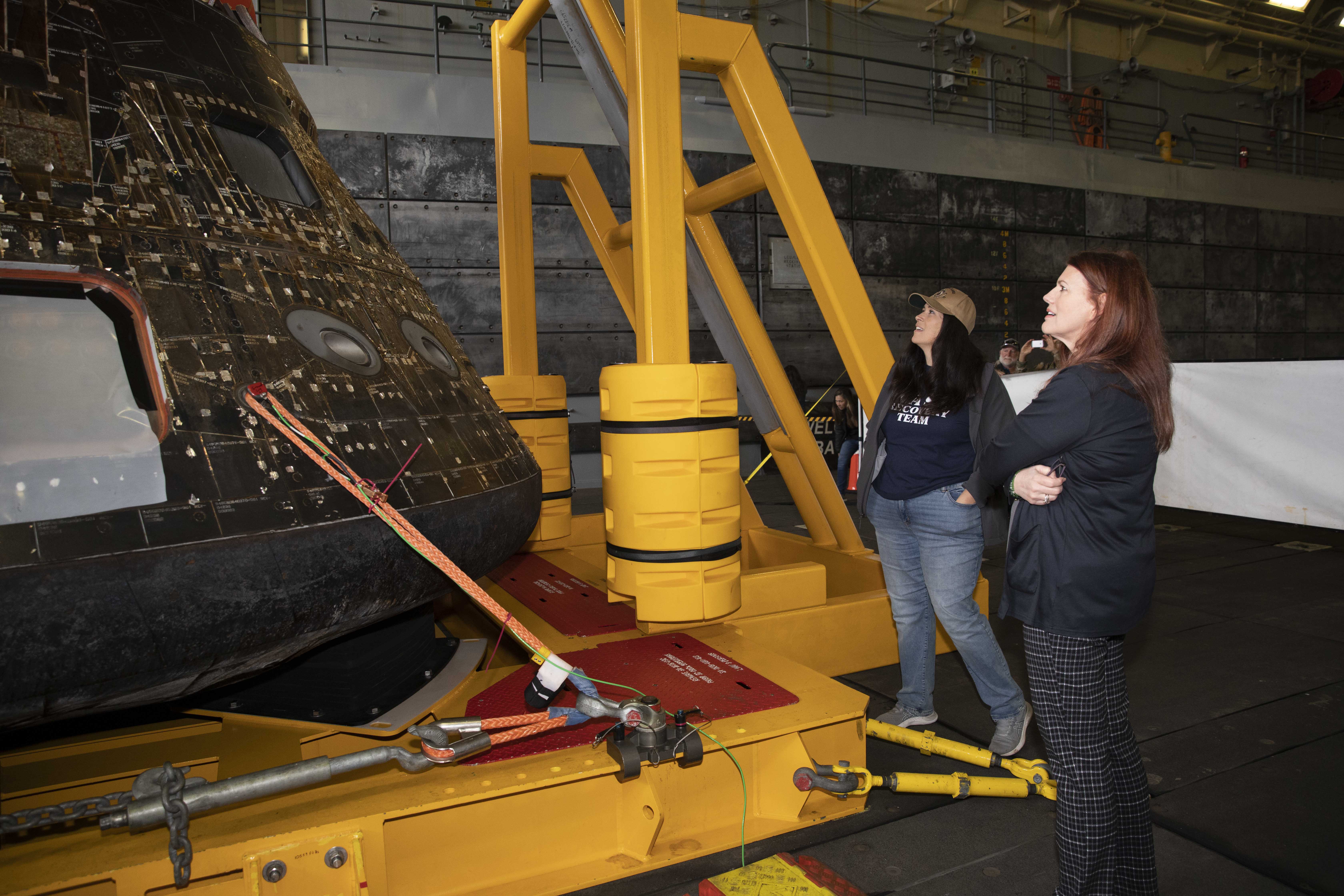
Kennedy Space Center Deputy Director Kelvin Manning stands near the Artemis I Orion spacecraft inside the well deck of the USS Portland at U.S. Naval Base San Diego on Dec. 13, 2022.
NASA Artemis Launch Director Charlie Blackwell-Thompson, with the Exploration Ground Systems program, stands near the Artemis I Orion spacecraft inside the well deck of the USS Portland at U.S. Naval Base San Diego on Dec. 13, 2022.
Kennedy Space Center Director Janet Petro stands near the Artemis I Orion spacecraft inside the well deck of the USS Portland at U.S. Naval Base San Diego on Dec. 13, 2022.
Kennedy Space Center Director Janet Petro, third from left, and recovery team members look at the Artemis I Orion spacecraft inside the well deck of the USS Portland at U.S. Naval Base San Diego on Dec. 13, 2022.
NASA Artemis Launch Director Charlie Blackwell-Thompson, at right, and Melissa Jones, NASA’s Artemis I Recovery director, both with the Exploration Ground Systems program, look at the Artemis I Orion spacecraft inside the well deck of the USS Portland at U.S. Naval Base San Diego on Dec. 13, 2022.
Team members with NASA’s Exploration Ground Systems program successfully removed the Artemis I Orion spacecraft from the USS Portland Dec. 14.
The Orion spacecraft was secured inside the well deck after splashing down at 12:40 p.m. EST on Dec. 11, 2022. U.S. Navy divers helped recover the Orion spacecraft. NASA, the Navy and other Department of Defense partners worked together to secure the spacecraft inside the ship’s well deck approximately five hours after Orion splashed down in the Pacific Ocean off the coast of Baja, California.
Engineers will conduct inspections around the spacecraft’s windows before installing hard covers and deflating the five airbags on the crew module uprighting system in preparation for the final leg of Orion’s journey over land. It will be loaded on a truck and transported back to the agency’s Kennedy Space Center in Florida for post-flight analysis.
Before its departure, teams will open Orion’s hatch as part of preparations for the trip to Kennedy and remove the Biology Experiment-1 payload which flew onboard Orion. The experiment involves using plant seeds, fungi, yeast, and algae to study the effects of space radiation before sending humans to the Moon and, eventually, to Mars. Removing the payload prior to Orion’s return to Kennedy allows scientists to begin their analysis before the samples begin to degrade.
Once it arrives to Kennedy, Orion will be delivered to the Multi-Payload Processing Facility where additional payloads will be taken out, its heat shield and other elements will be removed for analysis, and remaining hazards will be offloaded.
NASA’s Orion spacecraft for the Artemis I mission was successfully recovered inside the well deck of the United States Navy's USS Portland on Dec. 11, 2022 off the coast of Baja California. After launching atop the Space Launch System (SLS) rocket on Nov. 16, 2022, from the agency’s Kennedy Space Center (KSC) in Florida, Orion spent 25.5 days in space before returning to Earth, completing the Artemis I mission.
The Artemis I mission is the first integrated test of NASA’s deep space exploration systems: the Orion spacecraft, the SLS rocket, and Kennedy Space Center's Exploration Ground Systems.
This will provide the foundation to send humans to the lunar surface, develop a long-term presence on and around the Moon, and pave the way for humanity to set foot on Mars.
Ship 24 completes a single-engine static fire test at Starbase, Boca Chica, in Texas
"SpaceX’s Starship spacecraft and Super Heavy rocket (collectively referred to as Starship) represent a fully reusable transportation system designed to carry both crew and cargo to Earth orbit, the Moon, Mars and beyond. Starship will be the world’s most powerful launch vehicle ever developed, with the ability to carry in excess of 100 metric tonnes to Earth orbit."
Key Parameters:
Height: 120m/394ft
Diameter: 9m/30ft
Payload to LEO: 100+t/220+klb
Capabilities:
Satellites: "Starship is designed to deliver satellites further and at a lower marginal cost per launch than our current Falcon vehicles. With a payload compartment larger than any fairing currently in operation or development, Starship creates possibilities for new missions, including space telescopes even larger than the James Webb."
Landing on Mars: "Starship will enter Mars’ atmosphere at 7.5 kilometers per second and decelerate aerodynamically. The vehicle’s heat shield is designed to withstand multiple entries, but given that the vehicle is coming into Mars' atmosphere so hot, we still expect to see some ablation of the heat shield (similar to wear and tear on a brake pad)."
Starship's Engines: Raptors
"The Raptor engine is a reusable methalox staged-combustion engine that powers the Starship launch system. Raptor engines began flight testing on the Starship prototype rockets in July 2019, becoming the first full-flow staged combustion rocket engine ever flown."
Raptor Engine Parameters:
Diameter: 1.3m/4ft
Height: 3.1m/10.2ft
Thrust: 230tf/500 klbf
First Lunar Private Mission
"Later this decade, Japanese entrepreneur Yusaku Maezawa and the crew of dearMoon will become the first civilian passengers on a lunar Starship mission, featuring a fly-by of the Moon during their week-long journey. This flight is an important step toward enabling access for people who dream of traveling to space."
Expedition 68 Crew Photos: Dec. 2022 | International Space Station
Astronauts Nicole Mann and Frank Rubio pose with the Expedition 68 mission insignia
Cosmonaut Anna Kikina works on electronics maintenance
Cosmonauts Sergey Prokopyev and Dmitri Petelin work on an Orlan spacesuit
Cosmonaut Sergey Prokopyev works on an Orlan spacesuit
Astronaut Koichi Wakata works on the water recovery system
Astronaut Frank Rubio activates hardware for a space biology experiment
Astronaut Nicole Mann replaces life support gear on a spacesuit
The International Space Station orbits above the southern Pacific Ocean
NASA and Roscosmos continue to evaluate an external leak that occurred Dec. 14, 2022, from the Roscosmos Soyuz MS-22 spacecraft docked to the Rassvet module of the International Space Station. Roscosmos has identified the source of the leak as the external cooling loop of the Soyuz.
As part of the ongoing evaluation and investigation, Roscosmos flight controllers conducted a successful test of the Soyuz MS-22 thrusters at 3:08 a.m. EST Friday, Dec. 16. The systems that were tested were nominal, and Roscosmos assessments of additional Soyuz systems continue. Temperatures and humidity within the Soyuz spacecraft, which remains docked to the Rassvet module, are within acceptable limits.
NASA is supporting the ongoing investigation with the use of the Canadarm2 robotic arm to provide additional viewing of the Soyuz exterior on Sunday, Dec. 18. To accommodate this change in plans, NASA has determined a new target date for the upcoming U.S. spacewalk to install an International Space Station Roll-Out Solar Array (iROSA), which was originally scheduled for Monday, Dec. 19. The spacewalk will take place Wednesday, Dec. 21.
The Soyuz MS-22 spacecraft carried NASA astronaut Frank Rubio and Roscosmos cosmonauts Sergey Prokopyev and Dmitri Petelin into space after launching from the Baikonur Cosmodrome in Kazakhstan on Sept. 21.
The leak was first detected around 7:45 p.m. EST Dec. 14, when data pressure sensors in the cooling loop showed low readings. At that time, Roscosmos cosmonauts Sergey Prokopyev and Dmitri Petelin were preparing to conduct a spacewalk. The spacewalk was cancelled, so the cosmonauts did not exit the space station or become exposed to the leaking coolant. From data analysis and cameras aboard the space station, the majority of fluid had leaked out by yesterday, Dec. 15, around 1:30 p.m. EST.
Expedition 68 Crew
Station Commander Sergey Prokopyev of Roscosmos (Russia)
Roscosmos (Russia): Flight Engineers Anna Kikina & Dmitri Petelin
NASA: Flight Engineers Nicole Mann, Frank Rubio & Josh Cassada
JAXA (Japan): Flight Engineer Koichi Wakata
An international partnership of space agencies provides and operates the elements of the International Space Station (ISS). The principals are the space agencies of the United States, Russia, Europe, Japan, and Canada. The ISS has been the most politically complex space exploration program ever undertaken.
Learn more about the important research being operated on Station:


ESAMarsExpress-AndreaL..jpg)




V1.jpg)
V2.jpg)
V3.jpg)


