Wednesday, January 18, 2023

Billions of Celestial Objects Revealed in Milky Way Survey | NOIRLab

Billions of Celestial Objects Revealed in Milky Way Survey | NOIRLab

The image above, which is brimming with stars and dark dust clouds, is a small extract—a mere pinprick— of the full Dark Energy Camera Plane Survey (DECaPS2) of the Milky Way. The new dataset contains a staggering 3.32 billion celestial objects—arguably the largest such catalog so far. The data for this unprecedented survey were taken with the US Department of Energy-fabricated Dark Energy Camera at the National Science Foundation’s Cerro Tololo Inter-American Observatory in Chile, a Program of NOIRLab.


Astronomers have released a gargantuan survey of the galactic plane of the Milky Way. The new dataset contains a staggering 3.32 billion celestial objects — arguably the largest such catalog so far. The data for this unprecedented survey were taken with the US Department of Energy-fabricated Dark Energy Camera at the NSF’s Cerro Tololo Inter-American Observatory in Chile, a Program of NOIRLab. 

The survey is here reproduced in 4000-pixels resolution to be accessible on smaller devices.


Astronomers have released a gargantuan survey of the galactic plane of the Milky Way. The new dataset contains a staggering 3.32 billion celestial objects — arguably the largest such catalog so far. The data for this unprecedented survey were taken with the US Department of Energy-fabricated Dark Energy Camera at the NSF’s Cerro Tololo Inter-American Observatory in Chile, a Program of NOIRLab. 
For reference, a low-resolution image of the DECaPS2 data is overlaid on an image showing the full sky. The callout box is a full-resolution view of a small portion of the DECaPS2 data. 
--------------------------------------------------------------
Astronomers have released a gargantuan survey of the galactic plane of the Milky Way. The new dataset contains a staggering 3.32 billion celestial objects—arguably the largest such catalog so far. The data for this unprecedented survey were taken with the Dark Energy Camera, built by the US Department of Energy, at the National Science Foundation’s Cerro Tololo Inter-American Observatory in Chile, a Program of NOIRLab.

The Milky Way Galaxy contains hundreds of billions of stars, glimmering star-forming regions, and towering dark clouds of dust and gas. Imaging and cataloging these objects for study is a herculean task, but a newly released astronomical dataset known as the second data release of the Dark Energy Camera Plane Survey (DECaPS2) reveals a staggering number of these objects in unprecedented detail. The DECaPS2 survey, which took two years to complete and produced more than 10 terabytes of data from 21,400 individual exposures, identified approximately 3.32 billion objects—arguably the largest such catalog compiled to date. Astronomers and the public can explore the dataset here: 

https://decaps.legacysurvey.org/viewer

This unprecedented collection was captured by the Dark Energy Camera (DECam) instrument on the Víctor M. Blanco 4-meter Telescope at Cerro Tololo Inter-American Observatory (CTIO), a Program of NSF's NOIRLab. CTIO is a constellation of international astronomical telescopes perched atop Cerro Tololo in Chile at an altitude of 2200 meters (7200 feet). CTIO’s lofty vantage point gives astronomers an unrivaled view of the southern celestial hemisphere, which allowed DECam to capture the southern Galactic plane in such detail.

DECaPS2 is a survey of the plane of the Milky Way as seen from the southern sky taken at optical and near-infrared wavelengths. The first trove of data from DECaPS was released in 2017, and with the addition of the new data release, the survey now covers 6.5% of the night sky and spans a staggering 130 degrees in length. While it might sound modest, this equates to 13,000 times the angular area of the full Moon. 

The DECaPS2 dataset is available to the entire scientific community and is hosted by NOIRLab’s Astro Data Lab, which is part of the Community Science and Data Center. Interactive access to the imaging with panning/zooming inside of a web-browser is available from the Legacy Survey Viewer, the World Wide Telescope and Aladin. 

Most of the stars and dust in the Milky Way are located in its disk—the bright band stretching across this image—in which the spiral arms lie. While this profusion of stars and dust makes for beautiful images, it also makes the Galactic plane challenging to observe. The dark tendrils of dust seen threading through this image absorb starlight and blot out fainter stars entirely, and the light from diffuse nebulae interferes with any attempts to measure the brightness of individual objects. Another challenge arises from the sheer number of stars, which can overlap in the image and make it difficult to disentangle individual stars from their neighbors. 

Despite the challenges, astronomers delved into the Galactic plane to gain a better understanding of our Milky Way. By observing at near-infrared wavelengths, they were able to peer past much of the light-absorbing dust. The researchers also used an innovative data-processing approach, which allowed them to better predict the background behind each star. This helped to mitigate the effects of nebulae and crowded star fields on such large astronomical images, ensuring that the final catalog of processed data is more accurate. 

“One of the main reasons for the success of DECaPS2 is that we simply pointed at a region with an extraordinarily high density of stars and were careful about identifying sources that appear nearly on top of each other,” said Andrew Saydjari, a graduate student at Harvard University, researcher at the Center for Astrophysics | Harvard & Smithsonian and lead author of the paper. “Doing so allowed us to produce the largest such catalog ever from a single camera, in terms of the number of objects observed.”

“When combined with images from Pan-STARRS 1, DECaPS2 completes a 360-degree panoramic view of the Milky Way's disk and additionally reaches much fainter stars,” said Edward Schlafly, a researcher at the AURA-managed Space Telescope Science Institute and a co-author of the paper describing DECaPS2 published in the Astrophysical Journal Supplement. “With this new survey, we can map the three-dimensional structure of the Milky Way's stars and dust in unprecedented detail.”

“Since my work on the Sloan Digital Sky Survey two decades ago, I have been looking for a way to make better measurements on top of complex backgrounds," said Douglas Finkbeiner, a professor at the Center for Astrophysics, co-author of the paper, and principal investigator behind the project. “This work has achieved that and more!"

“This is quite a technical feat. Imagine a group photo of over three billion people and every single individual is recognizable!” says Debra Fischer, division director of Astronomical Sciences at NSF. “Astronomers will be poring over this detailed portrait of more than three billion stars in the Milky Way for decades to come. This is a fantastic example of what partnerships across federal agencies can achieve.”

DECam was originally built to carry out the Dark Energy Survey, which was conducted by the Department of Energy and the US National Science Foundation between 2013 and 2019.


Credit: DECaPS2/DOE/FNAL/DECam/CTIO/NOIRLab/NSF/AURA

Image Processing: M. Zamani & D. de Martin (NSF’s NOIRLab)

Release Date: Jan. 18, 2022


#NASA #Astronomy #Space #Science #Stars #MilkWay #Constellation #Cosmos #Universe #Telescope #Observatory #NOIRLab #AURA #NSF #DOE #CTIO #CerroTololo #Chile #SouthAmerica #UnitedStates #STEM #Education

Is There Weather on the Moon? We Asked a NASA Scientist

Is There Weather on the Moon? We Asked a NASA Scientist

"Is there weather on the Moon? Yes, but not the weather you’re used to. The Sun’s solar wind is a type of “space weather” that can have a big impact on the Moon due to its lack of atmosphere. It can also affect all sorts of things like satellites, electronics and communications. Better understanding how space weather interacts with the Moon will be critical as we send #Artemis astronauts to the lunar surface."

Learn more: https://go.nasa.gov/3WmUB69


Credit: National Aeronautics and Space Administration (NASA)

Producers: Jessica Wilde, Scott Bednar

Editor: James Lucas

Release Date: Jan. 18, 2023


#NASA #ESA #Space #Astronomy #Science #Moon #Exosphere #Artemis #LunarGateway #Star #Sun #SolarWind #Meteoroids #SpaceWeather #SolarSystem #Exploration #UnitedStates #Europe #International #STEM #Education #HD #Video

Aurora Borealis over Canada | International Space Station

Aurora Borealis over Canada | International Space Station

This time-lapse video shows the Expedition 60 crew’s view as they travel over Canada and the Pacific Ocean on September 15, 2019 at 07:50:20 to 08:06:35 GMT. The focus of this particular video is not the Earth—it is the Aurora Borealis in the sky. The ribbon-like aurora, commonly known as the Northern Lights, snake through the Earth’s upper atmosphere with varying intensities. The frequency of aurora follows an 11-year solar activity cycle which is at its minimum in 2019/2020, but aurora still be visible from the International Space Station when it does occur. The time-lapse ends with one of the 16 sunrises visible from the ISS every day.

Want to learn more about the Aurora Borealis? 

Visit NASA's About Auroras page:

https://www.nasa.gov/content/about-auroras/


An international partnership of space agencies provides and operates the elements of the  International Space Station (ISS). The principals are the space agencies of the United States, Russia, Europe, Japan, and Canada. The ISS has been the most politically complex space exploration program ever undertaken.


Credit:  Earth Science and Remote Sensing Unit, NASA's Johnson Space Center (JSC)

Duration: 1 minute

Release Date: Oct. 17, 2019


#NASA #ISS #Earth #Science #Planet #Aurora #AuroraBorealis #NorthernLights #EarthObservation #Canada #PacificOcean #Astronauts #Cosmonauts #HumanSpaceflight #Expedition60 #JSC #Houston #Texas #UnitedStates #OverviewEffect #OrbitalPerspective #STEM #Education #HD #Video

Orbital Sunset: Cloud Shadows Stretch across Earth | International Space Station

Orbital Sunset: Cloud Shadows Stretch across Earth | International Space Station


Cloud shadows stretch across the Earth during an orbital sunset as the International Space Station soared 258 miles above the Atlantic coast of Suriname in South America.

Follow Expedition 68 crew updates at: https://blogs.nasa.gov/spacestation/


Expedition 68 Crew

Station Commander: Sergey Prokopyev of Roscosmos (Russia)

Roscosmos (Russia): Flight Engineers Anna Kikina & Dmitri Petelin

NASA: Flight Engineers Nicole Mann, Frank Rubio & Josh Cassada

JAXA (Japan): Flight Engineer Koichi Wakata

An international partnership of space agencies provides and operates the elements of the  International Space Station (ISS). The principals are the space agencies of the United States, Russia, Europe, Japan, and Canada. The ISS has been the most politically complex space exploration program ever undertaken.


Credit: NASA's Johnson Space Center (JSC)

Image Date: Nov. 13, 2022

Release Date: Jan. 18, 2023


#NASA #Space #ISS #Earth #Star #Sun #OrbitalSunsets #Atmosphere #Clouds #Suriname #SouthAmerica #AtlanticOcean #Astronauts #NicoleMann #FrankRubio #JoshCassada #KoichiWakata #JAXA #Japan #日本 #Cosmonauts #Russia #Россия #Science #HumanSpaceflight #Expedition68 #JSC #UnitedStates #Canada #CSA #Research #Laboratory #STEM #Education

Great Britain & Ireland Show Their Summer Colors | International Space Station

Great Britain & Ireland Show Their Summer Colors | International Space Station


An astronaut on the International Space Station took this photograph during a rare clear day over Ireland and Great Britain. The wide view captures the contrasting colors of various land cover types present across the two islands.

Coastal mountains and rough terrain flank the western edge of Ireland, making the peninsulas there appear browner than the more vegetated (green) areas of central Ireland. The central region is composed of plains with bogs and hilly lowlands, largely consisting of assorted forests, agriculture, and pastures. Similar green tones carry over to the western side of Great Britain.

Many of the tan areas on the eastern side of Great Britain are within a rain shadow created by the uplands and mountains to the west. Weather systems move from west to east, and higher elevation areas on the west receive more rainfall than the lower eastern side. The tan color reflects grasslands where the vegetation was stressed due to high temperatures and drought conditions when this image was taken in summer 2022.

Cities are scattered across both islands, visible as dark-gray and white areas. Great Britain has the highest population density in the region, as indicated by the spatially extensive urban and suburban colors around London, Birmingham, and Manchester.

Across both islands, more than 78,200 square kilometers (30,200 square miles) of land (24 percent) is dedicated to conservation. These areas protect over 10,000 habitats that are used for breeding, migration, and shelter to flora and fauna, such as wildfowl, bats, and mosses.

Astronaut photograph ISS067-E-253753 was acquired on August 11, 2022, with a Nikon D5 digital camera using an 17 millimeter lens and is provided by the ISS Crew Earth Observations Facility and the Earth Science and Remote Sensing Unit, Johnson Space Center. The image was taken by a member of the Expedition 66 crew. 


Credit: NASA/JSC Gateway to Astronaut Photography of Earth. 

Caption by Sara Schmidt, GeoControl Systems, JETS Contract at NASA-JSC.

Image Date: Aug. 11, 2022

Release Date: Jan. 15, 2023


#NASA #Space #Science #ISS #Astronauts #Earth #Planet #Ireland #NorthernIreland #UnitedKingdom #UK #England #GreatBritain #Scotland #Summer #Summer2022 #Photography #HumanSpaceflight #Expedition66 #JSC #UnitedStates #Europe #International #STEM #Education

Tuesday, January 17, 2023

Globular Cluster ESO 520-21 | Hubble

 Globular Cluster ESO 520-21 | Hubble


This sparkling starfield, captured by the NASA/European Space Agency Hubble Space Telescope’s Wide Field Camera 3 and Advanced Camera for Surveys, contains the globular cluster ESO 520-21 (also known as Palomar 6). A densely packed, roughly spherical collection of stars, it lies close to the center of the Milky Way, where interstellar gas and dust absorb starlight and make observations more challenging. 

Globular clusters (GCs) are spheroidal collections of tightly bound stars orbiting galaxies perceived as natural laboratories enabling studies on stellar and chemical evolution. These objects are relatively rare, as there are just over ~200 such clusters so far identified in the Milky Way.

This absorption by interstellar material affects some wavelengths of light more than others, changing the colors of astronomical objects and causing them to appear redder than they actually are. Astronomers call this process “reddening”, and it makes determining the properties of globular clusters close to the galactic center—such as ESO 520-21—particularly difficult.

ESO 520-21 lies in the constellation Ophiuchus, near the celestial equator. Ophiuchus was one of the 48 constellations which appeared in the writings of the second-century Egyptian astronomer Ptolemy, all of which are among the 88 constellations officially recognized by the International Astronomical Union today. Not all the constellations proposed by astronomers throughout history have survived, however—forgotten or obsolete constellations include Felis (the Cat), Rangifer (the Reindeer), and even Officina Typographica (the Printer’s Workshop).


Credit: European Space Agency (ESA)/Hubble and NASA, R. Cohen

Duration: 30 seconds

Release Date: Sept. 27, 2021

#NASA #ESA #Astronomy #Space #Science #Stars #GlobularCluster #ESO52021 #Palomar6 #Ophiuchus #Constellation #Cosmos #Universe #SpaceTelescope #HST #GSFC #STScI #UnitedStates #Europe #STEM #Education #HD #Video

Globular Cluster ESO 520-21 | Hubble

Globular Cluster ESO 520-21 | Hubble


This sparkling starfield, captured by the NASA/European Space Agency Hubble Space Telescope’s Wide Field Camera 3 and Advanced Camera for Surveys, contains the globular cluster ESO 520-21 (also known as Palomar 6). A densely packed, roughly spherical collection of stars, it lies close to the center of the Milky Way, where interstellar gas and dust absorb starlight and make observations more challenging. 

Globular clusters (GCs) are spheroidal collections of tightly bound stars orbiting galaxies perceived as natural laboratories enabling studies on stellar and chemical evolution. These objects are relatively rare, as there are just over ~200 such clusters so far identified in the Milky Way.

This absorption by interstellar material affects some wavelengths of light more than others, changing the colors of astronomical objects and causing them to appear redder than they actually are. Astronomers call this process “reddening”, and it makes determining the properties of globular clusters close to the galactic center—such as ESO 520-21—particularly difficult.

ESO 520-21 lies in the constellation Ophiuchus, near the celestial equator. Ophiuchus was one of the 48 constellations which appeared in the writings of the second-century Egyptian astronomer Ptolemy, all of which are among the 88 constellations officially recognized by the International Astronomical Union today. Not all the constellations proposed by astronomers throughout history have survived, however—forgotten or obsolete constellations include Felis (the Cat), Rangifer (the Reindeer), and even Officina Typographica (the Printer’s Workshop).


Credit: European Space Agency (ESA)/Hubble and NASA, R. Cohen

Release Date: Sept. 20, 2021

#NASA #ESA #Astronomy #Space #Science #Stars #GlobularCluster #ESO52021 #Palomar6 #Ophiuchus #Constellation #Cosmos #Universe #SpaceTelescope #HST #GSFC #STScI #UnitedStates #Europe #STEM #Education

A Well-traveled Beagle | NASA's Artemis I Moon Mission

A Well-traveled Beagle | NASA's Artemis I Moon Mission


Snoopy, the zero gravity indicator that flew aboard NASA's Orion spacecraft during the Artemis I mission, wears a smile after being unpacked from his transport case on Jan. 5, 2023. Zero gravity indicators are small items carried aboard spacecraft that provide a visual indicator when a spacecraft has reached the weightlessness of microgravity. NASA has held an association with Snoopy since the Apollo Era—the character has contributed to the excitement for NASA human spaceflight missions, helping inspire generations to dream big, and is a symbol of NASA’s safety culture and mission success.

Orion returned to Kennedy on Dec. 30, 2022, after splashing down in the Pacific Ocean on Dec. 11, 2022, following a 25-day mission around the Moon. 

After launching atop the Space Launch System (SLS) rocket on Nov. 16, 2022, from the agency’s Kennedy Space Center (KSC) in Florida, Orion spent 25.5 days in space before returning to Earth, completing the Artemis I mission. Orion stayed in space longer than any ship for astronauts has done without docking to a space station and returned home faster and hotter than ever before.

The Artemis I mission is the first integrated test of NASA’s deep space exploration systems: the Orion spacecraft, the SLS rocket, and Kennedy Space Center's Exploration Ground Systems. 

Learn more about Artemis I: https://www.nasa.gov/specials/artemis-i


Image Credit: NASA/Isaac Watson

Release Date: Jan. 17, 2023


#NASA #Space #Astronomy #Earth #Moon #Snoopy #GravityIndicator #MoonToMars #Mars #Artemis #ArtemisI #SLS #Rocket #Orion #Spacecraft #ISS #Astronauts #Science #HumanSpaceflight #UnitedStates #Europe #ESA #SolarSystem #Exploration #Apollo #History #STEM #Education

Download Free NASA Commercial Crew 2023 Children's Artwork Calendar

Download Free NASA Commercial Crew 2023 Children's Artwork Calendar

Download Free Adobe PDF 2023 CCP Children's Artwork Calendar (2.5MB) here (English):

https://www.nasa.gov/sites/default/files/atoms/files/ksc_2023_ccp_childrens_artwork_calendar_508.pdf

Congratulations to this year’s winners of the 2023 Commercial Crew Program (CCP) Children’s Artwork Contest! 

The contest—designed to get our youth excited about science, technology, engineering and math and to inspire our future scientists, engineers and explorers—ran from Sept. 2 through Oct. 27. The contest asked young artists ages 4-12 years old to submit unique and original masterpieces featuring NASA themes: Rockets and Spacecraft, Living and Working in Space, Exploring the Solar System, and Astronauts.

Kids from all over the world submitted 2,260 entries, which were judged on originality and composition. A total of 36 entrants were selected first, second, or third place winners in each theme and age category. 

Thank you to all our incredible artists! NASA’s Commercial Crew Program is working hard to make living and working in space safe and affordable for people all around the world. When you grow up, there could be many different spacecraft taking scientists, researchers, educators, and even tourists to different low-Earth orbit destinations like space stations, laboratories, and hotels! The science NASA’s Commercial Crew Program helps enable in space is making life better here on Earth and helping explorers go back to the Moon and on to Mars.

2023 CCP Children's Artwork Calendar

Category: Rockets and Spacecraft

Ages 4 to 6

1st - SpaceX Dragon Crew-5, Kaushik, I., USA

2nd - NASA Rocket Launch Day, Kim, T., South Korea

3rd - Rockets and Spacecraft, J, Achyutkemparaj, India


KSC 2023 CCP Childrens Artwork Calendar Cover

Ages 7 to 9                                                   

1st - Artemis from the Moon to Mars, Costa, L., USA

2nd - Hello Future!, Yoo, J., South Korea

3rd - NASA & Galaxy, Yeo, S., USA


Ages 10 to 12                                                          

1st - A Long Flight to Mars, Zhang, X., USA / China

2nd - Rocket to Freedom, Wynar, M., USA

3rd - Working in Space, Lee, J., China / South Korea


Category: Exploring the Solar System

Ages 4 to 6                                                   

1st - Reach for the Stars, Chandra, A., USA      

2nd - Dancing with Planets, Jung, Y., South Korea                  

3rd - They are Smiling at Me, Zhou, C., USA     


Ages 7 to 9

1st - Exploring the Solar System, Chavala, H., USA / India     

2nd - Out in Space, Kimmel, G., USA      

3rd - My Happy Space, Sidharth, S., India          


Ages 10 to 12

1st - Puzzled Solar System, Thomas, E., USA

2nd - Each Planet has its Purpose , Lee, S., South Korea

3rd - Space Exploration of our Dreams, Yun, H., South Korea


KSC 2023 CCP Childrens Artwork Calendar Back Cover

Category: Living and Working in Space

Ages 4 to 6

1st - Dance my Dream in the Space, Zhou, E., USA

2nd - Art in Space, Yu, A., USA

3rd - Growing up in Space, Hui, M., Canada


Ages 7 to 9

1st - Atmosphere for Life, Usman Adnan Sheikh, M., Pakistan

2nd - Astronaut's Yummy Breakfast in Space, Niu, J., USA / China

3rd - IMAGI-SPACE, Christopher, N., India


Ages 10 to 12

1st - Living and Working in Space, Reddy, M., India

2nd - Daily Life in Space, Lee, M., USA

3rd - Jewelry Making Process in Space, Lee, S., South Korea


Category: Astronauts

Ages 4 to 6

1st - The Colors of the Life, Maity, A., UAE / India

2nd - Hello Astronauts, Fung, T., USA

3rd - Astronauts: Enjoying Coffee Time in Space, Mohapatra, A., India


Ages 7 to 9

1st - Astronaut on the Moon, Gleason, A., USA

2nd - World Peace on the Moon, Kim, S., USA / South Korea

3rd - Space…Playground of the Astronauts!, Rahman, A., India


Ages 10 to 12

1st - Exploring the Vast Beyond, Appou, G., USA

2nd - Me as Astronauts, Thiththika, A., India

3rd - Outer Space, Tong, S., USA


Credit: Commercial Crew Program, Kennedy Space Center (KSC)

Thank you to SciArt Exchange for helping NASA conduct this year’s contest.


#NASA #Astronomy #Space #Science #ISS #CommercialCrewProgram #SpaceX #CrewDragon #Boeing #Starliner #Calendar2023 #Calendar #Children #Youth #Artwork #World #Global #Contest #FreeDownload #AdobePDF #Astronauts #Earth #Moon #Planets #Mars #SolarSystem #Rockets #Spacecraft #Exploration #Learning #KSC #UnitedStates #International #STEM #Education

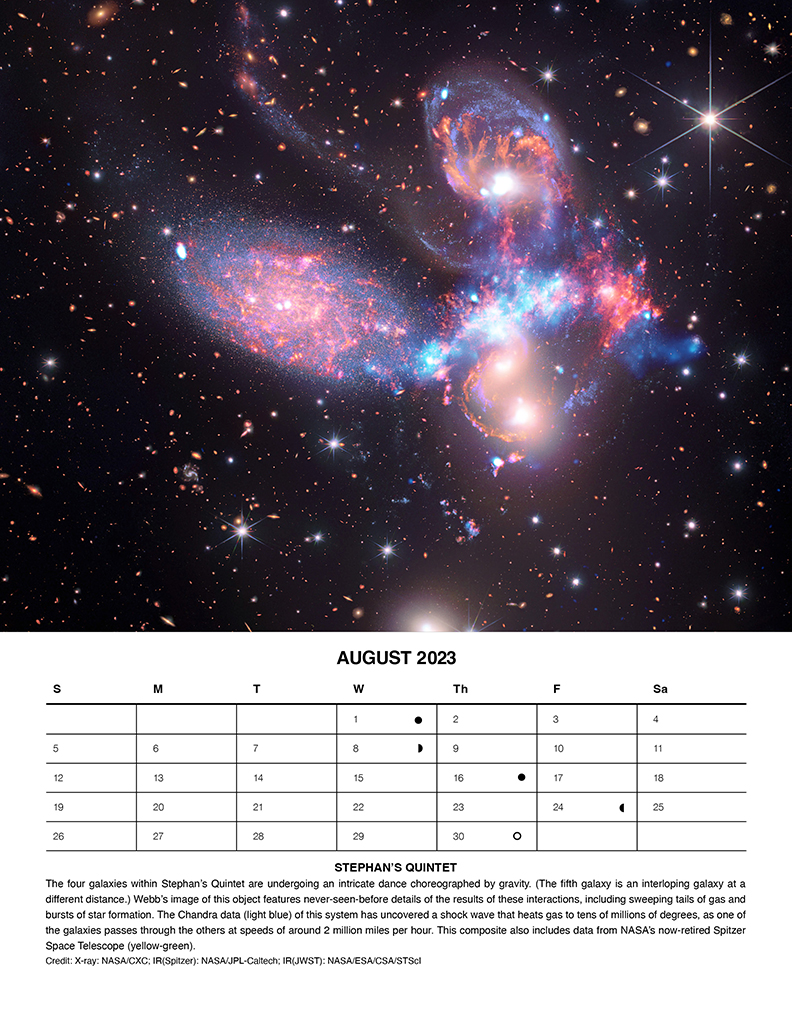
Download Free NASA Chandra X-ray Observatory Calendar 2023

Download Free NASA Chandra X-ray Observatory Calendar 2023

Print your own 2023 Chandra calendar with spectacular images from the past year. Featured objects include supernova remnants, clusters of galaxies, black holes and beyond. Available as a 14-page full color PDF. Individual months may also be downloaded separately. Links for image descriptions and credits are provided below.

Free download of all options: 

https://chandra.harvard.edu/resources/handouts/lithos/calendar2023/

Download Full Calendar: 

High Resolution (Adobe PDF) 

 11x17" (36.9 MB): 

https://chandra.harvard.edu/resources/handouts/lithos/calendar2023/11x17/full_11x17_high.pdf

 8.5x11" (27.3 MB):

https://chandra.harvard.edu/resources/handouts/lithos/calendar2023/85x11/full_%2085x11_high.pdf

Low Resolution (Adobe PDF)

 11x17" (1.5 MB): 

https://chandra.harvard.edu/resources/handouts/lithos/calendar2023/11x17/full_11x17_low.pdf

 8.5x11" (1.2 MB): 

https://chandra.harvard.edu/resources/handouts/lithos/calendar2023/85x11/full_%2085x11_low.pdf

Note: These handouts are printable documents in PDF format.


Credit: Harvard-Smithsonian Center for Astrophysics


#NASA #Astronomy #Space #Science #NASAChandra #Chandra #XrayObservatory #SpaceTelescope #Calendar2023 #Calendar #FreeDownload #AdobePDF #Stars #Galaxies #Cosmos #Astrophysics #Exploration #Learning #Universe #CfA #MSFC #UnitedStates #International #STEM #Education

Monday, January 16, 2023

New Mars Images | NASA's Curiosity & Perseverance Rovers + Ingenuity | JPL

New Mars Images | NASA's Curiosity & Perseverance Rovers + Ingenuity | JPL

    MSL - sol 3711 - MastCam
Mars2020 - sol 676 - Mastcam-Z
Mars2020 - sol 677 - Supercam
Mars2020 - sol 670 - Mastcam-Z
MSL - Sol 3711 - Mastcam
MSL - Sol 3710 - Mastcam
Mars2020 - sol 676 - Mastcam-Z

Support FriendsofNASA.org | For more information on NASA's Mars missions, visit: mars.nasa.gov

Celebrating 10 Years+ on Mars! (2012-2023)
Mission Name: Mars Science Laboratory (MSL)
Rover Name: Curiosity
Main Job: To determine if Mars was ever habitable to microbial life. 
Launch: Nov. 6, 2011
Landing Date: Aug. 5, 2012, Gale Crater, Mars

Mission Name: Mars 2020
Rover Name: Perseverance
Main Job: Seek signs of ancient life and collect samples of rock and regolith (broken rock and soil) for possible return to Earth.
Mars Helicopter (Ingenuity)
Launch: July 30, 2020    
Landing: Feb. 18, 2021, Jezero Crater, Mars

Image Credits: NASA/JPL-Caltech/ASU/MSSS/
Processing: Kevin M. Gill/Del-4Ri/Elisabetta Bonora & Marco Faccin/Thomas Appéré
Thomas' Website: http://bit.ly/3ZKlJzg
Image Release Dates: Jan. 15-16, 2023


#NASA #Space #Astronomy #Science #Mars #RedPlanet #Planet #Astrobiology #Geology #CuriosityRover #MSL #MountSharp #GaleCrater #PerseveranceRover #Mars2020 #IngenuityHelicopter #JezeroCrater #Robotics #Technology #Engineering #JPL #UnitedStates #MoonToMars #CitizenScience #KevinGill #PipploIMP #ThomasAppéré #STEM #Education

Why I Fly: Student Pilot Gabriella Orme | National Aviation Hall of Fame

Why I Fly: Student Pilot Gabriella Orme | National Aviation Hall of Fame

Student pilot and aviation enthusiast Gabriella has created her own company, working as an aviation welder!

For more information, please visit: https://whyiflyseries.com/

National Aviation Hall of Fame (NAHF)

https://nationalaviation.org

U.S. Civil Air Patrol:

https://www.gocivilairpatrol.com

This Why I Fly was made possible through a grant from The Ohio Department of Education and a partnership with Hemlock Films.


Credit: National Aviation Hall of Fame/Ohio Department of Education

Video: Hemlock  Films

Website: https://www.hemlockfilms.com

Duration: 3 minutes, 33 seconds

Release Date: Dec. 28, 2022


#NASA #Aviation #Aeronautics #Flying #GabriellaOrme #StudentPilot #CivilAirPatrol #AviationWelder #Aviators #Women #Flight #Aircraft #Cessna #Pioneers #Leaders #Ohio #STEM #Education #NAHF #UnitedStates #STEM #Education #HD #Video

The Great Lakes of North America Dressed for Winter | International Space Station

The Great Lakes of North America Dressed for Winter | International Space Station

On February 17 and 18, 2022, a strong winter storm brought snow, sleet, and rain to the Great Lakes area of the U.S. and Canada. An astronaut aboard the International Space Station snapped this photograph on February 20, 2022, after the storm.

At the time, the space station was orbiting directly over northern Iowa, but the oblique angle of the photo shows areas farther to the east including Michigan, Ontario, and the Great Lakes. Clouds still obscured parts of northern Michigan and Ontario, but clear skies prevailed in areas south. Notice the band of snow between Lake Huron and Lake Erie. This is where the storm dropped nearly 7 inches (18 centimeters) of snow in places.

The photograph also shows plenty of ice on Lake Huron—most notably in Saginaw Bay—and across much of Lake Erie. Almost one week later, ice cover on the Great Lakes reached its maximum extent for the 2021–2022 winter, measuring slightly above average (calculated since the start of record keeping in the early 1970s).

Ice on individual lakes can peak earlier or later depending on conditions that change daily. Lake Erie’s ice cover, for example, peaked late in January 2022 at 94 percent. It then dipped to 62 percent on February 3 and rose to 90 percent on February 5. By the time of this image on February 20, coverage had dropped to 81 percent. Quickly shifting ice cover is often a response to swift changes in wind conditions or air temperature.

The initiation of ice formation depends on factors such as the lake’s latitude, size, and depth. Notice in this image that Lake Michigan and Lake Ontario—significantly deeper lakes than Lake Erie—are still largely unfrozen. The exposed water on these lakes can provide the moisture for lake-effect snow. The phenomenon contributed to the huge accumulations of snow during a historic winter storm later in the year, when snowfall totals reached more than 50 inches (130 centimeters) in communities east of Lake Ontario and Lake Erie.

The Great Lakes, also called the Great Lakes of North America or the Laurentian Great Lakes, is a series of large interconnected freshwater lakes with sea-like characteristics in the mid-east region of North America that connect to the Atlantic Ocean via the Saint Lawrence River. They are Lakes Superior, Michigan, Huron, Erie, and Ontario and are in general on or near the Canada–United States border. Hydrologically, there are four lakes, because lakes Michigan and Huron join at the Straits of Mackinac. 

The Great Lakes are the largest group of freshwater lakes on Earth by total area and are second-largest by total volume, containing 21% of the world's surface fresh water by volume.

Astronaut photograph ISS066-E-147455 was acquired on February 20, 2022, with a Nikon D5 digital camera using a focal length of 24 millimeters. It is provided by the ISS Crew Earth Observations Facility and the Earth Science and Remote Sensing Unit, Johnson Space Center. The image was taken by a member of the Expedition 66 crew. The image has been cropped and enhanced to improve contrast, and lens artifacts have been removed. 

The International Space Station Program supports the laboratory as part of the ISS National Lab to help astronauts take pictures of Earth that will be of the greatest value to scientists and the public.


Image Credit: NASA/JSC Gateway to Astronaut Photography of Earth

Story Credit: Kathryn Hansen

Image Date: Feb. 20, 2022

Release Date: Dec. 30, 2022


#NASA #Space #ISS #Earth #Planet #TheGreatLakes #LaurentianGreatLakes #LakeHuron #LakeErie #LakeMichigan #LakeOntario #Weather #Meteorology #Winter #Canada #UnitedStates #Astronauts #Photography #OverviewEffect  #OrbitalPerspective #Science #NorthAmerica #Expedition66 #STEM #Education

Download Free 2023 NASA Science Calendars/Calendarios - Ciencia de la NASA!

Download Free 2023 NASA Science Calendars/Calendarios - Ciencia de la NASA!

Best Wishes for 2023 from FriendsofNASA.org!

Print Resolution (English - Adobe PDF - 102 MB): 

https://science.nasa.gov/files/atoms/files/2023%20NASA%20Science%20Calendar%20Print%20Resolution.pdf

Low Resolution (English - Adobe PDF - ~7MB):

https://science.nasa.gov/files/atoms/files/2023%20NASA%20Science%20Calendar%20508.pdf

Download All Calendar Options here: 

https://science.nasa.gov/get-involved/toolkit/planning-guide


Calendarios de la NASA: Online Gratuito

¡Mis mejores deseos para 2023 de FriendsofNASA.org!

Print Resolution Spanish (Español - Adobe PDF - 103 MB):

https://science.nasa.gov/files/atoms/files/2023%20Ciencia%20de%20la%20NASA%20Print%20Resolution.pdf

Low Resolution Spanish (Español - Adobe PDF - ~7MB):

https://science.nasa.gov/files/atoms/files/2023%20Ciencia%20de%20la%20NASA%20508.pdf

Science@NASA

https://science.nasa.gov/

Ciencia de la NASA: https://ciencia.nasa.gov/


Want to buy a print edition of the NASA 2023 Science Calendar (English) for $10 USD? 

Visit U.S. Government Publishing Office (GPO):

https://bookstore.gpo.gov/products/2023-nasa-science-calendar


Credit: NASA's Science Mission Directorate (SMD)


#NASA #Astronomy #Space #Science #Calendar2023 #Calendar #Calendars #FreeDownload #AdobePDF #NASAEspañol #Español #Calendario2023 #Calendario #Calendarios #OnlineGratuito #Earth #Moon #Planets #SolarSystem #Stars #Galaxies #Cosmos #Exploration #Learning #Universe #UnitedStates #International #STEM #Education

Sunday, January 15, 2023

Cosmic Fireworks: Spiral Galaxy NGC 6984 | Hubble

Cosmic Fireworks: Spiral Galaxy NGC 6984 | Hubble

This NASA/European Space Agency Hubble Space Telescope image features the galaxy NGC 6984, an elegant spiral galaxy in the constellation Indus roughly 200 million light-years away from Earth. The galaxy is a familiar sight for Hubble, having already been captured in 2013. The sweeping spiral arms are threaded through with a delicate tracery of dark lanes of gas and dust, and studded with bright stars and luminous star-forming regions.

These new observations were made following an extremely rare astronomical event—a double supernova in NGC 6984. Supernovae are unimaginably violent explosions on a truly vast scale, precipitated by the deaths of massive stars. These events are powerful but rare and fleeting—a single supernova can outshine its host galaxy for a brief time. The discovery of two supernovae at virtually the same time and location (in astronomical terms) prompted speculation from astronomers that the two supernovae may somehow be physically linked. Using optical and ultraviolet observations from Hubble’s Wide Field Camera 3, astronomers sought to get a better look at the site of the two supernovae, hopefully allowing them to discover if the two supernova explosions were indeed linked. Their findings could give astronomers important clues into the lives of binary stars.

As well as helping to unravel an astronomical mystery, these new observations added more data to the 2013 observations, and allowed this striking new image to be created. The observations—each of which covers only a narrow range of wavelengths—add new details and a greater range of colors to the image.


Credit: ESA/Hubble & NASA, D. Milisavljevic

Duration: 30 seconds

Release Date: Nov. 12, 2021


#NASA #ESA #Astronomy #Space #Science #Hubble #Galaxy #NGC6984 #Spiral #Indus #Constellation #Cosmos #Universe #SpaceTelescope #HST #GSFC #STScI #UnitedStates #Europe #STEM #Education #HD #Video

Cosmic Fireworks: Spiral Galaxy NGC 6984 | Hubble

Cosmic Fireworks: Spiral Galaxy NGC 6984 | Hubble

This NASA/European Space Agency Hubble Space Telescope image features the galaxy NGC 6984, an elegant spiral galaxy in the constellation Indus roughly 200 million light-years away from Earth. The galaxy is a familiar sight for Hubble, having already been captured in 2013. The sweeping spiral arms are threaded through with a delicate tracery of dark lanes of gas and dust, and studded with bright stars and luminous star-forming regions.

These new observations were made following an extremely rare astronomical event—a double supernova in NGC 6984. Supernovae are unimaginably violent explosions on a truly vast scale, precipitated by the deaths of massive stars. These events are powerful but rare and fleeting—a single supernova can outshine its host galaxy for a brief time. The discovery of two supernovae at virtually the same time and location (in astronomical terms) prompted speculation from astronomers that the two supernovae may somehow be physically linked. Using optical and ultraviolet observations from Hubble’s Wide Field Camera 3, astronomers sought to get a better look at the site of the two supernovae, hopefully allowing them to discover if the two supernova explosions were indeed linked. Their findings could give astronomers important clues into the lives of binary stars.

As well as helping to unravel an astronomical mystery, these new observations added more data to the 2013 observations, and allowed this striking new image to be created. The observations—each of which covers only a narrow range of wavelengths—add new details and a greater range of colors to the image.


Credit: ESA/Hubble & NASA, D. Milisavljevic

Release Date: Nov. 1, 2021


#NASA #ESA #Astronomy #Space #Science #Hubble #Galaxy #NGC6984 #Spiral #Indus #Constellation #Cosmos #Universe #SpaceTelescope #HST #GSFC #STScI #UnitedStates #Europe #STEM #Education