Tuesday, March 14, 2023

Jupiter's Moon Europa: Ocean Currents May Affect Rotation of Icy Crust | JPL

Jupiter's Moon Europa: Ocean Currents May Affect Rotation of Icy Crust | JPL

Research reveals a new explanation for how the icy shell of Jupiter’s moon Europa rotates at a different rate than its interior. NASA’s Europa Clipper Mission will take a closer look.

NASA scientists have strong evidence that Jupiter’s moon Europa has an internal ocean under its icy outer shell—an enormous body of salty water swirling around the moon’s rocky interior. New computer modeling suggests the water may actually be pushing the ice shell along, possibly speeding up and slowing down the rotation of the moon’s icy shell over time.

Image Description: This view of Jupiter’s icy moon Europa was captured by the JunoCam imager aboard NASA’s Juno spacecraft during the mission’s close flyby on Sept. 29, 2022. The agency’s Europa Clipper spacecraft will explore the moon when it reaches orbit around Jupiter in 2030. 

Scientists have known that Europa’s shell is probably free-floating, rotating at a different rate than the ocean below and the rocky interior. The new modeling is the first to show that Europa’s ocean currents could be contributing to the rotation of its icy shell.

A key element of the study involved calculating drag—the horizontal force that the moon’s ocean exerts on the ice above it. The research hints at how the power of the ocean flow and its drag against the ice layer could even account for some of the geology seen on Europa’s surface. Cracks and ridges could result from the icy shell slowly stretching and collapsing over time as it is pushed and tugged by the ocean currents.

“Before this, it was known through laboratory experiments and modeling that heating and cooling of Europa’s ocean may drive currents,” said Hamish Hay, a researcher at the University of Oxford and lead author of the study published in JGR: Planets. Hay performed the research while a postdoctoral research associate at NASA’s Jet Propulsion Laboratory in Southern California. “Now our results highlight a coupling between the ocean and the rotation of the icy shell that was never previously considered.”

It might even be possible, using measurements gathered by NASA’s upcoming Europa Clipper mission, to determine with precision how fast the icy shell rotates. When scientists compare images gathered by Europa Clipper with those captured in the past by NASA’s Galileo and Voyager missions, they will be able to examine locations of ice surface features and potentially determine if the position of the moon’s icy shell has changed over time.

For decades, planetary scientists have debated whether Europa’s icy shell might be rotating faster than the deep interior. However, rather than tying it to the ocean’s movement, scientists focused on an outside force: Jupiter. They theorized that as the gas giant’s gravity pulls on Europa, it also tugs on the moon’s shell and causes it to spin slightly faster.

“To me, it was completely unexpected that what happens in the ocean’s circulation could be enough to affect the icy shell. That was a huge surprise,” said co-author and Europa Clipper Project Scientist Robert Pappalardo of NASA's Jet Propulsion Laboratory (JPL). “And the idea that the cracks and ridges we see on Europa’s surface could be tied to the circulation of the ocean below—geologists don’t usually think, ‘Maybe it’s the ocean doing that.’”

Europa Clipper, now in its assembly, test, and launch operations phase at JPL, is set to launch in 2024. The spacecraft will begin orbiting Jupiter in 2030, and will use its suite of sophisticated instruments to gather science data as it flies by the moon about 50 times. The mission aims to determine if Europa, with its deep internal ocean, has conditions that could be suitable for life.

Download Europa Clipper Ocean World poster: go.nasa.gov/3Gsjzt5

Like a Pot of Water

Using techniques developed to study Earth’s ocean, the paper’s authors relied on NASA supercomputers to make large-scale models of Europa’s ocean. They explored the complexities of how the water circulates, and how heating and cooling affects that movement.

Scientists believe that Europa’s internal ocean is heated from below, due to radioactive decay and tidal heating within the moon’s rocky core. Like water heating in a pot on a stove, Europa’s warm water rises to the top of the ocean.

In the simulations, the circulation initially moved vertically, but the rotation of the moon as a whole caused the flowing water to veer in a more horizontal direction—in east-west and west-east currents. The researchers, by including drag in their simulations, were able to determine that if the currents are fast enough, there could be adequate drag on the ice above to speed up or slow down the shell’s rotation speed. The amount of interior heating—and thus, circulation patterns in the ocean—may change over time, potentially speeding up or slowing rotation of the icy shell above.

“The work could be important in understanding how other ocean worlds’ rotation speeds may have changed over time,” Hay said. “And now that we know about the potential coupling of interior oceans with the surfaces of these bodies, we may learn more about their geological histories as well as Europa’s.”

More information about Europa can be found here: europa.nasa.gov

More About the Mission

Europa Clipper’s main science goal is to determine whether there are places below the surface of Jupiter’s icy moon, Europa, that could support life. The mission’s three main science objectives are to understand the nature of the ice shell and the ocean beneath it, along with their composition and geology. The mission’s detailed exploration of Europa will help scientists better understand the astrobiological potential for habitable worlds beyond our planet.

Managed by Caltech in Pasadena, California, JPL leads the development of the Europa Clipper mission in partnership with the Johns Hopkins Applied Physics Laboratory (APL) in Laurel, Maryland, for NASA’s Science Mission Directorate in Washington. APL designed the main spacecraft body in collaboration with JPL and NASA’s Goddard Space Flight Center in Greenbelt, Maryland. The Planetary Missions Program Office at NASA’s Marshall Space Flight Center in Huntsville, Alabama, executes program management of the Europa Clipper mission.


Article Credit: NASA's Jet Propulsion Laboratory (JPL)

Image Data: NASA/JPL-Caltech/SwRI/MSSS

Image Processing: Kevin M. Gill CC BY 3.0 Full Image Details

Release Date: March 13, 2023


#NASA #Astronomy #Space #Science #Jupiter #Europa #Moon #Ocean #Astrobiology #Biosignatures #Habitability #Radiation #EuropaClipper #Juno #Spacecraft #SolarSystem #Exploration #JHUAPL #MSFC #JPL #California #UnitedStates #STEM #Education

NASA’s Workforce: Building a Legacy of Discovery

NASA’s Workforce: Building a Legacy of Discovery

Sustainable aviation, peering deep into the cosmos with the James Webb Space Telescope, and returning explorers to the Moon under Artemis. At NASA, we build on the amazing legacy our workforce has created to guide us where we want to go.

We’re building the STEM pipeline to the future, enabling the Artemis Generation to go farther than ever before.

For 12 years in a row, NASA has been named Best Place to Work in the Federal Government.

Are you a U.S. citizen? 

Come see why and check out our job postings: https://nasa.gov/careers

USAJobs: 

https://www.usajobs.gov/search/results?d=NN&p=1


Learn more about STEM at NASA:

https://stem.nasa.gov

Science, Technology, Engineering, Math (STEM)


Credit: National Aeronautics and Space Administration (NASA)

Duration: 1 minute 54 seconds

Release Date: March 13, 2023  


#NASA #Space #Astronomy #JWST #Earth #ISS #Moon #ArtemisI #Astronauts #SLS #SpaceLaunchSystem #OrionSpacecraft #Mars #DeepSpace #SolarSystem #HumanSpaceflight #ArtemisGeneration #Exploration #MoonToMars #Science #Engineering #Technology #Aerospace #UnitedStates #STEM #Education #HD #Video

Monday, March 13, 2023

Recientemente: ¡Luz verde para la tripulación!

Recientemente: ¡Luz verde para la tripulación!

Recientemente en la NASA, la versión en español de las cápsulas This Week at NASA    , te informa semanalmente de lo que está sucediendo en la NASA. 


Credit: National Aeronautics and Space Administration (NASA)

Duration: 2 minutes

Release Date: March 13, 2023


#NASA #NASAenespañol #español #ESA #Space #Astronomy #Earth #Moon #ArtemisII #Astronauts #OrionSpacecraft #Mars #DeepSpace #MoonToMars #Science #Engineering #Technology #Exploration #Aerospace #HumanSpaceflight #UnitedStates #Europe #ArtemisGeneration #STEM #Education #HD #Video

What Did NASA Learn from the Artemis I Moon Rocket Flight?

What Did NASA Learn from the Artemis I Moon Rocket Flight?

Rocket Science in 60 Seconds gives you an inside look at the work being done at NASA to explore deep space. NASA’s Space Launch System (SLS) rocket launched the Artemis I mission on Nov. 16, 2022, sending an uncrewed Orion spacecraft on a 25.5-day mission beyond the Moon and back. Now, NASA engineers are analyzing data from the flight test to benefit the production, assembly, and testing of future SLS Moon rockets that will safely send astronauts to the Moon. In this episode, SLS associate program manager Sharon Cobb gives a brief overview of the powerful SLS rocket and discusses what teams have learned from its first flight.

For more information about SLS, visit https://www.nasa.gov/sls


Credit: NASA's Marshall Space Flight Center (MSFC)

Duration: 1 minute

Release Date: March 13, 2023 


#NASA #Space #Astronomy #Earth #ISS #Moon #ArtemisI #Astronauts #SLS #SpaceLaunchSystem #NASASLS #OrionSpacecraft #Mars #DeepSpace #MoonToMars #Science #Engineering #Technology #SolarSystem #Exploration #HumanSpaceflight #MSFC #UnitedStates #STEM #Education #HD #Video

Aurora Borealis over Scotland

Aurora Borealis over Scotland: More Images


On Earth, auroras are mainly created by particles originally emitted by the Sun in the form of solar wind. When this stream of electrically charged particles gets close to our planet, it interacts with the magnetic field, which acts as a gigantic shield. While it protects Earth’s environment from solar wind particles, it can also trap a small fraction of them. Particles trapped within the magnetosphere—the region of space surrounding Earth in which charged particles are affected by its magnetic field—can be energized and then follow the magnetic field lines down to the magnetic poles. There, they interact with oxygen and nitrogen atoms in the upper layers of the atmosphere, creating the flickering, colorful lights visible in the polar regions here on Earth.

Earth auroras have different names depending on which pole they occur at. Aurora Borealis, or the northern lights, is the name given to auroras around the north pole and Aurora Australis, or the southern lights, is the name given for auroras around the south pole.

Learn more: 

The Colors of the Aurora (National Park Service)

https://www.nps.gov/articles/-articles-aps-v8-i1-c9.htm

NASA - About Aurora

https://www.nasa.gov/mission_pages/sunearth/aurora-news-stories/index.html


Image Credit & Copyright: Alan Tough

Location: Scotland, United Kingdom

Image Date: Feb. 26, 2023


#NASA #Space #Science #Earth #Planet #Aurora #AuroraBorealis #NorthernLights #MagneticField #Magnetosphere #SolarWind #Sun #Astrophotography #Astrophotographer #AlanTough #Scotland #UK #UnitedKingdom #STEM #Education #International

NASA’s SpaceX Crew-5 Endurance Dragon Spacecraft Splashdown: Night Landing

NASA’s SpaceX Crew-5 Endurance Dragon Spacecraft Splashdown: Night Landing


NASA astronauts Nicole Mann and Josh Cassada, JAXA (Japan Aerospace Exploration Agency) astronaut Koichi Wakata, and Roscosmos cosmonaut Anna Kikina (Russia) splashed down safely in the SpaceX Dragon Endurance in the Gulf of Mexico off the coast of Tampa, Florida, at 9:02 p.m. EST on Saturday, March 11, 2023, after 157 days in space.

Teams on the Shannon recovery ship, including two fast boats, secured the Dragon and ensured the spacecraft was safe for the recovery effort. As the fast boat teams completed their work, the recovery ship moved into position to hoist Dragon onto the main deck of Shannon with the astronauts inside. Once on the main deck, the crew was removed from the spacecraft and receive medical checks before taking a helicopter ride to Tampa to board a plane for Houston. 


Credit: NASA/Keegan Barber
Image Date: March 11, 2023


#NASA #Space #Earth #ISS #SpaceXCrew5 #SpaceX #CrewDragon #Spacecraft #Splashdown #Astronauts #NicoleMann #JoshCassada #KoichiWakata #JAXA #Japan #Cosmonauts #AnnaKikina #Роскосмос #Russia #Science #HumanSpaceflight #Expedition68 #JSC #UnitedStates #Research #STEM #Education

NASA’s SpaceX Crew-5 Splashdown: New Images | International Space Station

NASA’s SpaceX Crew-5 Splashdown: New Images | International Space Station


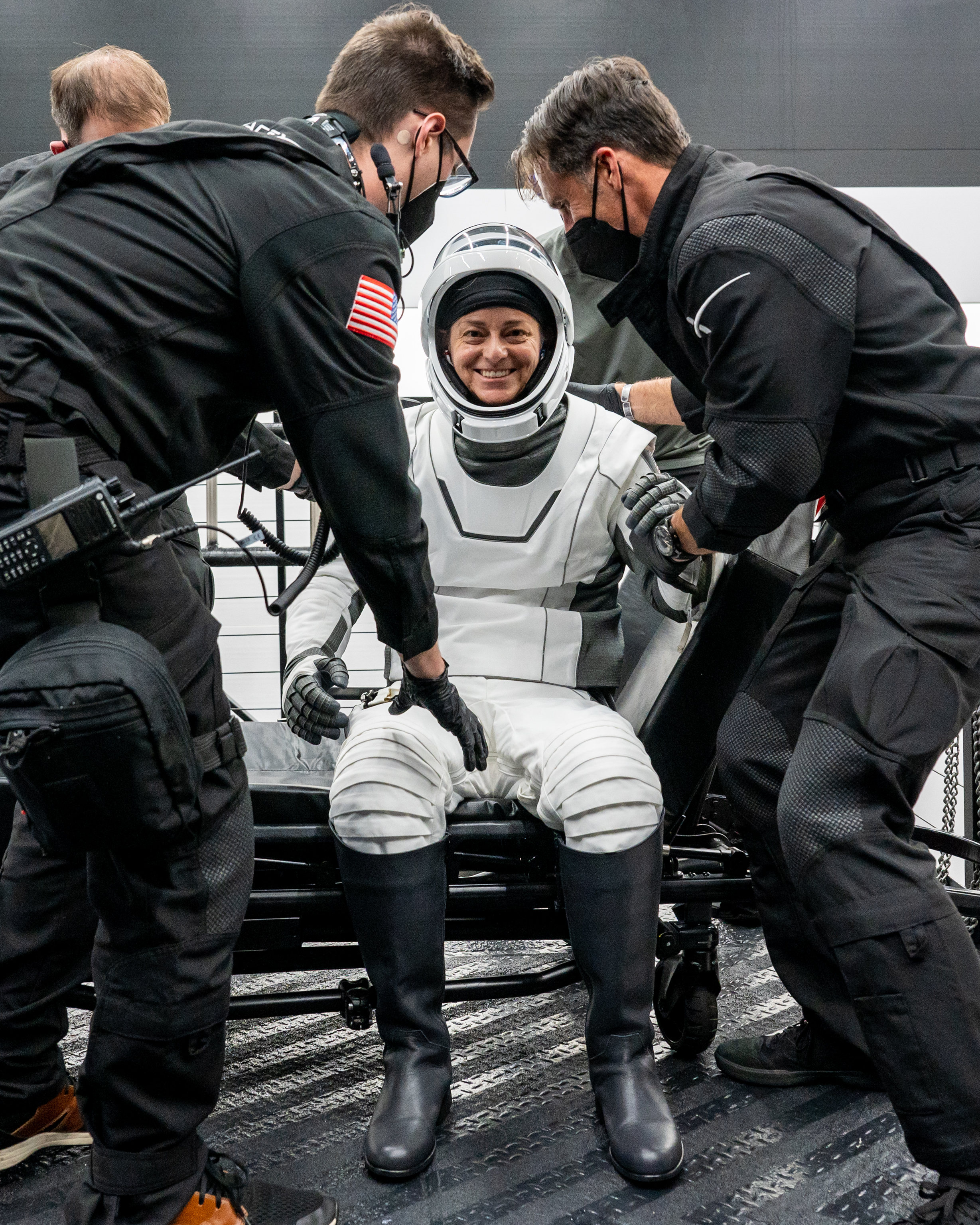
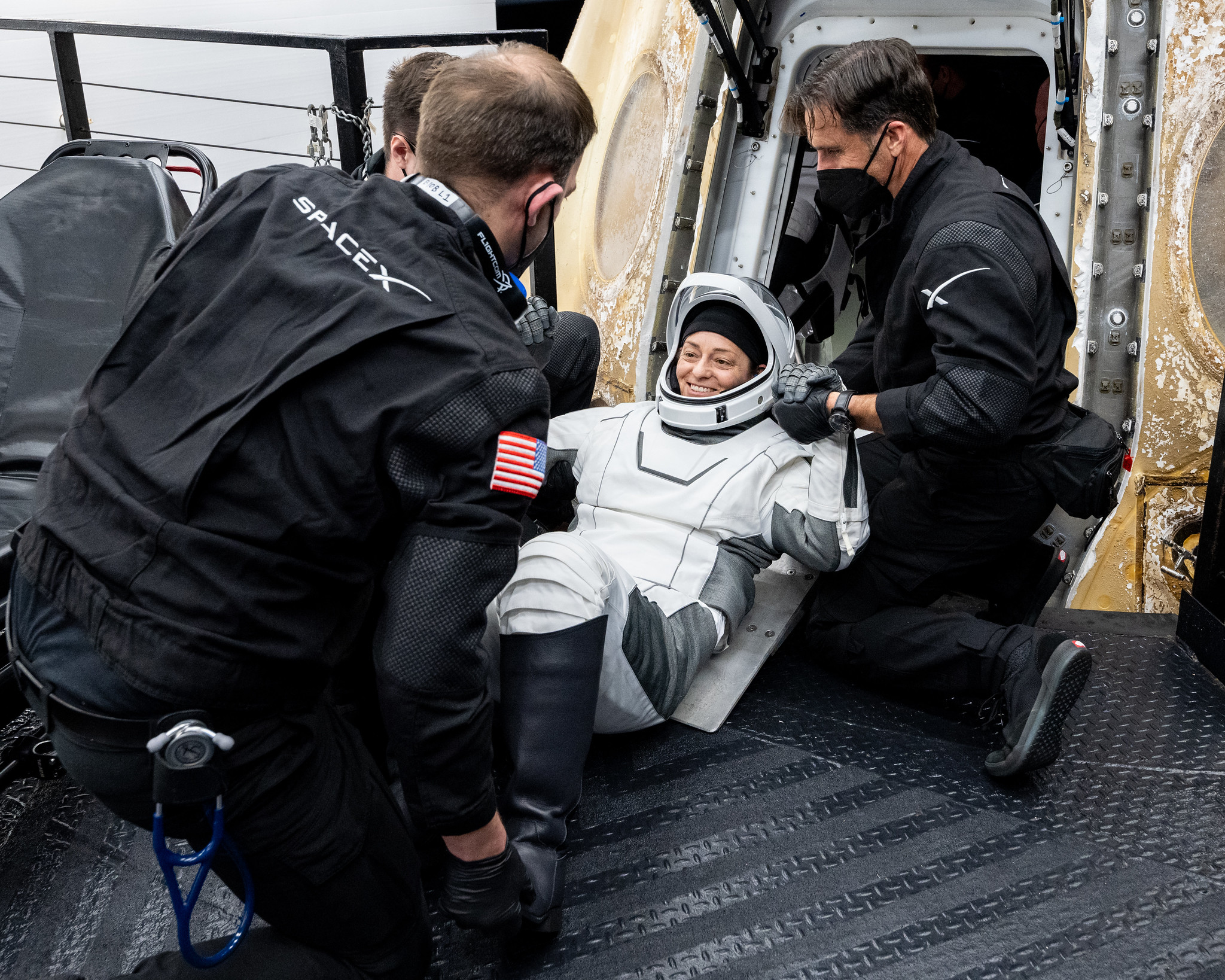
NASA Astronaut Nicole Mann is seen after being helped out of the SpaceX Dragon Endurance spacecraft onboard the SpaceX recovery ship Shannon


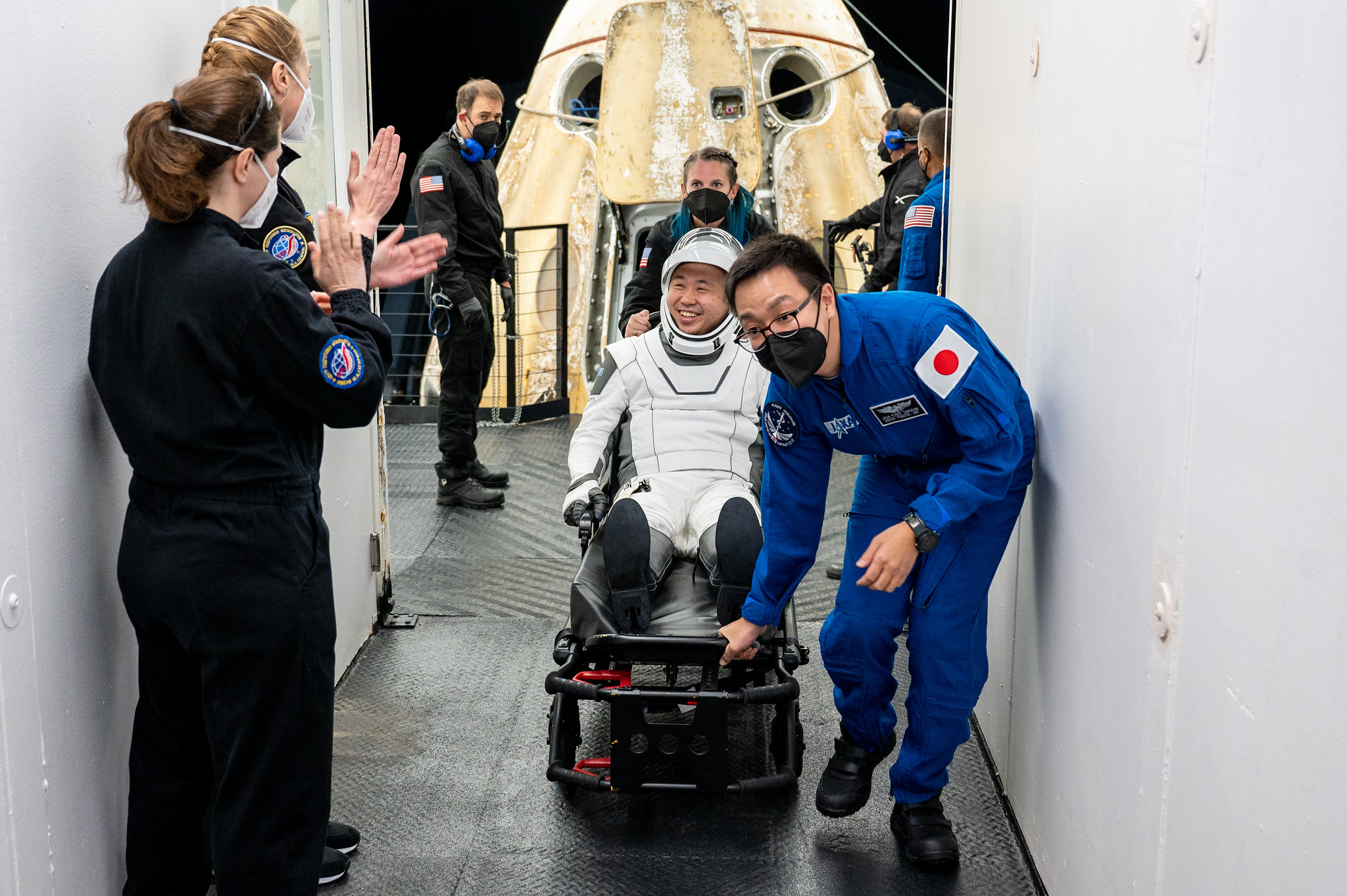
Japan Aerospace Exploration Agency (JAXA) astronaut Koichi Wakata is seen after being helped out of the SpaceX Dragon Endurance spacecraft

Wakata is seen inside an elevator onboard the SpaceX recovery ship Shannon
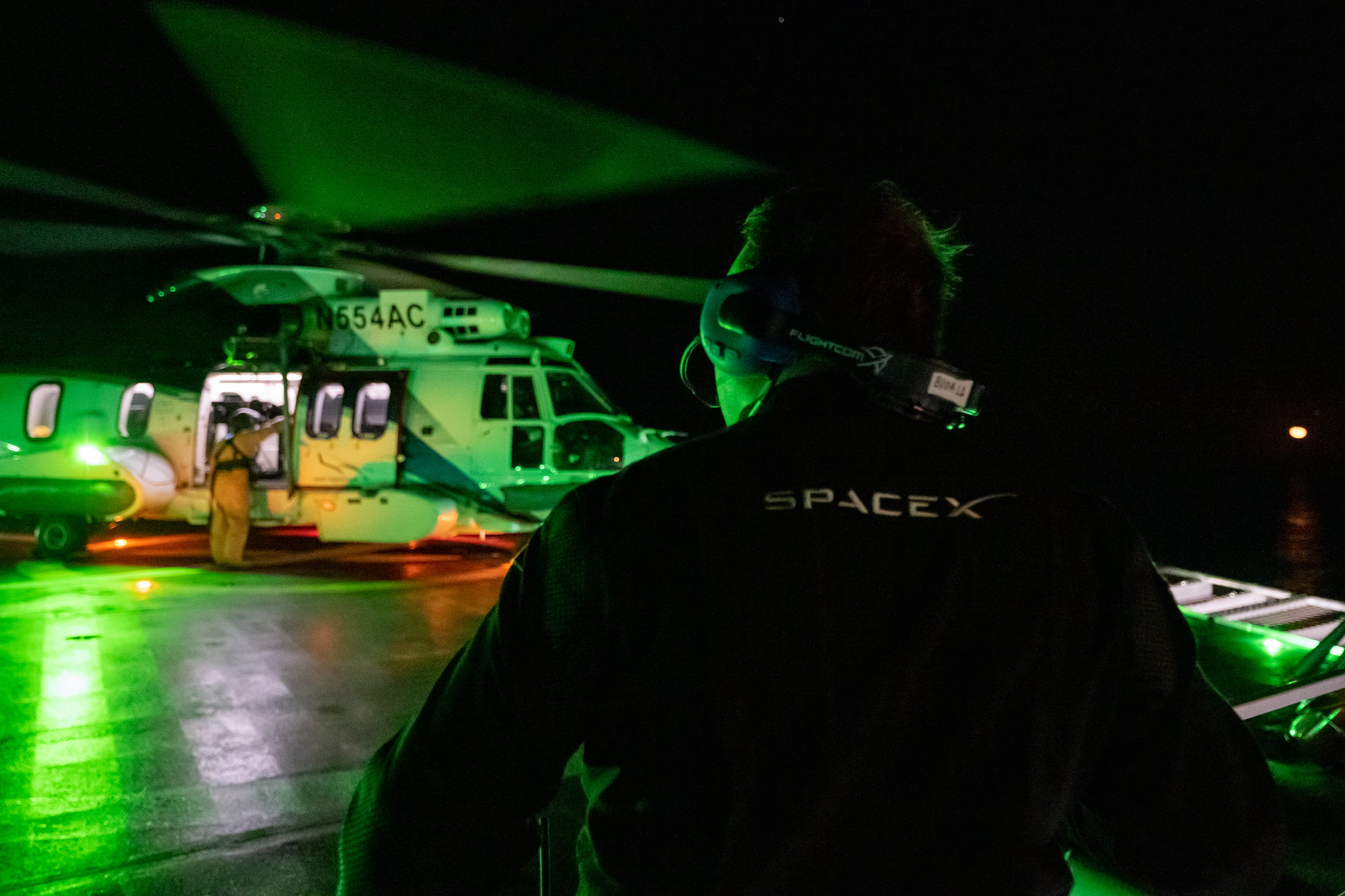
NASA Astronaut Josh Cassada is helped onto a helicopter onboard the SpaceX recovery ship Shannon
Roscosmos cosmonaut Anna Kikina (Russia) is helped onto a helicopter onboard the SpaceX recovery ship Shannon
Support teams raise the SpaceX Dragon Endurance spacecraft onto the SpaceX recovery ship Shannon shortly after it landed
The SpaceX Dragon Endurance spacecraft is seen as it lands

NASA astronauts Nicole Mann and Josh Cassada, JAXA (Japan Aerospace Exploration Agency) astronaut Koichi Wakata, and Roscosmos cosmonaut Anna Kikina (Russia) splashed down safely in the SpaceX Dragon Endurance in the Gulf of Mexico off the coast of Tampa, Florida, at 9:02 p.m. EST on Saturday, March 11, 2023, after 157 days in space.

Teams on the Shannon recovery ship, including two fast boats, secured the Dragon and ensured the spacecraft was safe for the recovery effort. As the fast boat teams completed their work, the recovery ship moved into position to hoist Dragon onto the main deck of Shannon with the astronauts inside. Once on the main deck, the crew was removed from the spacecraft and receive medical checks before taking a helicopter ride to Tampa to board a plane for Houston. 


Credit: NASA/Keegan Barber
Image Date: March 11, 2023


#NASA #Space #Earth #ISS #SpaceXCrew5 #SpaceX #CrewDragon #Splashdown #Astronauts #NicoleMann #JoshCassada #KoichiWakata #JAXA #Japan #Cosmonauts #AnnaKikina #Роскосмос #Russia #Science #HumanSpaceflight #Expedition68 #JSC #UnitedStates #Research #STEM #Education

Expedition 68 Astronaut Sultan Alneyadi Talks with United Arab Emirates Leaders

Expedition 68 Astronaut Sultan Alneyadi Talks with United Arab Emirates Leaders

Aboard the International Space Station, Expedition 68 Flight Engineer Sultan Alneyadi of the United Arab Emirates (UAE) discussed life and work aboard the orbital outpost during an in-flight event March 7, 2022, with leaders in Dubai. Alneyadi is beginning a long-duration mission living and working aboard the microgravity laboratory to advance scientific knowledge and demonstrate new technologies for future human and robotic exploration missions. 

UAE astronaut Sultan AlNeyadi of the Mohammed bin Rashid Space Center is making history by becoming the first astronaut from the Arab world to spend six months on the International Space Station.

An international partnership of space agencies provides and operates the elements of the International Space Station (ISS). The principals are the space agencies of the United States, Russia, Europe, Japan, and Canada. The ISS has been the most politically complex space exploration program ever undertaken.


Credit: NASA's Johnson Space Center (JSC)

Duration: 9 minutes, 24 seconds

Release Date: March 7, 2023


#NASA #Space #Earth #ISS #SpaceXCrew6 #Astronaut #SultanAlNedayi #Pioneer #MBRSC #UAE #Astronauts #Cosmonauts #Russia #Россия #Роскосмос #HumanSpaceflight #Expedition68 #Expedition69 #UnitedStates #STEM #Education #HD #Video

"Cola Wars" in Space | Smithsonian National Air & Space Museum

"Cola Wars" in Space | Smithsonian National Air & Space Museum

In 1985, at the height of the "Cola Wars," both Coke and Pepsi products were flown on NASA's Space Shuttle Mission STS 51-F so crew members could evaluate the dispensers and do a taste test. So which company developed the ultimate “out of this world cola?” Learn how the Cola Wars in Space turned out.

STS-51-F (also known as Spacelab 2) was the 19th flight of NASA's Space Shuttle program and the eighth flight of Space Shuttle Challenger. It launched from Kennedy Space Center, Florida, on July 29, 1985, and landed eight days later on August 6, 1985.

While STS-51-F's primary payload was the Spacelab 2 laboratory module, the payload that received the most publicity was the Carbonated Beverage Dispenser Evaluation, which was an experiment in which both Coca-Cola and Pepsi tried to make their carbonated drinks available to astronauts. [Wikipedia]


STEM in 30 is a free educational series for kids produced by the Smithsonian's National Air and Space Museum. We cover all the cool, fun, and weird ways that aviation and spaceflight touch our lives. 

This video was a part a full episode of STEM in 30 titled: Written in the Sky: The History & Future of Aerial Advertisement: STEM in 30 - Season 9 - Episode 5:    


Credit: Smithsonian National Air and Space Museum

Duration: 3 minutes, 28 seconds

Release Date: March 13, 2023

#NASA #Space #History #HumanSpaceflight #Astronauts #SpaceShuttle #STS51F #Cola #Coke #CocaCola #Pepsi #SoftDrinks #CarbonatedBeverages #Dispensers #Technology #Engineering #STEM #Education #NationalAirandSpaceMuseum #Washington #UnitedStates #HD #Video

Dwarf Galaxy UGCA 307 in Corvus | Hubble Space Telescope

Dwarf Galaxy UGCA 307 in Corvus | Hubble Space Telescope


UGCA 307 hangs against an irregular backdrop of distant galaxies in this image from the NASA/European Space Agency Hubble Space Telescope. The small galaxy consists of a diffuse band of stars containing red bubbles of gas that mark regions of recent star formation, and lies roughly 26 million light-years from Earth in the constellation Corvus. Appearing as just a small patch of stars, UGCA 307 is a diminutive dwarf galaxy without a defined structure—resembling a hazy patch of passing cloud.

Image Description: A wide band of bluish light extends from the center of the image to the right side. It is speckled with many tiny stars, and a few small, bright red bubbles of gas, identifying it as a galaxy. The background is black, and has small galaxies and stars spread around. Most are too small to distinguish, except for two oval-shaped galaxies, each having a hazy glow around a bright centre.

This image is part of a Hubble project to explore every known nearby galaxy, giving astronomers insights into our galactic neighborhood. Before this set of observations, almost three quarters of nearby galaxies had been investigated by Hubble in enough detail to spot the brightest stars and build up an understanding of the stars populating each galaxy. This Hubble project set out to explore the remaining quarter of nearby galaxies by taking advantage of short gaps in Hubble’s observing schedule.

This crystal-clear image was captured by Hubble’s Advanced Camera for Surveys (ACS), which was installed on the telescope in 2002 during Servicing Mission 3B. Hubble’s vantage point in low Earth orbit means that it is above atmospheric turbulence, giving it a sharper view of the Universe. However, it is also close enough to Earth that astronauts could visit the telescope to repair and refurbish the telescope. In total, five Space Shuttle missions flew to Hubble and kept it at the forefront of astronomy by installing new instruments. The ACS replaced one of Hubble’s original instruments, the Faint Object Camera, which was built by European Space Agency (ESA).


Credit: European Space Agency/Hubble & NASA, R. Tully

Release Date: March 13, 2023


#NASA #Hubble #Astronomy #Space #Science #Galaxy #UGCA307 #DwarfGalaxy #Corvus #Constellation #Cosmos #Universe #HST #SpaceTelescope #ESA #Europe #GSFC #STScI #UnitedStates #STEM #Education

Sunday, March 12, 2023

NASA Celebrates Women of Artemis Launch Team

NASA Celebrates Women of Artemis Launch Team

NASA celebrates the women responsible for helping return humanity to the Moon, including the first woman and first person of color under NASA’s Artemis missions. Artemis launch director—and NASA’s first woman launch director—Charlie Blackwell-Thompson leads her launch team, which is composed of about 30% women, into a new era of space exploration.

Since the early days at NASA, starting with the Mercury Program, women have helped pave the way for some of the agency's greatest achievements, and their roles continue to grow today. When Apollo 11 lifted off from the Kennedy Space Center in Florida, NASA’s JoAnn Morgan was the only woman engineer working in Firing Room 1 of Kennedy’s Launch Control Center. The number of women holding positions within Artemis has grown exponentially across the agency and NASA remains dedicated to maintaining a diverse and inclusive workforce.

Through Artemis, NASA will establish long-term lunar science and exploration capabilities on the Moon and inspire the next generation of explorers—the Artemis Generation.

Learn more about the Artemis Program:

https://www.nasa.gov/artemisprogram


Credit: NASA/Kim Shiflett

Release Date: March 8, 2023


#NASA #Space #Earth #Moon #Artemis #ArtemisIII #OrionSpacecraft #SLSRocket #Mars #MoonToMars #Women #Pioneers #Leaders #Leadership #Diversity #Science #Engineering #Technology #America #KSC #Florida #UnitedStates #ArtemisGeneration #History #STEM #Education

NASA's SpaceX Crew-5 Deorbit Burn & Splashdown | International Space Station

NASA's SpaceX Crew-5 Deorbit Burn & Splashdown | International Space Station

The SpaceX Dragon Endurance spacecraft is seen as it lands with NASA astronauts Nicole Mann and Josh Cassada, Japan Aerospace Exploration Agency (JAXA) astronaut Koichi Wakata, and Roscosmos cosmonaut Anna Kikina (Russia) onboard in the Gulf of Mexico off the coast of Tampa, Florida, Saturday, March 11, 2023. Mann, Cassada, Wakata, and Kikina are returning after 157 days in space as part of Expedition 68 aboard the International Space Station.


Credit: NASA/SpaceX

Acknowledgement: SciTech News

Duration: 7 minutes

Capture Date: March 11, 2023 


#NASA #Space #Earth #ISS #SpaceXCrew5 #SpaceX #CrewDragon #Deorbit #Splashdown #Astronauts #NicoleMann #JoshCassada #KoichiWakata #JAXA #Japan #Cosmonauts #AnnaKikina #Роскосмос #Russia #Science #HumanSpaceflight #Expedition68 #JSC #UnitedStates #Research #STEM #Education #HD #Video

NASA's SpaceX Crew-5 Recovery Operations | International Space Station

NASA's SpaceX Crew-5 Recovery Operations | International Space Station

NASA astronauts Nicole Mann and Josh Cassada, JAXA (Japan Aerospace Exploration Agency) astronaut Koichi Wakata, and Roscosmos cosmonaut Anna Kikina (Russia) splashed down safely in the SpaceX Dragon Endurance in the Gulf of Mexico off the coast of Tampa, Florida, at 9:02 p.m. EST on Saturday, March 11, 2023, after 157 days in space.

Teams on the Shannon recovery ship, including two fast boats, secured the Dragon and ensured the spacecraft was safe for the recovery effort. As the fast boat teams completed their work, the recovery ship moved into position to hoist Dragon onto the main deck of Shannon with the astronauts inside. Once on the main deck, the crew was removed from the spacecraft and receive medical checks before taking a helicopter ride to Tampa to board a plane for Houston. 


Video Credit: NASA/SpaceX

Acknowledgement: SciTech News

Duration: 6 minutes

Capture Date: March 11, 2023


#NASA #Space #Earth #ISS #SpaceXCrew5 #SpaceX #CrewDragon #Splashdown #Astronauts #NicoleMann #JoshCassada #KoichiWakata #JAXA #Japan #Cosmonauts #AnnaKikina #Роскосмос #Russia #Science #HumanSpaceflight #Expedition68 #JSC #UnitedStates #STEM #Education #HD #Video

NASA’s SpaceX Crew-5 Deorbit Burn & Splashdown | International Space Station

NASA’s SpaceX Crew-5 Deorbit Burn & Splashdown | International Space Station

The SpaceX Dragon spacecraft completed its deorbit ahead of splashdown at 9:02 p.m. EST, March 11, 2023, in the Gulf of Mexico off the coast of Tampa, Florida.

Four minutes before splashdown, the drogue parachutes deployed at 18,000 feet in altitude while Dragon was moving approximately 350 miles per hour, and less than a minute later, the main parachutes deployed at about 6,000 feet in altitude while the spacecraft was moving approximately 119 miles per hour. 

Support teams arrived via helicopter to the SpaceX recovery ship Shannon to prepare for the landing of the SpaceX Dragon Endurance spacecraft.

The SpaceX Dragon Endurance spacecraft is seen as it lands with NASA astronauts Nicole Mann and Josh Cassada, Japan Aerospace Exploration Agency (JAXA) astronaut Koichi Wakata, and Roscosmos cosmonaut Anna Kikina (Russia) onboard in the Gulf of Mexico off the coast of Tampa, Florida, Saturday, March 11, 2023. Mann, Cassada, Wakata, and Kikina are returning after 157 days in space as part of Expedition 68 aboard the International Space Station.


Credit: NASA/Keegan Barber

Image Date: March 11, 2023


#NASA #Space #Earth #ISS #SpaceXCrew5 #SpaceX #CrewDragon #Deorbit #Splashdown #Astronauts #NicoleMann #JoshCassada #KoichiWakata #JAXA #Japan #Cosmonauts #AnnaKikina #Роскосмос #Russia #Science #HumanSpaceflight #Expedition68 #JSC #UnitedStates #Research #STEM #Education

NASA’s SpaceX Crew-5 Splashdown | International Space Station

NASA’s SpaceX Crew-5 Splashdown | International Space Station

Support teams work around the SpaceX Dragon Endurance spacecraft shortly after it landed


NASA astronauts Nicole Mann and Josh Cassada, JAXA (Japan Aerospace Exploration Agency) astronaut Koichi Wakata, and Roscosmos cosmonaut Anna Kikina (Russia) splashed down safely in the SpaceX Dragon Endurance in the Gulf of Mexico off the coast of Tampa, Florida, at 9:02 p.m. EST on Saturday, March 11, 2023, after 157 days in space.

Teams on the Shannon recovery ship, including two fast boats, secured the Dragon and ensured the spacecraft was safe for the recovery effort. As the fast boat teams completed their work, the recovery ship moved into position to hoist Dragon onto the main deck of Shannon with the astronauts inside. Once on the main deck, the crew was removed from the spacecraft and receive medical checks before taking a helicopter ride to Tampa to board a plane for Houston. 


Credit: NASA/Keegan Barber

Image Date: March 11, 2023


#NASA #Space #Earth #ISS #SpaceXCrew5 #SpaceX #CrewDragon #Splashdown #Astronauts #NicoleMann #JoshCassada #KoichiWakata #JAXA #Japan #Cosmonauts #AnnaKikina #Роскосмос #Russia #Science #HumanSpaceflight #Expedition68 #JSC #UnitedStates #Research #STEM #Education

NASA’s SpaceX Crew-5 Splashdown | International Space Station

NASA’s SpaceX Crew-5 Splashdown | International Space Station


Roscosmos cosmonaut Anna Kikina, left, NASA astronauts Josh Cassada and Nicole Mann, and Japan Aerospace Exploration Agency (JAXA) astronaut Koichi Wakata, right, are seen inside the SpaceX Dragon Endurance spacecraft onboard the SpaceX recovery ship Shannon


NASA Astronaut Josh Cassada waves after being helped out of the SpaceX Dragon Endurance spacecraft


NASA Astronaut Nicole Mann gives a thumbs up after being helped out of the SpaceX Dragon Endurance spacecraft


Roscosmos cosmonaut Anna Kikina (Russia) is seen after being helped out of the SpaceX Dragon Endurance spacecraft


Japan Aerospace Exploration Agency (JAXA) astronaut Koichi Wakata is helped out of the SpaceX Dragon Endurance spacecraft

Japan Aerospace Exploration Agency (JAXA) astronaut Koichi Wakata is helped out of the SpaceX Dragon Endurance spacecraft


NASA astronauts Nicole Mann and Josh Cassada, JAXA (Japan Aerospace Exploration Agency) astronaut Koichi Wakata, and Roscosmos cosmonaut Anna Kikina (Russia) splashed down safely in the SpaceX Dragon Endurance in the Gulf of Mexico off the coast of Tampa, Florida, at 9:02 p.m. EST on Saturday, March 11, 2023, after 157 days in space.

Teams on the Shannon recovery ship, including two fast boats, secured the Dragon and ensured the spacecraft was safe for the recovery effort. As the fast boat teams completed their work, the recovery ship moved into position to hoist Dragon onto the main deck of Shannon with the astronauts inside. Once on the main deck, the crew was removed from the spacecraft and receive medical checks before taking a helicopter ride to Tampa to board a plane for Houston. 


Credit: NASA/Keegan Barber
Image Date: March 11, 2023

#NASA #Space #Earth #ISS #SpaceXCrew5 #SpaceX #CrewDragon #Splashdown #Astronauts #NicoleMann #JoshCassada #KoichiWakata #JAXA #Japan #Cosmonauts #AnnaKikina #Роскосмос #Russia #Science #HumanSpaceflight #Expedition68 #JSC #UnitedStates #Research #STEM #Education