Friday, June 02, 2023

Views of Barred Spiral Galaxy NGC 5068 | Webb Telescope

Views of Barred Spiral Galaxy NGC 5068 | Webb Telescope

This video highlights two views of the barred spiral galaxy NGC 5068 as seen by the NASA/European Space Agency/Canadian Space Agency James Webb Space Telescope. The galaxy’s bright central bar is visible in the upper left of this image. NGC 5068 lies around 17 million light-years from Earth in the constellation Virgo.

With its ability to peer through the gas and dust enshrouding newborn stars, the Webb is the perfect telescope to explore the processes governing star formation. Stars and planetary systems are born amongst swirling clouds of gas and dust that are opaque to visible-light observatories like Hubble or the European Southern Observatory's Very Large Telescope (VLT). The keen vision at infrared wavelengths of two of Webb’s instruments—MIRI and NIRCam—allowed astronomers to see right through the gargantuan clouds of dust in NGC 5068 and capture the processes of star formation as they happened. Both of these views are highlighted in this video.


Credit: European Space Agency/Webb, NASA & CSA, J. Lee and the PHANGS-JWST Team

Duration: 30 seconds

Release Date: June 2, 2023


#NASA #ESA #Astronomy #Space #Science #JWST #Stars #StarClusters #Galaxies #Galaxy #NGC5068 #Barred #Spiral #Virgo #Constellation #Cosmos #Universe #SpaceTelescope #MIRI #NIRCam #GSFC #STScI #UnitedStates #CSA #Canada #Europe #STEM #Education #HD #Video

Zoom into Star Clusters of Barred Spiral Galaxy NGC 5068 | Webb Telescope

Zoom into Star Clusters of Barred Spiral Galaxy NGC 5068 | Webb Telescope

This video takes the viewers on a journey to the barred spiral galaxy NGC 5068, whose bright central bar is visible in the upper left of this image. NGC 5068 lies around 17 million light-years from Earth in the constellation Virgo.

With its ability to peer through the gas and dust enshrouding newborn stars, the NASA/European Space Agency/Canadian Space Agency James Webb Space Telescope is the perfect telescope to explore the processes governing star formation. Stars and planetary systems are born amongst swirling clouds of gas and dust that are opaque to visible-light observatories like Hubble or the European Southern Observatory's Very Large Telescope (VLT). The keen vision at infrared wavelengths of two of Webb’s instruments—MIRI and NIRCam—allowed astronomers to see right through the gargantuan clouds of dust in NGC 5068 and capture the processes of star formation as they happened. This image combines the capabilities of these two instruments, providing a truly unique look at the composition of NGC 5068.


Credit: European Space Agency/Webb, NASA, CSA, J. Lee and the PHANGS-JWST Team, Dark Energy Survey/DOE/FNAL/NOIRLab/NSF/AURA, DSS, N. Bartmann (ESA/Webb), E. Slawik, N. Risinger, D. de Martin (ESA/Webb), M. Zamani (ESA/Webb)  

Duration: 1 minute

Release Date: June 2, 2023


#NASA #ESA #Astronomy #Space #Science #JWST #Stars #StarClusters #Galaxies #Galaxy #NGC5068 #Barred #Spiral #Virgo #Constellation #Cosmos #Universe #SpaceTelescope #MIRI #NIRCam #GSFC #STScI #UnitedStates #CSA #Canada #Europe #STEM #Education #HD #Video

Pan of Star Clusters in Barred Spiral Galaxy NGC 5068 | Webb Telescope

Pan of Star Clusters in Barred Spiral Galaxy NGC 5068 | Webb Telescope

This video features a new image of the barred spiral galaxy NGC 5068 as seen by the NASA/European Space Agency/Canadian Space Agency James Webb Space Telescope. The galaxy’s bright central bar is visible in the upper left of this image. NGC 5068 lies around 17 million light-years from Earth in the constellation Virgo.

With its ability to peer through the gas and dust enshrouding newborn stars, Webb is the perfect telescope to explore the processes governing star formation. Stars and planetary systems are born amongst swirling clouds of gas and dust that are opaque to visible-light observatories like Hubble or the European Southern Observatory's Very Large Telescope (VLT). The keen vision at infrared wavelengths of two of Webb’s instruments—MIRI and NIRCam—allowed astronomers to see right through the gargantuan clouds of dust in NGC 5068 and capture the processes of star formation as they happened. This image combines the capabilities of these two instruments, providing a truly unique look at the composition of NGC 5068.


Credit: ESA/Webb, NASA & CSA, J. Lee and the PHANGS-JWST Team  

Duration: 30 seconds

Release Date: June 2, 2023


#NASA #ESA #Astronomy #Space #Science #JWST #Stars #StarClusters #Galaxies #Galaxy #NGC5068 #Barred #Spiral #Virgo #Constellation #Cosmos #Universe #SpaceTelescope #MIRI #NIRCam #GSFC #STScI #UnitedStates #CSA #Canada #Europe #STEM #Education #HD #Video

Star Clusters in Barred Spiral Galaxy NGC 5068 | James Webb Space Telescope

Star Clusters in Barred Spiral Galaxy NGC 5068 | James Webb Space Telescope

A delicate tracery of dust and bright star clusters threads across this image from the NASA/European Space Agency/Canadian Space Agency James Webb Space Telescope. The bright tendrils of gas and stars belong to the barred spiral galaxy NGC 5068, whose bright central bar is visible in the upper left of this image. NGC 5068 lies around 17 million light-years from Earth in the constellation Virgo.

Image Description: A close-in image of a spiral galaxy, showing its core and part of a spiral arm. Thousands upon thousands of tiny stars that make it up can be seen, most dense in a whitish bar that forms its core. Clumps and filaments of dust form an almost skeletal structure that follows the twist of the galaxy and its spiral arm. Large, glowing bubbles of red gas are hidden in the dust.

With its ability to peer through the gas and dust enshrouding newborn stars, Webb is the perfect telescope to explore the processes governing star formation. Stars and planetary systems are born amongst swirling clouds of gas and dust that are opaque to observations in visible light, like many from Hubble or the European Southern Observatory's Very Large Telescope (VLT). The keen vision at infrared wavelengths of two of Webb’s instruments—MIRI and NIRCam—allowed astronomers to see right through the gargantuan clouds of dust in NGC 5068 and capture the processes of star formation as they happened. This image combines the capabilities of these two instruments, providing a truly unique look at the composition of NGC 5068.

This portrait of NGC 5068 is part of a campaign to create an astronomical treasure trove, a repository of observations of star formation in nearby galaxies. These observations are particularly valuable to astronomers for two reasons. The first is because star formation underpins so many fields in astronomy, from the physics of the tenuous plasma that lies between stars to the evolution of entire galaxies. By observing the formation of stars in nearby galaxies, astronomers hope to kick-start major scientific advances with some of the first available data from Webb.

The second reason is that Webb’s observations build on other studies using telescopes including the NASA/ESA Hubble Space Telescope and some of the world’s most capable ground-based observatories. Webb collected images of 19 nearby star-forming galaxies which astronomers could then combine with catalogs from Hubble of 10,000 star clusters, spectroscopic mapping of 20,000 star-forming emission nebulae from ESO's VLT, and observations of 12,000 dark, dense molecular clouds identified by the Atacama Large Millimeter/submillimeter Array (ALMA). These observations span the electromagnetic spectrum and give astronomers an unprecedented opportunity to piece together the minutiae of star formation.


Image Credit: ESA/Webb, NASA & CSA, J. Lee and the PHANGS-JWST Team

Release Date: June 2, 2023


#NASA #ESA #Astronomy #Space #Science #JWST #Stars #StarClusters #Galaxies #Galaxy #NGC5068 #Barred #Spiral #Virgo #Constellation #Cosmos #Universe #SpaceTelescope #GSFC #STScI #UnitedStates #CSA #Canada #Europe #STEM #Education

NASA's Space to Ground: Storm Watch | Week of June 2, 2023

NASA's Space to Ground: Storm Watch | Week of June 2, 2023

NASA's Space to Ground is your weekly update on what is happening aboard the International Space Station. A Dragon cargo craft is counting down to its liftoff to the International Space Station on Saturday, June 3, 2023, as two NASA astronauts get ready for next week’s spacewalk. Meanwhile, the Expedition 69 crew is keeping up with its human research, robotics, and lab maintenance activities.

Expedition 69 Crew (June 2023)
Station Commander: Sergey Prokopyev of Roscosmos (Russia)
Roscosmos (Russia): Flight Engineers Dmitri Petelin & Andrey Fedyaev
Flight Engineer Sultan Alneyadi of the United Arab Emirates (UAE)
NASA: Flight Engineers Frank Rubio, Stephen Bowen, Warren Hoburg

An international partnership of space agencies provides and operates the elements of the International Space Station (ISS). The principals are the space agencies of the United States, Russia, Europe, Japan, and Canada. The ISS has been the most politically complex space exploration program ever undertaken.

Learn more about the important research being operated on Station:

https://www.nasa.gov/iss-science 

For more information about STEM on Station:

https://www.nasa.gov/stemonstation

Science, Technology, Engineering, Math (STEM)


Credit: NASA's Johnson Space Center (JSC)

Duration: 2 minutes, 50 seconds

Release Date: June 1, 2023


#NASA #Space #ISS #Axiom #AxiomSpace #Ax2Mission #Ax2 #AX2Crew #Astronauts #PeggyWhitson #JohnShoffner #AliAlqarni #RayyanahBarnawi #SpaceX #CrewDragon #Science #MicrogravityResearch #SpaceLaboratory #InternationalCooperation #UAE #SaudiArabia #SaudiSpaceCommission #Cosmonauts #Russia #UnitedStates #STEM #Education #HD #Video

Baghdad, Iraq | International Space Station

Baghdad, Iraq | International Space Station

United Arab Emirates astronaut Sultan AlNeyadi capured this image and commented: "Here is the beautiful and historical city of Baghdad—the cornerstone of the Golden Age of knowledge.📚🔭 Scholars from this great city sparked the flames of discovery, setting the course for modern science. Their legacy reminds us to keep reaching for the stars.✨"

Baghdad is the capital of Iraq and the second-largest city in the Arab world after Cairo in Egypt. It is located on the Tigris River near the ruins of the ancient city of Babylon. Iraq, officially the Republic of Iraq, is a country in Western Asia. It is bordered by Turkey to the north, Iran to the east, the Persian Gulf and Kuwait to the southeast, Saudi Arabia to the south, Jordan to the southwest and Syria to the west.

Follow Expedition 69 updates here:


Expedition 69 Crew (May 2023)
Station Commander: Sergey Prokopyev of Roscosmos (Russia)
Roscosmos (Russia): Flight Engineers Dmitri Petelin & Andrey Fedyaev
Flight Engineer Sultan Alneyadi of the United Arab Emirates (UAE)
NASA: Flight Engineers Frank Rubio, Stephen Bowen, Warren Hoburg

An international partnership of space agencies provides and operates the elements of the International Space Station (ISS). The principals are the space agencies of the United States, Russia, Europe, Japan, and Canada. The ISS has been the most politically complex space exploration program ever undertaken.

Learn more about the important research being operated on Station:

For more information about STEM on Station:
Science, Technology, Engineering, Math (STEM)

Credit: NASA's Johnson Space Center (JSC)/UAE astronaut Sultan AlNeyadi
Image Release Date: May 17, 2023

#NASA #Space #Earth #Iraq #Baghdad #WesternAsia #Science #ISS #Astronauts #Cosmonauts #HumanSpaceflight #Technology #Russia #Россия #Роскосмос #UAE #UAESA #MBRSC #Microgravity #SpaceResearch #SpaceLaboratory #InternationalCooperation #Expedition69 #JSC #UnitedStates #History #STEM #Education

Thursday, June 01, 2023

NASA Artemis V Moon Rocket Engine Test | Preparing for Crewed Missions

NASA Artemis V Moon Rocket Engine Test Preparing for Crewed Missions


An Aerojet Rocketdyne RS-25 rocket engine (RS-25 Engine 10001) was tested on the Fred Haise Test Stand (formerly A-1 Test Stand) at NASA's John C. Stennis Space Center in Mississippi, on June 1, 2023 at 13:49 ET. This was the ninth hot fire test in a planned 12-test series of the newly redesigned RS-25 engines that will be used beginning with Artemis V. The test had a planned duration of 500 seconds, the same amount of time the engines must fire during an actual flight of NASA’s Space Launch System (SLS).

Lead contractor Aerojet Rocketdyne is using advanced manufacturing techniques, such as 3D printing, to reduce the cost and time needed to build new engines for use on missions beginning with Artemis V. Four RS-25 engines help power SLS at launch, including on its Artemis missions to the Moon.

Through Artemis, NASA is returning humans, including the first woman and the first person of color, to the Moon to explore the lunar surface and prepare for flights to Mars. SLS is the only rocket capable of sending the agency’s Orion spacecraft, astronauts, and supplies to the Moon in a single mission.

For information about the Space Launch System, visit: 

https://www.nasa.gov/exploration/systems/sls/index.html


Credit: NASA's Stennis Space Center

Acknowledgement: SciNews

Duration: 9 minutes

Release Date: June 1, 2023


#NASA #Space #Artemis #ArtemisV #Moon #Rocket #SpaceLaunchSystem #SLS #Engine #RS25 #AerojetRocketdyne #MoonToMars #DeepSpace #Propulsion #Engineering #Technology #NASAStennis #Mississippi #MSFC #UnitedStates #SolarSystem #Exploration #STEM #Education #HD #Video

Tonight's Sky: June 2023 (Northern Hemisphere)

Tonight's Sky: June 2023 (Northern Hemisphere)

Though the nights are shorter in June, they are filled with fine sights. Look for the Hercules constellation, which will lead you to a globular star cluster with hundreds of thousands of densely packed stars. You can also spot Draco the dragon, which will point you to the Cat’s Eye Nebula. Keep watching for space-based views of globular star clusters and the nebula.

About this Series

“Tonight’s Sky” is a monthly video of constellations you can observe in the night sky. The series is produced by the Space Telescope Science Institute, home of science operations for the Hubble Space Telescope, in partnership with NASA’s Universe of Learning. 


Credit: Space Telescope Science Institute (STScI)

Duration: 5 minutes, 43 seconds

Release Date: May 21, 2023


#NASA #Space #Astronomy #Science #Earth #Planets #SolarSystem #Stars #GlobularStarClusters #Hercules #Constellations #Galaxies #MilkyWayGalaxy #Skywatching #STScI #UnitedStates #Canada #Mexico #NorthernHemisphere #HubbleSpaceTelescope #HST #STEM #Education #HD #Video

What's Up for June 2023 | Skywatching Tips from NASA (Northern Hemisphere)

What's Up for June 2023 | Skywatching Tips from NASA (Northern Hemisphere)

What are some skywatching highlights in June 2023 (Northern Hemisphere)?

Mars and Venus draw closer throughout the month, while Saturn leads Jupiter into the morning sky. Bright stars Spica and Arcturus shine brightly overhead on June evenings, along with the Summer Triangle. And the June solstice, on the 21st, has a special claim to fame.

0:00 Intro

0:13 Mars & Venus in the evening

1:00 Saturn & Jupiter in the morning

1:19 Bright stars of June

2:22 June solstice

3:42 June Moon phases

Skywatching resources from NASA: https://solarsystem.nasa.gov/skywatching

NASA's Night Sky Network: https://nightsky.jpl.nasa.gov/


Credit: NASA's Jet Propulsion Laboratory (JPL)

Narrator: Preston Dyches

Duration: 4 minutes

Release Date: June 1, 2023


#NASA #Astronomy #Space #Science #Skywatching #Earth #SummerSolstice #Moon #Planets #Venus #Mars #Saturn #Jupiter #SolarSystem #Stars #Spica #Arcturus #Constellations #MilkyWayGalaxy #JPL #Caltech #California #Skywatching #UnitedStates #Canada #Mexico #NorthernHemisphere #SouthernHemisphere #STEM #Education #History #HD #Video

Mars: A Colorful Landslide in Eos Chasma | NASA's Mars Reconnaissance Orbiter

Mars: A Colorful Landslide in Eos Chasma | NASA's Mars Reconnaissance Orbiter


This image was requested in the very first month of NASA's Mars Reconnaissance Orbiter's Primary Science Phase, Nov. 2006. Due to many competing targets in the Valles Marineris canyon system, it took nearly 15 years to acquire. However, it was worth the wait!

A massive landslide has transported diverse rocks from the canyon’s wall layers down onto its floor, jumbling them up in the process. Lower-resolution infrared data had previously revealed an unusual concentration of the igneous mineral orthopyroxene at this location. The range of colors visible to HiRISE implies that many other minerals are present here as well.

Image Data:

Acquisition date

July 23, 2021

Local Mars time

15:44

Latitude (centered)

-12.482°

Longitude (East)

320.816°

Spacecraft altitude

264.7 km (164.5 miles)


Image Credit: NASA/JPL-Caltech/University of Arizona

Narration: Tre Gibbs

Caption Credit: James Wray 

Release Date: Sept. 22, 2021


#NASA #Space #Astronomy #Mars #Planet #RedPlanet #VallesMarineris #EosChasma #Landslide #Science #Geology #Landscape #Terrain #Geoscience #MRO #MarsReconnaissanceOrbiter #Spacecraft #HiRISE #Camera #JPL #Caltech #UniversityOfArizona #BallAerospace #MSSS #STEM #Education #HD #Video

"Thank You For Flying SpaceX Crew Dragon!"

"Thank You For Flying SpaceX Crew Dragon!"

On May 30, 2020, a SpaceX Falcon 9 rocket launched a Crew Dragon spacecraft on its historic first human spaceflight mission to the International Space Station. This mission restored and expanded human spaceflight capability to the United States after the last space shuttle flight (STS-135) in July 2011.

SpaceX has now launched 10 human spaceflight missions in three years, carrying 38 astronauts from all around the world to orbit for NASA, Inspiration4, and Axiom Space, with many more flights in the future on the manifest.

SpaceX's Crew Dragon spacecraft was developed and tested to fly astronauts to and from the International Space Station from U.S. soil.

NASA’s Commercial Crew Program is facilitating the development of a U.S. commercial crew space transportation capability with the goal of achieving safe, reliable and cost-effective access to and from the International Space Station and low-Earth orbit. The public-private partnerships fostered by the program will stimulate growth in a robust commercial space industry and spark life-changing innovations for future generations.

Learn more about NASA’s Commercial Crew Program at:

https://www.nasa.gov/commercialcrew


Credit: Space Exploration Technologies Corp. (SpaceX)

Duration: 1 minute

Release Date: May 31, 2023


#NASA #Space #ISS #SpaceX #Astronauts #CrewDragon #CrewDragonSpacecraft #DragonSpacecraft #CommercialSpace #Science #MicrogravityResearch #SpaceLaboratory #InternationalCooperation #CommercialCrewProgram #CCP #UnitedStates #History #STEM #Education #HD #Video

Mars: A Colorful Landslide in Eos Chasma | NASA's Mars Reconnaissance Orbiter

Mars: A Colorful Landslide in Eos Chasma | NASA's Mars Reconnaissance Orbiter


This image was requested in the very first month of NASA's Mars Reconnaissance Orbiter's Primary Science Phase, Nov. 2006. Due to many competing targets in the Valles Marineris canyon system, it took nearly 15 years to acquire. However, it was worth the wait!

A massive landslide has transported diverse rocks from the canyon’s wall layers down onto its floor, jumbling them up in the process. Lower-resolution infrared data had previously revealed an unusual concentration of the igneous mineral orthopyroxene at this location. The range of colors visible to HiRISE implies that many other minerals are present here as well.

Image Data:

Acquisition date

July 23, 2021

Local Mars time

15:44

Latitude (centered)

-12.482°

Longitude (East)

320.816°

Spacecraft altitude

264.7 km (164.5 miles)


Image Credit: NASA/JPL-Caltech/University of Arizona

Caption Credit: James Wray 

Release Date: Sept. 22, 2021


#NASA #Space #Astronomy #Mars #Planet #RedPlanet #VallesMarineris #EosChasma #Landslide #Science #Geology #Landscape #Terrain #Geoscience #MRO #MarsReconnaissanceOrbiter #Spacecraft #HiRISE #Camera #JPL #Caltech #UniversityOfArizona #BallAerospace #MSSS #STEM #Education

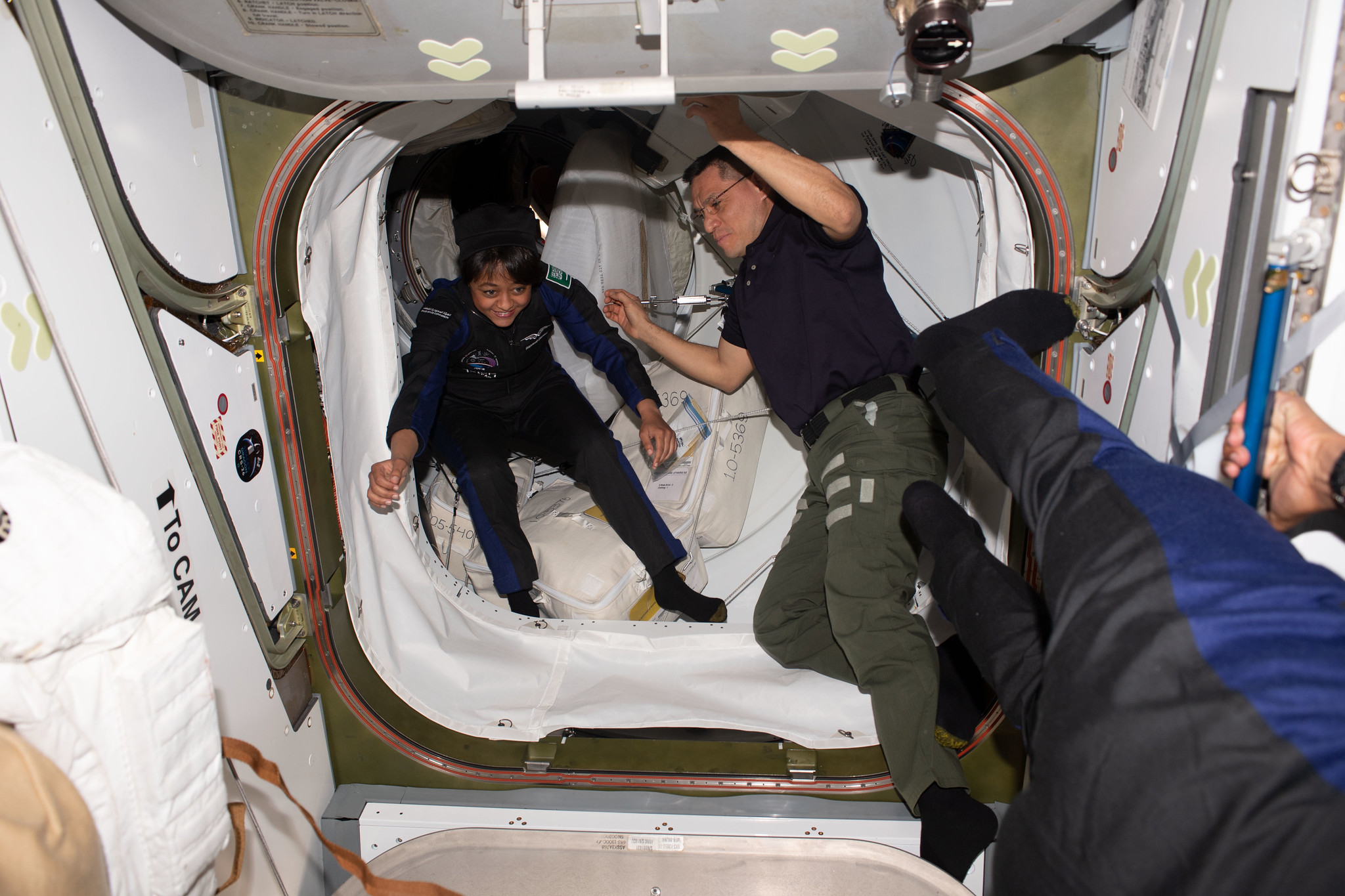
Ax-2 Astronauts & SpaceX Crew Dragon 'Freedom' | International Space Station

Ax-2 Astronauts & SpaceX Crew Dragon 'Freedom' | International Space Station

Ax-2 Commander Peggy Whitson (USA) enters the International Space Station
Ax-2 Pilot John Shoffner (USA) enters the International Space Station
Ax-2 Mission Specialist Rayyanah Barnawi (Saudi Arabia) enters the International Space Station. NASA Astronaut Frank Rubio is on the right.
Ax-2 Mission Specialist Ali Alqarni (Saudi Arabia) enters the International Space Station
The SpaceX Dragon Freedom spacecraft docked to the International Space Station
The SpaceX Dragon Freedom spacecraft is pictured docked to the International Space Station
SpaceX Dragon Freedom spacecraft departs the International Space Station

Record-breaking American astronaut Peggy Whitson and her Axiom Space Ax-2 crewmates John Shoffner (USA), Ali Alqarni (Saudi Arabia), and Rayyanah Barnawi (Saudi Arabia) completed their stay aboard the International Space Station on May 30, 2023. The crew safely returned to Earth the same day aboard the SpaceX Crew Dragon Freedom spacecraft with splashdown off the coast of Tampa, Florida.

Rayyanah Barnawi made history as the first Arab woman aboard the International Space Station. She  became the 600th astronaut.


Expedition 69 Crew (May-June 2023)

Station Commander: Sergey Prokopyev of Roscosmos (Russia)

Roscosmos (Russia): Flight Engineers Dmitri Petelin & Andrey Fedyaev

Flight Engineer Sultan Alneyadi of the United Arab Emirates (UAE)

NASA: Flight Engineers Frank Rubio, Stephen Bowen, Warren Hoburg

An international partnership of space agencies provides and operates the elements of the International Space Station (ISS). The principals are the space agencies of the United States, Russia, Europe, Japan, and Canada. The ISS has been the most politically complex space exploration program ever undertaken.


Credit: NASA's Johnson Space Center (JSC)

Image Dates: May 22-30, 2023


#NASA #Space #ISS #Axiom #AxiomSpace #Ax2Mission #Ax2 #AX2Crew #Astronauts #PeggyWhitson #JohnShoffner #AliAlqarni #RayyanahBarnawi #SpaceX #CrewDragon #CommercialSpace #Science #MicrogravityResearch #SpaceLaboratory #InternationalCooperation #SaudiArabia #SaudiSpaceCommission #UnitedStates #History #STEM #Education  

Wednesday, May 31, 2023

NASA Flight Director Pooja Jesrani | Johnson Space Center

NASA Flight Director Pooja Jesrani | Johnson Space Center


“There had been less than 100 flight directors in NASA’s history, and we just selected our newest class which brought us up to 101. I am the 15th female."

“On your first shift, when you’re in charge of the International Space Station by yourself, it’s your naming shift. It’s a really cool tradition where we’re able to invite all of our family and friends. It’s a big, momentous occasion for the Flight Director’s Office because all of us have a team name."

“Mine is Unity."

“I wanted something to resemble teamwork for the fact that Mission Control is a really big team. Though I’m a Flight Director and the leader of that team, especially in Houston, I’m not significant unless there is a team behind me. Unity was the symbol I wanted because no matter how many different pieces there are to the puzzle, we all have to act as one. One in terms of being there for the safety of the crew, the safety of the vehicle, and mission success."

"I went to Mexico City a few years back, and I saw a quote on a wall that said, 'I am, because we are.' I really resonated with that because I am who I am—I am a Flight Director—because we are. We as a team, we all sit here together. We all do this mission together."

– Pooja Jesrani, Flight Director, Johnson Space Center


Image Credit: NASA/Norah Moran 

Caption Credit: NASA/Tahira Allen 

Release Date: May 20, 2021


#NASA #Space #Science #Earth #Moon #ArtemisProgram #PoojaJesrani #FlightDirector #Leader #MissionControl #AsianAmerican #WomenInSTEM #JohnsonSpaceCenter #JSC #Houston #Texas #UnitedStates #STEM #Education

NASA's Artemis II Moon Mission Service Module: Final Assembly & Testing

NASA's Artemis II Moon Mission Service Module: Final Assembly & Testing


The service module for the Artemis II Orion spacecraft was moved into the Final Assembly and System Testing (FAST) Cell inside the Operations and Checkout Building at NASA's Kennedy Space Center in Florida, where it will be integrated with the crew module before being handed over to NASA's Exploration Ground Systems for fueling.

Artemis II will be NASA’s first crewed flight test of the Space Launch System rocket and Orion spacecraft around the Moon to verify today’s capabilities for humans to explore deep space and pave the way for long-term exploration and science on the lunar surface.


Credit: National Aeronautics and Space Administration (NASA)

Release Date: May 22, 2023


#NASA #Space #Earth #Moon #ArtemisProgram #ArtemisII #EuropeanServiceModule #ESM #ServiceModule #OrionSpacecraft #Astronauts #HumanSpaceflight #Science #Technology  #SolarSystem #SpaceExploration #KSC #Florida #UnitedStates #Europe #ESA #STEM #Education

NASA’s Modern History Makers: Phuong Marangoni | Artemis Program

NASA’s Modern History Makers: Phuong Marangoni | Artemis Program

Phuong Marangoni stands in front of a portrait wall in the Research Support Building.

“If someone told me years ago that this was where I would be, I would have never been able to even fathom it. Especially working for a project as cool as Gateway’s Power and Propulsion Element.”

Phuong Marangoni is the deputy project planning and control lead for NASA’s Power and Propulsion Element (PPE) project supporting Gateway, a cornerstone of Artemis. Managed at NASA’s Glenn Research Center in Cleveland, the PPE provides the orbiting lunar space station with power; high-rate communications; and propulsion for deep space transit, orbital transfer, and station-keeping.

Marangoni began her career as a software engineer for the Department of Defense. From there, she transitioned into a position as an acquisition manager for legacy engines and aircraft programs where she also learned about production and development of new aircraft.

“That opportunity was pivotal in my career,” said Marangoni. “I gained so much insight and knowledge into managing an aircraft program. It’s very complex.”

Since childhood, Marangoni has been acquainted with complexity in both her personal and professional life. She was born in Vietnam and immigrated to the United States with her family at a very young age. She grew up in a household that was different from other students her age, with strict parents who prioritized studying and preparing for the future.

“My family and I had humble beginnings,” said Marangoni. “We had all sorts of challenges like language, culture, and financial stability. My parents were always looking to find ways to help us continue to learn and grow. A lot of those space camps and learning opportunities outside school came with a cost that we couldn’t always afford.”

Marangoni’s parents continuously sought out opportunities to better their children’s lives. They signed their daughter up to attend a free summer program hosted by a local community college that introduced Science Technology, Engineering, and Math (STEM) to underrepresented communities.

“I loved every minute of it,” said Marangoni. “We got to simulate space missions and launch rockets. It was one of the very few, if not the only, opportunity I had that cemented my career goal to some degree.”

When choosing a career path, Marangoni was torn between her love of art and new love for STEM. She proceeded with her passion for STEM and earned a bachelor’s degree in computer engineering from Wright State University and a master’s degree in engineering management from Penn State University. After graduation, Marangoni faced the challenge of not knowing where her path could potentially take her.

“It felt like being in a thick fog with a flashlight and all you can see is a few feet in front of you and nothing beyond that,” said Marangoni. “I grew up in an environment where my surroundings were simply different, so I lacked role models I could relate to. It was hard to envision who I saw myself to be or what I wanted to do.”

She persisted, and her path ultimately led her to NASA Glenn, where she hopes to serve as a role model and inspiration for the younger generation. She encourages anyone interested in a STEM career to pursue their dream, despite any challenges they may have to overcome.

“Know that a STEM career will help you develop foundational problem-solving skills that will enable you to solve so many different types of problems,” said Marangoni. “Not just science or engineering problems, but everything else out there. The skillset will truly open so many career opportunities for you and may provide you with the flexibility to grow and pursue a career that gives you purpose.”

NASA is in a Golden Era of aeronautics and space exploration. In partnership with commercial and private businesses, NASA is currently making history with significant missions such as Artemis, X-57 Maxwell, and X-59 Quesst. The NASA’s Modern History Makers series highlights members of NASA Glenn’s workforce who make these remarkable missions possible.


Image Credit: NASA/Bridget Caswell

Caption Credit: Jacqueline Minerd, NASA’s Glenn Research Center

Release Date: May 11, 2023


#NASA #Space #Science #Earth #Moon #ArtemisProgram #Gateway #PhuongMarangoni #ComputerEngineer #Manager #Leader #WomenInSTEM #AsianAmerican #VietnameseAmerican #NASAGlenn #GlennResearchCenter #Cleveland #Ohio #UnitedStates #STEM #Education