The Hidden Fires of The Flame Nebula: Infrared View | ESO's VISTA
Credit: European Southern Observatory (ESO)/J. Emerson/VISTA
Acknowledgment: Cambridge Astronomical Survey Unit
Release Date: December 11, 2009
Friends of NASA (FoN) is an independent non-governmental organization (NGO) dedicated to building international support for peaceful space exploration, commerce, scientific discovery, and STEM education.
The Hidden Fires of The Flame Nebula: Infrared View | ESO's VISTA
Credit: European Southern Observatory (ESO)/J. Emerson/VISTA
Acknowledgment: Cambridge Astronomical Survey Unit
Release Date: December 11, 2009
Spiral Galaxy NGC 3344: Wide-field image (Ground-based image)
Distance: 20 million light years
Credit: NASA, European Space Agency (ESA), Digitized Sky Survey 2
Acknowledgement: Davide De Martin
Release Date: February 14, 2018
#NASA #ESA #Hubble #Astronomy #Space #Science #Stars #Galaxy #Spiral #NGC3344 #LeoMinor #Constellation #Cosmos #Universe #Telescope #UnitedStates #GSFC #Europe #STEM #Education
Galaxy in a Spin: NGC 3344 | Hubble
The galaxy features an outer ring swirling around an inner ring with a subtle bar structure in the center. The central regions of the galaxy are predominately populated by young stars, with the galactic fringes also featuring areas of active star formation.
Central bars are found in around two thirds of spiral galaxies. NGC 3344’s is clearly visible here, although it is not as dramatic as some.
The high density of stars in galaxies’ central regions gives them enough gravitational influence to affect the movement of other stars in their galaxy. However, NGC 3344’s outer stars are moving in an unusual manner, although the presence of the bar cannot entirely account for this, leaving astronomers puzzled. It is possible that in its past NGC 3344 passed close by another galaxy and accreted stars from it, but more research is needed to state this with confidence.
The image is a combination of exposures taken in visible and near-infrared light, using Hubble’s Advanced Camera for Surveys. The field of view is around 3.4 by 3.4 arcminutes, or around a tenth of the diameter of the full Moon.
Credit: European Space Agency/Hubble & NASA
Release Date: October 15, 2012
#NASA #ESA #Hubble #Astronomy #Space #Science #Stars #Galaxy #Spiral #NGC3344 #LeoMinor #Constellation #Cosmos #Universe #SpaceTelescope #UnitedStates #GSFC #Europe #STEM #Education
The Different Colors of Spiral Galaxy NGC 3344 | Hubble
This video shows what the galaxy NGC 3344 looks like in different wavelengths of light. Astronomers collect light of different wavelengths to find out different types of information about astronomical objects.
Distance: about 20 million light-years
Credit: NASA & European Space Agency (ESA)
Duration: 26 seconds
Release Date: February 14, 2018
#NASA #ESA #Hubble #Astronomy #Space #Science #Stars #Galaxy #Spiral #NGC3344 #LeoMinor #Constellation #Cosmos #Universe #SpaceTelescope #UnitedStates #GSFC #Europe #STEM #Education #HD #Video
Decoding the Colors of Spiral Galaxy NGC 3344 | Hubble
Hubblecast 107: Our eyes detect only visible light, but on board Hubble are a variety of instruments that together detect many different wavelengths of light. This means that Hubble is able to observe galaxies over a wide range of wavelengths to reveal features that would otherwise remain invisible to our eyes.
Distance: about 20 million light-years
This episode of the Hubblecast explores the meaning of the colors in the spiral galaxy NGC 3344.
Credits: ESA/Hubble
Directed by: Rosa Jesse
Visual design and editing: Martin Kornmesser
Written by: Mathias Jäger, Nicole Shaerer
Narration: Sara Mendes da Costa
Images: NASA, ESA/Hubble
Videos: NASA, ESA/Hubble
Animations: NASA, ESA/Hubble, M. Kornmesser, L. Calçada
Web and technical support: Mathias Andre and Raquel Yumi Shida
Executive producer: Lars Lindberg Christensen
Duration: 4 minutes, 47 seconds
Release Date: February 14, 2018
#NASA #ESA #Hubble #Astronomy #Space #Science #Stars #Galaxy #Spiral #NGC3344 #LeoMinor #Constellation #Cosmos #Universe #SpaceTelescope #UnitedStates #GSFC #Europe #STEM #Education #HD #Video
Pan on Spiral Galaxy NGC 3344 | Hubble
This video pans over NASA/European Space Agency Hubble Space Telescope observations of the spiral galaxy NGC 3344 that lies about 20 million light-years away. The galaxy is seen face-on, allowing us to see its spiral arms and the bright core. Because of the many filters used to create this image—ranging from the ultraviolet to the near-infrared—the bright young stars glowing blue and the red regions of dense gas and dust are visible.
Credit: European Space Agency/Hubble
Duration: 50 seconds
Release Date: February 14, 2018
#NASA #ESA #Hubble #Astronomy #Space #Science #Stars #Galaxy #Spiral #NGC3344 #LeoMinor #Constellation #Cosmos #Universe #SpaceTelescope #UnitedStates #GSFC #Europe #STEM #Education #HD #Video
Zoom-in on Spiral Galaxy NGC 3344 | Hubble
This video zooms in on the spiral galaxy NGC 3344, about 20 million light-years away from the Earth. The footage begins with a view of the night sky in the direction of the constellation of Leo Minor, as seen from the ground. It then zooms through observations from the Digitized Sky Survey 2, and ends with a view of the galaxy obtained with the NASA/European Space Agency Hubble Space Telescope.
Credit: European Space Agency/Hubble, NASA, Digitized Sky Survey 2
Acknowledgement: Davide De Martin
Duration: 50 seconds
Release Date: February 14, 2018
#NASA #ESA #Hubble #Astronomy #Space #Science #Stars #Galaxy #Spiral #NGC3344 #LeoMinor #Constellation #Cosmos #Universe #SpaceTelescope #UnitedStates #GSFC #Europe #STEM #Education #HD #Video
Spiral Galaxy NGC 3344 | Hubble
Credit: European Space Agency/Hubble, NASA
Release Date: February 14, 2018
#NASA #ESA #Hubble #Astronomy #Space #Science #Stars #Galaxy #Spiral #NGC3344 #LeoMinor #Constellation #Cosmos #Universe #SpaceTelescope #UnitedStates #GSFC #Europe #STEM #Education
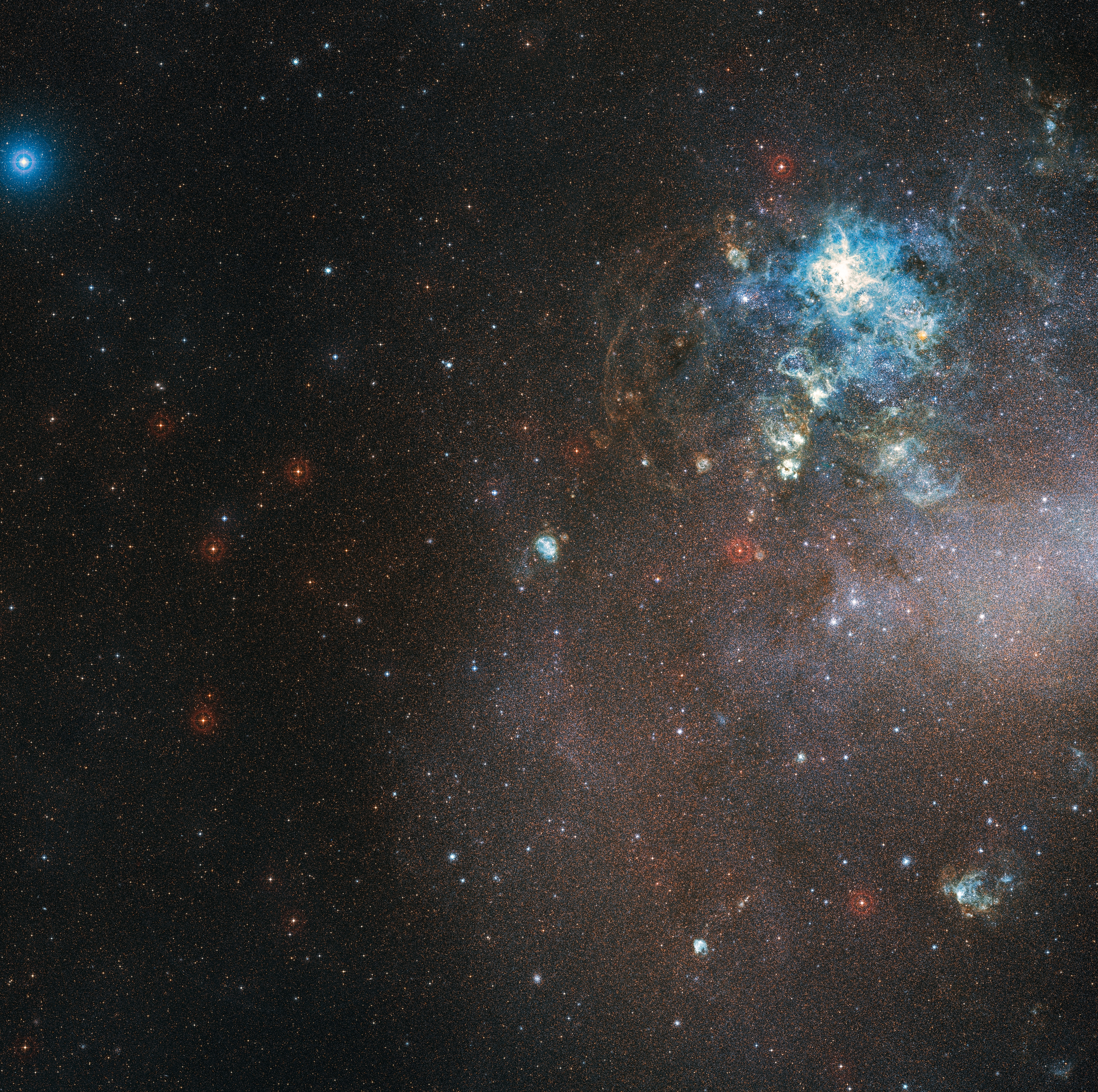
Bubbles of Brand New Stars in The Large Magellanic Cloud: Wide-field View | ESO
This dazzling region of newly-forming stars in the Large Magellanic Cloud (LMC) was captured by the Multi Unit Spectroscopic Explorer (MUSE) instrument on the European Southern Observatory’s Very Large Telescope (VLT). The relatively small amount of dust in the LMC and MUSE’s acute vision allowed intricate details of the region to be picked out in visible light.
Distance: around 160,000 light-years
The image is a color composite made from exposures from the Digitized Sky Survey 2, and shows the region surrounding LHA 120-N 180B, visible at the center of the image.
Credit: European Southern Observatory (ESO)/Digitized Sky Survey 2
Acknowledgment: Davide De Martin
Release Date: February 6, 2019
#NASA #ESO #Astronomy #Space #Science #Stars #StarFormation #LHA120N180B #N180 #HerbigHaroObject #HerbigHaro1177 #HH1177 #Mensa #Constellation #LMC #Galaxy #Cosmos #Universe #VLT #MUSE #ParanalObservatory #Chile #Europe #STEM #Education
Tour Bubbles of Brand New Stars in The Large Magellanic Cloud | ESO
ESOcast 193 Light: This dazzling region of newly-forming stars in the Large Magellanic Cloud (LMC) was captured by the Multi Unit Spectroscopic Explorer (MUSE) instrument on the European Southern Observatory ’s Very Large Telescope (VLT). The relatively small amount of dust in the LMC and MUSE’s acute vision allowed intricate details of the region to be picked out in visible light.
Deep within the glowing cloud of the HII region LHA 120-N 180B, MUSE spotted a jet emitted by a fledgling star—a massive young stellar object. This was the first time such a jet has been observed in visible light outside the Milky Way. Usually, such jets are obscured by their dusty surroundings, meaning they can only be detected at infrared or radio wavelengths by telescopes such as ALMA. However, the relatively dust-free environment of the LMC allowed this jet—named Herbig–Haro 1177, or HH 1177 for short—to be observed at visible wavelengths. At nearly 33 light-years in length, it is one of the longest such jets ever observed.
Credit: European Southern Observatory (ESO)
Duration: 1 minute, 29 seconds
Release Date: February 6, 2019
#NASA #ESO #Astronomy #Space #Science #Stars #StarFormation #LHA120N180B #N180 #HerbigHaroObject #HerbigHaro1177 #HH1177 #Mensa #Constellation #LMC #Galaxy #Cosmos #Universe #VLT #MUSE #ParanalObservatory #Chile #Europe #STEM #Education #HD #Video
Panning across Bubbles of Brand New Stars in The Large Magellanic Cloud | ESO
This pan video explores a dazzling region of newly-forming stars in the Large Magellanic Cloud (LMC). The HII region LHA 120-N 180B—also known as N180—was captured by the Multi Unit Spectroscopic Explorer (MUSE) instrument on the European Southern Observatory’s Very Large Telescope (VLT). The relatively small amount of dust in the LMC and MUSE’s acute vision allowed intricate details of the region to be picked out in visible light.
Deep within the glowing cloud of N180, MUSE spotted a jet emitted by a fledgling star—a massive young stellar object. This was the first time such a jet had been observed in visible light outside the Milky Way. Usually, such jets are obscured by their dusty surroundings, meaning they can only be detected at infrared or radio wavelengths by telescopes, such as Atacama Large Millimeter/submillimeter Array (ALMA). However, the relatively dust-free environment of the LMC allowed this jet—named Herbig–Haro 1177, or HH 1177 for short—to be observed at visible wavelengths. At nearly 33 light-years in length, it is one of the longest such jets ever observed.
Credit: European Southern Observatory (ESO), A McLeod et al.
Zooming into Bubbles of Brand New Stars in The Large Magellanic Cloud | ESO
This zoom video starts with a wide view of the Milky Way and ends with a close-up look at a dazzling region of newly-forming stars in the HII region LHA 120-N 180B—also known as N180. This glowing region of newborn stars in the Large Magellanic Cloud (LMC) was captured by the Multi Unit Spectroscopic Explorer (MUSE) instrument on the European Southern Observatory’s Very Large Telescope (VLT). The relatively small amount of dust in the LMC and MUSE’s acute vision allowed intricate details of the region to be picked out in visible light.
Distance: around 160,000 light-years
Credit: European Southern Observatory (ESO)/Digitized Sky Survey 2/N. Risinger
Duration: 50 seconds
Release Date: February 6, 2019
#NASA #ESO #Astronomy #Space #Science #Stars #StarFormation #LHA120N180B #N180 #HerbigHaroObjects #Mensa #Constellation #LMC #Galaxy #Cosmos #Universe #VLT #MUSE #ParanalObservatory #Chile #Europe #STEM #Education #HD #Video
Bubbles of Brand New Stars in The Large Magellanic Cloud | ESO
Credit: European Southern Observatory (ESO), A McLeod et al.
Release Date: February 6, 2019
#NASA #ESO #Astronomy #Space #Science #Stars #StarFormation #LHA120N180B #N180 #HerbigHaroObjects #Mensa #Constellation #LMC #Galaxy #Cosmos #Universe #VLT #MUSE #ParanalObservatory #Chile #Europe #STEM #Education
SpaceX Dragon CRS-25 Resupply Ship Undocking | International Space Station
Image Date: August 19, 2022
The Seven-member Expedition 67 Crew | International Space Station
Expedition 67 Crew
Commander Oleg Artemyev (Russia)
Roscosmos Flight Engineers: Denis Matveev and Sergey Korsakov (Russia)
NASA Flight Engineers: Kjell Lindgren, Bob Hines, Jessica Watkins (USA)
European Space Agency (ESA) Flight Engineer: Samantha Cristoforetti (Italy)
An international partnership of space agencies provides and operates the elements of the International Space Station (ISS). The principals are the space agencies of the United States, Russia, Europe, Japan, and Canada. The ISS has been the most politically complex space exploration program ever undertaken.
Learn more about the important research being operated on Station:
https://www.nasa.gov/iss-science
For more information about STEM on Station:
https://www.nasa.gov/stemonstation
Science, Technology, Engineering, Math (STEM) Education
Credit: NASA's Johnson Space Center (JSC)
Release Date: August 18, 2022
#NASA #Space #ISS #ESA #Astronauts #KjellLindgren #BobHines #JessicaWatkins #SamanthaCristoforetti #Italy #Italia #Minerva #Cosmonauts #OlegArtemyev #SergeyKorsakov #DenisMatveev #Science #HumanSpaceflight #Expedition67 #UnitedStates #Europe #Russia #Россия #Research #Laboratory #STEM #Education
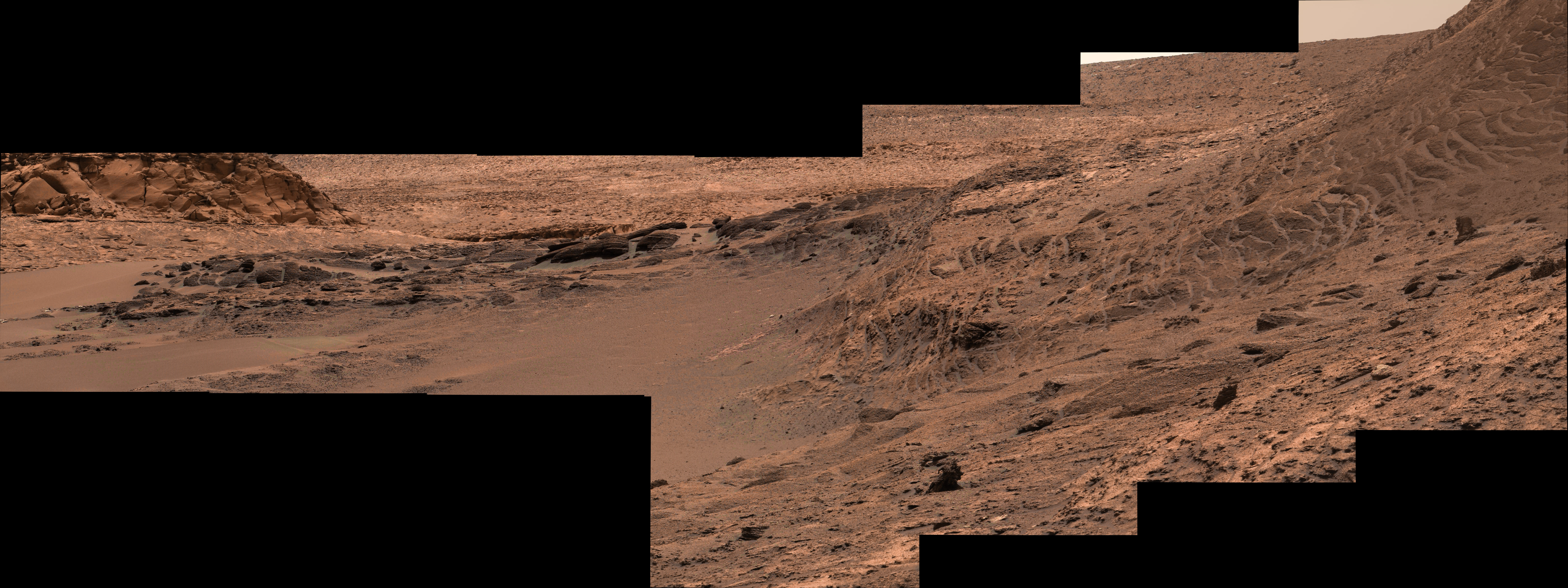
NASA's Mars Curiosity Rover: New August 2022 Images | JPL
MSL - sol 3570 - MAHLI
Mars2020 - sol 533 - Supercam
MSL - sol 3565 - Mastcam
MSL - sol 3566 - Mastcam
MSL - sol 3565 - Mastcam
MSL - sol 3568 - MastCam
Rover Name: Curiosity
Main Job: To determine if Mars was ever habitable to microbial life.
Launch: Nov. 6, 2011
Landing Date: Aug. 5, 2012, Gale Crater, Mars
For more information on NASA's Mars missions, visit: mars.nasa.gov
Image Credit: NASA/JPL-Caltech/MSSS/Kevin M. Gill
Release Dates: August 19-22, 2022
#NASA #Space #Astronomy #Science #Mars #RedPlanet #Planet #Astrobiology #Geology #MountSharp #GaleCrater #CuriosityRover #Curiosity #Rover #Robotics #Technology #Engineering #JPL #California #UnitedStates #JourneyToMars #CitizenScience #STEM #Education