Friends of NASA (FoN) is an independent non-governmental organization (NGO) dedicated to building international support for peaceful space exploration, commerce, scientific discovery, and STEM education.
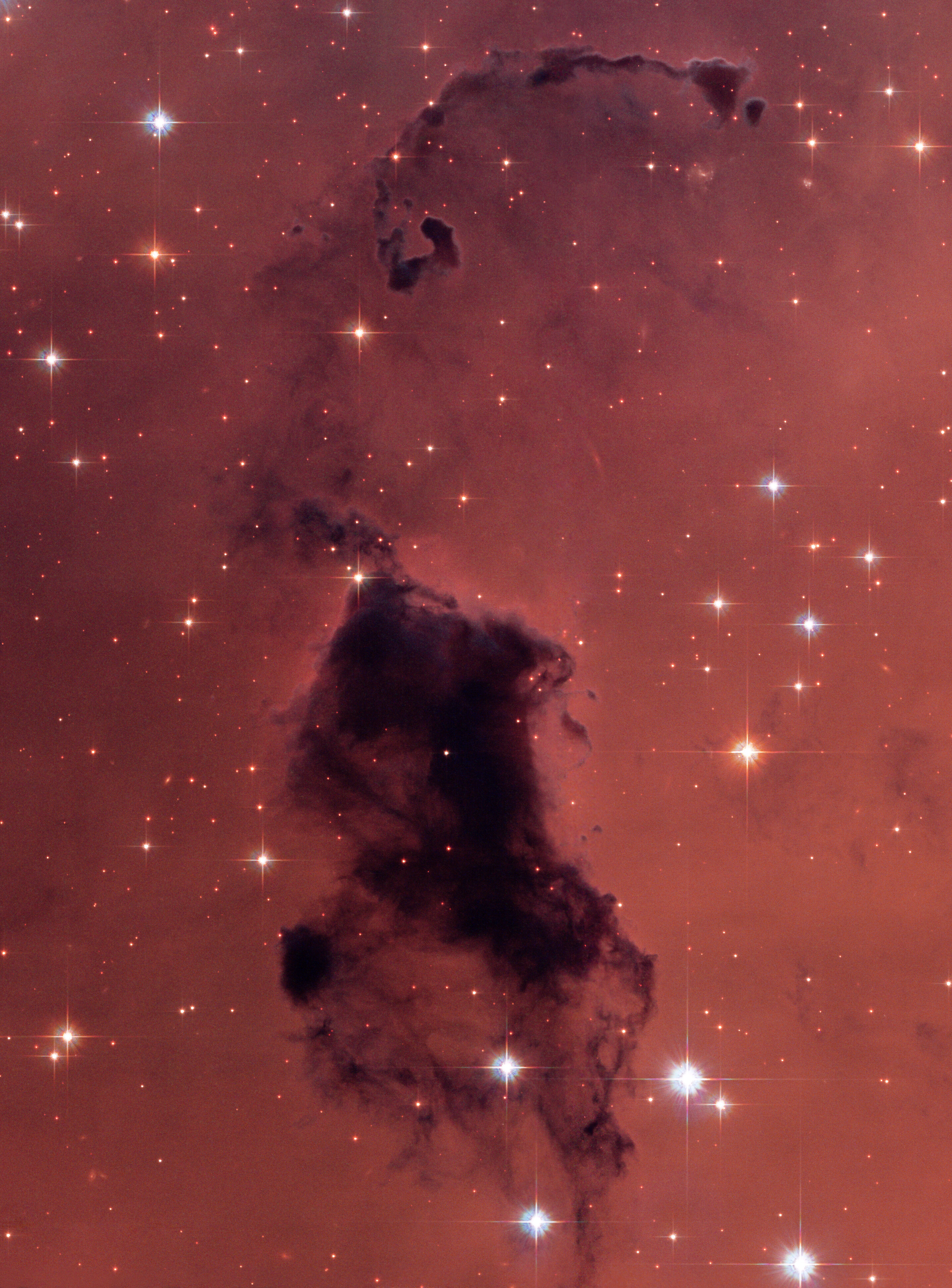
The yearly ritual of spring cleaning clears a house of dust as well as dust "bunnies", those pesky dust balls that frolic under beds and behind furniture. The NASA/European Space Agency Hubble Space Telescope has photographed similar dense knots of dust and gas in our Milky Way Galaxy. This cosmic dust, however, is not a nuisance. It is a concentration of elements that are responsible for the formation of stars in our galaxy and throughout the universe.
Distance:9,000 light years
These opaque, dark knots of gas and dust are called Bok globules, and they are absorbing light in the center of the nearby emission nebula and star-forming region, NGC 281. The globules are named after astronomer Bart Bok, who proposed their existence in the 1940's.
Credit: NASA, European Space Agency, and The Hubble Heritage Team (STScI/AURA)
Inside The Pac Man Nebula: An Arcade Adventure for Young Stars | Hubble
Astronomers have used the NASA/European Space Agency Hubble Space Telescope to study the young open star cluster IC 1590, which is found within the star formation region NGC 281—nicknamed the Pacman Nebula due to its resemblance to the famous arcade game character. This image only shows the central part of the nebula, where the brightest stars at the core of the cluster are found, with part of the Pacman’s hungry mouth visible as the dark region below.
However, Pacman is not gobbling up these stars. Instead, the nebula’s gas and dust are being used as raw ingredients to make new stars. However, the stars in IC 1590 are still plotting their escape from the Pacman Nebula, as open clusters are only loosely bound together and the grouping will eventually disperse within a few tens of millions of years.
IC 1590 lies about ten thousand light-years from Earth in the constellation of Cassiopeia (The Queen). Through small telescopes the core of the cluster that appears at the top of this picture shows up as a triple star, but the nebula that surrounds it is much fainter and very hard to see. The eagle-eyed American astronomer E. E. Barnard, using a 15 cm telescope, first recorded it in the late nineteenth century.
This picture was created from images taken using the Wide Field Channel of Hubble’s Advanced Camera for Surveys. Images though yellow (F550M, colored blue), orange (F660N, colored green) and red (F658N) filters were combined. The F658N filter isolates light from glowing hydrogen gas. The total exposure times per filter were 450 s, 1017 s and 678 s, respectively and the field of view is about 3.3 arcminutes across.
The Pac Man Nebula | Kitt Peak National Observatory
This wide-field view of the star-forming region NGC 281 in the constellation Cassiopeia was taken with the WIYN 0.9-meter telescope at Kitt Peak National Observatory near Tucson, AZ.
Distance:9,000 light years
Credit: T.A. Rector/University of Alaska Anchorage and WIYN/AURA/NSF
Artemis I Moon Rocket Flight Test is “Go for Launch” | This Week @NASA
Our Artemis I flight test is “go for launch,” the first deep-space long-duration biology test, and the Webb Space Telescope captures new images of Jupiter . . . a few of the stories to tell you about—This Week at NASA!
Credit: National Aeronautics and Space Administration (NASA)
Portrayed in this image is a picturesque dust lane obscuring some of the Milky Way stars, usually referred to as the Pipe Nebula due to its curious shape. Also known under the more technical names Barnard 59, Barnard 65-67, and Barnard 78, this dark spot is visible to the naked eye in the constellation of Ophiuchus, the Snake Holder.
Distance:600 light years
Credit: European Southern Observatory (ESO)/Y. Beletsky
Before our Space Launch System (SLS) rocket and Orion spacecraft can launch our nation into a new era of spaceflight, the duo must first undergo a wet dress rehearsal at the launch pad prior to liftoff.
Watch SLS and Orion continue on their path to the pad as they travel to Kennedy Space Center's Launch Pad 39B for a full countdown rehearsal—an operation involving hundreds of engineers stationed all across the nation.
This pan video gives a close-up view of part of a vast dark cloud of interstellar dust called the Pipe Nebula. This very detailed image of what is also known as Barnard 59 was captured by the Wide Field Imager on the MPG/ESO 2.2-meter telescope at the European Southern Observatory's La Silla Observatory.
This video sequence starts with a broad panorama of the spectacular region in the direction of the center of the Milky Way. We then close in on a curious dark feature called the Pipe Nebula. Here dense clouds of interstellar dust are silhouetted against the rich star clouds in the constellation of Ophiuchus (The Serpent Bearer), close to the more familiar constellation of Scorpius (The Scorpion). We finally focus on one end of the pipe, a strange dark feature called Barnard 59. It is shown in a very detailed new image from the MPG/ESO 2.2-meter telescope at ESO's La Silla Observatory.
Distance:600 light years
Credit: European Southern Observatory (ESO)/Nick Risinger/S. Guisard
This picture shows Barnard 59, part of a vast dark cloud of interstellar dust called the Pipe Nebula. This new and very detailed image of what is known as a dark nebula was captured by the Wide Field Imager on the MPG/ESO 2.2-meter telescope at ESO’s La Silla Observatory.
Managers and engineers from NASA’s Marshall Space Flight Center in Alabama share their thoughts about the Space Launch System (SLS) rocket for Artemis I. Van L. Strickland, SLS program operations manager; John Blevins, SLS chief engineer; and Sharon Cobb, SLS associate program manager, commend a diverse workforce for its effort and dedication to prepare the backbone of NASA’s return to the Moon. SLS will launch the Orion spacecraft on its mission beyond the Moon and back to Earth.
Artemis I is scheduled to launch no earlier than Aug. 29, 2022, at 8:33 a.m. EDT from Kennedy Space Center’s Launch Complex 39B in Florida.
Panning across "A Spiral Galaxy Amongst Friends" | Hubble
This image, taken with Hubble’s Wide Field Camera 3 (WFC3), features the spiral galaxy NGC 4680. At 2 o’clock and 7 o’clock two other galaxies can be seen flanking NGC 4680. NGC 4680 enjoyed a wave of attention in 1997, as it played host to a supernova explosion known as SN 1997bp. Amazingly, the supernova was identified by an Australian amateur astronomer named Robert Evans, who has identified an extraordinary 42 supernova explosions.
NGC 4680 is actually a rather tricky galaxy to classify. It is sometimes referred to as a spiral galaxy, but it is also sometimes classified as a lenticular galaxy. Lenticular galaxies fall somewhere in between spiral galaxies and elliptical galaxies. Whilst NGC 4680 does have distinguishable spiral arms, they are not clearly defined, and the tip of one arm appears very diffuse. Galaxies are not static, and their morphologies (and therefore their classifications) vary throughout their lifetimes. Spiral galaxies are thought to evolve into elliptical galaxies, most likely by merging with one another, causing them to lose their distinctive spiral structures.
Distance:140 light years
Credit: European Space Agency/Hubble & NASA, A. Riess et al.
This image, taken with Hubble’s Wide Field Camera 3 (WFC3), features the spiral galaxy NGC 4680. At 2 o’clock and 7 o’clock two other galaxies can be seen flanking NGC 4680. NGC 4680 enjoyed a wave of attention in 1997, as it played host to a supernova explosion known as SN 1997bp. Amazingly, the supernova was identified by an Australian amateur astronomer named Robert Evans, who has identified an extraordinary 42 supernova explosions.
NGC 4680 is actually a rather tricky galaxy to classify. It is sometimes referred to as a spiral galaxy, but it is also sometimes classified as a lenticular galaxy. Lenticular galaxies fall somewhere in between spiral galaxies and elliptical galaxies. Whilst NGC 4680 does have distinguishable spiral arms, they are not clearly defined, and the tip of one arm appears very diffuse. Galaxies are not static, and their morphologies (and therefore their classifications) vary throughout their lifetimes. Spiral galaxies are thought to evolve into elliptical galaxies, most likely by merging with one another, causing them to lose their distinctive spiral structures.
Expedition 67 NASA Astronaut Frank Rubio Discusses Upcoming Mission with Media
[Note: There are long pauses between each media interview.]
NASA Astronaut Frank Rubio discusses his upcoming mission to the International Space Station with media during virtual individual media interviews from Star City, Russia. Rubio, along with Roscosmos cosmonauts Sergey Prokopyev and Dmitri Petelin, is scheduled to launch to the space station Wednesday, Sept. 21, 2022, aboard the Soyuz MS-22 spacecraft from the Baikonur Cosmodrome in Kazakhstan. He will be a flight engineer and member of the Expedition 68 station crew.
Dr. Frank Rubio was selected by NASA to join the 2017 Astronaut Candidate Class. He reported for duty in August 2017 and having completed the initial astronaut candidate training, he has been given a mission assignment. The Florida native graduated from the U.S. Military Academy and earned a Doctorate of Medicine from the Uniformed Services University of the Health Sciences. Prior to attending medical school, he served as a UH-60 Blackhawk helicopter pilot and flew more than 1,100 hours, including more than 600 hours of combat and imminent danger time during deployments to Bosnia, Afghanistan, and Iraq. Dr. Rubio is a board certified family physician and flight surgeon.
NASA Astronaut Frank Rubio Official NASA Biography
An international partnership of space agencies provides and operates the elements of the International Space Station (ISS). The principals are the space agencies of the United States, Russia, Europe, Japan, and Canada. The ISS has been the most politically complex space exploration program ever undertaken.
NASA's Space to Ground: Paving the Way | Week of Aug. 26, 2022
NASA's Space to Ground is your weekly update on what's happening aboard the International Space Station. The fifth crewed operational mission aboard a SpaceX Dragon spacecraft has been given a launch date of October 3, 2022, from Florida’s Kennedy Space Center (KSC). The four SpaceX Crew-5 crewmates, Commander Nicole Mann, Pilot Josh Cassada, and Mission Specialists Koichi Wakata and Anna Kikina will dock Dragon Endurance to the forward port on the station’s Harmony module about 24 hours later.
Expedition 67 Crew
Commander Oleg Artemyev (Russia)
Roscosmos Flight Engineers: Denis Matveev and Sergey Korsakov (Russia)
NASA Flight Engineers: Kjell Lindgren, Bob Hines, Jessica Watkins (USA)
European Space Agency (ESA) Flight Engineer: Samantha Cristoforetti (Italy)
An international partnership of space agencies provides and operates the elements of the International Space Station (ISS). The principals are the space agencies of the United States, Russia, Europe, Japan, and Canada. The ISS has been the most politically complex space exploration program ever undertaken.
Learn more about the important research being operated on the International Space Station:
Alpha Centauri & Beta Centauri: Closest Star System to Our Solar System | ESO
At the center of this image of the Centaurus constellation are Alpha Centauri and Beta Centauri, two triple star systems. The brightest stars of both systems orbit near to each other, making them appear as one star. Alpha Centauri is the nearest "star" to Earth except for the Sun. This photograph of the Centaurus constellation was taken at the European Southern Observatory's La Silla Observatory.
Distance: about 4 light years
Credit: Zdeněk Bardon/European Southern Observatory (ESO)