Wednesday, May 31, 2023

Recientemente: La segunda misión de astronautas privados viaja a la estación espacial

Recientemente: La segunda misión de astronautas privados viaja a la estación espacial

Recientemente en la NASA, la versión en español de las cápsulas This Week at NASA, te informa semanalmente de lo que está sucediendo en la NASA. 


Credit: National Aeronautics and Space Administration (NASA)

Duration: 2 minutes

Broadcast Date: May 26, 2023

Release Date: May 31, 2023


#NASA #Space #nasaenespañol #español #ISS #Axiom #AxiomSpace #Ax2Mission #Ax2 #AX2Crew #Astronauts #PeggyWhitson #JohnShoffner #AliAlqarni #RayyanahBarnawi #SpaceX #CrewDragon #CommercialSpace #Science #SpaceLaboratory #SaudiArabia #SaudiSpaceCommission #ArtemisProgram #Robotics #UnitedStates #STEM #Education #History #HD #Video

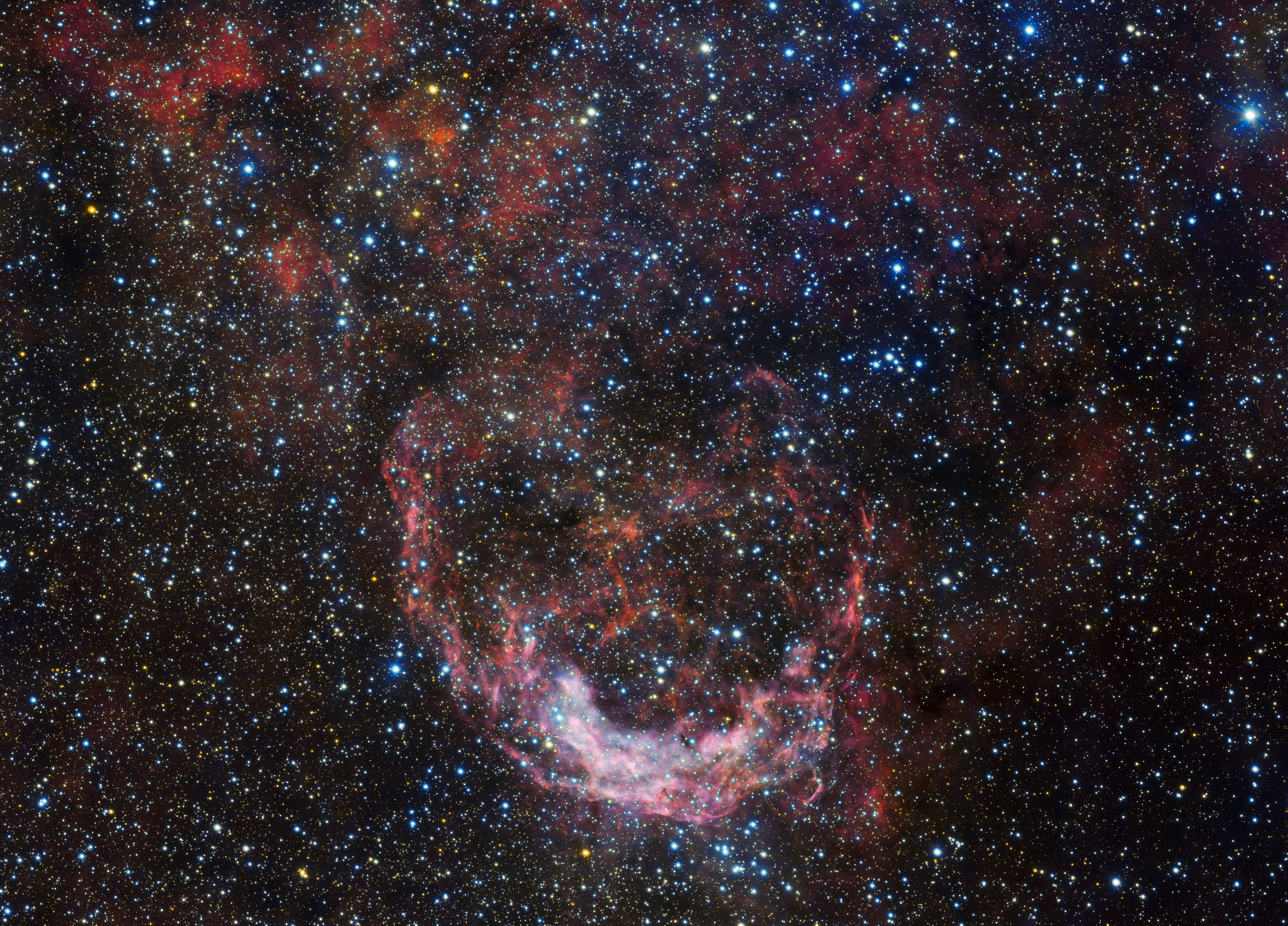
Nebula NGC 3199 in Carina | European Southern Observatory

Nebula NGC 3199 in Carina | European Southern Observatory

This image shows a crescent-shaped cocoon of gas and dust—a nebula known as NGC 3199, which is located 12,000 light-years away from Earth. It appears to plough through the star-studded sky like a ship through stormy seas. This imagery is very appropriate due to NGC 3199’s location in Carina —a southern constellation which is named after the keel of a ship!

NGC 3199 was discovered by British astronomer John Herschel in 1834 as he compiled his famous catalog of interesting night sky objects. The nebula’s bright crescent feature is now known to be part of a much larger but fainter bubble of gas and dust.

The nebula contains a notable star named HD 89358, which is an unusual type of extremely hot and massive star known as a Wolf-Rayet star. HD 89358 generates incredibly intense stellar winds and outflows that smash into and sweep up the surrounding material, contributing to NGC 3199’s twisted and lopsided morphology.


Credit: European Southern Observatory (ESO)

Release Date: July 30, 2018


#NASA #ESO #Astronomy #Space #Science #Nebulae #Nebula #NGC3199 #Star #HD89358 #WolfRayetStar #Carina #Constellation #MilkyWayGalaxy #Cosmos #Universe #Telescope #Observatory #Chile #Europe #STEM #Education

Supercomputer Simulation: How a Disk Galaxy Forms

Supercomputer Simulation: How a Disk Galaxy Forms

How did we get here? We know that we live on a planet orbiting a star orbiting a galaxy, but how did all of this form? Since our universe moves too slowly to watch, faster-moving computer simulations are created to help find out. Specifically, this featured video from the IllustrisTNG collaboration tracks gas from the early universe (redshift 12) until today (redshift 0). As the simulation begins, ambient gas falls into and accumulates in a region of relatively high gravity. After a few billion years, a well-defined center materializes from a strange and fascinating cosmic dance. Gas blobs—some representing small satellite galaxies—continue to fall into and become absorbed by the rotating galaxy as the present epoch is reached and the video ends. For the Milky Way Galaxy, however, big mergers may not be over—recent evidence indicates that our large spiral disk Galaxy will collide and coalesce with the slightly larger Andromeda spiral disk galaxy in the next few billion years.


Video Credit: TNG Collaboration, MPCDF, FAS Harvard University

Release Date: May 29, 2023


#NASA #Space #Astronomy #Science #Galaxies #MilkyWayGalaxy #Astrophysics #Physics #Cosmology #Cosmos #Universe #ComputerSimulation #Supercomputers #IllustrisTNGProject #MaxPlanckGesellschaft #FASHarvardUniversity #STEM #Education #APoD #HD #Video

Axiom Space Ax-2 Crew Dragon Spacecraft Return & Recovery | SpaceX

Axiom Space Ax-2 Crew Dragon Spacecraft Return & Recovery | SpaceX

The crew of Axiom Space’s Ax-2 mission to the International Space Station, Commander Peggy Whitson (USA), Pilot John Shoffner (USA) and Mission Specialists Ali Alqarni (Saudi Arabia) and Rayyanah Barnawi (Saudi Arabia), was successfully recovered from SpaceX’s “Freedom” Crew Dragon spacecraft, on May 31, 2023.


Credit: Space Exploration Technologies Corp. (SpaceX)/Axiom Space

Acknowledgement: SciNews

Duration: 3 minutes, 28 seconds

Release Date: May 31, 2023


#NASA #Space #ISS #Axiom #AxiomSpace #Ax2Mission #Ax2 #AX2Crew #Astronauts #PeggyWhitson #JohnShoffner #AliAlqarni #RayyanahBarnawi #SpaceX #CrewDragon #CommercialSpace #Science #MicrogravityResearch #SpaceLaboratory #InternationalCooperation #SaudiArabia #SaudiSpaceCommission #UnitedStates #STEM #Education #History #HD #Video

Tuesday, May 30, 2023

Expedition 69 Crew Answers Student Questions | International Space Station

Expedition 69 Crew Answers Student Questions | International Space Station

Aboard the International Space Station, NASA Expedition 69 Flight Engineers Stephen Bowen and Frank Rubio answered pre-recorded questions about life and work on the orbiting laboratory during an in-flight event May 30, 2023, with students at the New Mexico Museum of Space History in Alamogordo, New Mexico. Bowen and Rubio are in the midst of a science mission living and working aboard the microgravity laboratory to advance scientific knowledge and demonstrate new technologies. Such research benefits people on Earth and lays the groundwork for future human exploration through the agency’s Artemis missions, which will send astronauts to the Moon to prepare for future expeditions to Mars. 

Follow Expedition 69 updates here:

https://blogs.nasa.gov/spacestation/

Expedition 69 Crew (May 2023)

Station Commander: Sergey Prokopyev of Roscosmos (Russia)

Roscosmos (Russia): Flight Engineers Dmitri Petelin & Andrey Fedyaev

Flight Engineer Sultan Alneyadi of the United Arab Emirates (UAE)

NASA: Flight Engineers Frank Rubio, Stephen Bowen, Warren Hoburg

An international partnership of space agencies provides and operates the elements of the International Space Station (ISS). The principals are the space agencies of the United States, Russia, Europe, Japan, and Canada. The ISS has been the most politically complex space exploration program ever undertaken.


Credit: NASA's Johnson Space Center (JSC)

Duration: 17 minutes

Release Date: May 30, 2023


#NASA #Space #Earth #Science #ISS #Astronauts #StephenBowen #FrankRubio #WoodyHoburg #Cosmonauts #HumanSpaceflight #UnitedStates #Russia #Россия #Роскосмос #Students #NewMexico #Expedition69 #STEM #Education #HD #Video

Shenzhou-15 & Shenzhou-16 Crews Meet in Earth Orbit | China Space Station

Shenzhou-15 & Shenzhou-16 Crews Meet in Earth Orbit | China Space Station

The Shenzhou-16 manned spacecraft embarked on its journey to the China Space Station on Tuesday, May 30, 2023. It is the first crewed mission since the China Space Station entered its application and development stage.

Carried by a Long March-2F rocket, the Shenzhou-16 crew spacecraft lifted off from the Jiuquan Satellite Launch Center in northwestern China at 9:31 a.m, Beijing Time, May 30. The spacecraft conducted a fast automated rendezvous and docked with the radial port of the China Space Station module Tianhe at 16:29 Beijing Time, forming a combination of three modules and three spacecraft.

Let's experience the meeting of the Shenzhou-15 and Shenzhou-16 crews in space in 80 seconds.


Credit: China Global Television Network (CGTN)

Duration: 1 minute, 23 seconds

Release Date: May 30, 2023


#NASA #Space #China #中国 #LongMarch2FRocket #长征二号F遥十六 #SpaceLaboratory #CSS #ChinaSpaceStation #中国空间站 ##Shenzhou15 #Shenzhou16 #神舟十六 #Taikonauts #Astronauts #Commander #JingHaipeng #ZhuYangzhu #GuiHaichao #CMSA #国家航天局 #Science #Technology #HumanSpaceflight #STEM #Education #HD #Video

Saturn's Ocean Moon Enceladus: Large Water Vapor Plume Found | Webb Telescope

Saturn's Ocean Moon Enceladus: Large Water Vapor Plume Found | Webb Telescope


Researchers using the NASA/European Space Agency/Canadian Space Agency James Webb Space telescope recently discovered a plume jetting out from the south pole of Saturn’s moon Enceladus and extending more than 40 times the size of the moon itself. This animation illustrates how the moon’s water plumes feed the moon’s torus. By analyzing the Webb data, astronomers have determined roughly 30 percent of the water stays within this torus, and the other 70 percent escapes to supply the rest of the Saturnian system of water.


Credit: NASA, ESA, CSA, G. Villanueva (NASA’s Goddard Space Flight Center), A. Pagan (STScI), L. Hustak (STScI)

Duration: 21 seconds

Release Date: May 25, 2023


#NASA #Space #Astronomy #Science #Saturn #Planet #Enceladus #Moon #OceanMoon #SouthPole #WaterVapour #Plume #Jet #Astrobiology #SolarSystem #JWST #GSFC #STScI #UnitedStates #Europe #ESA #Canada #CSA #Infographics #STEM #Education #Animation #HD #Video

Saturn's Ocean Moon Enceladus: Large Water Vapor Plume Found | Webb Telescope

Saturn's Ocean Moon Enceladus: Large Water Vapor Plume Found | Webb Telescope

A water vapor plume jetting from the south pole of Saturn’s moon Enceladus

Saturn’s moon Enceladus feeds the water supply for the entire system of the ringed planet

Images from the NASA/European Space Agency/Canadian Space Agency James Webb Space Telescope’s NIRCam (Near-Infrared Camera) show a water vapor plume jetting from the south pole of Saturn’s moon Enceladus, extending out 40 times the size of the moon itself. The inset, an image from NASA's Cassini orbiter, emphasises how small Enceladus appears in the Webb image compared to the water plume. Enceladus, a prime candidate in the search for life elsewhere in our Solar System, is a small moon about four percent the size of Earth.

Image 1 Description: The two-part graphic shows a clearer image of a bright white circular moon at top left in a box. It is labelled Enceladus (Cassini). The majority of the graphic shows Webb’s image, which appears pixelated. At the bottom is the label, plume (Webb).

Webb is allowing researchers, for the first time, to see directly how this plume feeds the water supply for the entire system of Saturn and its rings. By analyzing the Webb data, astronomers have determined roughly 30 percent of the water stays within a torus, a fuzzy doughnut of water that is co-located with Saturn’s E-ring, and the other 70 percent escapes to supply the rest of the Saturnian system with water.

Enceladus, at just 505 kilometers across, is one of the most exciting scientific targets in our Solar System in the search for life beyond Earth. A global reservoir of salty water sits below the moon’s icy outer crust, and geyser-like volcanoes spew jets of ice particles, water vapor, and organic chemicals out of crevices in the moon’s surface informally called ‘tiger stripes’.

Webb’s NIRCam was built by a team at the University of Arizona and Lockheed Martin’s Advanced Technology Center.


Credit: NASA, ESA, CSA, STScI, G. Villanueva (NASA’s Goddard Space Flight Center), A. Pagan (STScI)

Release Date: May 30, 2023


#NASA #Space #Astronomy #Science #Saturn #Planet #Enceladus #Moon #OceanMoon #SouthPole #WaterVapour #Plume #Jet #Astrobiology #SolarSystem #JWST #GSFC #STScI #UnitedStates #Europe #ESA #Canada #CSA #Infographics #STEM #Education

Ax-2 Astronauts Farewell Ceremony | International Space Station

Ax-2 Astronauts: Farewell Ceremony | International Space Station


Record-breaking American astronaut Peggy Whitson and her Axiom Space Ax-2 crewmates John Shoffner (USA), Ali Alqarni (Saudi Arabia), and Rayyanah Barnawi (Saudi Arabia) say goodbye to the International Space Station in a farewell ceremony on May 29, 2023. The crew is returning to Earth on May 30, 2023, aboard the SpaceX Crew Dragon Freedom spacecraft.

Rayyanah Barnawi is making history as the first Arab woman aboard the International Space Station. She has become the 600th astronaut.

Expedition 69 Crew (May 2023)

Station Commander: Sergey Prokopyev of Roscosmos (Russia)

Roscosmos (Russia): Flight Engineers Dmitri Petelin & Andrey Fedyaev

Flight Engineer Sultan Alneyadi of the United Arab Emirates (UAE)

NASA: Flight Engineers Frank Rubio, Stephen Bowen, Warren Hoburg

An international partnership of space agencies provides and operates the elements of the International Space Station (ISS). The principals are the space agencies of the United States, Russia, Europe, Japan, and Canada. The ISS has been the most politically complex space exploration program ever undertaken.


Credit:  NASA TV

Acknowledgement: VideoFromSpace

Duration: 10 minutes

Broadcast Date: May 29, 2023

Release Date: May 30, 2023


#NASA #Space #ISS #Axiom #AxiomSpace #Ax2Mission #Ax2 #AX2Crew #Astronauts #PeggyWhitson #JohnShoffner #AliAlqarni #RayyanahBarnawi #SpaceX #CrewDragon #CommercialSpace #Science #MicrogravityResearch #SpaceLaboratory #InternationalCooperation #SaudiArabia #SaudiSpaceCommission #UnitedStates #STEM #Education #History #HD #Video

"Spring Sprouts" of The Martian North | NASA Mars Reconnaissance Orbiter

"Spring Sprouts" of The Martian North | NASA Mars Reconnaissance Orbiter

The sun is rising in Mars’ Northern Hemisphere, and spring activity is starting as the seasonal polar cap begins to sublimate (going from ice directly to gas). A layer of dry ice covers the sand dunes in this image.

Gas jets sprout through the ice layer carrying dust and sand from the surface, showing up as dark fans. At this time in early Martian spring, the fans are visible between the sand dunes. The ground between the dunes is on the scale of tens of centimeters, and ice in places where the sun hits more directly will thin fastest, releasing the jets. Later, the ice over and around the dunes will rupture and more fans will appear on the dunes.

This image was acquired on December 24, 2020, by NASA's Mars Reconnaissance Orbiter (MRO) at an altitude of 271 km from the planet's surface. The image is less than 1 km across. 

The University of Arizona, Tucson, operates the High Resolution Imaging Science Experiment (HiRISE) instrument, which was built by Ball Aerospace & Technologies Corp., Boulder, Colorado. 

NASA's Jet Propulsion Laboratory, a division of Caltech in Pasadena, California, manages the Mars Reconnaissance Orbiter Project for NASA's Science Mission Directorate, Washington.

“For 17 years, MRO has been revealing Mars to us as no one had seen it before,” said the mission’s project scientist, Rich Zurek of JPL.

Image Credits: NASA/JPL-Caltech/University of Arizona

Narration: Tre Gibbs

Duration: 47 seconds

Caption Credit: Candy Hansen 

Capture Date: Jan. 22, 2021


#NASA #Space #Astronomy #Mars #Planet #RedPlanet #Science #Geology #Landscape #Terrain #Geoscience #NorthernHemisphere #SandDunes #GasJets #DarkFans #MRO #Orbiter #Spacecraft #HiRISE #HiRISECamera #JPL #Caltech #UniversityOfArizona #BallAerospace #STEM #Education #HD #Video

"Spring Sprouts" of The Martian North | NASA Mars Reconnaissance Orbiter

"Spring Sprouts" of The Martian North | NASA Mars Reconnaissance Orbiter

The sun is rising in Mars’ Northern Hemisphere, and spring activity is starting as the seasonal polar cap begins to sublimate (going from ice directly to gas). A layer of dry ice covers the sand dunes in this image.

Gas jets sprout through the ice layer carrying dust and sand from the surface, showing up as dark fans. At this time in early Martian spring, the fans are visible between the sand dunes. The ground between the dunes is on the scale of tens of centimeters, and ice in places where the sun hits more directly will thin fastest, releasing the jets. Later, the ice over and around the dunes will rupture and more fans will appear on the dunes.

This image was acquired on December 24, 2020, by NASA's Mars Reconnaissance Orbiter (MRO) at an altitude of 271 km from the planet's surface. The image is less than 1 km across. 

The University of Arizona, Tucson, operates the High Resolution Imaging Science Experiment (HiRISE) instrument, which was built by Ball Aerospace & Technologies Corp., Boulder, Colorado. 

NASA's Jet Propulsion Laboratory, a division of Caltech in Pasadena, California, manages the Mars Reconnaissance Orbiter Project for NASA's Science Mission Directorate, Washington.

“For 17 years, MRO has been revealing Mars to us as no one had seen it before,” said the mission’s project scientist, Rich Zurek of JPL.

Image Credit: NASA/JPL-Caltech/University of Arizona

Caption Credit: Candy Hansen 

Image Date: Dec. 24, 2020


#NASA #Space #Astronomy #Mars #Planet #RedPlanet #Science #Geology #Landscape #Terrain #Geoscience #NorthernHemisphere #SandDunes #GasJets #DarkFans #MRO #Orbiter #Spacecraft #HiRISE #HiRISECamera #JPL #Caltech #UniversityOfArizona #BallAerospace #STEM #Education

Monday, May 29, 2023

Shenzhou-16 Mission: Long March Rocket Launch | China Space Station

Shenzhou-16 Mission: Long March Rocket Launch | China Space Station

The Shenzhou-16 crew spacecraft was successfully launched by a Long March-2F Y16 launch vehicle from the Jiuquan Satellite Launch Center, Gansu Province, China, on May 30, 2023, at 01:31 UTC (09:31 China Standard Time). Shenzhou-16 is the fifth crew of three astronauts on a mission to the China Space Station: Jing Haipeng (景海鹏, commander), Zhu Yangzhu (朱杨柱) and Gui Haichao (桂海潮).


Credit: China National Space Administration (CNSA)/China Central Television (CCTV)/China Global Television Network (CGTN)

Acknowledgement: SciNews

Duration: 6 minutes

Release Date: May 29, 2023

#NASA #Space #China #中国 #LongMarch2FRocket #长征二号F遥十六 #SpaceLaboratory #CSS #ChinaSpaceStation #中国空间站 #Shenzhou16 #神舟十六 #Taikonauts #Astronauts #Commander #JingHaipeng #ZhuYangzhu #GuiHaichao #CMSA #国家航天局 #Science #Technology #HumanSpaceflight #STEM #Education #HD #Video

China's Shenzhou-16 Mission & Crew | China Space Station

China's Shenzhou-16 Mission & Crew | China Space Station


A Long March-2F carrier rocket, carrying the Shenzhou-16 spacecraft with three astronauts on board, successfully blasted off from the Jiuquan Satellite Launch Center in northwest China on Tuesday morning, May 30, 2023.

The Shenzhou-16 manned mission, the first since the China Space Station entered its application and development stage, will conduct a fast automated rendezvous in orbit and dock at the radial port of the Tianhe core module, forming a combination of three modules and three spaceships. China unveiled its crew members for the Shenzhou-16 spaceflight mission on Monday, May 29, 2023 with the astronauts meeting the press a day before their scheduled launch. 

Taikonauts Jing Haipeng (Commander), Zhu Yangzhu and Gui Haichao will carry out the mission to the China Space Station (CSS), the China Manned Space Agency (CMSA) announced at the press conference. Gui Haichao makes history as China's first civilian astronaut and payload specialist.

Gui Haichao, born in November 1986, was also selected as a member of China's third batch of astronauts in 2020, serving as a payload specialist.

"The word 'astronaut' was sacred and far from me in the past, and I've been dreaming of moving my research work into space one day," he said. "I didn't hesitate to sign up when I learned in 2018 that the country was about to select payload specialists."

With Gui's arrival, the China Space Station will welcome its first payload specialist.

The Shenzhou-15 crew will return to north China's Dongfeng landing site after completing an in-orbit rotation mission with the Shenzhou-16 crew.


Credit: China Global Television Network (CGTN)

Release Date: May 29, 2023


#NASA #Space #China #中国 #Earth #MicrogravityExperiments #SpaceResearch #SpaceLaboratory #CSS #ChinaSpaceStation #天和核心舱 #Shenzhou16 #Taikonauts #Astronauts #Commander #JingHaipeng #ZhuYangzhu #GuiHaichao #CNSA #CMSA #国家航天局 #Science #Technology #HumanSpaceflight #Infographics #STEM #Education

China's Shenzhou-16 Crew Training | China Space Station

China's Shenzhou-16 Crew Training | China Space Station

China unveiled its crew members for the Shenzhou-16 spaceflight mission on Monday, May 29, 2023, with the astronauts meeting the press a day before their scheduled launch. 

Taikonauts Jing Haipeng, Zhu Yangzhu and Gui Haichao will carry out the mission to the China Space Station (CSS), the China Manned Space Agency (CMSA) announced at a press conference. Gui Haichao makes history as China's first civilian astronaut.

What did they do in their training? 

The Shenzhou-16 manned mission, the first since the China Space Station entered its application and development stage, will conduct a fast automated rendezvous in orbit and dock at the radial port of the Tianhe core module, forming a combination of three modules and three spaceships.

The Shenzhou-15 crew will return to north China's Dongfeng landing site after completing an in-orbit rotation mission with the Shenzhou-16 crew.


Credit: China Global Television Network (CGTN)

Duration: 3 minutes, 34 seconds

Release Date: May 29, 2023


#NASA #Space #China #中国 #Earth #MicrogravityExperiments #SpaceResearch #SpaceLaboratory #CSS #ChinaSpaceStation #天和核心舱 #Shenzhou16 #Taikonauts #Astronauts #Training #Commander #JingHaipeng #ZhuYangzhu #GuiHaichao #CNSA #CMSA #国家航天局 #Science #Technology #HumanSpaceflight #STEM #Education #HD #Video

Star Forming Region N90: Wide-field View (ground-based image)

Star Forming Region N90: Wide-field View (ground-based image)

This image shows the area around nebula N90. N90 is a rich star-forming region in the Small Magellanic Cloud, a satellite galaxy of our Milky Way.

Distance: 200,000 light years

This is a color composite made from Digitized Sky Survey 2 (DSS2) exposure. The field of view is 3.1x2.8 degrees.


Credit: Davide De Martin (ESA/Hubble), the ESA/ESO/NASA/Digitized Sky Survey 2

Release Date: Jan. 8, 2007


#NASA #Space #Astronomy #Science #Nebulae #N90 #Nebula #OpenStarCluster #NGC602 #MagellanicCloud #SMC #Hydrus #Constellation #Cosmos #Universe #Telescope #UnitedStates #STEM #Education

Open Star Cluster NGC 602 in The Small Magellanic Cloud | NASA Chandra

Open Star Cluster NGC 602 in The Small Magellanic Cloud | NASA Chandra

NGC 602 is a young, bright open cluster of stars located in the Small Magellanic Cloud (SMC)—a satellite galaxy close to the Milky Way. It is embedded in a nebula known as N90.

Distance: 200,000 light years


Credit: NASA's Chandra X-ray Observatory

Duration: 2 minutes

Release Date: April 8, 2013


#NASA #Space #Astronomy #Science #Stars #MagellanicCloud #SMC #Hydrus #Constellation #Cosmos #Universe #Spitzer #SpaceTelescopes #Infrared #Hubble #HST #ChandraObservatory #Xray #JPL #Caltech #GSFC #STScI #UnitedStates #ESA #Europe #STEM #Education #HD #Video