Thursday, August 27, 2026

Irregular Galaxy Arp 263 in Leo: Star clusters & irregular clumps | Webb Telescope

Irregular Galaxy Arp 263 in Leo: Star clusters & irregular clumps | Webb Telescope

This NASA/European Space Agency picture is an infrared look into the strange final phase of a galactic merger. Arp 263, an irregular galaxy, lies in the constellation Leo at a relatively nearby distance of around 25 million light-years. Originally discovered in 1784 and also cataloged as NGC 3239, this galaxy was included in American astronomer Halton Arp’s Atlas of Peculiar Galaxies in 1966, as possibly one of the most remarkable and strange galaxies in the sample. Arp categorized it with the galaxies featuring “irregular clumps”.

Arp 263 is believed to result from a past galactic merger. Apart from its unusual distorted shape, astronomers have noticed a few features that point to this. It has two short, curved tails of stars, beyond the field of view of this Webb image. This is a feature associated with gravitational interactions. However, there are no nearby galaxies that Arp 263 could be interacting with now. The stars in the galaxy are oriented differently to its hydrogen gas, where they would normally be symmetric, and parts of that gas are moving at a range of velocities to each other. And, of course, the widespread formation of new stars across Arp 263 is typical of a galaxy whose gas has been seriously shaken up.

Although Arp 263 clearly has not yet settled into a more regular shape after its gravitational tug-of-war, its former companion galaxy is now nowhere to be found. It is possible that this was a dwarf galaxy small enough to have been already completely dissolved into the larger Arp 263—or that its companion was simply much more heavy than it was bright, making it difficult to spot as a remnant.

This image from Webb’s Near-Infrared Camera (NIRCam) reveals an alternative view of Arp 263, taking us inside the thick gas crowding the galaxy to see the many stars scattered there. These old stars contrast with the several areas of star birth, where multitudes of new stars are forming in numerous clusters. Dust spread throughout the galaxy glows with the light, here shown in red, emitted by complex molecules; around the star-forming regions we also see—in blue colors—hydrogen gas, ionized by starlight and emitting its own light in turn. The most intense area of star formation features a curved chain of compact star clusters, leading to the largest and brightest star-forming nebula. Webb allows us to peek into this stellar nursery and see the stars that have formed within.

The brightest of the bright spots in Arp 263 is a shining star, named BD+17 2217. It appears so large and bright with long diffraction spikes created by the telescope’s optics, because it is part of our own galaxy. The galaxies that appear in the background are much more distant, most hundreds of millions of light-years away from both us and Arp 263. A few of these galaxies are identifiable as spiral galaxies, but Webb’s NIRCam reveals the hundreds of much more distant galaxies lurking in the background as orange dots.

This image was made with data from observing program #3707 (PI: Leroy), a survey of the nearby, large, star-forming galaxies in the southern sky. These galaxies are close enough that Webb’s sharp vision can deliver a detailed picture of the stars, star clusters, and interstellar dust within the galaxy. The observations will be used to better understand the cycle of star formation and how it plays out across galaxies; Arp 263, with its disturbed disc of gas and its chaotic star formation, presents a unique and fascinating target for these investigations.

Image Description: An irregular galaxy, appearing like a broad band of tiny stars. It is denser on one side with a faint cloud of gas among the stars. Clumps of brighter points are newly formed stars, with the largest lights being star clusters, and with many surrounded in glowing blue gas clouds. Plumes of red dust surround the galaxy. A foreground star appears very large and bright. A few distant galaxies appear in the background.


Image Credit: ESA/Webb, NASA & CSA, A. Leroy
Release Date: Aug. 27, 2026


#NASA #ESA #Astronomy #Space #Science #Stars #StarBD172217 #StellarNurseries #StarClusters #Galaxies #Arp263 #IrregularGalaxies #InteractingGalaxies #Cosmos #Universe #JWST #NIRCam #InfraredAstronomy #SpaceTelescopes #Europe #NASAGoddard #GSFC #STScI #UnitedStates #CSA #Canada #STEM #Education

Expedition 75: Menon & Adenot on Spacewalk | International Space Station

Expedition 75: Menon & Adenot on Spacewalk | International Space Station


Spacewalkers Anil Menon of NASA (red stripes) and Sophie Adenot of the European Space Agency (ESA) installed a high-speed antenna on the station while soaring 260 miles above Earth on Tuesday, Aug. 25, 2026. They also pictured the SpaceX Dragon (Image#2) and the Alpha Magnetic Spectrometer (Image#8), a cosmic particle detector. NASA astronaut Anil Menon and ESA astronaut Sophie Adenot concluded their spacewalk outside the International Space Station at 2:57 p.m. EDT.  

During the 6‑hour, 30‑minute spacewalk, Menon and Adenot successfully installed and connected the spare space‑to‑ground antenna, a critical link that enables high‑speed data transmission between NASA’s Mission Control Center in Houston and the orbital complex. Afterward, they secured the failed unit that was removed and temporarily stowed during the duo’s spacewalk on Aug. 18, to a spare‑parts platform on the station’s truss structure.

Initial checkouts of the newly installed antenna showed good power and data transmission. Flight controllers on the ground will continue testing the antenna overnight to ensure full functionality. 

U.S. spacewalk 98 was Menon’s third career spacewalk and the second for Adenot. It also was the 283rd spacewalk in support of space station assembly, maintenance, and upgrades.


Expedition 75 Crew
Station Commander: Jessica Meir
Roscosmos (Russia) Flight Engineers:
Andrey Fedyaev,
Anna Kikina, Pyotr Dubrov
European Space Agency Flight Engineer: Sophie Adenot
NASA Flight Engineers: Jack Hathaway, Anil Menon

An international partnership of space agencies provides and operates the elements of the International Space Station (ISS). The principals are the space agencies of the United States, Russia, Europe, Japan, and Canada.


Image Credits: NASA's Johnson Space Center/A. Menon/S. Adenot
Image Date: Aug. 25, 2026


#NASA #Space #Science #ISS #Planets #Earth #Astronauts #Spacewalks #USSpacewalk98 #EVAs #Spacesuits #AnilMenon #SophieAdenot #France #CNES #AstronautPhotography #Cosmonauts #Russia #Россия #Roscosmos #Роскосмос #HumanSpaceflight #Expedition75 #InternationalCooperation #UnitedStates #STEM #Education

Wednesday, August 26, 2026

A "Starry Night" | International Space Station

A "Starry Night" | International Space Station


Expedition 75 commander, flight engineer, and NASA astronaut Jessica Meir: "Starry starry night. Channeling my inner post-impressionism vibes as I experiment with long exposure star trails from the International Space Station's Japanese Experiment Module (JEM) window. Maybe van Gogh was dreaming in long exposure for his masterpiece. That’s the Japan Aerospace Exploration Agency (JAXA) external platform (JEF) in the foreground, looking toward the port truss solar arrays on the left. Taken with a Nikon Z9, 14mm lens, 180s exposure."

The Starry Night is an oil-on-canvas painting by the Dutch Post-Impressionist painter Vincent van Gogh. Painted in June 1889, it depicts the view from the east-facing window of his asylum room at Saint-Rémy-de-Provence, just before sunrise with the addition of an imaginary village.


Expedition 75 Crew
Station Commander: Jessica Meir
Roscosmos (Russia) Flight Engineers:
Andrey Fedyaev,
Anna Kikina, Pyotr Dubrov
European Space Agency Flight Engineer: Sophie Adenot
NASA Flight Engineers: Jack Hathaway, Anil Menon

An international partnership of space agencies provides and operates the elements of the International Space Station (ISS). The principals are the space agencies of the United States, Russia, Europe, Japan, and Canada.


Image Credit: NASA's Johnson Space Center/J. Meir
Release Date: Aug. 26, 2026

#NASA #Space #Science #ISS #Stars #Planets #Earth #JAXA #Japan #日本 #JEM #Astronauts #JessicaMeir #AstronautPhotography #Cosmonauts #Russia #Россия #Roscosmos #Роскосмос #HumanSpaceflight #Expedition75 #InternationalCooperation #UnitedStates #STEM #Education

Comet 220P/McNaught: A Lengthening Tail—View from Arizona

Comet 220P/McNaught: A Lengthening Tail—View from Arizona

Astrophotographer Chris Schur: "Last chance this morning before the full Moon washes out sky. Was able to squeeze in 1h 15m of integration in a Moonless dark sky this morning. Field here is about 2.5 degrees wide, and comets tail is easily 2 degrees in length. G2V calibration for most accurate colors of stars and comet."

220P/McNaught, is a Jupiter-family comet with a 5.5-year orbit around the Sun. It is one of several comets discovered by Australian astronomer, Robert H. McNaught. It reached perihelion (closest approach to the Sun) on June 14, 2026, two weeks after a large outburst where the comet brightened as much as 8,000 times.

Arizona is a landlocked state in the Southwestern region of the United States, sharing the Four Corners region of the western United States with Colorado, New Mexico, and Utah. It also borders Nevada to the northwest and California to the west, and shares an international border with the Mexican states of Sonora and Baja California to the south and southwest.


Image Credit: Chris Schur
Location: Payson, Arizona, United States
Image Details: FOV: 125' x 100' -Orientation: N up -Seeing: 6 -Transparency: 6 -Orig. Scale: 1.6 arcsec/Pixel -Instrument: 10" f/2.9 Newt -Exposure: 1h 15m total LRGB -Camera: Atik 16200
Date: Aug. 25, 2026

#NASA #Astronomy #Space #Science #Planets #Earth #Comets #Comet220PMcNaught #JupiterFamilyComets #JFc #SolarSystem #MilkyWayGalaxy #Cosmos #Universe #Astrophotography #ChrisSchur #Astrophotographers #Payson #Arizona #UnitedStates #STEM #Education

"Giant Leaps Start Here" | NASA's Johnson Space Center

"Giant Leaps Start Here" | NASA's Johnson Space Center

"The first word uttered by our astronauts in space before history is made—big or small—is 'Houston…' NASA’s Johnson Space Center has served as the iconic setting to some of humankind’s greatest achievements. For over 60 years, as part of NASA’s nationwide team, Johnson has led the world in human space exploration. Today, we push forward to the Moon. Tomorrow, we leap to greater heights and new destinations. There is history to be made. Giant Leaps Start Here!"

Learn more: https://www.nasa.gov/johnson/

NASA’s Artemis program:


Video Credit: NASA's Johnson Space Center
Duration: 1 minute
Release Date: Aug. 26, 2026

#NASA #Space #ISS #Astronauts #HumanSpaceflight #NASAJohnson #JSC #Houston #Texas #LongDurationMissions #DeepSpaceMissions #UnitedStates #ArtemisProgram #Moon #MoonToMars #Mars #History #STEM #Education #HD #Video

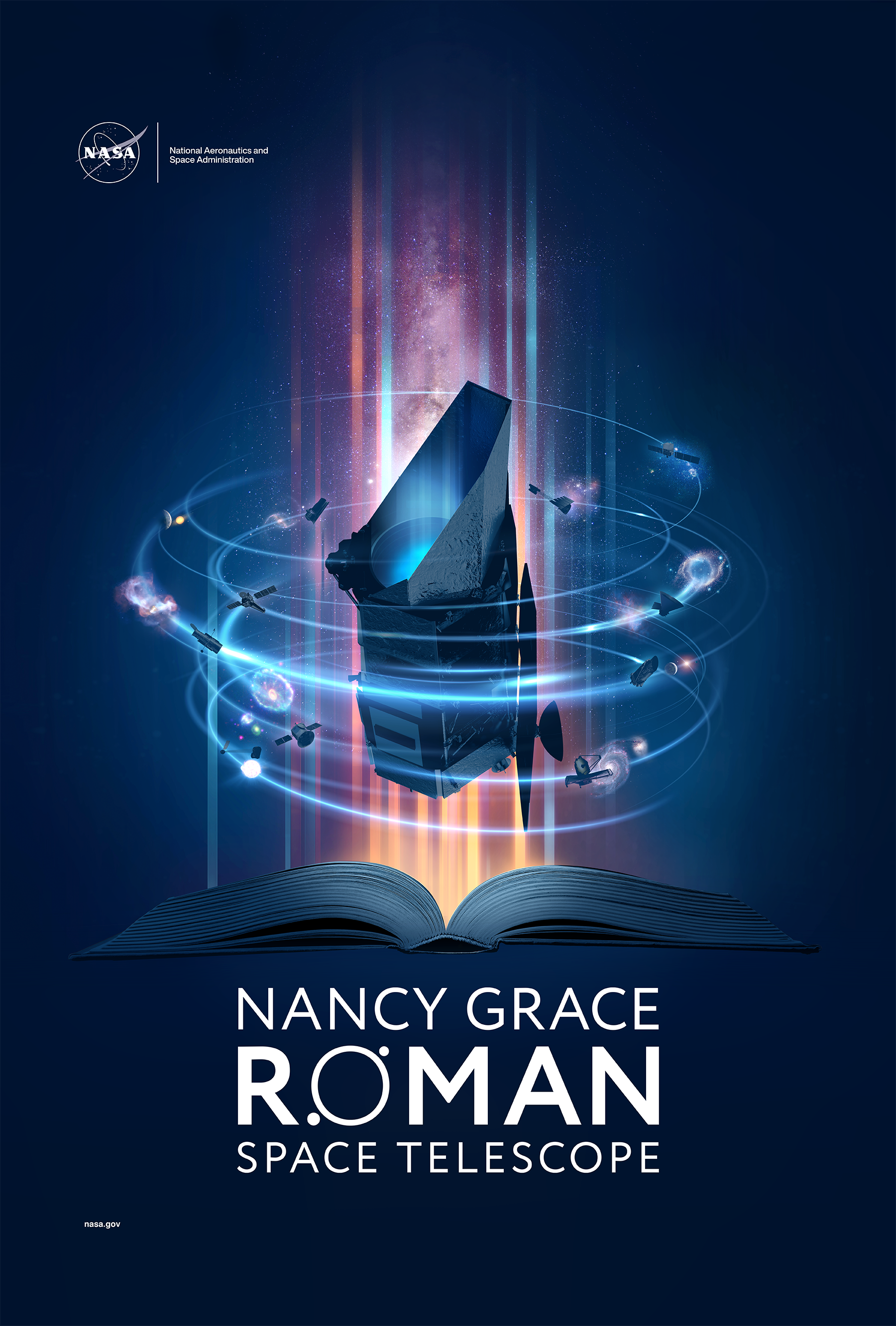
NASA's Nancy Grace Roman Space Telescope: What You Need To Know

NASA's Nancy Grace Roman Space Telescope: What You Need To Know

NASA’s Nancy Grace Roman Space Telescope will give us a sweeping new view of the universe, capturing enormous areas of the sky while delivering high-resolution, sensitive observations. 

Roman will investigate some of astronomy’s major mysteries, from dark energy and dark matter to the evolution of galaxies and worlds beyond our solar system. With its powerful Wide Field Instrument, Roman will survey billions of cosmic objects and could reveal discoveries scientists have not imagined yet. 

Named after NASA’s first chief astronomer, the Nancy Grace Roman Space Telescope will have a deep, panoramic view of the cosmos, producing images over 100 times larger than our Hubble Space Telescope, but with the same crisp resolution. 


The Roman telescope and the discoveries it will support:
https://www.stsci.edu/roman

Roman’s namesake—Dr. Nancy Grace Roman, NASA’s first chief astronomer—made it her personal mission to make cosmic vistas readily accessible to all by paving the way for telescopes based in space.

“The mission will acquire enormous quantities of astronomical imagery that will permit scientists to make groundbreaking discoveries for decades to come, honoring Dr. Roman’s legacy in promoting scientific tools for the broader community,” said Jackie Townsend, Roman’s deputy project manager at NASA Goddard. “I like to think Dr. Roman would be extremely proud of her namesake telescope and thrilled to see what mysteries it will uncover in the coming years.”


Credit: NASA's Goddard Space Flight Center 
Producer: Paul Morris
Support: Scott Wiessinger & Sophia Roberts
Video Credit: Vera C. Rubin B-roll: EPA_Video via POND5
Duration: 7 minutes
Release Date: Aug. 26, 2026

#NASA #Space #Astronomy #Science #NASARoman #RomanSpaceTelescope #NancyGraceRomanSpaceTelescope #NancyGraceRoman #Exoplanets #Planets #SolarSystem #Stars #MilkyWayGalaxy #Galaxies #Cosmos #Universe #SpaceTelescopes #NASAGoddard #GSFC #STScI #NASAKennedy #Florida #UnitedStates #STEM #Education #HD #Video

SpaceX Falcon Heavy Pre-launch: Roman Space Telescope | NASA Kennedy

SpaceX Falcon Heavy Pre-launch: Roman Space Telescope | NASA Kennedy

Teams continue launch preparations on the SpaceX Falcon Heavy that will launch NASA's Nancy Grace Roman Space Telescope, inside the SpaceX hangar at Launch Complex 39A at Kennedy Space Center in Florida.


Teams inside the Payload Hazardous Servicing Facility at NASA’s Kennedy Space Center in Florida encapsulate the agency’s Nancy Grace Roman Space Telescope within the payload fairing on Friday, Aug. 21, 2026, ahead of mating to a SpaceX Falcon Heavy rocket.


Dr. Nancy Grace Roman (1925-2018) visits James Webb Space Telescope (JWST) and the Hubble Project Team on March 31, 2017.

Teams continue launch preparations on the SpaceX Falcon Heavy that will launch NASA's Nancy Grace Roman Space Telescope, inside the SpaceX hangar at Launch Complex 39A at Kennedy Space Center in Florida on Wednesday, Aug. 26, 2026. The rocket has 27 Merlin engines on its first stage and can generate more than five million pounds of thrust at liftoff. NASA and SpaceX are targeting launch no earlier than 7:26 a.m. EDT Sunday, Aug. 30, from Kennedy. 

Roman’s primary mission is to settle essential questions about dark energy, exoplanets, and infrared astrophysics by conducting wide-field surveys that explore the universe’s structure, evolution, and composition. 

The Roman telescope and the discoveries it will support:
https://www.stsci.edu/roman

Roman’s namesake—Dr. Nancy Grace Roman, NASA’s first chief astronomer—made it her personal mission to make cosmic vistas readily accessible to all by paving the way for telescopes based in space.

“The mission will acquire enormous quantities of astronomical imagery that will permit scientists to make groundbreaking discoveries for decades to come, honoring Dr. Roman’s legacy in promoting scientific tools for the broader community,” said Jackie Townsend, Roman’s deputy project manager at NASA Goddard. “I like to think Dr. Roman would be extremely proud of her namesake telescope and thrilled to see what mysteries it will uncover in the coming years.”


Image Credits: SpaceX/NASA/Sydney Rohde (Rocz)
Image Dates: Aug. 24-26, 2026

#NASA #Space #Astronomy #Science #SpaceX #FalconHeavyRocket #NASARoman #RomanSpaceTelescope #Encapsulation #NancyGraceRomanSpaceTelescope #NancyGraceRoman #Exoplanets #Planets #SolarSystem #Stars #MilkyWayGalaxy #Galaxies #Cosmos #Universe #SpaceTelescopes #NASAGoddard #GSFC #STScI #NASAKennedy #Florida #UnitedStates #STEM #Education

Starburst Galaxies: Fast & Furious Star Formation | James Webb Space Telescope

Starburst Galaxies: Fast & Furious Star Formation | James Webb Space Telescope

While our Sun was born almost five billion years ago, there are brand new stars forming today. Within our Milky Way galaxy, the vibrant glowing regions such as the Orion, Eagle, and Carina Nebulas are places where stars are currently being born.

In certain galaxies, such as many elliptical galaxies, there is little star formation taking place. Other galaxies, like our Milky Way, have a moderate amount of newborn stars. Still others, called starburst galaxies, are experiencing a sudden and short-lived period of rampant stellar birth.

In this video, delve into galaxies where the fast rate of star formation produces furious activity. These starburst galaxies are especially well observed in infrared light by NASA's James Webb Space Telescope, revealing fine details of the dynamic star-forming regions.

In particular, Webb's observations of galaxy Messier 82 peer through the dust clouds to reveal its inner structure and capture the full extent of its spectacular galactic wind. This video features a 3D visualization of Messier 82 created by a team of astronomers and artists at the Space Telescope Science Institute.

Learn more:

NASA’s Webb Pinpoints Millions of Stars Within Cigar Galaxy (June 2026)
https://science.nasa.gov/missions/webb/nasas-webb-pinpoints-millions-of-stars-within-cigar-galaxy/
NASA’s Webb ‘UNCOVERs’ Galaxy Population Driving Cosmic Renovation (June 2025)
https://science.nasa.gov/missions/webb/nasas-webb-uncovers-galaxy-population-driving-cosmic-renovation/
NASA’s Webb Depicts Staggering Structure in 19 Nearby Spiral Galaxies (January 2024)
https://science.nasa.gov/missions/webb/nasas-webb-depicts-staggering-structure-in-19-nearby-spiral-galaxies/


Credits
Director / Writer: Frank Summers
Producer: Greg Bacon
Editor: Danielle Kirshenblat
Visualization: Leah Hustak, Christian Nieves, Joseph Olmsted, Alyssa Pagan
Narrator: Ralf Crawford
Science Advisor: Adam Smercina
Advisors: Christopher Britt, Alexander Cotnoir, Abigal Major
Duration: 3 minutes, 29 seconds
Release Date: Aug. 26, 2026


#NASA #ESA #Astronomy #Space #Science #Stars #StarFormation #Galaxies #StarburstGalaxies #Cosmos #Universe #JWST #NIRCam #MIRI #InfraredAstronomy #SpaceTelescopes #ESO #Europe #NASAGoddard #NASAJPL #STScI #UnitedStates #CSA #Canada #STEM #Education #HD #Video

Space Shuttle Endeavour Departs International Space Station (2000-2026)

Space Shuttle Endeavour Departs International Space Station (2000-2026)

Backdropped by Earth's horizon and the blackness of space, the International Space Station appears very small from the point of view of the Space Shuttle Endeavour as the two spacecraft carry out their relative separation. Endeavour's vertical stabilizer, orbital maneuvering system (OMS) pods and payload bay are seen in this image photographed by an STS-123 crewmember onboard the shuttle. Earlier the STS-123 and Expedition 16 crews concluded 12 days of cooperative work onboard the shuttle and station. Undocking of the two spacecraft occurred at 7:25 p.m. (CDT) on March 24, 2008.

International Space Station—26 Years in Orbit (2000-2026)

An international partnership of space agencies provides and operates the elements of the International Space Station (ISS). The principals are the space agencies of the United States, Russia, Europe, Japan, and Canada.

An international partnership of space agencies provides and operates the elements of the International Space Station (ISS). The principals are the space agencies of the United States, Russia, Europe, Japan, and Canada.

The station was designed between 1984 and 1993. Elements of the station were under construction throughout the US, Canada, Japan, and Europe beginning in the late 1980s.

The International Space Station Program brings together international flight crews, multiple launch vehicles, globally distributed launch and flight operations, training, engineering, and development facilities, communications networks, and the international scientific research community.


Credit: National Aeronautics and Space Administration (NASA)
Date: March 24, 2008


#NASA #Space #Science #ISS #Planets #Earth #SpaceShuttles #SpaceShuttleEndeavour #STS123 #Astronauts #AstronautPhotography #Cosmonauts #Russia #Roscosmos #JAXA #Japan #CSA #Canada #ESA #Europe #HumanSpaceflight #Expedition16 #InternationalCooperation #UnitedStates #History #STEM #Education

China's Long March-6C Rocket Launches Thai STEM Education Satellite + 6 More

China's Long March-6C Rocket Launches Thai STEM Education Satellite + 6 More

China on Tuesday, Aug. 25, 2026, successfully launched the Long March‑6C Y1 carrier rocket, placing seven satellites on a rideshare mission into their planned orbits to cover key areas, including remote sensing, technology validation and science education. The rocket lifted off at 11:21am (Beijing Time) Launch Complex 9A at the Taiyuan Satellite Launch Center in north China's Shanxi province.

For Thailand’s Geo-Informatics and Space Technology Development Agency, China's Galaxy Space made the GISTDA CubeSat-1, also dubbed Lingzhi-09 Thailand CubeSat, guided by their international client to provide students with a way to learn about satellite design and development. In orbit, it will be tasked with collecting remote sensing data to support the agricultural sector and ecological monitoring.

Galaxy Space’s sale of the satellite to Thailand marked the first time a commercial satellite maker has done so in China. Equipment to communicate with GISTDA CubeSat-1 was stated to have been provided to the Thai side along with technical know-how for its continued operation as well.

In flying today, the launch vehicle returned following a twenty-seven and a half-month gap since its debut flight, taking place back in May 2024. The Long March 6C is not designed to fly often, instead serving as an affordable solution for multi-satellite rideshare to sun-synchronous orbit, said to be cheaper than Rocket Lab’s Electron, by utilizing hardware from the Long March 6A. The first-stage is almost entirely the same, while a custom inter-stage and 2.9-meter diameter second-stage are produced, at a low rate, to increase performance.

This mission from Taiyuan was China’s seventh of the year to launch a foreign-owned satellite. January saw Algerian remote sensing satellites depart Jiuquan twice, followed by Pakistani Earth observation spacecraft in February and April, then a sea launch carrying satellites for Indonesia and Uzbekistan earlier this month, and just over a week ago the United Arab Emirates had a spacecraft launched.

Today’s launch was the second for the Long March 6C, the 28th mission of the Long March 6A series, the 274th Long March vehicle from the Shanghai Academy of Spaceflight Technology, and the 665th launch of the Long March launch vehicle series. This was also the 60th launch from China in 2026.


Video Credit: CCTV
Text Credit: CCTV, Jack C.
Duration: 35 seconds
Release Date: Aug. 25, 2026

#NASA #Space #Satellites #Science #Engineering #SpaceTechnology #Earth #China #中国 #Thailand #Lingzhi09ThailandCubeSat #灵知09泰国立方星 #ScienceEducation #RemoteSensing #EarthObservation #LongMarch6Rocket #长征六号运载火箭 #LongMarch6CY1 #TaiyuanSatelliteLaunchCenter #TSLC #Taiyuan #Shanxi #山西 #STEM #Education #HD #Video

Tuesday, August 25, 2026

Planet Mars: Thickly Frosted Polar Gullies | NASA's Mars Reconnaissance Orbiter

Planet Mars: Thickly Frosted Polar Gullies | NASA's Mars Reconnaissance Orbiter

Carbon dioxide frost from the past winter still thickly blankets this terrain imaged in early Martian spring. Dark blob-like surface markings show the initial hints at the coming defrosting and soon these dark marks will cover the entire scene before the frost dissipates entirely in summer.

Of special interest in this image are the gullies that are visible at regular intervals leading from the tops of the high-standing mesas to the lower terrain. During defrosting, these gullies will become active and they will host flows of a slurry of frost, gas, and underlying rocky material. The cold carbon dioxide frost temperatures mean that no liquid water is involved.

Carbon dioxide (CO₂) ice blocks on Mars may dig gullies as they slide and sublimate in the thin atmosphere. Sublimation is the transition of a substance from solid to gas without becoming liquid.

Repeated observations of these sites allow us to understand these seasonal effects on Mars and comparison to other years give us valuable insight into the variability of Mars’ current climate.

This HiRISE enhanced color camera image (less than 1 km in size) was captured by NASA's Mars Reconnaissance Orbiter (MRO) at an altitude of 251 km (~156 miles).

NASA's Mars Reconnaissance Orbiter has spent over twenty years (2006-2026) orbiting the Red Planet, collecting valuable scientific data. 

Learn more about MRO:

The University of Arizona, in Tucson, operates the High Resolution Imaging Science Experiment (HiRISE). It was built by BAE Systems in Boulder, Colorado. NASA's Jet Propulsion Laboratory, a division of Caltech in Pasadena, California, manages the Mars Reconnaissance Orbiter Project for NASA's Science Mission Directorate (SMD), Washington.


Image Credit: NASA/JPL-Caltech/University of Arizona
Image Date: Feb. 3, 2026
Release Date: Aug. 25, 2026


#NASA #Space #Astronomy #Science #Mars #Planets #RedPlanet #Geology #Geoscience #Landscapes #Terrain #Gullies #CarbonDioxide #CO2 #CarbonDioxideIce #CarbonDioxideFrost #PolarRegions #MRO #MarsOrbiter #MarsSpacecraft #HiRISECamera #JPL #Caltech #UA #UnitedStates #STEM #Education

Marmalade Skies over Gemini North Telescope in Hawaii

Marmalade Skies over Gemini North Telescope in Hawaii

The skies over Gemini North (left), one half of the International Gemini Observatory, in Hawai‘i, are alive with color in this image. The International Gemini Observatory is funded in part by the U.S. National Science Foundation (NSF) and operated by NSF NOIRLab. The gorgeous orange tint of the night sky seen here is due to a phenomenon called airglow. Airglow is primarily caused when sunlight excites atoms and molecules in Earth’s upper atmosphere by transferring energy to them. This excess energy is released as a particle of light called a photon. The frequency of each photon determines which captivating color will appear. It is possible to see this light with the naked eye under very dark skies, but a camera can capture it more easily. 

Arcing against this marmalade sky is the Milky Way, and beneath it, to the right, is another rarely seen phenomenon. The hazy white glow is zodiacal light, created by sunlight scattering off small interstellar dust particles leftover from the formation of our Solar System. This effect is mainly visible during evening and morning twilight along the plane of the Solar System and the zodiac constellations, thus giving this effect its name.

Tomáš Slovinský, the photographer, is a NOIRLab Audiovisual Ambassador.

Gemini North is one half of the International Gemini Observatory, partly funded by the U.S. National Science Foundation (NSF) and operated by NSF NOIRLab.

Learn more: https://noirlab.edu/public/programs/gemini-observatory/gemini-north/


Credit: International Gemini Observatory/NOIRLab/NSF/AURA/T. Slovinský
Release Date: Aug. 19, 2026


#NASA #Astronomy #Space #Science #Planets #Earth #Atmospheres #Airglow #SolarSystem #ZodiacalLight #MilkyWayGalaxy #Cosmos #Universe #InternationalGeminiObservatory #GeminiNorthTelescope #Maunakea #Hawaii #Astrophotographers #TomášSlovinský #Astrophotography #NOIRLab #NSF #AURA #UnitedStates #STEM #Education

Introducing Plans for SpaceX Starbase Louisiana to Support Starship Launches

Introducing Plans for SpaceX Starbase Louisiana to Support Starship Launches

"Introducing Starbase, Louisianaa high-cadence launch site that will enable Starship to open a pathway to the stars for humanity."

Louisiana is a state in the Deep South and South Central regions of the United States. It is bordered by Texas to the west, Arkansas to the north, and Mississippi to the east. 

NASA plans to use a lunar lander version of Starship to deliver astronauts and cargo to the Moon during the Artemis IV mission and beyond through the Human Landing System (HLS) Program.


Download the Free Starship User Guide (PDF):
https://www.spacex.com/media/starship_users_guide_v1.pdf

Video Credit: SpaceX
Duration: 1 minute, 18 seconds
Date: Aug. 21, 2026

#NASA #SpaceX #Space #Earth #Mars #Moon #MoonToMars #ArtemisProgram #ArtemisIII #ArtemisIV #Starship #Starships #ReusableSpacecraft #SuperHeavyBooster #ElonMusk #Engineering #SpaceTechnology #HumanSpaceflight #CommercialSpace #SpaceExploration #StarbaseLouisiana #UnitedStates #STEM #Education #HD #Video

Long-Lived Hotspots on Supergiant Betelgeuse Star’s Bubbling Surface | ALMA

Long-Lived Hotspots on Supergiant Betelgeuse Star’s Bubbling Surface | ALMA

This is a remarkable view of the red super-giant star Betelguese in Orion. This huge star, around 800 times the size of our sun, shows huge convective bubbles on its surface. What is perhaps most remarkable here is the resolution achieved. Betelgeuse is around four thousand trillion miles away from us and appears about as large in the sky as an American dime viewed from roughly 55 miles (88 km) away.

This remarkably detailed image was obtained with the Atacama Large Millimeter/submillimeter Array (ALMA) in the Atacama Desert of northern Chile. It reveals the uneven surface of Betelgeuse, the famous red supergiant in the constellation Orion. The observations show bright hotspots and an irregular, corrugated outline shaped by the enormous motions taking place within the star.

Located roughly 600 light-years from Earth, Betelgeuse is one of the closest red supergiants. Its immense size makes it possible for ALMA to resolve structures across its atmosphere that would remain hidden in most other stars.

The new observations were obtained in 2023 using ALMA in its longest-baseline configuration, achieving a resolution as fine as about seven milliarcseconds. They reveal an atmosphere with an average temperature of around 2300 K and at least two hotter regions, to the northeast and southwest of the stellar disk. The brightest hotspot is up to about 800 K hotter than the surrounding gas.

These structures are thought to be linked to enormous convective motions inside Betelgeuse. Hot gas rising from deeper layers can generate shocks as it reaches the star’s outer atmosphere, producing the bright and uneven features detected by ALMA.

One finding particularly surprised the researchers. When they compared the 2023 observations with similar ALMA data obtained in 2015, the prominent northeastern hotspot appeared in almost the same location and with a similar intensity. This suggests that the feature has persisted for at least seven years—considerably longer than the lifetimes of large convective structures predicted by current models.

The surface itself is also far from spherical. ALMA measured variations of up to about six percent in its apparent radius, while fainter emission extends several stellar radii into Betelgeuse’s atmosphere. Observations of molecules including silicon monoxide (SiO) and carbon monoxide (CO) reveal an even more irregular and clumpy environment surrounding the star.

The orientation of the long-lived hotspots is also intriguing in light of recent evidence for a close companion to Betelgeuse, although the observations do not establish a direct connection. Continued high-resolution observations with ALMA could reveal whether the hotspots remain fixed and how they relate to convection, mass loss, and the structure of the star’s extended atmosphere.

Betelgeuse is approaching the final stages of its evolution and will eventually explode as a supernova. “Its eventual fate as a supernova makes it fascinating to know what it actually looks like now,” says lead author Bill Dent, an astronomer at ESO.

Image Description:
A Bubbling Betelgeuse: This ALMA image shows the submillimeter surface of Betelgeuse, revealing its irregular shape and regions of hotter gas. The brightest hotspot, toward the northeast of the star, appears at nearly the same location in ALMA observations separated by more than seven years, suggesting that some structures in Betelgeuse’s atmosphere can survive considerably longer than predicted by current models of stellar convection.

This post is based on the original published by the European Southern Observatory (ESO), an ALMA partner on behalf of Europe. 

The Atacama Large Millimeter/submillimeter Array (ALMA), an international astronomy facility, is a partnership of the European Southern Observatory (ESO), the U.S. National Science Foundation (NSF), and the National Institutes of Natural Sciences (NINS) of Japan in cooperation with the Republic of Chile. ALMA is funded by ESO on behalf of its Member States, by NSF in cooperation with the National Research Council of Canada (NRC) and the National Science and Technology Council (NSTC) in Taiwan, and by NINS in cooperation with the Academia Sinica (AS) in Taiwan and the Korea Astronomy and Space Science Institute (KASI).

ALMA construction and operations are led by ESO on behalf of its Member States; by the National Radio Astronomy Observatory (NRAO), managed by Associated Universities, Inc. (AUI), on behalf of North America; and by the National Astronomical Observatory of Japan (NAOJ) on behalf of East Asia. The Joint ALMA Observatory (JAO) provides the unified leadership and management of ALMA's construction, commissioning, and operation. 


Learn more about the Atacama Large Millimeter/submillimeter Array (ALMA):
https://www.almaobservatory.org/en/about-alma/

Image Credit: ALMA (ESO/NAOJ/NRAO)/W. Dent et al.
Release Date: Aug. 24, 2026

#NASA #Astronomy #Science #Space #Stars #SupergiantStars #Betelgeuse #OrionConstellation #MilkyWayGalaxy #Heliophysics #Universe #ALMA #RadioAstronomy #Chile #NSF #AUI #NRAO #UnitedStates #NAOJ #Japan #ESO #Europe #STEM #Education

Galactic Gems Glisten in New Image Gallery | NASA's Chandra X-ray Observatory

Galactic Gems Glisten in New Image Gallery | NASA's Chandra X-ray Observatory

Galaxies are cosmic gems—each with characteristics including size and shape that make them distinct. This new gallery displays a collection of galactic images from NASA’s Chandra X-ray Observatory and other telescopes.

Just as gems reveal the history of the Earth through how they were forged over billions of years, these galactic gems are a way to study our Earth’s place in our home galaxy of the Milky Way. By looking outward to other galaxies, we learn more about our own—including clues to its past and future.

Astronomers put galaxies into three main categories: spirals like our own Milky Way with arms emanating from their cores, ellipticals that are older and likely the results of mergers, and irregulars that can encompass a wide range of galactic phenomena.

For example, face-on spiral galaxies, like Messier 33 and NGC 3938, offer unobstructed views of where energetic pairs of stars and cosmic explosions live along spiral arms. Barred spirals like NGC 1672 and NGC 1385 show how central bar-shaped collections of stars, gas, and dust funnel fuel inward to ignite bursts of star formation. NGC 4725 reveals how star formation can be triggered by a collision with another galaxy. Meanwhile, edge-on views of NGC 4631 and the starburst Messier 82 showcase giant halos and superwinds of million-degree gas driven thousands of light-years into space by intense explosions of stars, enriching surrounding intergalactic space with vital elements.

Powerful, growing black holes in the cores of their host galaxies send energy outward in outbursts and jets that impact entire galaxies. In Centaurus A, Chandra and IXPE data expose a high-energy particle jet blasting tens of thousands of light-years into space from its central engine. In Messier 106, jets from the supermassive black hole heat surrounding gas to create "anomalous" spiral arms. Meanwhile, the iconic Sombrero Galaxy highlights a supermassive black hole embedded in a colossal stellar bulge, where Chandra’s X-rays map a diffuse halo of million-degree gas and hot stellar remnants surrounding its sweeping dust lanes.

The gallery also showcases galaxies undergoing extreme gravitational transformations. A direct impact in Arp 143 acts like a cosmic bullseye, creating an expanding ring galaxy and triggering waves of star birth. Violent mergers—such as NGC 3256 and the dust-shrouded starburst II Zw 096—reveal the kind of chaotic galaxy collisions that dominated the early universe and offer a preview of the Milky Way’s distant future merger with Andromeda. NGC 1569 acts as a local laboratory for studying early universe starbursts, NGC 660 showcases a rare "polar ring" galaxy where a ring of stars orbits over its poles, and Messier 90 shows a spiral galaxy plowing through the hostile Virgo Cluster, having its star-forming gas violently stripped away.

Each category is visually unique and also plays an important role in the story of the universe, just as gemstones and minerals reveal the history and composition of planet Earth.

All of the 16 new galaxies in this collection contain X-ray data from Chandra that has been collected across Chandra’s decades in space. This high-energy data has been combined with data from telescopes such as NASA’s James Webb and Hubble Space Telescopes, IXPE, Swift, NuSTAR and others both on the ground and in space.

X-rays are critical for the study of galaxies, revealing unique and important information about these cosmic building blocks. Chandra sees some of the hottest and most energetic galactic phenomena in the universe—forming a more complete picture of how galaxies live, interact, and evolve when combined with data from other types of light and telescopes.


Video Credit: NASA's Chandra X-ray Observatory
Duration: 4 minutes, 47 seconds
Release Date: Aug. 25, 2026

#NASA #Astronomy #Space #Science #Galaxies #Cosmos #Universe #NASAChandra #XrayAstronomy #CXC #NASASpitzer #NASAWebb #JWST #NASAHubble #HST #NASAGoddard #NASAJPL #STScI #UnitedStates #STEM #Education #HD #Video

'Fuzzy' Elliptical Galaxy NGC 4660 in the Virgo Cluster | Hubble Space Telescope

'Fuzzy' Elliptical Galaxy NGC 4660 in the Virgo Cluster | Hubble Space Telescope


Virgo cluster galaxy NGC 4660, is an elliptical located about 50 million light-years from Earth. Hubble's "eye" is so sharp that it was able to pick out the fuzzy globular clusters that at this distance, look like individual stars bunched up around the galaxies, instead of groupings of stars.

Most elliptical galaxies are composed of older, low-mass stars with a sparse interstellar medium, and they tend to be surrounded by large numbers of globular clusters. An elliptical galaxy is a type of galaxy with an approximately ellipsoidal shape and a smooth, nearly featureless image.


Credit: ESA, NASA and E. Peng (Peking University, Beijing)
Release Date: Aug. 5, 2008


#NASA #ESA #Hubble #Astronomy #Space #Science #Stars #StarClusters #Galaxies #NGC4660 #EllipticalGalaxies #VirgoCluster #VirgoConstellation #Cosmos #Universe #HST #HubbleSpaceTelescope #GSFC #STScI #UnitedStates #Europe #STEM #Education