Sunday, January 12, 2025

Shenzhou-19 Crew In-Orbit Test of Pipe Inspection Robot | China Space Station

Shenzhou-19 Crew In-Orbit Test of Pipe Inspection Robot | China Space Station

The Shenzhou-19 crew aboard the Tiangong Space Station conducted an in-orbit test for a pipe inspection robot and completed a variety of other tasks, including scientific research and experiments and space station maintenance work last week.

The crew members—Cai Xuzhe, Song Lingdong, and Wang Haoze—were sent into the space station on Oct. 30, 2024, for a six-month mission.

During the robot test mission, the astronauts placed the robot in a simulated pipe, powered it up, and initiated the inspection task. Upon completion, the robot returned to the entrance of the pipe for retrieval by the astronauts.

The experiment validated key technologies including robot mechanism design and coordinated motion control in complex pipe environments, establishing a technical foundation for automatic pipeline inspection at the space station.

In the field of space medicine experiments, the crew employed electroencephalogram (EEG) equipment and software for a range of tests. The data gathered will aid researchers in studying how gravity affects visual motion processing, understanding the cognitive principles and neural basis of human relationships in a microgravity environment, and exploring the relationship between brainwave music intervention and long-term spaceflight.

In studying bone and muscle, the crew used equipment to gather data on plantar pressure, joint kinematics, and motion images from running and resistance exercises under specific loads, mapping the relationships between motion parameters and plantar pressure.

Additionally, the astronauts collected data by wearing motion trackers and heart rate monitors, and completed weekly sleep quality questionnaires to investigate the impact of the space environment on human body.

In the field of microgravity physical sciences, the crew carried out routine tasks, such as cleaning non-container experimental chambers, replacing experimental samples and performing maintenance on axis mechanisms and electrodes.

Last week, the crew and ground researchers conducted a system-wide pressure emergency drill, simulating the entire response process for an internal pressure loss in the space station.

This exercise strengthened astronauts' emergency response skills and enhanced space-to-ground coordination.

Shenzhou-19 Crew:
Commander Cai Xuzhe (蔡旭哲)
Mission Specialist Wang Haoze (王浩泽)
Mission Specialist Song Lingdong (宋令东)

Video Credit:CCTV
Duration: 2 minutes, 15 seconds
Release Date: Jan. 12, 2025


#NASA #Space #Science #Earth #China #中国 #Robotics #Robots #Shenzhou19 #神舟十九号 #Taikonauts #Astronauts #CSS #ChinaSpaceStation #中国空间站 #TiangongSpaceStation #SpaceLaboratory #MicrogravityResearch #CMSA #中国载人航天工程办公室 #CAS #LongDurationMissions #HumanSpaceflight #STEM #Education #HD #Video

Saturday, January 11, 2025

Blue Origin's New Glenn Rocket: Ready for First NG-1 Flight: Weather Permitting

Blue Origin's New Glenn Rocket: Ready for First NG-1 Flight: Weather Permitting

Blue Origin's New Glenn rocket vertical at Launch Complex 36 (LC-36) at Cape Canaveral, Florida


New Glenn’s rocket fairing has thousands of Blue Origin employee signatures on it—"a tribute to the hard work and passion for mission we all have here at Blue."


New Glenn’s inaugural mission (NG-1) is now targeting no earlier than Monday, January 13, 2025, from Launch Complex 36 at Cape Canaveral, Florida due to current ocean weather conditions. The three-hour launch window opens at 1 a.m. EST (0600 UTC).   

"The payload is our Blue Ring Pathfinder. It will test Blue Ring’s core flight, ground systems, and operational capabilities."  

"Our key objective is to reach orbit safely. We know landing the booster on our first try offshore in the Atlantic is ambitious—but we’re going for it." 

“This is our first flight and we’ve prepared rigorously for it,” said Jarrett Jones, SVP, New Glenn. “But no amount of ground testing or mission simulations are a replacement for flying this rocket. It’s time to fly. No matter what happens, we’ll learn, refine, and apply that knowledge to our next launch.” 

"Blue Origin has several New Glenn vehicles in production and a full customer manifest. Customers include NASA, Amazon’s Project Kuiper, AST SpaceMobile, several telecommunications providers, and a mix of U.S. government customers."

About New Glenn 

New Glenn stands more than 320 feet (98 meters) high and features a seven-meter payload fairing, enabling twice the volume of standard five-meter class commercial launch systems. Its reusable first stage aims for a minimum of 25 missions and will land on Jacklyn, a sea-based platform located several hundred miles downrange. Reusability is integral to radically reducing cost-per-launch.   

The vehicle is powered by seven of Blue Origin’s BE-4 engines, the most powerful liquefied natural gas (LNG)-fueled, oxygen-rich staged combustion engine ever flown. LNG is cleaner-burning and higher-performing than kerosene-based fuels, and the seven BE-4s generate over 3.8 million lbf of thrust. The vehicle’s second stage is powered by two BE-3Us, liquid oxygen (LOX)/liquid hydrogen (LH2) engines designed to together yield over 320,000 lbf of vacuum thrust.   

In addition to the BE-4 and BE-3U, Blue Origin manufactures BE-7 engines for our Blue Moon lunar landers and New Shepard’s BE-3PM engine. 

Learn more: https://www.blueorigin.com/new-glenn


Image Credit: Blue Origin
Release Date: Jan. 9-11, 2024


#NASA #Space #BlueOrigin #NewGlenn #NewGlennRocket #NG1 #FirstLaunch #CommercialSpace #ArtemisProgram #BlueMoonLanders #SpaceTechnology #HumanSpaceflight #LC36 #CapeCanaveral #Florida #UnitedStates #FortheBenefitofEarth #Infographics #STEM #Education

NASA Artemis II Moon Rocket Assembly Updates | Kennedy Space Center

NASA Artemis II Moon Rocket Assembly Updates | Kennedy Space Center

The NASA Space Launch System's two solid rocket boosters for the Artemis II mission stand one aft assembly and one segment tall inside the Vehicle Assembly Building at NASA's Kennedy Space Center.
Teams with NASA’s Exploration Ground Systems transport lower the agency’s 212-foot-tall Space Launch System (SLS) core stage into High Bay 2 at the Vehicle Assembly Building at NASA’s Kennedy Space Center in Florida on Wednesday, Dec. 11, 2024. The one-of-a kind lifting beam is designed to lift the core stage from the transfer aisle to High Bay 2 where it will remain while teams stack the two solid rocket boosters on top of mobile launcher 1 for the SLS core stage. Boeing and their sub-contractor Futuramic refurbished High Bay 2 to increase efficiencies while processing core stages for Artemis II and beyond.


Over the last month, NASA's Exploration Ground Systems (EGS) team has made significant progress stacking NASA's Space Launch System solid rocket boosters for the Artemis II mission. Now, both boosters stand one aft assembly and one segment tall inside the Vehicle Assembly Building at NASA's Kennedy Space Center in Florida.

Comprising 10 segments total—five segments for each booster—the SLS solid rocket boosters arrived via train to NASA Kennedy in September 2023 from Northrop Grumman’s manufacturing facility in Utah. The booster segments underwent processing in the spaceport’s Rotation, Processing and Surge Facility before being transferred to the NASA’s iconic VAB for stacking operations.

The first components of the Artemis II Moon rocket to be stacked, the solid rocket boosters will help support the remaining rocket segments and the Orion spacecraft during final assembly. At launch, the 177-foot-tall twin solid rocket boosters provide more than 75 percent of the total SLS thrust during liftoff from NASA Kennedy’s Launch Pad 39B.

Additionally, EGS technicians inside the 525-foot-tall facility used an overhead crane to transport the agency’s 212-foot-tall Space Launch System (SLS) core stage into High Bay 2 at the Vehicle Assembly Building (VAB) at NASA’s Kennedy Space Center in Florida on Wednesday, Dec. 11, 2024. The one-of-a kind lifting beam is designed to lift the core stage from the transfer aisle to High Bay 2 where it will remain while teams stack the two solid rocket boosters on top of mobile launcher 1 for the SLS core stage. Workers then installed the right aft assembly, placing the core stage carefully onto the 380-foot-tall structure used to process, assemble, and launch the SLS rocket and Orion spacecraft.

Artemis II will launch no earlier than April 2026.

For more information about SLS, visit: 

Check the NASA Artemis II Mission page for updates:

Image Credit: NASA/Kim Shiflett
Image Dates: Dec. 11-Jan. 11, 2025


#NASA #ESA #CSA #Space #Moon #ArtemisProgram #ArtemisIIMission #ArtemisII #SLSRocket #CoreStage #SRB #SolidRocketBoosters #Astronauts #DeepSpace #MoonToMars #Science #SpaceExploration #HumanSpaceflight #VAB #EGS #KSC #NASAKennedy #MerrittIsland #Spaceport #Florida #UnitedStates #Canada #Europe #STEM #Education

SpaceX Starship Stacking & Fueling: Flight Test#7 Launch Prep at Starbase Texas

 SpaceX Starship Stacking & Fueling: Flight Test#7 Launch Prep at Starbase Texas


The seventh flight test of Starship is preparing to launch as soon as Monday, January 13, 2025. Teams at Starbase are keeping an eye on weather conditions for preflight operations. The upcoming flight test will launch a new generation ship with significant upgrades, attempt Starship’s first payload deployment test, fly multiple reentry experiments geared towards ship catch and reuse, and launch and return the Super Heavy booster.

A live webcast of the flight test will begin about 35 minutes before liftoff. You can watch here . . .

Starship Test Flight 7:

The launch window will open at 4:00 p.m. CT. As is the case with all developmental testing, the schedule is dynamic and likely to change, so be sure to check in here for updates.

SpaceX’s Starship spacecraft and Super Heavy rocket—collectively referred to as Starship—represent a fully reusable transportation system designed to carry both crew and cargo to Earth orbit, the Moon, Mars and beyond. Starship is the world’s most powerful launch vehicle ever developed, capable of carrying up to 150 metric tonnes fully reusable and 250 metric tonnes expendable.

Key Starship Parameters:
Height: 121m/397ft
Diameter: 9m/29.5ft
Payload to LEO: 100–150t (fully reusable)

"Starship is essential to both SpaceX’s plans to deploy its next-generation Starship system as well as for NASA, which will use a lunar lander version of Starship for landing astronauts on the Moon during the Artemis III mission through the Human Landing System (HLS) program."

Learn more about Starship:
Download the Free Starship User Guide (PDF):


Image Credit: Space Exploration Technologies Corporation (SpaceX)
Capture Date: Jan. 10, 2024

#NASA #SpaceX #Space #Earth #Mars #Moon #MoonToMars #ArtemisProgram #ArtemisIII #Starship #Spacecraft #Starship7 #TestFlight7 #HeavyBooster #SuperHeavyRocket #ElonMusk #Engineering #SpaceTechnology #HumanSpaceflight #CommercialSpace #SpaceExploration #Starbase #BocaChica #Texas #UnitedStates #STEM #Education

Friday, January 10, 2025

NOAA/NASA Global Climate Year 2024 Report

NOAA/NASA Global Climate Year 2024 Report

On Friday, Jan. 10, 2025, climate experts from National Oceanic and Atmospheric Administration (NOAA) and NASA provided a recap and ranking of the global temperature for 2024 from both NOAA and NASA, the significant global weather and climate events from last year, and a review of the ocean heat content and sea ice. Immediately after the briefing, NOAA and NASA experts answered questions from the media.

Subject matter experts included: 

Russell Vose, Ph.D., Chief, Monitoring and Assessment Branch, NOAA National Centers for Environmental Information 

Gavin Schmidt, Ph.D., Director, NASA Goddard Institute for Space Studies

Learn more and receive updates: 

https://www.noaa.gov/climate

https://www.giss.nasa.gov

https://science.nasa.gov/climate-change/


Video Credit: NOAA
Duration: 1 hour
Release Date: Jan. 10, 2025

#NASA #NOAA #Space #Satellites #Science #Planet #Earth #GlobalTemperatureRecords #Year2024 #Weather #Meteorology #ClimateModels #ClimateChange #GlobalHeating #Climate #Environment #InSituMeasurements #GlobalTemperatureMap #GreenhouseGases #EarthObservation #RemoteSensing #NASAGISS #GISS #GSFC #JPL #UnitedStates #STEM #Education #HD #Video

NASA Artemis III Moon Rocket: Liquid Oxygen Fuel Tank Prepared for Cleaning

NASA Artemis III Moon Rocket: Liquid Oxygen Fuel Tank Prepared for Cleaning


These are examples of impressive NASA photos for 2024. This flight hardware will be used for Artemis III—one of the first crewed Artemis Moon missions. Together with its four RS-25 engines, the rocket’s massive 212-foot-tall core stage—the largest stage NASA has ever built—and its twin solid rocket boosters produce 8.8 million pounds of thrust to send NASA’s Orion spacecraft, astronauts and supplies beyond Earth’s orbit to the Moon and, ultimately, Mars.

Teams at NASA’s Michoud Assembly Facility (MAF) in New Orleans install wash probes into a liquid oxygen tank inside the factory’s cleaning cell on Oct. 25, 2024. This tank will be used on the core stage of the agency’s SLS rocket for its Artemis III mission. It will undergo an internal cleaning before moving on to its next phase of production. Inside the cleaning cell, a solution is sprayed into the tank to remove particulates that may collect during the manufacturing process. Once a tank is cleaned, teams use mobile clean rooms for internal access to the tank to prevent external contaminates from entering the hardware.

The propellant tank is one of five major elements that make up the 212-foot-tall rocket stage. No other rocket is capable of carrying astronauts in Orion around the Moon in a single mission.

Follow updates on the Artemis blog: 

https://blogs.nasa.gov/artemis/

NASA's Space Launch System (SLS)

https://www.nasa.gov/sls

NASA's Artemis III Mission:

https://www.nasa.gov/mission/artemis-iii/

Read the Artemis Plan (74-page PDF Free Download): 

https://www.nasa.gov/sites/default/files/atoms/files/artemis_plan-20200921.pdf

NASA's Michoud Assembly Facility (MAF)

https://www.nasa.gov/michoud-assembly-facility/


Image Credit: NASA/Michael DeMocker
Image Date: Oct. 10, 2024


#NASA #Space #Earth #Moon #Artemis #ArtemisIII #SLS #SLSRocket #CoreStage #LiquidOxygenTank #Boeing #ULA #CrewedMissions #DeepSpace #MoonToMars #Science #Engineering #SpaceTechnology #HumanSpaceflight #SolarSystem #SpaceExploration #MSFC #MAF #NewOrleans #Louisiana #UnitedStates #STEM #Education

2024: The Warmest Year on Record | NASA's Goddard Space Flight Center

2024: The Warmest Year on Record | NASA's Goddard Space Flight Center

Earth's average surface temperature in 2024 was the warmest on record, according to an analysis led by NASA scientists.

Learn more and receive updates: 

https://science.nasa.gov/climate-change/

https://www.giss.nasa.gov

https://www.noaa.gov/climate


Credit: NASA's Goddard Space Flight Center
Grace Weikert (GSFC AMA): Lead Producer
Mark SubbaRao (NASA GSFC): Lead Visualizer
Sally Younger (NASA JPL): Lead Writer
Jenny Marder Fadoul (NASA GSFC): Writer
Kathleen Gaeta Greer (GSFC AMA): Support
Katie Jepson (GSFC KBR): Support
Sofie Bates (NASA GSFC): Support
Duration: 1 minute
Release Date: Jan. 10, 2025


#NASA #Space #Satellites #Science #Planet #Earth #GlobalTemperatureRecords #Year2024 #Weather #Meteorology #ClimateModels #ClimateChange #GlobalHeating #Climate #Environment #InSituMeasurements #GlobalTemperatureMap #GreenhouseGases #Aerosols #EarthObservation #RemoteSensing #NASAGISS #GISS #GSFC #JPL #UnitedStates #STEM #Education #HD #Video

Taurus Molecular Cloud: Young Stars & Dark Nebulae in The Milky Way

Taurus Molecular Cloud: Young Stars & Dark Nebulae in The Milky Way

An unassuming region in the constellation Taurus holds these dark and dusty nebulae. Scattered through the scene, stars in multiple star systems are forming within their natal Taurus molecular cloud complex sround 450 light-years away within the Milky Way galaxy. Millions of years young and still going through stellar adolescence, the stars are variable in brightness and in the late phases of their gravitational collapse. Known as T-Tauri class stars they tend to be faint and take on a yellowish hue in the image. One of the brightest T-Tauri stars in Taurus, V773 (aka HD283447) is near the center of the telescopic frame that spans over 1 degree. Toward the top is the dense, dark marking on the sky cataloged as Barnard 209.


Image Credit & Copyright: Long Xin
Long Xin's website: https://www.astrobin.com/users/xlong/
Release Date: Jan. 10, 2025


#NASA #Astronomy #Space #Science #Nebulae #Nebula #Barnard209 #DarkNebula #TaurusMolecularCloud #Stars #TTauriStars #StellarNursery #V773 #HD283447 #Taurus #Constellation #MilkyWayGalaxy #Cosmos #Universe #CitizenScience #Astrophotographer #LongXin #Astrophotography #GSFC #UnitedStates #STEM #Education #APoD

NASA's Space to Ground: In The Year 2025 | Week of Jan. 10, 2025

NASA's Space to Ground: In The Year 2025 | Week of Jan. 10, 2025

NASA has big plans for science, research, and exploration aboard the International Space Station in 2025. From spacewalks, to hydroponic and aeroponic plant growth techniques, there's a lot to look forward to in low Earth orbit. This November, we will celebrate 25 years of continuous human presence on the International Space Station.

Expedition 72 Updates:

Expedition 72 Crew
Station Commander: Suni Williams
Roscosmos (Russia) Flight Engineers: Alexey Ovchinin, Ivan Vagner, Aleksandr Gorbunov
NASA Flight Engineers: Butch Wilmore, Don Pettit, Nick Hague

An international partnership of space agencies provides and operates the elements of the International Space Station (ISS). The principals are the space agencies of the United States, Russia, Europe, Japan, and Canada.

Learn more about the important research being operated on Station:

https://www.nasa.gov/iss-science 

For more information about STEM on Station:

https://www.nasa.gov/stemonstation

Science, Technology, Engineering, Math (STEM)


Video Credit: NASA's Johnson Space Center (JSC)
Duration: 3 minutes, 25 seconds
Release Date: Jan. 10, 2025


#NASA #Space #Science #ISS #Planet #Earth #Astronauts #DonPettit #SuniWilliams #ButchWilmore #NickHague #Cosmonauts #Russia #Россия #Roscosmos #Роскосмос #InternationalCooperation #LongDurationMissions #SpaceLaboratory #HumanSpaceflight #UnitedStates #Expedition72 #STEM #Education #HD #Video

Thursday, January 09, 2025

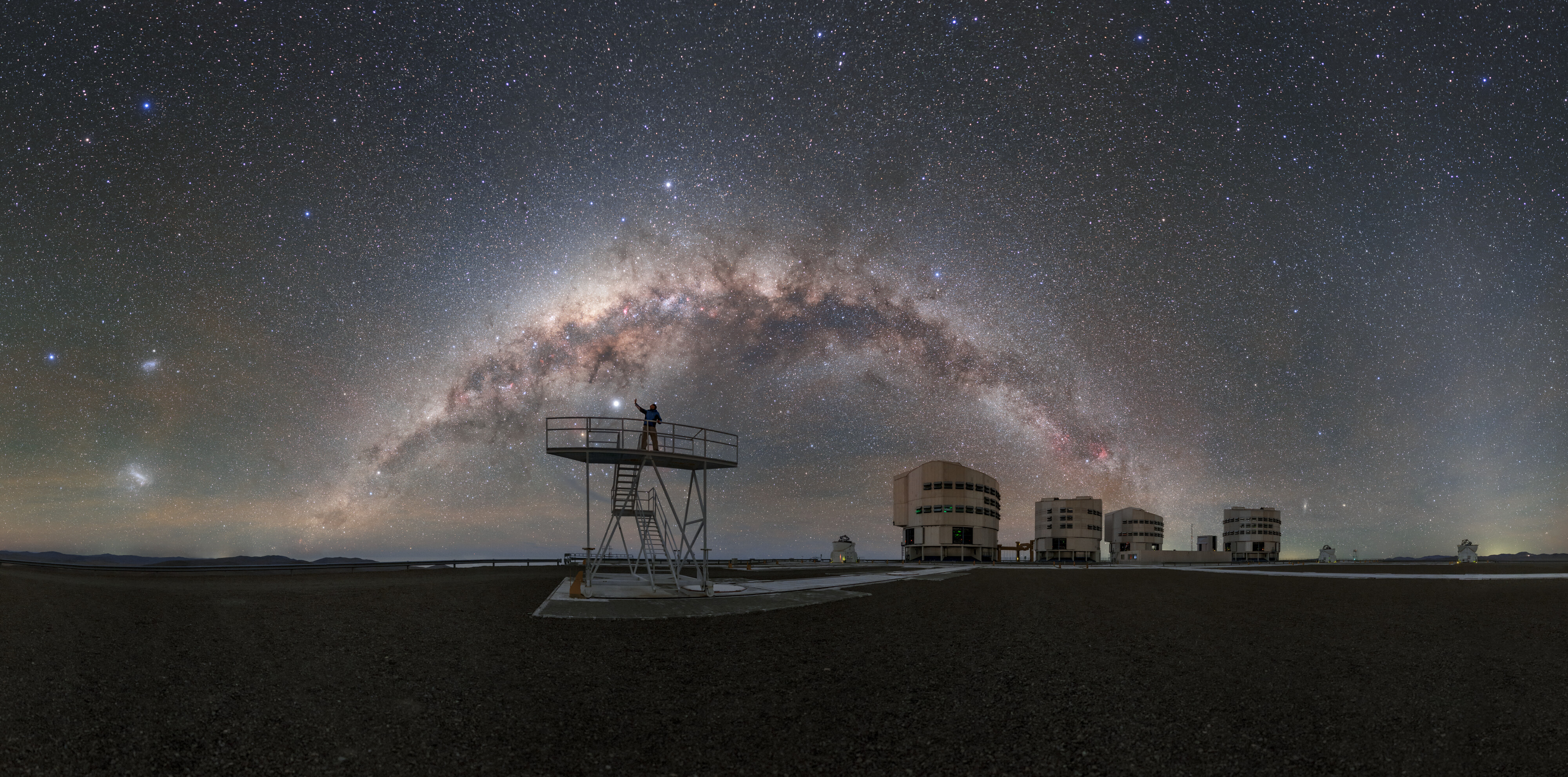
Reaching for Jupiter under The Milky Way | Paranal Observatory in Chile | ESO

Reaching for Jupiter under The Milky Way | Paranal Observatory in Chile | ESO


The dark skies above the European Southern Observatory’s Paranal Observatory, home to the European Southern Observatory’s Very Large Telescope (VLT), yield breathtaking views so clear and so full of stars that you could almost touch them. Standing atop a platform at VLT, ESO Photo Ambassador Petr Horálek reaches towards a standout object in the sky. You may assume this bright body, like many others in the sky, to be a star, but it is in fact a planet in our Solar System—the gas giant Jupiter.

Closer to Earth, the four Unit Telescopes (UTs) that comprise the VLT can be seen in the background. Each UT features an 8.2-meter mirror and they operate synergistically to produce some of the sharpest views of the Universe. Accompanying the four UTs are four smaller, moveable Auxiliary Telescopes (ATs) that have 1.8-meter mirrors. 

The Chilean Atacama desert once again proves its value as the ideal location for ESO’s VLT. The remoteness of the observatory means that there is very little to no light pollution. This is vital for astronomy and also yields such breathtaking views.

Learn more about ESO’s Paranal Observatory
https://www.eso.org/public/teles-instr/paranal-observatory/


Credit: European Southern Observatory (ESO)/P. Horálek
Release Date: June 14, 2021


#NASA #ESO #Astronomy #Space #Science #Planets #Earth #Jupiter #SolarSystem #MilkyWayGalaxy #Cosmos #Universe #ParanalObservatory #DarkSkies #LightPollution #Astrophotographer #PetrHorálek #Astrophotography #AtacamaDesert #Chile #Europe #STEM #Education

Spiral Galaxy NGC 300 in Sculptor | MPG/ESO Telescope

Spiral Galaxy NGC 300 in Sculptor | MPG/ESO Telescope


This picture of the spectacular southern spiral galaxy NGC 300 was taken using the Wide Field Imager (WFI) at the European Southern Observatory’s La Silla Observatory in Chile. It was assembled from many individual images through a large set of different filters over many observing nights, spanning several years. The main purpose of this extensive observational campaign was to get an unusually thorough census of the stars in the galaxy, counting both the number and varieties of stars and marking regions, or even individual stars, that warrant deeper and more focussed investigation. However, such a rich data collection will also have many other uses for years to come.

Distance: 6 million light years

The images were mostly taken through filters that transmit red, green or blue light. These were supplemented by images through special filters that allow through only the light from ionized hydrogen or oxygen gas and highlight the glowing clouds in the galaxy’s spiral arms. The total exposure time amounted to around 50 hours.

Learn about the MPG/ESO 2.2-meter telescope:
https://www.eso.org/public/teles-instr/lasilla/mpg22/


Credit: European Southern Observatory (ESO)
Release Date: Sept. 8, 2010


#NASA #FoN #ESO #Astronomy #Space #Science #Stars #Galaxies #Galaxy #NGC300 #SpiralGalaxy #Sculptor #Constellation #Cosmos #Universe #MPGESOTelescope #LaSillaObservatory #Chile #Europe #STEM #Education

New Year's Day Dawns on Cuba | International Space Station

New Year's Day Dawns on Cuba | International Space Station


New Year's Day dawns on Cuba as the sunlight gleams off its Atlantic and Caribbean coasts in this photograph from the International Space Station as it orbited 260 miles above the Gulf of Mexico.

The Republic of Cuba is an island country consisting of the island of Cuba, as well as Isla de la Juventud and several minor archipelagos. Cuba is located where the northern Caribbean Sea, Gulf of Mexico, and Atlantic Ocean meet. Cuba is located east of the Yucatán Peninsula (Mexico), south of both the American state of Florida and the Bahamas, west of Hispaniola (Haiti/Dominican Republic), and north of both Jamaica and the Cayman Islands. 

Population: 11 million

Expedition 72 Crew
Station Commander: Suni Williams
Roscosmos (Russia) Flight Engineers: Alexey Ovchinin, Ivan Vagner, Aleksandr Gorbunov
NASA Flight Engineers: Butch Wilmore, Don Pettit, Nick Hague

An international partnership of space agencies provides and operates the elements of the International Space Station (ISS). The principals are the space agencies of the United States, Russia, Europe, Japan, and Canada.


Credit: NASA's Johnson Space Center (JSC)
Image Date: Jan. 1, 2025

#NASA #Space #Science #ISS #Planet #Earth #Cuba #Island #Caribbean #CaribbeanSea #AtlanticOcean #Astronauts #Cosmonauts #Russia #Россия #Roscosmos #Роскосмос #InternationalCooperation #LongDurationMissions #SpaceLaboratory #HumanSpaceflight #UnitedStates #Expedition72 #STEM #Education

SpaceX Starship Rollout: Flight Test#7 Launch Prep at Starbase Texas

SpaceX Starship Rollout: Flight Test#7 Launch Prep at Starbase Texas


The seventh flight test of Starship is preparing to launch as soon as Monday, January 13, 2025. Teams at Starbase are keeping an eye on weather conditions for preflight operations. The upcoming flight test will launch a new generation ship with significant upgrades, attempt Starship’s first payload deployment test, fly multiple reentry experiments geared towards ship catch and reuse, and launch and return the Super Heavy booster.

A live webcast of the flight test will begin about 35 minutes before liftoff. You can watch here . . .

Starship Test Flight 7:

The launch window will open at 4:00 p.m. CT. As is the case with all developmental testing, the schedule is dynamic and likely to change, so be sure to check in here for updates.

SpaceX’s Starship spacecraft and Super Heavy rocket—collectively referred to as Starship—represent a fully reusable transportation system designed to carry both crew and cargo to Earth orbit, the Moon, Mars and beyond. Starship is the world’s most powerful launch vehicle ever developed, capable of carrying up to 150 metric tonnes fully reusable and 250 metric tonnes expendable.

Key Starship Parameters:
Height: 121m/397ft
Diameter: 9m/29.5ft
Payload to LEO: 100–150t (fully reusable)

"Starship is essential to both SpaceX’s plans to deploy its next-generation Starship system as well as for NASA, which will use a lunar lander version of Starship for landing astronauts on the Moon during the Artemis III mission through the Human Landing System (HLS) program."

Learn more about Starship:
Download the Free Starship User Guide (PDF):


Image Credit: Space Exploration Technologies Corporation (SpaceX)
Capture Date: Jan. 9, 2024

#NASA #SpaceX #Space #Earth #Mars #Moon #MoonToMars #ArtemisProgram #ArtemisIII #Starship #Spacecraft #Starship7 #TestFlight7 #HeavyBooster #SuperHeavyRocket #ElonMusk #Engineering #SpaceTechnology #HumanSpaceflight #CommercialSpace #SpaceExploration #Starbase #BocaChica #Texas #UnitedStates #STEM #Education

Satellites: Essential for tackling climate change | Japan Aerospace Exploration Agency

Satellites: Essential for tackling climate change | Japan Aerospace Exploration Agency

"To tackle climate change, it is essential to gain a deep understanding of the Earth we live on. The first step toward this goal is to accurately comprehend the mechanisms and current state of our planet. The Earth observation satellites operated by the Japan Aerospace Exploration Agency (JAXA) monitor a range of essential climate variables across the Earth's environment on a global scale, collecting and accumulating data over extended periods."

"This initiative provides a critical foundation for accurately assessing the impacts of climate change and formulating effective countermeasures. In this feature, guided by Professor Tadahiro Hayakawa from the Graduate School of Science at Tohoku University and Advisor to the Director General of JAXA's Earth Observation Research Center, we will explore how satellite technology addresses climate change and its anticipated advancements in the future."

Learn more about JAXA Earth Satellites:


Video Credit: Japan Aerospace Exploration Agency (JAXA)
Duration: 7 minutes
Release Date: Jan. 8, 2025

#NASA #JAXA #Space #Satellites #衛星 #Science #Planet #Earth #Asia #GlobalTemperatureRecords #Weather #Meteorology #ClimateChange #GlobalHeating #Climate #Environment #GreenhouseGases #地球観測衛星 #EarthObservation #RemoteSensing #TohokuUniversity #東北大学 #Japan #日本 #STEM #Education #Animation #HD #Video

The Himalayas separate China from a cloudy India | International Space Station

The Himalayas Separate China from a Cloudy India | International Space Station

The Himalayas separate the arid steppe of China's Tibetan Plateau from a cloudy Indian subcontinent in this photograph from the International Space Station as it soared 261 miles above Asia.

The Himalayas, or Himalaya, is a mountain range in Asia. The range has a number of the Earth's highest peaks, including the highest, Mount Everest. Over 100 peaks exceed elevations of 7,200 meters (23,600 feet) above sea level in the Himalayas. The Himalayas cross five countries: Nepal, China, Pakistan, Bhutan and India.

Expedition 72 Updates:

Expedition 72 Crew
Station Commander: Suni Williams
Roscosmos (Russia) Flight Engineers: Alexey Ovchinin, Ivan Vagner, Aleksandr Gorbunov
NASA Flight Engineers: Butch Wilmore, Don Pettit, Nick Hague

An international partnership of space agencies provides and operates the elements of the International Space Station (ISS). The principals are the space agencies of the United States, Russia, Europe, Japan, and Canada.


Credit: NASA's Johnson Space Center (JSC)
Image Date:  Dec. 19, 2024
Release Date: Jan. 7, 2025


#NASA #Space #Science #ISS #Earth #Asia #Himalayas #China #中国 #Tibet #བོད #藏 #India #BhāratGaṇarājya #Astronauts #Cosmonauts #Russia #Россия #Roscosmos #Роскосмос #InternationalCooperation #LongDurationMissions #SpaceLaboratory #HumanSpaceflight #UnitedStates #Expedition72 #STEM #Education

Wednesday, January 08, 2025

SpaceX Starship: Final Preparations for Flight Test#7 at Starbase Texas

SpaceX Starship: Final Preparations for Flight Test#7 at Starbase Texas


The seventh flight test of Starship is preparing to launch as soon as Monday, January 13, 2025. Teams at Starbase are keeping an eye on weather conditions for preflight operations. The upcoming flight test will launch a new generation ship with significant upgrades, attempt Starship’s first payload deployment test, fly multiple reentry experiments geared towards ship catch and reuse, and launch and return the Super Heavy booster.

A live webcast of the flight test will begin about 35 minutes before liftoff. You can watch here . . .

Starship Test Flight 7:

The launch window will open at 4:00 p.m. CT. As is the case with all developmental testing, the schedule is dynamic and likely to change, so be sure to check in here for updates.

SpaceX’s Starship spacecraft and Super Heavy rocket—collectively referred to as Starship—represent a fully reusable transportation system designed to carry both crew and cargo to Earth orbit, the Moon, Mars and beyond. Starship is the world’s most powerful launch vehicle ever developed, capable of carrying up to 150 metric tonnes fully reusable and 250 metric tonnes expendable.

Key Starship Parameters:
Height: 121m/397ft
Diameter: 9m/29.5ft
Payload to LEO: 100–150t (fully reusable)

"Starship is essential to both SpaceX’s plans to deploy its next-generation Starship system as well as for NASA, which will use a lunar lander version of Starship for landing astronauts on the Moon during the Artemis III mission through the Human Landing System (HLS) program."

Learn more about Starship:
Download the Free Starship User Guide (PDF):


Image Credit: Space Exploration Technologies Corporation (SpaceX)
Capture Date: Jan. 8, 2024

#NASA #SpaceX #Space #Earth #Mars #Moon #MoonToMars #ArtemisProgram #ArtemisIII #Starship #Spacecraft #Starship7 #TestFlight7 #HeavyBooster #SuperHeavyRocket #ElonMusk #Engineering #SpaceTechnology #HumanSpaceflight #CommercialSpace #SpaceExploration #Starbase #BocaChica #Texas #UnitedStates #STEM #Education