Friends of NASA (FoN) is an independent non-governmental organization (NGO) dedicated to building international support for peaceful space exploration, commerce, scientific discovery, and STEM education.
Packing a Spacecraft for India: Science Payload for Earth Science Mission | JPL
Part of a partnership between NASA and the Indian Space Research Organisation (ISRO), the spacecraft known as NISAR—short for NASA-ISRO Synthetic Aperture Radar—recently moved one step closer to being able to study changes to the land and ice on Earth. Take a behind-the-scenes trip with NISAR Mechanical Integration Lead Scott Nowak into the clean room at NASA’s Jet Propulsion Laboratory (JPL) in Southern California as he highlights the NISAR team’s work to assemble the satellite’s science instrument payload and to pack it up to ship out to ISRO’s satellite facility in Bengaluru, India. Technicians and engineers there will integrate the instruments into the main body, or bus, of the satellite, and put it through further testing in preparation for a 2024 launch.
Tour: Astronomers Discover a Surprisingly Lonely Galaxy | NASA Chandra
A distant—and lonely—galaxy appears to have pulled in and assimilated all of its former companion galaxies. This result made with NASA’s Chandra X-ray Observatory and the International Gemini Observatory may push the limits for how quickly astronomers expect galaxies to grow in the early universe.
The unexpectedly solo galaxy is located about 9.2 billion light-years from Earth and contains a quasar, a supermassive black hole pulling in gas at the center of the galaxy and driving powerful jets of matter seen in radio waves. The environment of this galaxy, known as 3C297, appears to have the key features of a galaxy cluster, enormous structures that usually contain hundreds or even thousands of galaxies. Yet 3C297 stands alone.
A team of researchers expected to see at least a dozen galaxies within 3C297, yet they found only one. Accurate distance measurements from Gemini data revealed that none of the 19 galaxies that appear close to 3C297 in the optical image are actually at the same distance as the lonely galaxy.
The question is, what happened to all of these galaxies in 3C297? The team thinks the gravitational pull of the one large galaxy combined with interactions between the galaxies was too strong, and they merged with the large galaxy. For these galaxies, apparently resistance was futile.
The researchers think 3C297 is no longer a galaxy cluster, but a “fossil group.” This is the end stage of a galaxy pulling in and merging with several other galaxies. While many other fossil groups have been detected before, this one is particularly distant, at 9.2 billion light-years away. (The previous record holders for fossil groups were at distances of 4.9 and 7.9 billion light-years.)
It may be challenging to explain how the Universe can create this system only 4.6 billion years after the Big Bang. This result does not break the current ideas of cosmology, but it begins to push the limits on how quickly both galaxies and galaxy clusters must have formed.
New NASA Artemis V Moon Rocket Engine Test: Preparing for Crewed Missions
NASA’s testing for redesigned RS-25 engines to be used on future Space Launch System (SLS) missions continued with a March 8, 2023, full-duration hot fire at NASA’s Stennis Space Center, near Bay St. Louis, Mississippi.
The test, conducted on the Fred Haise Test Stand at NASA Stennis, was the third of the year and part of an ongoing certification hot fire series. It also was the third test since an upgraded nozzle was installed on the RS-25 engine just prior to a Feb 8 hot fire. The redesigned engines provided by lead SLS engines contractor Aerojet Rocketdyne will be used on future Artemis flights to the Moon, beginning with Artemis V, as NASA continues its mission to explore the secrets of the universe for the benefit of all.
“Early indications are that the nozzle is working well,” said Mike Lauer, deputy program manager of RS-25 engines at Aerojet Rocketdyne. “Even though we changed manufacturing methods, we did not want to radically change the performance of the nozzle. We are very pleased that the nozzle appears to be performing very much in line with our previous history.”
Operators fired the RS-25 engine during the test for a scheduled 520 seconds and up to 113% power level. During missions to the Moon, engines fire for about 500 seconds and up to the 111% power level to help SLS lift the Orion spacecraft and other payloads to orbit. With added seconds and the increased power level during ground tests, engineers can learn more about engine performance and provide a margin of operational safety.
The nozzle, or bell-shaped part at the bottom of the RS-25 engine, helps generate thrust by ejecting the engine’s exhaust at maximum speed to propel SLS to space. It is one of multiple upgraded components on the redesigned engine and also critical in ensuring efficiency by using a minimum amount of propellants, or fuel, to generate thrust and help propel the rocket to space. The nozzle is one reason the RS-25 is one of the most fuel-efficient rocket engines in the world.
Over the course of the storied history of the RS-25 engine, many components have gone through changes or upgrades. One component that mostly went unchanged was the nozzle.
For redesigned RS-25 engines, however, a team focused on re-engineering every part of the nozzle. This included using precision machining to improve production of the more than 1,000 tubes that comprise the nozzle wall. These tubes are critical in flowing super-cold liquid hydrogen to keep the nozzle cool. The team also is using 3D printing to manufacture selected nozzle parts.
Upgrades to the nozzle include a new type and amount of insulation, which is a critical consideration since the RS-25 engines are exposed to more heat during SLS launches than previous space shuttle missions. SLS features four RS-25 engines instead of the three main engines used for the space shuttle and the proximity of the RS-25 nozzle to the SLS solid rocket boosters is closer than on the space shuttle.
The goal of the upgrades is to streamline the nozzle production process, while making it more cost efficient and still achieving the same performance level as with previous RS-25 engines. While new manufacturing methods have been incorporated into the production of the nozzle, the shape, length, and diameter remain the same.
Sixteen main engines remained from the shuttle program. All were modified and tested at NASA Stennis for use on the first four Artemis missions.
For information about the Space Launch System, visit:
NASA's SpaceX Crew-5: A Scientific Mission | International Space Station
Nicole Mann, Josh Cassada, Koichi Wakata (Japan), and Anna Kikina (Russia), crew members of NASA’s SpaceX Crew-5, are headed home wrapping up their long-duration mission on the orbital outpost. From growing tomatoes to studying cosmic rays to observing quantum mechanics, the four crew members of NASA's SpaceX Crew-5 mission contributed to more than 100 scientific investigations and technology demonstrations during their five months aboard the International Space Station. These experiments help prepare humans for future space exploration missions while bringing benefits for humanity back to Earth.
Learn more about the science of Crew-5 as our astronauts get ready to head home: https://go.nasa.gov/3T2gbgw
Expedition 68 Crew (March 2023)
Station Commander: Sergey Prokopyev of Roscosmos (Russia)
Roscosmos (Russia): Flight Engineers Anna Kikina, Dmitri Petelin, Andrey Fedyaev
An international partnership of space agencies provides and operates the elements of the International Space Station (ISS). The principals are the space agencies of the United States, Russia, Europe, Japan, and Canada. The ISS has been the most politically complex space exploration program ever undertaken.
Expedition 68: NASA’s SpaceX Crew-5 Space Station Farewell Remarks
Astronauts Give Farewell Remarks Ahead of Upcoming Departure from the International Space Station
NASA astronauts Frank Rubio, Nicole Mann, Josh Cassada, Stephen Bowen, and Woody Hoburg, as well as JAXA (Japan Aerospace Exploration Agency) astronaut Koichi Wakata, United Arab Emirates astronaut Sultan Alneyadi, and Roscosmos cosmonauts Andrey Fedyaev, Sergey Prokopyev, Dimitri Petelin, and Anna Kikina of Russia gave remarks on March 8, 2023, aboard the International Space Station in anticipation of the upcoming departure of the Crew-5 mission.
Mann, Cassada, Wakata, and Kikina, crew members of NASA’s SpaceX Crew-5, are headed home wrapping up their long-duration mission on the orbital outpost.
Expedition 68 Crew (March 2023)
Station Commander: Sergey Prokopyev of Roscosmos (Russia)
Roscosmos (Russia): Flight Engineers Anna Kikina, Dmitri Petelin, Andrey Fedyaev
NASA: Flight Engineers Nicole Mann, Frank Rubio, Josh Cassada, Stephen Bowen, Warren Hoburg
An international partnership of space agencies provides and operates the elements of the International Space Station (ISS). The principals are the space agencies of the United States, Russia, Europe, Japan, and Canada. The ISS has been the most politically complex space exploration program ever undertaken.
The Story of NASA Astronaut Ellen Ochoa: First Hispanic Woman in Space
"This Women’s History Month, we are highlighting stories of women whose accomplishments have often not received widespread attention. Today, we learn about NASA astronaut Ellen Ochoa, who became the first Hispanic woman to go to space in 1993."
The Missing Link for Water in Our Solar System | ESO
ESOcast 258 Light: Using the Atacama Large Millimeter/submillimeter Array (ALMA), astronomers have detected the chemical signature of gaseous water in the planet-forming disc V883 Orionis. This acts as a timestamp for the water’s formation, allowing us to trace its journey.
Credit: European Southern Observatory (ESO)
Directed by: Herbert Zodet and Martin Wallner
Editing: Herbert Zodet
Web and technical support: Gurvan Bazin and Raquel Yumi Shida
Written by: Rebecca Forsberg and Rory Harris
Footage and photos: ESO, ALMA (ESO/NAOJ/NRAO) and L. Calçada
Scientific consultants: Paola Amico and Mariya Lyubenova
Expedition 68: Welcoming New Crew Members | International Space Station
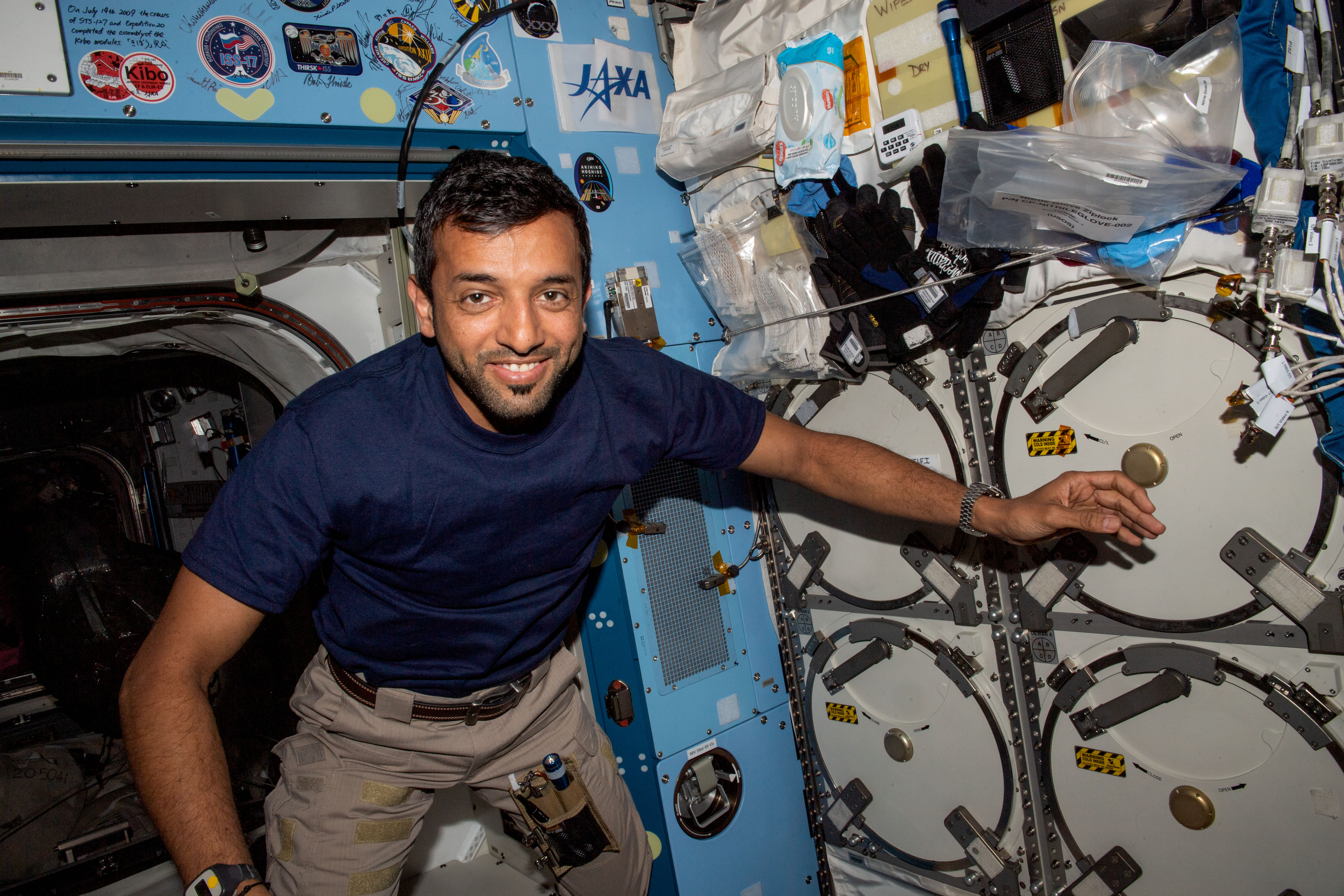
Expedition 68 Flight Engineer Sultan Alneyadi from the United Arab Emirates is pictured inside Japan's Kibo laboratory module during his first week aboard the International Space Station.
Clockwise from top, are Expedition 68 Commander Sergey Prokopyev with Flight Engineers Andrey Fedyaev, Dmitri Petelin, and Anna Kikina, all from Roscosmos (Russia).
NASA astronaut and Expedition 68 Flight Engineer Stephen Bowen is pictured conducting maintenance activities during his first week aboard the International Space Station. This is Bowen's fourth visit to the orbital outpost.
NASA astronaut and Expedition 68 Flight Engineer Warren "Woody" Hoburg is pictured inside the Kibo laboratory module during his first week aboard the International Space Station. In the back, is NASA astronaut and Expedition 68 Flight Engineer Frank Rubio who has been aboard the station since Sept. 21, 2022.
From left, are Expedition 68 Flight Engineers Anna Kikina of Roscosmos (Russia), Josh Cassada and Nicole Mann from NASA, and Koichi Wakata of JAXA (Japan Aerospace Exploration Agency) posing for a fun portrait inside the International Space Station's Kibo laboratory module.
Clockwise from top, are Expedition 68 Flight Engineers Josh Cassada and Nicole Mann from NASA, Koichi Wakata of JAXA (Japan Aerospace Exploration Agency), and Anna Kikina of Roscosmos (Russia) posing for a fun portrait inside the International Space Station's Kibo laboratory module.
The newly-expanded International Space Station crew of 11 members kicked off a busy work week conducting a variety of research and visiting vehicle activities. Meanwhile, four Expedition 68 crew members are also getting ready to complete their mission and return to Earth.
New station residents Stephen Bowen and Woody Hoburg of NASA, who commanded and piloted the SpaceX Crew-6 mission respectively, reviewed docked Crew Dragon procedures first thing on Monday. The duo, along Crew-6 mission specialist Sultan Alneyadi of the United Arab Emirates and Andrey Fedyaev of Roscosmos (Russia), automatically docked Crew Dragon Endeavour to the Harmony module’s space-facing port at 1:40 a.m. EST on Friday, March 3, 2023. The quartet will live and work aboard the orbital outpost for six months.
The four newest crew members continue getting up to speed with life on orbit familiarizing themselves with space station operations and systems. The foursome also spent Monday, March 6 installing new space biology hardware, replacing electronic components, and updating emergency procedures for the expanded crew.
The orbiting crew will soon return to a seven-member status when four station residents finalize their mission that began last year. Flight Engineers Nicole Mann and Josh Cassada of NASA, along with Koichi Wakata of JAXA (Japan Aerospace Exploration Agency) and Anna Kikina of Roscosmos, launched to the station as the SpaceX Crew-5 mission on Oct. 5, 2022, joining the Expedition 68 crew one day later. All four homebound crew members have begun their handover activities. They will enter the Crew Dragon Endurance, undock from the Harmony module’s forward port, then splash down off the coast of Florida on a soon-to-be-announced date.
The next Dragon mission to the station will be the SpaceX CRS-27 resupply mission scheduled for March 14, 2023, at 8:30 p.m. EDT. The Dragon cargo craft will automatically dock about 24 hours later to the Harmony port vacated by the Crew Dragon Endurance when it undocks a few days earlier.
An international partnership of space agencies provides and operates the elements of the International Space Station (ISS). The principals are the space agencies of the United States, Russia, Europe, Japan, and Canada. The ISS has been the most politically complex space exploration program ever undertaken.
Introducing Australia’s First Female Astronaut Katherine Bennell-Pegg
The Australian Space Agency has announced Katherine Bennell-Pegg will be trained as this country's first female astronaut. Congratulations to our fellow Friends of NASA member!
Katherine, Director of Space Technology at the Australian Space Agency, will be the first Australian woman to be trained as an astronaut by an international space agency.
Unlike previous instances where Australian astronauts have flown as citizens of other nations, Katherine will train as an Australian.
She will begin training in April through until mid-2024. She will remain an employee of the Australian Space Agency, where she has worked since the end of 2019.
This picture shows a dwarf galaxy named UGC 685. Such galaxies are small and contain just a tiny fraction of the number of stars in a galaxy like the Milky Way. Dwarf galaxies often show a hazy structure, an ill-defined shape, and an appearance somewhat akin to a swarm or cloud of stars—and UGC 685 is no exception to this. Classified as an SAm galaxy—a type of unbarred spiral galaxy—it is located about 15 million light-years from Earth.
These data were gathered under the NASA/European Space Agency Hubble Space Telescope’s LEGUS (Legacy ExtraGalactic UV Survey) Program, the sharpest and most comprehensive ultraviolet survey of star-forming galaxies in the nearby Universe.
LEGUS is imaging 50 spiral and dwarf galaxies in our cosmic neighborhood in multiple colors using Hubble’s Wide Field Camera 3. The survey is picking apart the structures of these galaxies and resolving their constituent stars, clusters, groups, and other stellar associations. Star formation plays a huge role in shaping its host galaxy; by exploring these targets in detail via both new observations and archival Hubble data, LEGUS will shed light on how stars form and cluster together, how these clusters evolve, how a star’s formation affects its surroundings, and how stars explode at the end of their lives.
Credit: European Space Agency (ESA)/Hubble & NASA; the LEGUS team, B. Tully, D. Calzetti
Caribbean & Central American Students Speak to the International Space Station
During this event, students from the Caribbean and Central America had the opportunity to speak with NASA Astronaut Josh Cassada to learn about natural disaster research and monitoring, as seen from the unique perspective of the International Space Station. More than 400 questions were submitted by schools in the region. The selected questions were related to climate change and monitoring hazard events such as hurricanes, volcanic eruptions, tsunamis, and coastal erosion.
Learn more about the Amateur Radio on the International Space Station (ARISS) program at https://www.ariss.org.
This event is part of the Disaster Fighters campaign, an initiative sponsored by the World Bank, GFDRR, United Nations Office for Disaster Risk Reduction, CDEMA, CEPREDENAC, PACIFICO, and NASA Disasters Program, among other organizations. The campaign and video were produced by the team at Pacifico Risk Communications: Emiliano Rodriguez Nuesch, Malena Albertoni, Alejo Santos, Nancy Núñez, Rodrigo Gonzalez Alvarado and Diego Voloschin. The contact was made possible by the IK1SLD ARISS HamTV Telebridge Ground Station located in Casale Monferrato, Italy.
Expedition 68 Astronaut Frank Rubio Talks with Televisa Univision (Spanish media)
Aboard the International Space Station, Expedition 68 Flight Engineer Frank Rubio of NASA discussed life and work aboard the orbital outpost during an in-flight interview March 7, 2023, with Telemundo’s Jorge Ramos. Rubio is in the midst of a long-duration mission living and working aboard the microgravity laboratory to advance scientific knowledge and demonstrate new technologies for future human and robotic exploration missions. Such research benefits people on Earth and lays the groundwork for future human exploration through the agency’s Artemis missions, which will send astronauts to the Moon to prepare for future expeditions to Mars.
An international partnership of space agencies provides and operates the elements of the International Space Station (ISS). The principals are the space agencies of the United States, Russia, Europe, Japan, and Canada. The ISS has been the most politically complex space exploration program ever undertaken.
Zooming in on The Hubble Legacy Field of 200,000 Galaxies
This video takes the viewer on a journey into the Hubble Legacy Field, a mosaic of the distant Universe that documents 16 years of observations from the NASA/ESA Hubble Space Telescope. This image contains 200,000 galaxies that stretch back through 13.3 billion years of time to just 500 million years after the Big Bang.
Pan across The Hubble Legacy Field of 200,000 Galaxies
This explores the detail of the Hubble Legacy Field, a mosaic of the distant universe that documents 16 years of observations from the NASA/European Space Agency Hubble Space Telescope. This image contains 200,000 galaxies that stretch back through 13.3 billion years of time to just 500 million years after the Big Bang.
Credit: NASA, European Space Agency (ESA), G. Illingworth and D. Magee (University of California, Santa Cruz), K. Whitaker (University of Connecticut), R. Bouwens (Leiden University), P. Oesch (University of Geneva), and the Hubble Legacy Field team.
Expedition 68 Crew: Russia, U.S. & Japan | International Space Station
Clockwise from left, are Expedition 68 Flight Engineers Anna Kikina of Roscosmos (Russia), Josh Cassada and Nicole Mann from NASA, and Koichi Wakata of JAXA (Japan Aerospace Exploration Agency) posing for a fun portrait inside the International Space Station's Kibo laboratory module.
Expedition 68 Crew (March 2023)
Station Commander: Sergey Prokopyev of Roscosmos (Russia)
Roscosmos (Russia): Flight Engineers Anna Kikina, Dmitri Petelin, Andrey Fedyaev
NASA: Flight Engineers Nicole Mann, Frank Rubio, Josh Cassada, Stephen Bowen, Warren Hoburg
JAXA (Japan): Flight Engineer Koichi Wakata
An international partnership of space agencies provides and operates the elements of the International Space Station (ISS). The principals are the space agencies of the United States, Russia, Europe, Japan, and Canada. The ISS has been the most politically complex space exploration program ever undertaken.